

Solar Panels, Heat Collectors and Solar Harnessing Devices for SS 1
Solar panels generate electricity from light; solar collectors absorb heat. Orientation, shading and maintenance affect how effectively each device works.
Read guide
Teacher/Educational Writer
Royal Alikor is an educator with six years of classroom teaching and three years of elementary school leadership experience and is still teaching. He develops and reviews practical, curriculum-aligned learning materials for Nigerian schools and teachers.
Lessons ◉ 0 views
Solar panels generate electricity from light; solar collectors absorb heat. Orientation, shading and maintenance affect how effectively each device works.
Read guide→
Lessons ◉ 0 views
Sensors detect changes in light, temperature, movement or pressure and turn them into usable signals for monitoring, alarms and automated control.
Read guide→
Lessons ◉ 0 views
Heat is energy transferred because of a temperature difference. Heating may raise temperature or cause expansion, depending on the substance and conditions.
Read guide→
Lessons ◉ 1 views
A force field is a region where an object experiences a force without contact. Gravitational, electric and magnetic fields act on different properties.
Read guide→
Lessons ◉ 0 views
Gravity attracts masses towards one another. Near Earth's surface, freely falling objects accelerate at about 9.8 m/s² when air resistance is negligible.
Read guide→
Lessons ◉ 0 views
An electric field surrounds a charge and exerts forces on other charges. Field lines point from positive to negative and show field direction.
Read guide→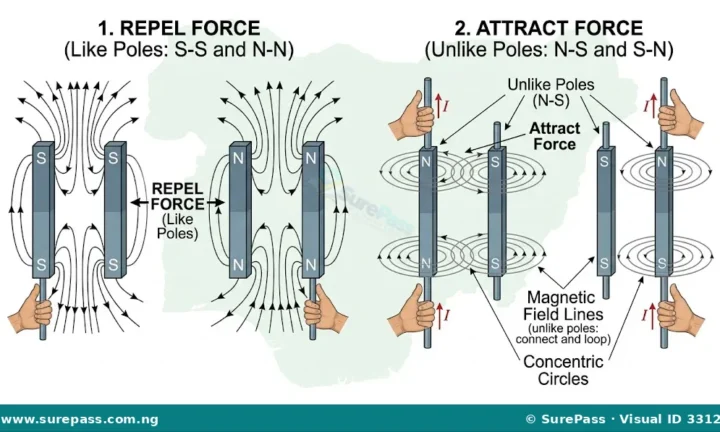 Lessons ◉ 0 views
A magnetic field surrounds a magnet or current-carrying conductor. Field lines run from north to south outside a magnet and never cross.
Read guide→
Lessons ◉ 0 views
Work occurs when a force causes displacement; power measures the rate of energy transfer. Energy changes form but is conserved in a closed…
Read guide→
Lessons ◉ 0 views
Matter consists of particles: atoms combine to form molecules, and particle spacing and motion help explain differences among solids, liquids and gases.
Read guide→
Lessons ◉ 0 views
Time is measured in seconds using clocks, stopwatches and timers. Accurate experiments require suitable instruments and consistent timing procedures.
Read guide→
Lessons ◉ 0 views
Electric charge may be positive or negative. Friction, contact and induction redistribute charge; unlike charges attract and like charges repel.
Read guide→
Lessons ◉ 0 views
Motion is a change in position over time; forces can alter movement. Friction opposes relative motion and may be useful for grip or…
Read guide→Pick your class and subject. SurePass opens the matching lesson shelf and keeps the clock with you as you move around the site.
You stayed with it for 25 focused minutes. That counts.