


ARTICLE CONTENTSOn this page 7 sections
Ecology and Agricultural Production in Nigeria
Performance Objectives
By the end of the lesson, students should be able to:
- state the meaning, types and locations of ecological zones in Nigeria;
- describe the features and agricultural products of the savannah ecological zone in Nigeria;
- describe the features and agricultural products of the forest ecological zone in Nigeria.
Historical Development of Agriculture and Ecology in Nigeria
Agriculture has been a cornerstone of human existence in the area now known as Nigeria for thousands of years. The relationship between people, their farming practices, and the natural environment (ecology) has continuously evolved, shaping the landscape and the types of food produced.
Early Agricultural Practices (Pre-Colonial Era)
Before the arrival of Europeans, Nigerian societies developed diverse agricultural systems adapted to their local ecological zones. Farmers practised shifting cultivation, where land was farmed for a few years and then left fallow to regain fertility. This method was sustainable in areas with abundant land and lower population densities. Crops like yams, cocoyams, millet, sorghum, and various vegetables were cultivated. Livestock rearing, including cattle, goats, and sheep, was also common, especially in the northern savannah regions. The choice of crops and farming techniques was heavily influenced by the climate, soil type, and vegetation of each ecological zone.
Colonial Influence on Agriculture (19th and 20th Centuries)
The colonial period brought significant changes to Nigerian agriculture. The British administration encouraged the production of cash crops for export to Europe. This led to a shift from purely subsistence farming (growing food for personal consumption) to commercial agriculture. Crops like cocoa, palm oil, groundnuts, and cotton became very important. Large plantations were sometimes established, and new farming techniques were introduced, though traditional methods largely persisted. This focus on cash crops often led to specialisation in certain regions, for example, cocoa in the Southwest, palm oil in the Southeast, and groundnuts and cotton in the North. This specialisation sometimes put pressure on specific ecological zones, leading to increased land use and changes in natural vegetation.
Post-Colonial Agricultural Developments
After Nigeria gained independence, efforts were made to modernise agriculture and increase food production for a growing population. Government initiatives aimed at improving irrigation, providing fertilisers, and introducing high-yielding crop varieties. However, challenges such as climate change, soil degradation, and rapid population growth have continued to influence agricultural practices. The historical interaction between farming and the environment has left a legacy of diverse agricultural systems, each uniquely adapted to Nigeria’s varied ecological zones.
Meaning of Ecological Zones
An ecological zone is a large area of land or water that shares similar climate, vegetation, soil types, and animal life.
These zones are distinct natural regions where specific plants and animals thrive due to the prevailing environmental conditions. In Nigeria, these zones significantly influence the types of agricultural activities that can be successfully carried out.
Types and Locations of Ecological Zones in Nigeria
Nigeria is a country with diverse geographical features, leading to several distinct ecological zones. These zones generally run in east-west bands across the country, influenced by the decreasing rainfall from the south to the north.
The major ecological zones in Nigeria include:
- The Mangrove Swamp and Coastal Vegetation Zone
- The Freshwater Swamp Forest Zone
- The Tropical Rainforest Zone (or Forest Zone)
- The Derived Savannah Zone
- The Guinea Savannah Zone
- The Sudan Savannah Zone
- The Sahel Savannah Zone
For the purpose of agricultural production, these zones are often broadly categorised into two main types: the Forest Ecological Zone and the Savannah Ecological Zone, with the other zones being sub-categories or transitional areas.
The Forest Ecological Zone in Nigeria
The Forest Ecological Zone is primarily found in the southern parts of Nigeria, extending from the coastal areas inland. It is characterised by high rainfall, dense vegetation, and generally fertile soils.
Features of the Forest Ecological Zone
The key features of the Forest Ecological Zone include:
- High Rainfall: This zone receives abundant rainfall, typically ranging from 1,500 mm to over 3,000 mm annually, distributed over a long rainy season.
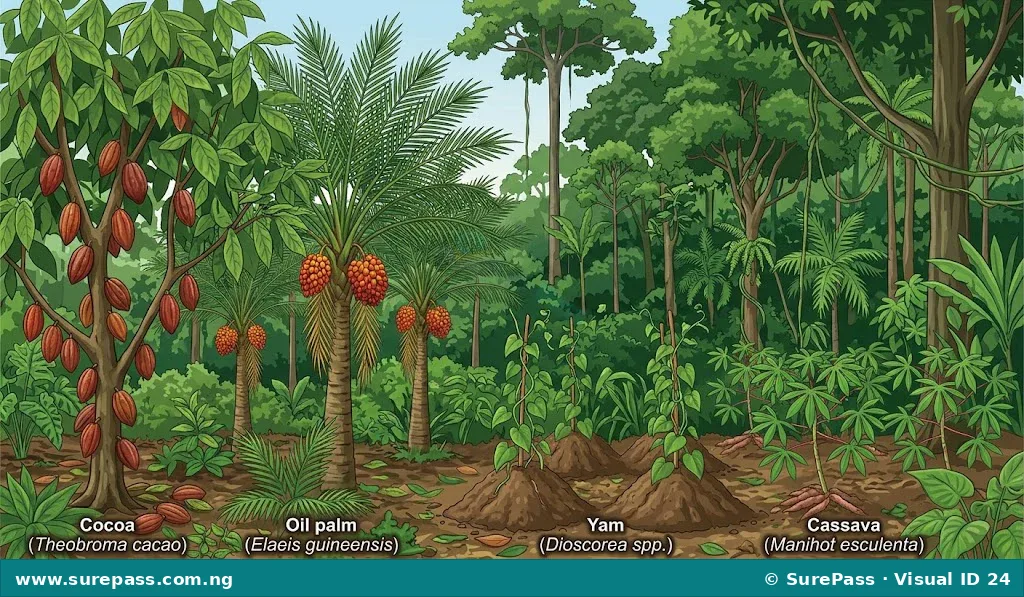
- Dense Vegetation: It is dominated by tall, evergreen trees forming a multi-layered canopy. The vegetation is lush and diverse, including tropical rainforests, freshwater swamps, and mangrove forests closer to the coast.
- High Humidity: The presence of dense vegetation and high rainfall contributes to consistently high humidity levels throughout the year.
- Lateritic Soils: The soils are often lateritic, meaning they are rich in iron and aluminium oxides. While generally fertile, they can become less productive if continuously farmed without proper management.
- Warm Temperatures: Temperatures are consistently warm, with little seasonal variation, typically ranging between 25°C and 30°C.
Agricultural Products of the Forest Ecological Zone
The favourable climate and soil conditions in the Forest Ecological Zone support a wide range of crops, many of which are important for both local consumption and export.
Key agricultural products include:
- Tree Crops:
- Cocoa: A major cash crop, especially in states like Ondo, Osun, Oyo, and Cross River.
- Oil Palm: Widely cultivated for palm oil and palm kernel, particularly in the Southeast and South-South regions.
- Rubber: Grown for latex production, mainly in Edo and Delta states.
- Kola Nut: An important stimulant crop, common in the Southwest.
- Root and Tuber Crops:
- Yam: A staple food crop, widely grown across the zone.
- Cassava: Another major staple, adaptable to various soil conditions.
- Cocoyam: Cultivated for its edible corms.
- Fruits and Vegetables:
- Plantain and Banana: Common fruit crops.
- Citrus Fruits: Oranges, grapefruits, and lemons are grown.
- Various Leafy Vegetables: Such as “ugu” (fluted pumpkin), “soko” (celosia), and “tete” (amaranth).
- Other Crops:
- Maize: Grown, but often yields better in the savannah transition zones.
- Rice: Cultivated in swampy areas, particularly in the freshwater swamp forest zone.
The Savannah Ecological Zone in Nigeria
The Savannah Ecological Zone covers the vast central and northern parts of Nigeria. It is characterised by a distinct wet and dry season, grasslands with scattered trees, and generally less rainfall than the forest zone.
Features of the Savannah Ecological Zone
The key features of the Savannah Ecological Zone include:
- Seasonal Rainfall: This zone experiences a clear distinction between a wet season (typically April/May to October) and a long dry season (November to March/April). Rainfall decreases from south to north, ranging from about 600 mm to 1,500 mm annually.
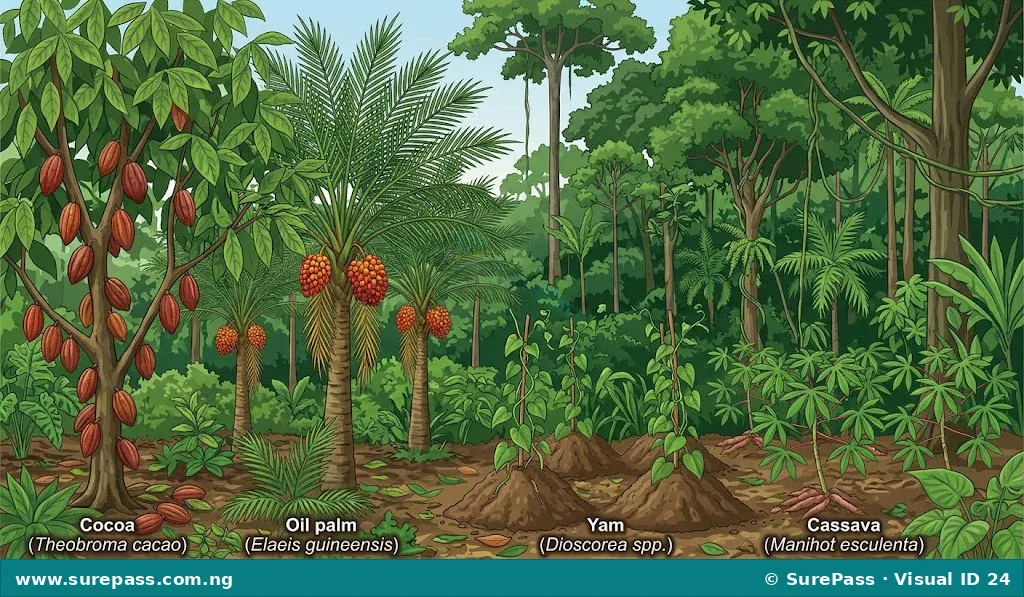
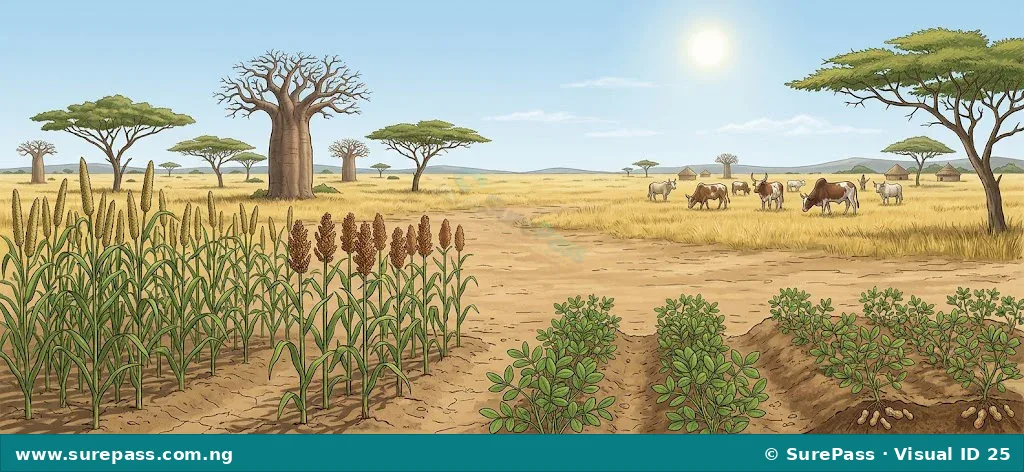
- Grasslands with Scattered Trees: The dominant vegetation consists of tall grasses, interspersed with scattered drought-resistant trees like baobab, shea butter, and acacia. The density of trees decreases towards the drier northern parts.
- Lower Humidity: Humidity is generally lower, especially during the dry season, compared to the forest zone.
- Sandy and Loamy Soils: Soils vary but are often sandy or loamy, and can be prone to erosion, especially in the drier northern areas. Fertility can be maintained with proper farming practices.
- Temperature Extremes: While generally warm, temperatures can be very high during the dry season and cooler during the harmattan period.
Agricultural Products of the Savannah Ecological Zone
The savannah zone is crucial for Nigeria’s food security, particularly for grain and livestock production, due to its extensive grasslands and suitable climate for certain crops.
Key agricultural products include:
- Cereal Crops:
- Millet: A staple grain, especially in the drier northern parts.
- Sorghum (Guinea Corn): Another important grain, widely cultivated across the savannah.
- Maize (Corn): Grown extensively, particularly in the Guinea and Derived Savannah zones.
- Rice: Cultivated in floodplains and irrigated areas within the savannah.
- Legumes and Oil Seeds:
- Groundnuts (Peanuts): A significant cash crop and food source, especially in the Sudan and Guinea Savannah.
- Soybeans: Increasingly cultivated for oil and protein.
- Cowpeas (Beans): A vital source of protein, widely grown.
- Root and Tuber Crops:
- Yam: Thrives in the southern Guinea Savannah, which borders the forest zone.
- Cassava: Adaptable and grown in many parts of the savannah.
- Cash Crops:
- Cotton: An important fibre crop, grown in states like Katsina, Kano, and Kaduna.
- Shea Butter: Collected from wild shea trees for its oil, used in food and cosmetics.
- Livestock:
- Cattle: Extensive cattle rearing (pastoralism) is a major economic activity, especially by the Fulani, due to the availability of grazing lands.
- Goats and Sheep: Also widely reared across the zone.
0 comments
Open the discussion when you need it. Comments stay collapsed until requested so the initial article remains light.