



ARTICLE CONTENTSOn this page 8 sections
Length
Performance Objectives
By the end of the lesson, students should be able to:
- estimate distances in kilometers and lengths in meters or centimeter and compare with measurements;
- add lengths;
- subtract lengths.
What is Length?
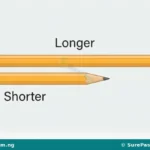
Length tells us how long an object is or the distance between two points.
When someone asks “How long is your pencil?” or “How far is it from your house to school?”, they are asking about length or distance. Length helps people understand the size of things and how much space they take up.
Units of Length
To measure length, standard units are used. These units help everyone understand the measurement in the same way. The common units of length are:
- Centimetre (cm): This unit is used for measuring small lengths, such as the length of a pencil, a book, or a finger.
- Metre (m): This unit is used for measuring medium lengths, such as the height of a door, the width of a classroom, or the length of a fabric. One metre is equal to 100 centimetres.
- Kilometre (km): This unit is used for measuring long distances, such as the distance between two towns, or the distance from a home to the market. One kilometre is equal to 1000 metres.
Estimating Length and Distance
Estimation means making a careful guess about a measurement without using a measuring tool. It helps to have an idea of the size or distance before measuring it accurately.
Estimating Length in Centimetres and Metres
To estimate length in centimetres or metres, familiar objects or parts of the body can be used as a guide. For example, the width of a thumb might be about 2 centimetres, or the length of a step might be about 1 metre.
The procedure for estimating and measuring length involves the following steps:
- Look at the object: Observe the object whose length is to be estimated.
- Make an estimate: Think about how long it looks in centimetres or metres. For example, a person might think, “This table is about 2 metres long.”
- Measure the actual length: Use a ruler, metre rule, or tape measure to find the exact length of the object.
- Compare: Check how close the estimate was to the actual measurement.
Examples of objects to estimate and measure include:
- The length of a school desk.
- The width of the classroom door.
- The height of a water bottle.
- The length of a textbook.
Estimating Distances in Kilometres
Estimating distances in kilometres is useful for longer journeys. People can think about how long it takes to travel a certain distance or use known landmarks.
The procedure for estimating and comparing distances involves the following steps:
- Identify the distance: Choose two points, such as a school and a nearby market.
- Make an estimate: Think about how far apart they are in kilometres. For example, a person might think, “The market is about 3 kilometres from school.”
- Find the actual distance: An adult can be asked, a map can be checked, or a car’s odometer can be used to find the exact distance.
- Compare: See how close the estimate was to the actual distance.
Measuring Length Accurately
To get the exact length or distance, measuring tools are used. The common tools for measuring length are:
- Ruler: Used for measuring short lengths, usually up to 30 centimetres.
- Metre Rule: Used for measuring lengths up to 1 metre.
- Tape Measure: Used for measuring longer lengths, often many metres, and can be flexible to measure around curves.
When measuring, always start from the zero mark on the tool and read the measurement carefully at the end of the object.
Adding Lengths
When the total length of two or more objects, or the total distance covered, needs to be found, their lengths are added together. It is important to add units of the same kind (centimetres with centimetres, metres with metres, and kilometres with kilometres).
If the sum of centimetres is 100 or more, 100 cm is converted to 1 m and added to the metres. If the sum of metres is 1000 or more, 1000 m is converted to 1 km and added to the kilometres.
Worked Examples for Adding Lengths
Example 1: Add 15 cm and 23 cm.
$$
\begin{array}{r}
15 \text{ cm} \\
+23 \text{ cm} \\
\hline
38 \text{ cm}
\end{array}
$$
The total length is 38 cm.
Example 2: Add 4 m 30 cm and 2 m 50 cm.
First, add the centimetres:
$$
\begin{array}{r}
30 \text{ cm} \\
+50 \text{ cm} \\
\hline
80 \text{ cm}
\end{array}
$$
Next, add the metres:
$$
\begin{array}{r}
4 \text{ m} \\
+2 \text{ m} \\
\hline
6 \text{ m}
\end{array}
$$
The total length is 6 m 80 cm.
Example 3: Add 5 km 200 m and 3 km 900 m.
First, add the metres:
$$
\begin{array}{r}
200 \text{ m} \\
+900 \text{ m} \\
\hline
1100 \text{ m}
\end{array}
$$
Since 1100 m is more than 1000 m, 1000 m is converted to 1 km. So, 1100 m = 1 km 100 m.
Next, add the kilometres, remembering to add the 1 km from the metres conversion:
$$
\begin{array}{r}
5 \text{ km} \\
3 \text{ km} \\
+1 \text{ km} \\
\hline
9 \text{ km}
\end{array}
$$
The total distance is 9 km 100 m.
Example 4: A tailor used 3 m 75 cm of fabric for a shirt and 2 m 40 cm for a pair of trousers. What is the total length of fabric used?
Add the centimetres:
$$
\begin{array}{r}
75 \text{ cm} \\
+40 \text{ cm} \\
\hline
115 \text{ cm}
\end{array}
$$
Convert 115 cm to 1 m 15 cm.
Add the metres, including the 1 m from the conversion:
$$
\begin{array}{r}
3 \text{ m} \\
2 \text{ m} \\
+1 \text{ m} \\
\hline
6 \text{ m}
\end{array}
$$
The total length of fabric used is 6 m 15 cm.
Subtracting Lengths
When the difference between two lengths, or how much length is left after some is used, needs to be found, subtraction is performed. Just like addition, units of the same kind are subtracted.
If a larger number of centimetres needs to be subtracted from a smaller number of centimetres, 1 metre is “borrowed” from the metres column and converted to 100 cm. Similarly, if a larger number of metres needs to be subtracted from a smaller number of metres, 1 kilometre is “borrowed” and converted to 1000 m.
Worked Examples for Subtracting Lengths
Example 1: Subtract 12 cm from 45 cm.
$$
\begin{array}{r}
45 \text{ cm} \\
-12 \text{ cm} \\
\hline
33 \text{ cm}
\end{array}
$$
The remaining length is 33 cm.
Example 2: Subtract 1 m 20 cm from 3 m 70 cm.
First, subtract the centimetres:
$$
\begin{array}{r}
70 \text{ cm} \\
-20 \text{ cm} \\
\hline
50 \text{ cm}
\end{array}
$$
Next, subtract the metres:
$$
\begin{array}{r}
3 \text{ m} \\
-1 \text{ m} \\
\hline
2 \text{ m}
\end{array}
$$
The difference in length is 2 m 50 cm.
Example 3: Subtract 2 m 80 cm from 5 m 30 cm.
It is not possible to subtract 80 cm from 30 cm. So, 1 m is borrowed from 5 m, leaving 4 m. The borrowed 1 m is converted to 100 cm and added to 30 cm, making it 130 cm.
Now, subtract the centimetres:
$$
\begin{array}{r}
130 \text{ cm} \\
-80 \text{ cm} \\
\hline
50 \text{ cm}
\end{array}
$$
Next, subtract the metres (remembering that 5 m became 4 m):
$$
\begin{array}{r}
4 \text{ m} \\
-2 \text{ m} \\
\hline
2 \text{ m}
\end{array}
$$
The difference in length is 2 m 50 cm.
Example 4: A road is 10 km 500 m long. If 3 km 800 m of the road has been repaired, what length of road is left to be repaired?
It is not possible to subtract 800 m from 500 m. So, 1 km is borrowed from 10 km, leaving 9 km. The borrowed 1 km is converted to 1000 m and added to 500 m, making it 1500 m.
Now, subtract the metres:
$$
\begin{array}{r}
1500 \text{ m} \\
-800 \text{ m} \\
\hline
700 \text{ m}
\end{array}
$$
Next, subtract the kilometres (remembering that 10 km became 9 km):
$$
\begin{array}{r}
9 \text{ km} \\
-3 \text{ km} \\
\hline
6 \text{ km}
\end{array}
$$
The length of road left to be repaired is 6 km 700 m.


0 comments
Open the discussion when you need it. Comments stay collapsed until requested so the initial article remains light.