


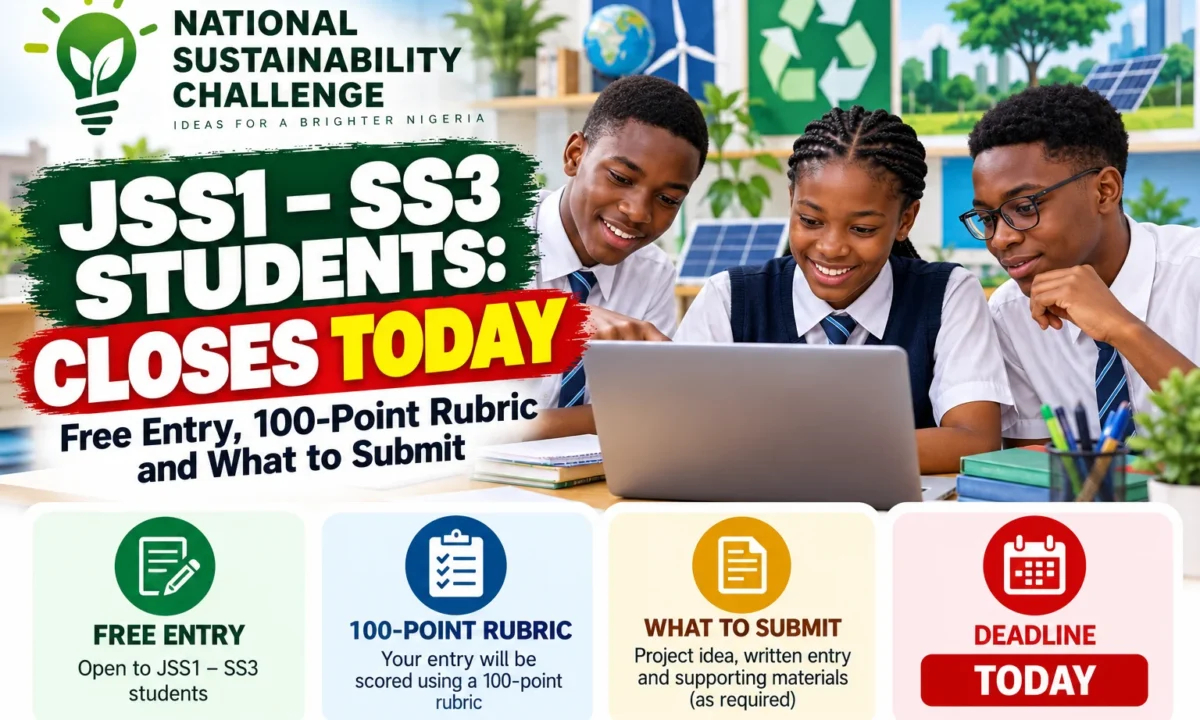
Today is the final day for secondary-school teams to enter the National Sustainability Challenge 2026. The extended Phase 1 application window closes October 5, and the organisers say entry is 100 per cent free.
Each team must consist of exactly two currently enrolled students from the same Nigerian secondary school, from JSS1 to SS3, supported by one designated teacher or school mentor who serves as the official communication contact.
The challenge is designed around a real sustainability problem in the students’ school or local community. Teams do not need an expensive prototype, laboratory equipment or polished invention for Phase 1. The organisers are looking for evidence that students understand a genuine problem and can propose a practical, evidence-based response.
What the Application Is Actually Judged On
Phase 1 requires team details, problem evidence and answers to 10 challenge questions. Entries are reviewed against a 100-point scorecard, with a recommended semi-final advancement score of 70 points.
- Problem understanding and relevance — 15 points: Is the problem specific, locally relevant and understood beyond surface symptoms?
- Evidence and local research — 15 points: Are there credible observations, surveys, student measurements or community interviews?
- Solution quality and innovation — 20 points: Does the solution have a logical mechanism and offer something practically useful?
- Feasibility — 15 points: Can students realistically develop it with accessible resources and proper safety awareness?
- Sustainability and SDG impact — 15 points: Is there a believable environmental, social or economic benefit?
- Scalability — 10 points: Could the idea expand beyond the immediate school/community?
- Student ownership and teamwork — 5 points and clarity/application quality — 5 points.
That scoring system gives teams a clear strategy for the final day: strengthen evidence instead of adding decorative language. A simple idea backed by measurements, photographs, a short survey or interviews can be stronger than an ambitious idea with no proof that the problem actually exists.
How to Submit Before the Deadline
- Visit the official National Sustainability Challenge page.
- Confirm that the team contains exactly two JSS1–SS3 students from the same school and one teacher/school mentor.
- Choose a specific local sustainability problem the students can explain from direct observation.
- Gather simple, credible evidence such as photos, measurements, school/community observations, survey responses or interviews.
- Answer the 10 Phase 1 questions directly and make sure the proposed solution is realistic.
- Use the Apply Now route on the official programme page and submit before the October 5 window closes.
- Keep a copy of the submission and ensure the mentor’s contact details are correct because the mentor is the official communication point.
The organisers plan to shortlist regional semi-finalists in October, while the National Grand Finals are scheduled for November 3, 2026. Finalist teams will pitch their solutions live before sustainability experts and other stakeholders.
Schools entering today should resist the temptation to let an adult rewrite the project into something the students cannot explain. The scoring rubric awards student ownership, and finalists may have to defend the idea in person.
For teams that already have an idea but have not submitted, today is the deadline. The strongest final-hour improvement is not a fancy prototype — it is clearer evidence, a better-defined problem and a solution the two students genuinely understand.

0 comments
Open the discussion when you need it. Comments stay collapsed until requested so the initial article remains light.