




ARTICLE CONTENTSOn this page 10 sections
Energy
Performance Objectives
By the end of the lesson, students should be able to:
- explain the meaning and different sources of energy;
- identify various forms of energy;
- explain the meaning of energy transformation;
- enumerate types of energy transformation;
- outline the importance of energy transformation;
- describe the various uses of energy transformation.
Meaning of Energy
Energy is the ability or capacity to do work.
Every activity in the universe requires energy to occur. Living things, such as humans, animals and plants, need energy to grow, move, reproduce and carry out life processes. Non-living things, including cars, generators, electric irons and calculators, also require energy to function. Without energy, no work can be performed.
Sources of Energy
A source of energy is any material, substance or natural phenomenon from which usable energy can be obtained.
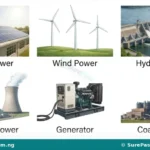
Energy sources are generally grouped into two main categories: renewable and non-renewable sources. Renewable sources are those that can be replenished naturally over a short period and do not run out, such as sunlight and wind. Non-renewable sources exist in limited quantities and can be exhausted through continuous use, such as crude oil and coal.
Common sources of energy include:
- The Sun: The primary source of energy for the Earth, providing solar energy which supports life and drives weather systems.
- Food: The source of chemical energy used by living organisms to perform daily physical activities and metabolic functions.
- Wind: Moving air that possesses kinetic energy, which can be used to turn wind turbines and generate electricity.
- Water: Flowing or falling water from rivers and dams used to drive turbines in hydroelectric power stations.
- Fossil Fuels: Natural substances such as crude oil, coal and natural gas formed from the remains of ancient plants and animals over millions of years.
- Chemical Cells and Batteries: Devices that store chemical substances to produce electrical energy when connected to a circuit.
- Wood and Biomass: Organic materials from plants and trees that release thermal energy when burned.
Forms of Energy
Forms of energy refer to the different states or ways in which energy exists in nature.
Energy can exist in various forms, and each form can be observed through its effects on matter. The main forms of energy are:
- Kinetic Energy: The energy possessed by an object due to its motion. Examples include a running child, a rolling football, a moving car and flowing water.
- Potential Energy: The stored energy possessed by an object due to its position, state or configuration. Examples include water stored behind a high dam, a stone resting on a cliff, or a stretched catapult rubber.
- Chemical Energy: Energy stored in the chemical bonds of substances. This energy is released during chemical reactions. Examples include energy stored in food, petrol, diesel, firewood and dry cell batteries.
- Thermal (Heat) Energy: Energy that flows from a hotter object to a colder object due to a temperature difference. Examples include energy from a burning candle, a gas cooker flame or a boiling kettle.
- Light Energy: A form of visible electromagnetic radiation that enables organisms to see. Examples include light from the sun, a glowing electric bulb or a lit torchlight.
- Sound Energy: Energy produced by vibrating objects that travels through a medium as sound waves. Examples include sound from a beating drum, a ringing school bell or a speaking person.
- Electrical Energy: Energy produced by the movement of electric charges through a conductor. Examples include electricity flowing through copper wires to power television sets, fans and refrigerators.
Meaning of Energy Transformation
Energy transformation is the process of changing energy from one form to another.
According to the Law of Conservation of Energy, energy cannot be created or destroyed, but it can only be changed from one form to another. This means that the total amount of energy in a closed system remains constant, even though the energy may change its appearance or state during various processes.
Types of Energy Transformation
Types of energy transformation refer to the specific pathways or conversions that occur when energy changes from a particular starting form to a different final form.
Common types of energy transformation include:
- Chemical to Electrical to Light and Heat: This occurs when a battery-powered torchlight is switched on. The chemical energy in the battery converts to electrical energy in the wires, which then converts to light and heat energy in the bulb.
- Chemical to Thermal and Kinetic: This occurs when fuel burns in a car engine. The chemical energy in petrol or diesel is converted into heat (thermal energy) and mechanical movement (kinetic energy) to drive the vehicle.
- Electrical to Thermal: This occurs when an electric iron, electric kettle or hot plate is plugged into a power source. The electrical energy is converted directly into heat energy.
- Electrical to Sound and Light: This occurs when a television set is switched on. The electrical energy from the mains is converted into light energy on the screen and sound energy from the speakers.
- Potential to Kinetic: This occurs when a stone resting on a high wall falls to the ground. The stored potential energy is converted into kinetic energy as the stone accelerates downwards.
- Solar (Light) to Chemical: This occurs during photosynthesis when green plants absorb sunlight and convert it into chemical energy stored in food molecules.
- Chemical to Kinetic: This occurs when the human body breaks down digested food to enable physical movement, such as running, jumping or lifting heavy objects.
Importance of Energy Transformation
Energy transformation is essential because energy in its raw or stored form is often not directly usable for specific human tasks or natural processes.
The importance of energy transformation includes:
- Making Energy Usable: Raw energy sources, such as crude oil or sunlight, cannot directly power home appliances or vehicles. Transforming them into electricity or mechanical motion makes them highly useful.
- Sustaining Life on Earth: Without the transformation of solar energy into chemical energy by plants, there would be no food chain to support animal and human life.
- Enabling Modern Technology: Computers, mobile phones and medical equipment rely entirely on the conversion of electrical energy into light, sound and electromagnetic signals to function.
- Facilitating Transportation: The conversion of chemical energy in fossil fuels into kinetic energy allows cars, trains, ships and aeroplanes to move people and goods across long distances.
Uses of Energy Transformation
Energy transformation is applied in various daily activities, homes, schools and industries to perform specific tasks.
Practical uses of energy transformation include:
- Lighting Homes and Streets: Transforming electrical energy into light energy using fluorescent tubes, light-emitting diodes (LEDs) or incandescent bulbs.
- Cooking Food: Transforming chemical energy from cooking gas, kerosene or firewood, or electrical energy from electric cookers, into thermal energy to heat and cook food.
- Operating Communication Devices: Transforming chemical energy in mobile phone batteries into electrical energy, which is further transformed into light on the screen and sound through the speaker.
- Pumping Water: Transforming electrical energy in water pumps into mechanical kinetic energy to lift water from underground boreholes into overhead storage tanks.
- Ironing Clothes: Transforming electrical energy into thermal energy using pressing irons to smooth fabrics.
- Powering Industrial Machinery: Transforming electrical energy into mechanical kinetic energy to operate factory machines that manufacture goods, grind grains or mix construction materials.
Activity: Identifying Sources and Forms of Energy
This practical activity helps learners develop skills in identifying different sources of energy and observing how energy is transformed from one form to another.
The required materials are:
- A dry cell battery
- A hand-held torchlight
- A box of matches or a candle
- A small hand bell or a drum
- An activity sheet and a pen
The procedure involves the following steps:
- Examine the dry cell battery and record its source type and the form of energy stored inside it on the activity sheet.
- Insert the battery into the torchlight, switch it on, and observe the resulting forms of energy produced by the bulb.
- Carefully strike a matchstick or light a candle under adult supervision, and identify the forms of energy released into the surrounding air.
- Ring the hand bell or beat the drum, and identify the form of energy produced by the vibration.
- Record all observations in the table provided on the activity sheet.
The observation table should be completed as follows:
| Object / Activity | Source of Energy | Initial Form of Energy | Final Form of Energy |
|---|---|---|---|
| Dry cell battery | Chemical chemicals | Chemical energy | Electrical energy (when connected) |
| Switching on a torchlight | Battery | Chemical energy | Light and Heat energy |
| Striking a matchstick | Match head chemicals | Chemical energy | Thermal and Light energy |
| Ringing a hand bell | Mechanical movement | Kinetic energy | Sound energy |




0 comments
Open the discussion when you need it. Comments stay collapsed until requested so the initial article remains light.