



ARTICLE CONTENTSOn this page 8 sections
Basic Electricity
Performance Objectives
By the end of the lesson, students should be able to:
- state types of electricity;
- explain methods of generating electricity;
- identify conductors and non-conductors of electricity;
- differentiate between conductors and non-conductors;
- make a group of materials that are conductors and non-conductors of electricity;
- carry out a simple experiment to demonstrate the presence of static electricity in daily life activities.
Electricity is a very important part of modern life. It powers many things used every day, from lights and fans to televisions and mobile phones. Understanding electricity helps people to use it safely and appreciate its role in the home, school and community.
What is Electricity?
Electricity is a form of energy that can be used to power machines and light up homes.
It is the flow of tiny particles that carry energy. Without electricity, many of the devices that make life comfortable and productive would not work. It helps to cook food, keep food cold, pump water and even charge phones.
Types of Electricity
Electricity can be found in different forms. The two main types of electricity are static electricity and current electricity.
Static Electricity
Static electricity is a type of electricity that stays in one place and does not flow.
It is often created when two different materials rub against each other. This rubbing causes tiny particles of electricity to move from one object to another, making one object have too much electricity and the other too little. This imbalance creates a static charge. When these charged objects come close to other light objects, they can attract them.
Examples of static electricity in daily life include:
- Rubbing a plastic comb through dry hair and then using it to pick up small pieces of paper.
- Rubbing a balloon on clothes and sticking it to a wall.
- Feeling a small shock when touching a metal door handle after walking across a carpet.
Current Electricity
Current electricity is a type of electricity that flows continuously through a path, like water flowing in a river.
This flowing electricity is what powers most electrical appliances. It needs a complete path, called a circuit, to flow from its source to the device it powers and back again. This continuous flow makes it useful for steady power.
Examples of current electricity include:
- Electricity that lights up bulbs in homes.
- Electricity that powers fans and air conditioners.
- Electricity that makes televisions and radios work.
Differences Between Static and Current Electricity
The main difference between static and current electricity is how they behave:
- Static electricity stays in one place and does not move. It is a build-up of electric charge on the surface of an object.
- Current electricity flows continuously through a path or wire. It is the movement of electric charge from one point to another.
How Electricity is Made (Methods of Generation)
Electricity is generated in many ways, using different sources of energy. These methods convert other forms of energy into electrical energy.
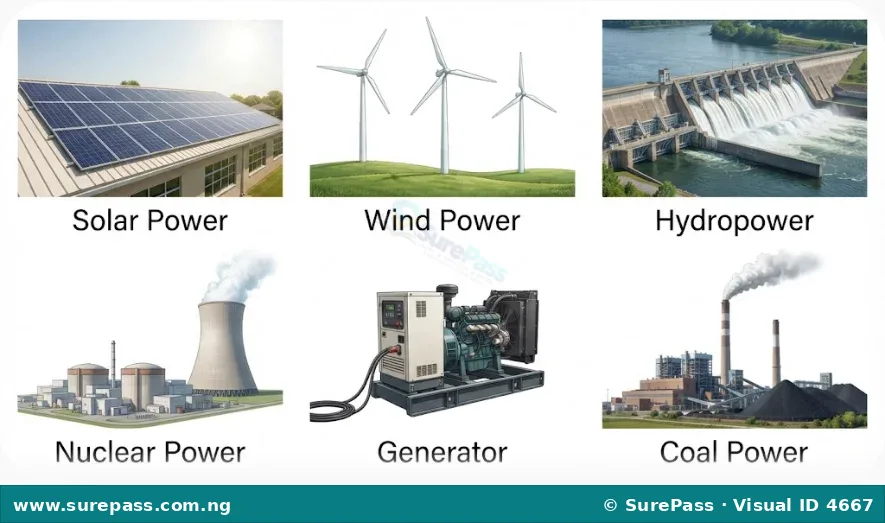
Solar Power
Solar power uses energy from the sun to make electricity. Special panels called solar panels capture sunlight and turn it into electrical energy. This method is clean and renewable, meaning the sun’s energy will not run out.
Wind Power
Wind power uses the force of moving air to generate electricity. Large machines called wind turbines have blades that spin when the wind blows. This spinning motion is used to produce electricity. Wind power is also a clean and renewable source of energy.
Hydropower
Hydropower uses the energy of flowing water to make electricity. Dams are built across rivers to create a large body of water. When this water is released, it flows through turbines, making them spin and generate electricity. The Kainji Dam in Nigeria is an example of a hydropower station.
Nuclear Power
Nuclear power uses the energy released from splitting tiny particles called atoms to generate electricity. This process creates a lot of heat, which is used to boil water and produce steam. The steam then turns turbines to make electricity. Nuclear power plants produce a large amount of electricity from a small amount of fuel.
Generators
Generators are machines that convert mechanical energy into electrical energy. They are commonly used in homes, offices and businesses to provide electricity when there is a power cut. Generators can run on fuel like petrol or diesel.
Coal Power
Coal power uses coal, a fossil fuel, to generate electricity. Coal is burned to heat water and produce steam. This steam then turns turbines, which are connected to generators to produce electricity. Coal power plants are a common source of electricity, but burning coal can release smoke into the air.
Conductors and Non-Conductors of Electricity
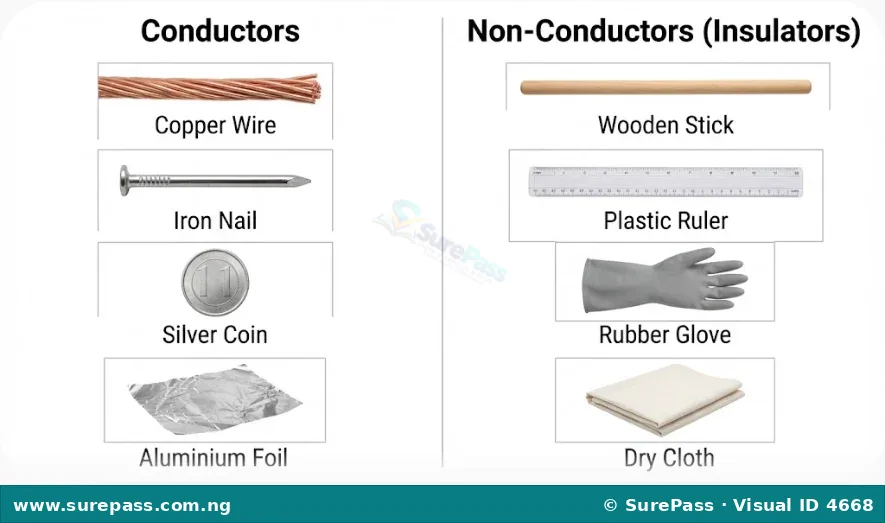
Materials behave differently when electricity tries to pass through them. Some materials allow electricity to flow easily, while others do not.
What are Conductors?
Conductors are materials that allow electricity to pass through them easily.
These materials have tiny particles that can move freely, carrying the electric current. Most metals are good conductors of electricity. Conductors are used to make wires that carry electricity to homes and appliances.
Examples of conductors include:
- Copper (used in electrical wires)
- Iron (used in many tools and structures)
- Aluminium (used in some wires and foil)
- Silver and Gold (very good conductors, but expensive)
What are Non-Conductors (Insulators)?
Non-conductors, also called insulators, are materials that do not allow electricity to pass through them easily.
These materials have particles that are tightly held and do not move freely, preventing the flow of electric current. Insulators are important for safety because they stop electricity from escaping and causing harm. They are used to cover electrical wires and handles of tools.
Examples of non-conductors (insulators) include:
- Plastic (used to cover wires and make electrical casings)
- Rubber (used in gloves and shoe soles for protection)
- Wood (especially dry wood)
- Glass
- Dry cloth
- Paper
Identifying and Grouping Conductors and Non-Conductors
It is important to know which materials are conductors and which are non-conductors for safety and proper use of electricity. Conductors are typically metals, while non-conductors are often materials like plastic, wood, and rubber.
To group materials, one can test them to see if they allow electricity to flow. Materials that light up a bulb in a simple circuit are conductors, while those that do not are non-conductors.
Differences Between Conductors and Non-Conductors
The main differences between conductors and non-conductors are:
- Conductors allow electric current to flow through them. Non-conductors (insulators) do not allow electric current to flow through them.
- Conductors are usually metals like copper, iron, and aluminium. Non-conductors are usually materials like plastic, rubber, wood, and glass.
- Conductors are used to carry electricity. Non-conductors are used for safety to block electricity and prevent shocks.
Practical Activity: Demonstrating Static Electricity
This experiment shows how static electricity can attract light objects.
The required materials are:
- A plastic comb or a biro pen
- Small pieces of paper (torn into tiny bits)
- Dry hair (or a woollen cloth)
The procedure involves the following steps:
- Tear a sheet of paper into very small pieces and place them on a flat surface like a table.
- Take the plastic comb or biro pen. Make sure it is clean and dry.
- Rub the comb or pen vigorously through dry hair for about 10-15 seconds. If dry hair is not available, rub it on a woollen cloth.
- Quickly bring the rubbed comb or pen close to the small pieces of paper on the table, without touching them.
- Observe what happens to the paper pieces.
Observation: The small pieces of paper will jump up and stick to the comb or pen. This happens because rubbing creates static electricity on the comb or pen, which then attracts the light paper pieces.
Practical Activity: Identifying Conductors and Non-Conductors
This activity helps to identify which materials allow electricity to pass through them.
The required materials are:
- A small battery (e.g., 1.5V or 3V)
- Two short pieces of insulated wire with bare ends
- A small torch bulb or LED light
- Various test materials:
- A piece of copper wire
- An iron nail
- A plastic ruler
- A wooden stick
- A rubber band
- A piece of aluminium foil
- A piece of paper
The procedure involves the following steps:
- Connect one end of a wire to one terminal of the battery and the other end to one terminal of the bulb.
- Connect the second wire to the other terminal of the bulb. You now have two free bare ends of wire: one from the battery and one from the bulb. This forms an open circuit.
- Take one of the test materials, for example, the copper wire. Touch one bare end of the circuit wire to one end of the copper wire and the other bare end of the circuit wire to the other end of the copper wire.
- Observe if the bulb lights up.
- Repeat step 3 and 4 for each of the other test materials (iron nail, plastic ruler, wooden stick, rubber band, aluminium foil, paper).
- Record your observations in a simple table, noting which materials made the bulb light up and which did not.
Safety Tip: Always handle electrical components carefully. Do not connect wires directly across the battery terminals for a long time without a bulb, as this can drain the battery quickly or cause it to heat up. This experiment uses very low voltage and is generally safe, but adult supervision is always recommended.
Observation: The bulb will light up when the circuit is completed with materials like copper wire, iron nail, and aluminium foil. The bulb will not light up when the circuit is completed with materials like plastic ruler, wooden stick, rubber band, and paper.
Conclusion: Materials that made the bulb light up are conductors of electricity. Materials that did not make the bulb light up are non-conductors (insulators) of electricity.





0 comments
Open the discussion when you need it. Comments stay collapsed until requested so the initial article remains light.