



ARTICLE CONTENTSOn this page 11 sections
States of Water, Water Cycle and Rain Formation
Performance Objectives
By the end of the lesson, students should be able to:
- identify pure water as a liquid with no colour, taste or odour;
- explain evaporation, condensation and freezing;
- conduct simple experiments to determine changes that take place when water is heated;
- describe the water cycle;
- describe the process of rain formation;
- explain the relationship between the water cycle and rain formation;
- draw the water cycle.
What is Water?
Water is a very important liquid found all around us. It is essential for all living things, including humans, animals and plants. People use water for drinking, cooking, washing, bathing and many other activities.
Identifying Pure Water
Pure water has special properties that make it different from other liquids. It is important to know these properties to identify pure water.
- Colour: Pure water has no colour. It is colourless. When you look at pure water in a clear glass, it looks clear.
- Taste: Pure water has no taste. It is tasteless. When you drink pure water, it does not have a sweet, sour, bitter or salty taste.
- Odour: Pure water has no smell. It is odourless. You cannot smell anything from pure water.
Other liquids like kerosene, orange juice, palm oil or vegetable oil have colour, taste or smell. For example, orange juice has an orange colour and a sweet taste. Kerosene has a strong smell. These differences help to identify pure water.
States of Water
Water can exist in three different forms, also known as states. These states are liquid, solid and gas.
- Liquid State: This is the most common state of water. Water in rivers, lakes, oceans and the water people drink is in the liquid state. Liquid water flows and takes the shape of its container.
- Solid State: When liquid water becomes very cold, it turns into ice. Ice is the solid state of water. Ice has a fixed shape and does not flow. Examples of solid water include ice cubes and hailstones.
- Gaseous State (Steam or Water Vapour): When liquid water is heated, it turns into steam or water vapour. This is the gaseous state of water. Steam is an invisible gas, but sometimes people see a white mist above boiling water, which is tiny water droplets formed from steam. Water vapour is always present in the air around us, even if it cannot be seen.
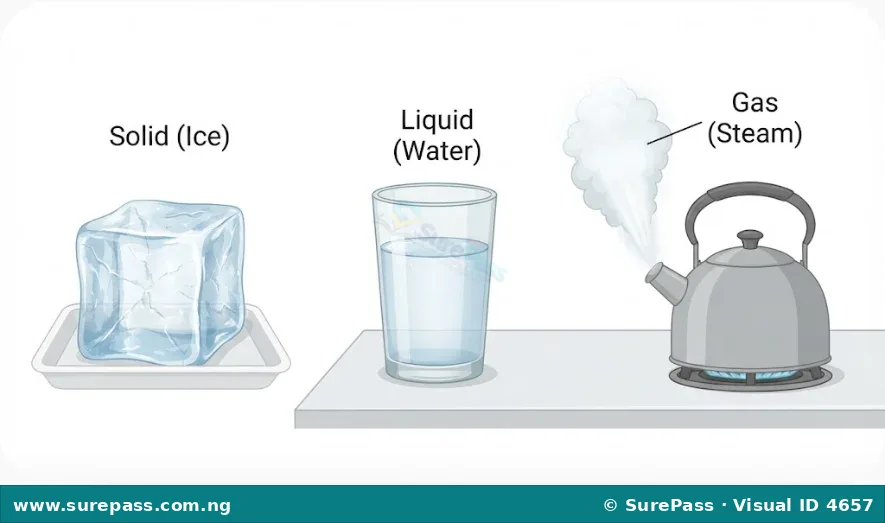
Changes of State of Water
Water can change from one state to another. These changes happen when water is either heated or cooled.
Evaporation
Evaporation is the process where liquid water changes into water vapour (gas) when it is heated. This happens when water gains enough energy to turn into a gas. Evaporation occurs slowly at room temperature, like when wet clothes dry in the sun, or quickly when water is boiled.
Examples of evaporation in daily life include:
- Wet clothes drying under the sun.
- Puddles of water disappearing from the ground after rainfall.
- Water boiling in a pot, turning into steam.
Condensation
Condensation is the process where water vapour (gas) changes back into liquid water when it cools down. This happens when water vapour loses energy and turns back into tiny liquid droplets. Condensation is the opposite of evaporation.
Examples of condensation in daily life include:
- Water droplets forming on the outside of a cold drink glass.
- Fog or mist forming in the air on a cool morning.
- Clouds forming in the sky.
- Water droplets forming on the lid of a pot when food is cooking.
Freezing
Freezing is the process where liquid water changes into solid ice when it becomes very cold. This happens when water loses enough heat energy to become solid.
Examples of freezing in daily life include:
- Water turning into ice cubes in a freezer.
- Puddles of water turning into ice in very cold weather.
- Water in a bottle cracking when it freezes solid.
Simple Experiments on Changes of State
These experiments help to observe how water changes its state when heated or cooled.
Experiment 1: Observing Evaporation and Condensation
This experiment shows how liquid water turns into steam and then back into liquid water.
The required materials are:
- A small amount of water
- A metal cup or pot
- A lid for the metal cup or pot
- A stove or heating source
- Oven mitts or a thick cloth for safety
The procedure involves the following steps:
- Pour a small amount of water into the metal cup or pot.
- Place the cup on a stove and ask an adult to help light the stove.
- Observe the water as it heats up. Bubbles will form, and steam will rise from the water. This is evaporation.
- Carefully place the lid on the cup.
- After a few minutes, use oven mitts or a thick cloth to carefully lift the lid.
- Observe the underside of the lid. You will see small water droplets. These droplets formed when the steam (water vapour) touched the cooler lid and changed back into liquid water. This is condensation.
- Ask an adult to turn off the stove. Allow the cup and water to cool down completely before touching them.
Safety Note: Always have an adult supervise when using a stove or any heating source. Be careful with hot water and steam, as they can cause burns.
Experiment 2: Observing Freezing
This experiment shows how liquid water turns into solid ice.
The required materials are:
- A small amount of water
- An ice tray or a small plastic container
- A freezer
The procedure involves the following steps:
- Pour water into the ice tray or small plastic container.
- Place the ice tray or container into a freezer.
- Leave it in the freezer for several hours or overnight.
- After some time, remove the tray or container from the freezer.
- Observe the water. It will have turned into solid ice. This is freezing.
The Water Cycle
The water cycle is the continuous movement of water on, above and below the surface of the Earth. It is how water keeps moving around our planet, changing its state as it goes. The water cycle has several main stages:
- Evaporation: The sun heats up water in oceans, rivers, lakes and even puddles. This heat causes the liquid water to turn into water vapour (gas), which rises into the air.
- Condensation: As the water vapour rises higher into the atmosphere, it cools down. When it cools enough, the water vapour changes back into tiny liquid water droplets or ice crystals. These tiny droplets and crystals come together to form clouds.
- Precipitation: When too many water droplets or ice crystals gather in the clouds, they become heavy. They then fall back to Earth in different forms, such as rain, snow or hail. For Primary 4, the focus is on rain.
- Collection: The water that falls as rain collects in various places. It flows into rivers, lakes and oceans. Some water soaks into the ground to become groundwater. This collected water will then evaporate again, and the cycle continues.
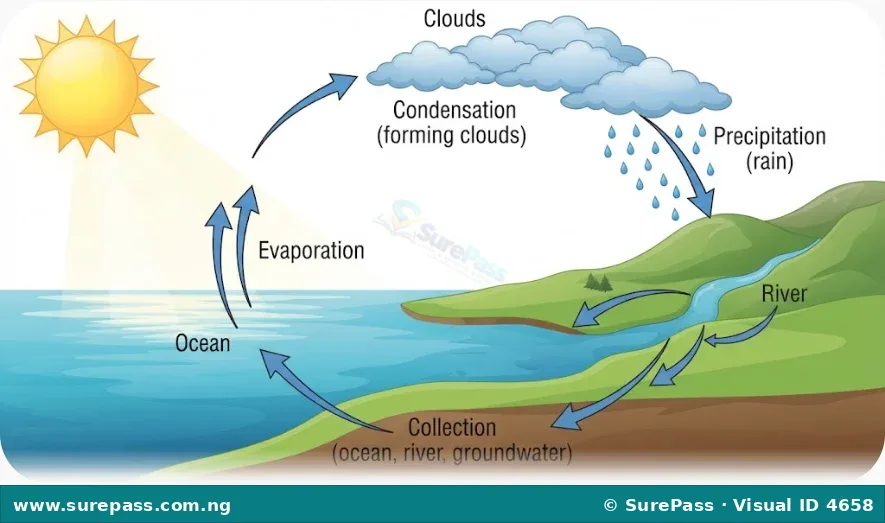
Rain Formation
Rain formation is an important part of the water cycle. It is how water returns from the atmosphere to the Earth’s surface.
The process of rain formation involves these steps:
- Evaporation: Water from oceans, rivers, lakes and moist land evaporates due to the sun’s heat, turning into invisible water vapour.
- Rising and Cooling: This water vapour rises into the atmosphere. As it goes higher, the air becomes colder.
- Condensation and Cloud Formation: The cold air causes the water vapour to cool down and condense. This means the water vapour changes back into tiny liquid water droplets or ice crystals. These tiny droplets and crystals gather together to form clouds.
- Droplet Growth: Inside the clouds, these tiny water droplets or ice crystals bump into each other and combine. They grow larger and larger.
- Falling as Rain: When the water droplets become too heavy for the air to hold them up, they fall to the Earth as rain.
Relationship Between the Water Cycle and Rain Formation
Rain formation is a key part of the water cycle. The water cycle describes the entire journey of water, from the Earth’s surface to the atmosphere and back again. Rain formation is the specific stage within this cycle where water falls back to Earth from the clouds.
Without evaporation, there would be no water vapour to form clouds. Without condensation, there would be no clouds. And without clouds, there would be no rain. So, rain formation is a direct result of the processes of evaporation and condensation working together within the continuous water cycle.
Drawing the Water Cycle
Drawing the water cycle helps to understand its different stages. When drawing, remember to include the main parts and show the movement of water with arrows.
The required materials are:
- Cardboard paper or drawing paper
- Pencil
- Crayons or colour pencils
The procedure involves the following steps:
- Draw a large body of water at the bottom of your paper, like an ocean or a lake.
- Draw the sun shining above the water.
- Draw arrows pointing upwards from the water towards the sky. Label this “Evaporation.”
- Draw clouds in the sky.
- Draw arrows pointing from the rising water vapour towards the clouds. Label the formation of clouds as “Condensation.”
- Draw arrows pointing downwards from the clouds towards the land and the body of water. Show droplets falling. Label this “Precipitation” (or “Rain”).
- Draw rivers flowing from the land back into the large body of water. Label this “Collection.”
- Use colours to make your drawing clear and easy to understand. For example, blue for water, white for clouds, and yellow for the sun.



0 comments
Open the discussion when you need it. Comments stay collapsed until requested so the initial article remains light.