


ARTICLE CONTENTSOn this page 10 sections
Growth and Developmental Changes in Animals
Performance Objectives
By the end of the lesson, students should be able to:
- identify growth and developmental changes in animals;
- draw and label the life cycle of some common animals, e.g. insects and frog;
- mention the names of the young ones of different animals.
Introduction to Growth and Development in Animals
Animals, like all living things, do not stay the same throughout their lives. They change over time. These changes involve growing bigger and also changing in their body form or abilities. From the moment an animal is born or hatches from an egg, it begins a journey of growth and development.
Meaning of Growth in Animals
Growth in animals means an increase in size and weight.
When an animal grows, its body gets larger, and it often becomes heavier. For example, a tiny chick hatches from an egg and grows into a much larger hen or rooster. A small puppy grows into a bigger dog. This increase in size is a clear sign of growth.
Meaning of Development in Animals
Development in animals means the changes in the body structure and abilities of an animal as it grows.
Development involves more than just getting bigger. It includes changes in how an animal looks, what it can do, and how its body parts work. For instance, a tadpole develops legs and lungs as it changes into a frog. A caterpillar develops wings as it changes into a butterfly. These are developmental changes.
Examples of Growth and Developmental Changes in Animals
Animals show many different kinds of growth and developmental changes. Some animals simply grow larger, while others go through amazing transformations.
Examples of animals showing growth include:
- A baby human grows into a child, then an adult.
- A small goat kid grows into a large adult goat.
- A tiny fish hatches from an egg and grows into a bigger fish.
Examples of animals showing developmental changes include:
- A caterpillar changes into a pupa, then into a butterfly. The butterfly looks very different from the caterpillar.
- A tadpole, which lives in water and has a tail, changes into a frog that lives on land and has legs.
- A maggot, which is a worm-like larva, changes into a fly.
Life Cycles of Animals
A life cycle describes the series of changes an animal goes through from birth to adulthood, and then to producing its own young.
Every animal has a life cycle. Some life cycles are simple, where the young animal looks much like the adult, only smaller. Other life cycles are complex, involving several different stages where the animal changes its form completely. These complex changes are called metamorphosis.
Life Cycle of an Insect (e.g., Butterfly)
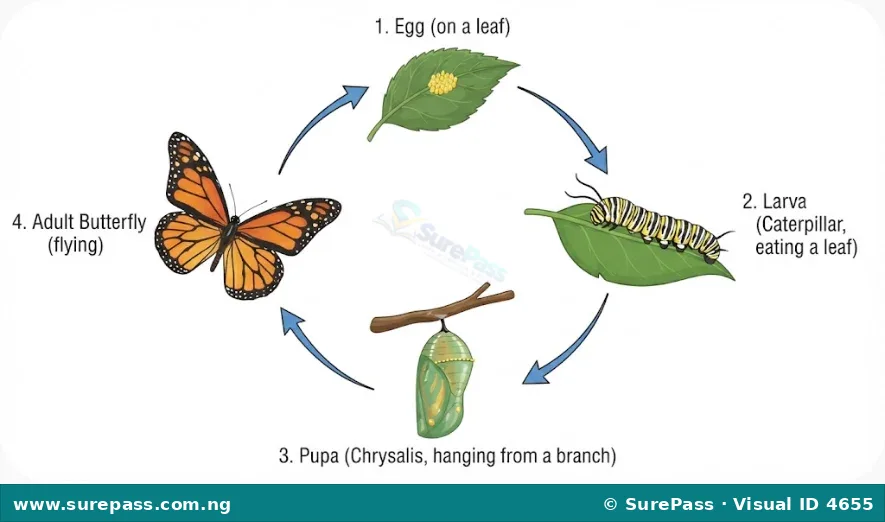
Butterflies go through a complete metamorphosis, meaning they have four distinct stages in their life cycle. Each stage looks very different from the others.
The stages of a butterfly’s life cycle are:
- Egg: The life cycle begins when an adult butterfly lays tiny eggs, usually on a leaf.
- Larva (Caterpillar): The egg hatches into a larva, which is called a caterpillar. The caterpillar’s main job is to eat and grow. It sheds its skin several times as it gets bigger.
- Pupa (Chrysalis): After growing enough, the caterpillar forms a pupa. For butterflies, this pupa is often called a chrysalis. Inside the chrysalis, the caterpillar’s body undergoes a big transformation.
- Adult Butterfly: Finally, an adult butterfly emerges from the chrysalis. The adult butterfly has wings and can fly. Its job is to lay new eggs to start the cycle again.
Observe the image below to see the different stages of a butterfly’s life cycle.
Life Cycle of a Frog
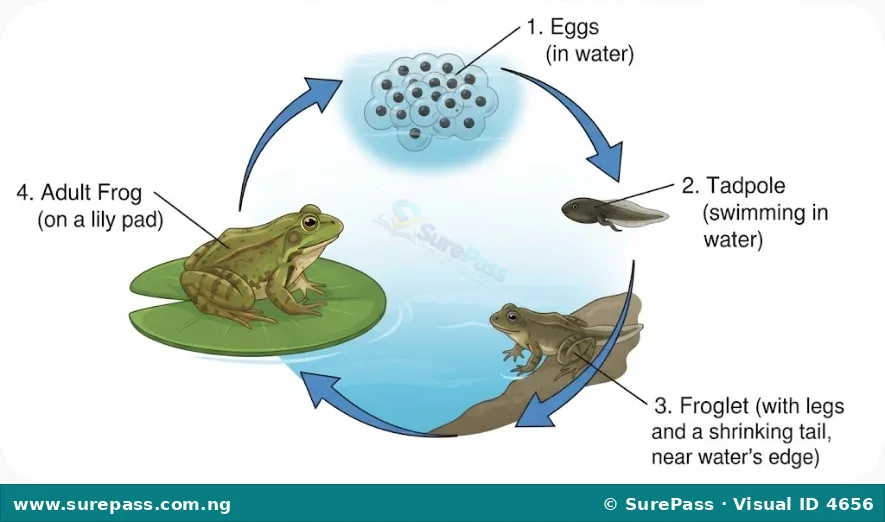
Frogs also go through a complete metamorphosis, but their stages are different from those of insects. They start their lives in water and move to land as adults.
The stages of a frog’s life cycle are:
- Eggs: An adult female frog lays many eggs in water, often in a jelly-like cluster called frogspawn.
- Tadpole: The eggs hatch into tadpoles. Tadpoles live in water, have gills for breathing, and a long tail for swimming. They eat plants.
- Froglet (Young Frog): As the tadpole grows, it starts to develop hind legs, then front legs. Its tail begins to shrink, and its gills are replaced by lungs, allowing it to breathe air.
- Adult Frog: The froglet loses its tail completely and becomes an adult frog. Adult frogs can live both in water and on land. They eat insects and other small animals, and they lay eggs to continue the life cycle.
Look at the diagram below showing the life cycle of a frog.
Names of Young Ones of Different Animals
Many animals have special names for their young ones. Knowing these names helps to identify the different stages of an animal’s life.
Here are the names of the young ones of some common animals:
- Dog: Puppy
- Cat: Kitten
- Chicken: Chick
- Goat: Kid
- Sheep: Lamb
- Cow: Calf
- Pig: Piglet
- Duck: Duckling
- Lion: Cub
- Butterfly (larva stage): Caterpillar
- Fly (larva stage): Maggot
- Frog (larva stage): Tadpole
Recording and Interpreting Animal Changes
Observing animals and recording their changes is an important skill in science. By carefully watching and writing down what happens, people can understand how animals grow and develop.
Recording Changes in Animals
To record changes in animals, one can:
- Observe carefully: Look closely at the animal at different times. Notice its size, colour, shape, and what it does.
- Draw pictures: Sketch the animal at different stages of its life. This helps to capture visual changes.
- Write notes: Describe in a notebook what is observed. Include dates, sizes, and any new features or behaviours.
- Measure: If possible and safe, measure the animal’s length or weight at different times to track growth.
Analysing and Interpreting Observations
After recording observations, the next step is to analyse and interpret them. This means looking at the recorded information to understand what it tells about the animal’s growth and development.
For example, if observations of a chick show it getting bigger and growing feathers, it can be interpreted that the chick is growing and developing into an adult bird. If observations of a tadpole show it losing its tail and growing legs, it can be interpreted that the tadpole is developing into a frog.
Drawing and Labelling Life Cycles
Drawing and labelling the life cycles of animals helps to show all the stages clearly and in the correct order. This skill helps to understand the complete journey of an animal’s life.
The procedure for drawing and labelling a life cycle involves the following steps:
- Choose an animal: Select an animal whose life cycle is to be drawn, such as a butterfly or a frog.
- Identify the stages: Recall all the main stages of the animal’s life cycle (e.g., egg, larva, pupa, adult for a butterfly).
- Draw each stage: Sketch each stage clearly. Make sure each drawing looks like that stage of the animal.
- Arrange in a cycle: Draw the stages in a circle or a sequence to show that it is a continuous cycle.
- Label each stage: Write the correct name for each stage next to its drawing.
- Add arrows: Draw arrows between the stages to show the direction of the changes in the life cycle.


0 comments
Open the discussion when you need it. Comments stay collapsed until requested so the initial article remains light.