



ARTICLE CONTENTSOn this page 7 sections
Changes in Nature
Performance Objectives
By the end of the lesson, students should be able to:
- observe changes in their surroundings;
- define temporary and permanent change;
- identify temporary and permanent changes in their surroundings;
- state the difference between temporary and permanent changes;
- conduct simple experiments on permanent and temporary changes.
Introduction to Changes in Nature
The world around us is always changing. From the food we eat to the objects we use, many things undergo changes. Some changes are easy to see, while others happen slowly over time. These changes can be grouped into two main types: temporary changes and permanent changes.
Understanding these changes helps us to know more about the materials and objects in our environment.
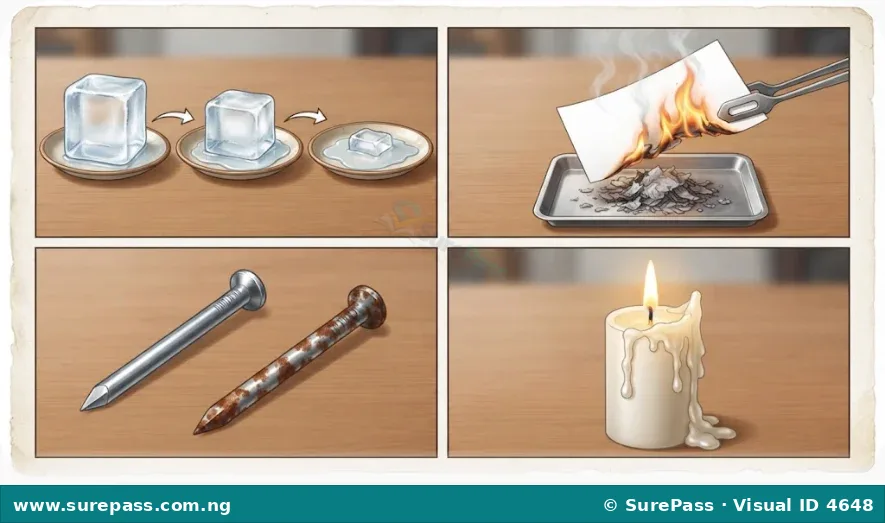
Temporary Changes
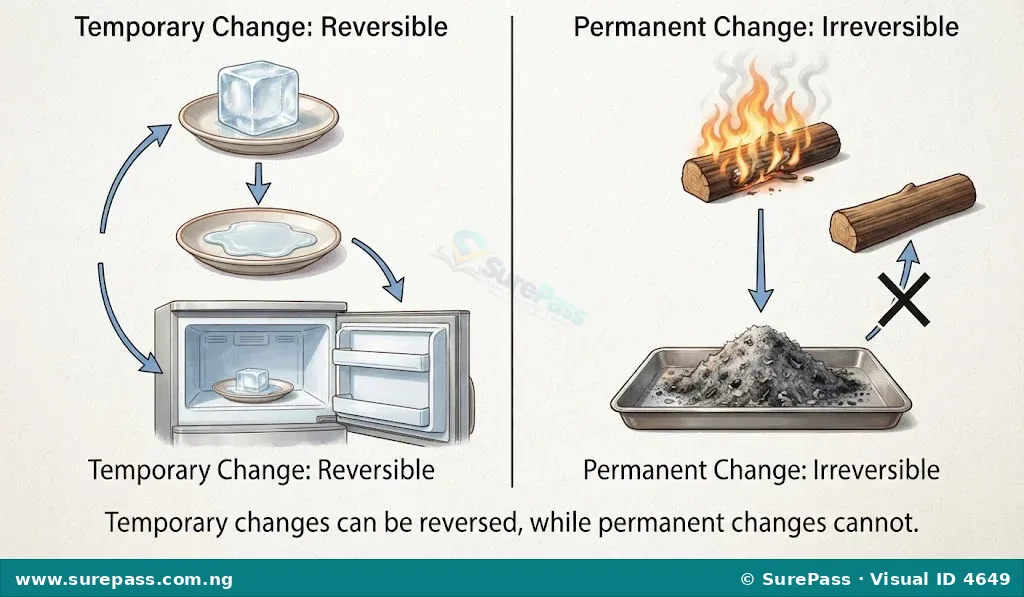
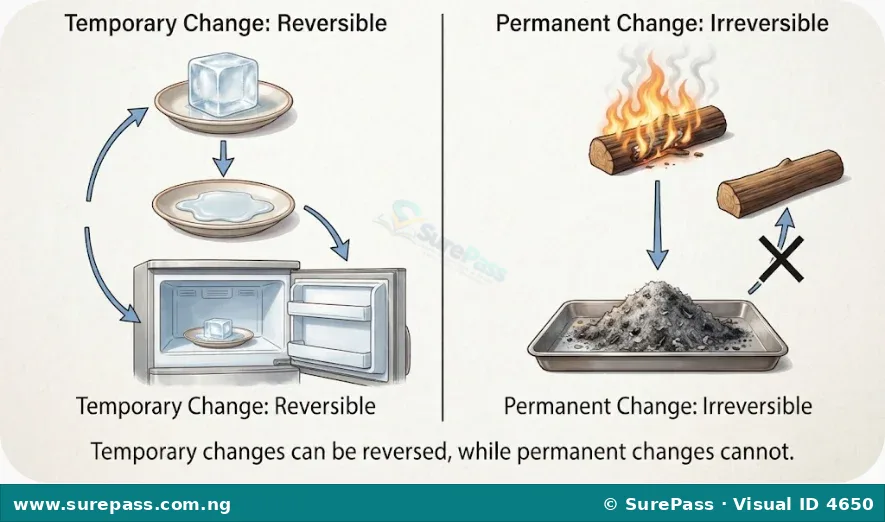
A temporary change is a change that can be reversed. This means that after the change happens, the material can go back to its original form or state.
Imagine a block of ice. When it gets warm, it melts into water. If this water is put back into a freezer, it will turn back into ice. This is an example of a temporary change because the water can return to being ice.
Examples of Temporary Changes in the Surroundings
Many temporary changes happen around us every day. These changes do not create new materials. Instead, they often change the shape, size, or state of a material.
Examples of temporary changes include:
- Melting candle wax: When a candle burns, the wax near the flame melts into a liquid. When the flame is put out, the liquid wax cools down and becomes solid again. The wax remains wax.
- Dissolving salt in water: When table salt is stirred into water, it disappears and forms a salty solution. If the water is allowed to evaporate, the salt will be left behind, returning to its original solid form.
- Melting Vaseline (petroleum jelly): Vaseline is a soft solid. If it is heated, it melts into a liquid. When it cools down, it becomes solid Vaseline again.
- Folding paper: When a piece of paper is folded, its shape changes, but it is still paper. It can be unfolded to its original flat shape.
- Boiling water: When water is heated, it turns into steam. If the steam cools down, it turns back into liquid water.
Permanent Changes
A permanent change is a change that cannot be reversed. This means that after the change happens, the material cannot easily go back to its original form or state. A new material is often formed during a permanent change.
Think about burning a piece of wood. When wood burns, it turns into ash and smoke. It is impossible to turn the ash and smoke back into wood. This is an example of a permanent change.
Examples of Permanent Changes in the Surroundings
Permanent changes often involve a material changing into a completely different material. These changes are usually difficult or impossible to undo.
Examples of permanent changes include:
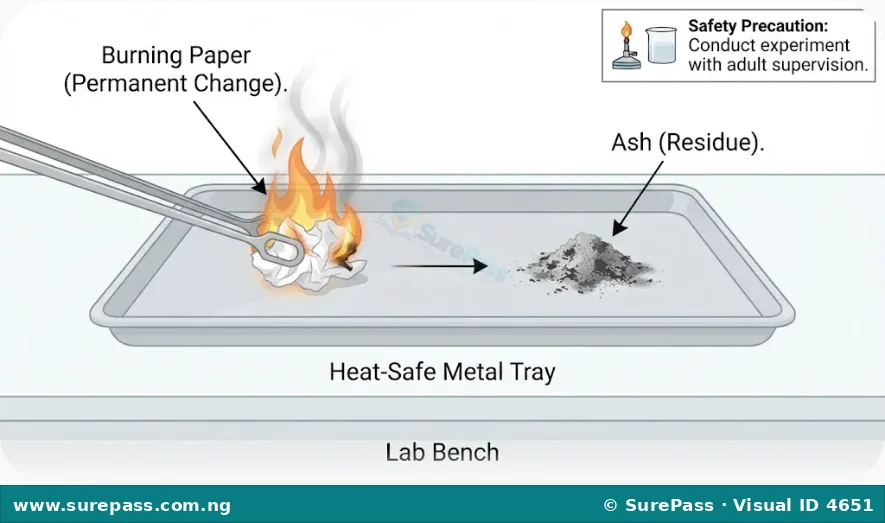
- Burning paper: When paper burns, it turns into ash and smoke. The ash cannot be turned back into paper.
- Burning wood: Similar to paper, when wood burns, it changes into ash and smoke. The wood is gone forever.
- Rusting nails: When iron nails are left in moist air for a long time, they react with oxygen and water to form rust. Rust is a new material that is reddish-brown and flaky. The nail cannot easily return to its original shiny iron state.
- Cooking food: When raw food like an egg or yam is cooked, its appearance, taste, and texture change. A cooked egg cannot be turned back into a raw egg.
- Ripening of fruits: A green, unripe fruit changes colour, taste, and texture as it ripens. An overripe fruit cannot become unripe again.
Differences Between Temporary and Permanent Changes
Temporary and permanent changes have clear differences. These differences help us to classify the many changes we see around us.
The main differences between temporary and permanent changes are:
- Reversibility: Temporary changes can be reversed, meaning the original material can be recovered. Permanent changes cannot be reversed, and the original material is lost.
- New Material Formation: In a temporary change, no new material is formed; only the state, shape, or size changes. In a permanent change, one or more new materials are formed.
- Energy Change: Temporary changes usually involve less energy change. Permanent changes often involve a significant release or absorption of energy, like heat or light.
Conducting Simple Experiments on Changes
We can observe and understand temporary and permanent changes by carrying out simple experiments. These experiments help us to see the changes directly and record what happens.
Experiment 1: Observing a Temporary Change (Melting Vaseline)
This experiment shows how Vaseline changes from solid to liquid and back again.
The required materials are:
- A small amount of Vaseline (petroleum jelly)
- A small, clean metal spoon or a small heat-safe dish
- A source of gentle heat (e.g., warm water bath, or adult-supervised low flame from a candle/spirit lamp)
- A stopwatch or clock (optional, for timing)
- A notebook and pen for recording observations
The procedure involves the following steps:
- Place a small amount of Vaseline into the spoon or heat-safe dish.
- Carefully hold the spoon over the gentle heat source. If using a candle, an adult must supervise closely. If using a warm water bath, place the spoon into the warm water.
- Observe what happens to the Vaseline as it gets warm. Note its appearance and state.
- Once the Vaseline has completely melted into a liquid, remove it from the heat source.
- Place the spoon with the liquid Vaseline in a cool place, like a window sill or on a table away from heat.
- Observe what happens to the liquid Vaseline as it cools down.
- Record all your observations in a table.
Recording and Interpreting Observations for Experiment 1
After conducting the experiment, it is important to record your observations clearly. A table helps to organise the information.
An example of an observation table for melting Vaseline:
| Step | Observation | Interpretation |
|---|---|---|
| 1. Vaseline before heating | Soft, white solid. | Original state. |
| 2. Vaseline during heating | It slowly turns into a clear liquid. | Change of state from solid to liquid. |
| 3. Vaseline after cooling | The clear liquid turns back into a soft, white solid. | Change of state from liquid back to solid. |
Interpretation: From these observations, we can conclude that melting Vaseline is a temporary change. The Vaseline changed from solid to liquid and then back to solid. No new material was formed, and the change was reversible.
Experiment 2: Observing a Permanent Change (Burning Paper)
This experiment shows how paper changes when it burns.
The required materials are:
- A small piece of paper
- A matchbox or lighter (to be handled ONLY by an adult)
- A heat-safe plate or metal tray
- A notebook and pen for recording observations
The procedure involves the following steps:
- Place the small piece of paper on the heat-safe plate or metal tray. Ensure there are no flammable materials nearby.
- An adult should carefully light one corner of the paper with a match or lighter.
- Observe what happens to the paper as it burns. Note any changes in its appearance, colour, and what is left behind.
- Once the paper has completely burned and cooled, examine the remaining material.
- Record all your observations in a table.
Safety Note: This experiment involves fire. It must be conducted ONLY with strict adult supervision in a well-ventilated area, away from any flammable materials. Have a bucket of water or sand nearby for emergencies.
Recording and Interpreting Observations for Experiment 2
After conducting the experiment, record your observations clearly.
An example of an observation table for burning paper:
| Step | Observation | Interpretation |
|---|---|---|
| 1. Paper before burning | Thin, white, flat sheet. | Original material. |
| 2. Paper during burning | It catches fire, turns black, produces smoke and light. | Material is reacting with oxygen, changing rapidly. |
| 3. Material after burning | A small pile of soft, black, flaky ash is left. | A new material (ash) has been formed. |
Interpretation: From these observations, we can conclude that burning paper is a permanent change. The paper changed into ash and smoke, which are completely new materials. The ash cannot be turned back into paper, so the change is irreversible.




0 comments
Open the discussion when you need it. Comments stay collapsed until requested so the initial article remains light.