


ARTICLE CONTENTSOn this page 6 sections
Human Body: The Teeth
Performance Objectives
By the end of the lesson, students should be able to:
- name the types of teeth in the mouth;
- locate the relative positions of each type of teeth in the mouth;
- state the number of the different types of teeth in the mouth;
- mention the uses of each type of teeth;
- draw and label types of human teeth.
What Are Teeth?
Teeth are hard, white structures found inside the mouth. They are fixed in the jawbones.
Teeth are very important for eating food. They help to cut, tear, crush, and grind food into smaller pieces so it can be swallowed easily. This is the first step in digestion.
Types of Teeth
Humans have different types of teeth, and each type has a special shape and job. In a fully grown mouth, there are usually 32 teeth in total. These teeth are divided into four main types:
- Incisors
- Canines
- Premolars
- Molars
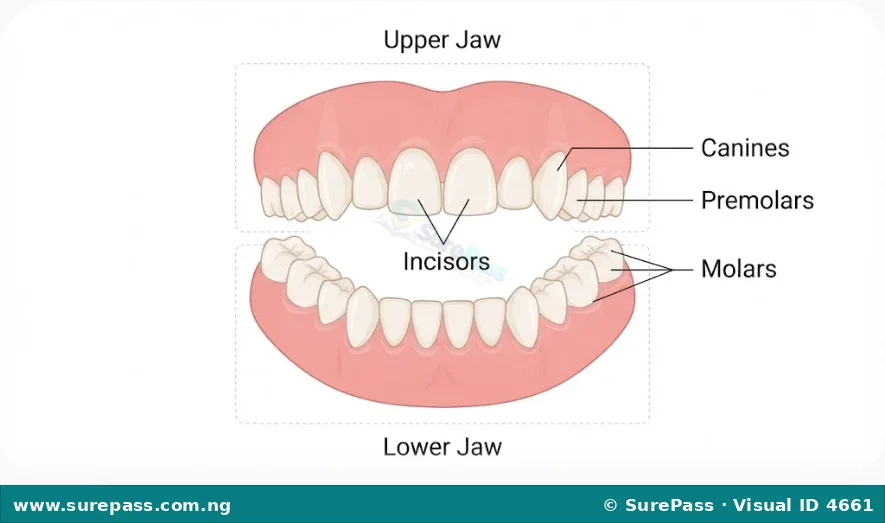
Incisors
Incisors are the teeth at the very front of the mouth. They have sharp, flat edges.
Position: They are located at the front of both the upper and lower jaws.
Number: There are 8 incisors in total, 4 in the upper jaw and 4 in the lower jaw.
Function: Incisors are used for cutting and biting food. For example, when a person bites into a piece of bread or yam, the incisors do the work.
Canines
Canines are pointed teeth located next to the incisors. They are often longer and sharper than other teeth.
Position: They are found on either side of the incisors, one in each corner of the front part of the mouth.
Number: There are 4 canines in total, 2 in the upper jaw and 2 in the lower jaw.
Function: Canines are used for tearing food. They are very useful for tearing tough foods like meat.
Premolars
Premolars are wider teeth with flat surfaces, located behind the canines. They have two pointed cusps on their chewing surface.
Position: They are found between the canines and the molars.
Number: There are 8 premolars in total, 4 in the upper jaw and 4 in the lower jaw.</p
Function: Premolars are used for crushing and grinding food into smaller pieces before it is swallowed.
Molars
Molars are the largest and strongest teeth, located at the very back of the mouth. They have broad, flat surfaces with several cusps.
Position: They are found at the back of both the upper and lower jaws, behind the premolars.
Number: There are 12 molars in total, 6 in the upper jaw and 6 in the lower jaw.
Function: Molars are mainly used for heavy grinding and crushing of food. They work like mills to break down food into a paste, making it easy to swallow.
Arrangement of Teeth in the Mouth
The teeth are arranged in a specific order in the mouth to perform their different functions effectively. The incisors are at the front, followed by the canines, then the premolars, and finally the molars at the very back.
This arrangement allows a person to first bite and cut food with the incisors, then tear it with the canines, and finally crush and grind it with the premolars and molars.
Drawing and Labelling Types of Human Teeth
Drawing and labelling the different types of teeth helps to understand their positions and shapes better. This skill involves carefully observing the teeth and representing them accurately on paper.
The procedure involves the following steps:
- Observe your teeth: Use a mirror to look at your own teeth. Notice the different shapes and positions of the teeth at the front, sides, and back of your mouth.
- Draw the jaw outline: Lightly draw the general shape of the upper and lower jaws, like a curved line for each jaw.
- Draw the incisors: At the front of each jaw, draw four flat, sharp-edged teeth. These are the incisors.
- Draw the canines: Next to the incisors on each side, draw one pointed tooth. These are the canines.
- Draw the premolars: Behind each canine, draw two wider teeth with flat surfaces. These are the premolars.
- Draw the molars: At the very back of each jaw, draw three large, broad teeth with flat chewing surfaces. These are the molars.
- Label the teeth: Clearly write the name of each type of tooth (Incisors, Canines, Premolars, Molars) next to the teeth you have drawn.




0 comments
Open the discussion when you need it. Comments stay collapsed until requested so the initial article remains light.