


ARTICLE CONTENTSOn this page 10 sections
Non-Living Things: Rocks
Performance Objectives
By the end of the lesson, students should be able to:
- identify different types of rocks by their physical appearance;
- identify the physical characteristics of the different types of rocks;
- group rocks according to colour, hardness, lustre, etc.;
- name some major landmark rocks in Nigeria;
- identify their location on a regional map of Nigeria;
- state the uses of rocks;
- prepare an album of different types of rocks.
What Are Rocks?
A rock is a naturally occurring solid material made up of one or more minerals. Rocks are found everywhere on Earth, forming mountains, hills, and the ground beneath our feet.
Rocks are non-living things. They come in many different shapes, sizes, and colours. Some rocks are very hard, while others are soft. They are an important part of our environment and are used for many things.
Types of Rocks
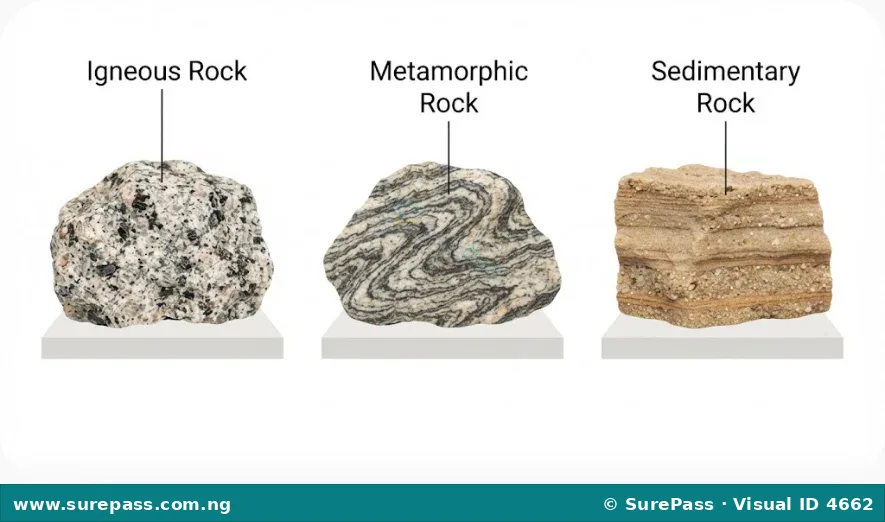
Rocks are generally grouped into three main types based on how they are formed. These types are igneous rocks, metamorphic rocks, and sedimentary rocks.
Igneous Rocks
Igneous rocks are formed when hot, molten rock material, called magma or lava, cools and hardens. Magma is molten rock found deep inside the Earth, while lava is molten rock that flows out onto the Earth’s surface during a volcanic eruption.
When magma or lava cools, it turns into solid rock. Some igneous rocks cool slowly, forming large crystals, while others cool quickly, forming small crystals or a glassy texture.
Metamorphic Rocks
Metamorphic rocks are formed from existing rocks that have been changed by intense heat, pressure, or chemical reactions deep within the Earth. The word “metamorphic” means “change in form.”
These changes can make the original rock harder, denser, or change its mineral composition and texture. For example, limestone can change into marble, and shale can change into slate under these conditions.
Sedimentary Rocks
Sedimentary rocks are formed from pieces of other rocks, minerals, or organic matter that have been broken down by weathering and erosion. These small pieces, called sediments, are carried by wind, water, or ice and then deposited in layers.
Over a long time, these layers of sediment are pressed together and cemented by natural minerals, forming solid rock. Sedimentary rocks often show visible layers or contain fossils of ancient plants and animals.
Characteristic Properties of Rocks
Rocks have different physical characteristics that help us identify them. These properties include colour, hardness, and lustre.
Colour
Rocks come in a wide range of colours. Some are uniform in colour, while others have multiple colours or patterns. The colour of a rock is often due to the minerals it contains.
- Igneous Rocks: Can be light-coloured (like granite, which is often grey, pink, or white with dark specks) or dark-coloured (like basalt, which is usually dark grey or black).
- Metamorphic Rocks: Their colours can vary widely depending on the original rock and the changes it underwent. Marble can be white, grey, or coloured, while slate is typically dark grey or black.
- Sedimentary Rocks: Often have earthy colours like brown, red, yellow, or grey. Sandstone can be reddish-brown, and shale is often grey or black.
Hardness
Hardness refers to how resistant a rock is to scratching or breaking. Some rocks are very hard and difficult to scratch, while others are soft and can be scratched easily.
- Igneous Rocks: Many igneous rocks, especially those that cooled slowly, are very hard and durable, such as granite.
- Metamorphic Rocks: Often become harder and denser than their original forms due to intense pressure and heat. Marble and slate are generally hard.
- Sedimentary Rocks: Can vary in hardness. Some, like sandstone, are relatively hard, while others, like shale, can be quite soft and crumbly.
Lustre
Lustre describes how shiny or dull the surface of a rock appears when light reflects off it. Some rocks have a shiny, glassy look, while others look dull or earthy.
- Igneous Rocks: Can have a glassy lustre (like obsidian) or a duller, crystalline lustre (like granite).
- Metamorphic Rocks: May have a dull, earthy lustre (like slate) or a sparkling, crystalline lustre (like marble).
- Sedimentary Rocks: Often have a dull or earthy lustre, as they are made of compacted sediments.
Grouping Rocks
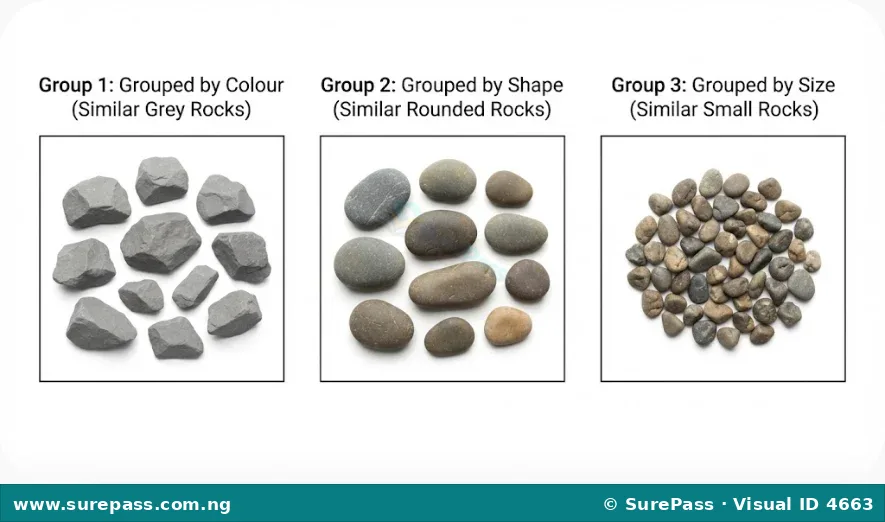
Rocks can be grouped based on their physical properties such as shape, colour, size, hardness, and lustre. This helps in identifying and understanding different rocks.
Grouping by Shape
Rocks can be found in many shapes. Some are round and smooth, especially those found in rivers or beaches, while others are jagged and irregular, like those broken from larger rocks.
Grouping by Colour
Rocks can be grouped by their dominant colour. For example, all red rocks can be put together, all grey rocks, and so on.
Grouping by Size
Rocks range from tiny pebbles to very large boulders. They can be grouped into small, medium, or large sizes.
Grouping by Hardness
Rocks can be tested for hardness by trying to scratch them with a fingernail, a coin, or a steel nail. Harder rocks will not scratch easily, while softer rocks will.
Grouping by Lustre
Rocks can be grouped by how shiny they are. Some rocks might be very shiny, others slightly shiny, and some completely dull.
Major Landmark Rocks in Nigeria
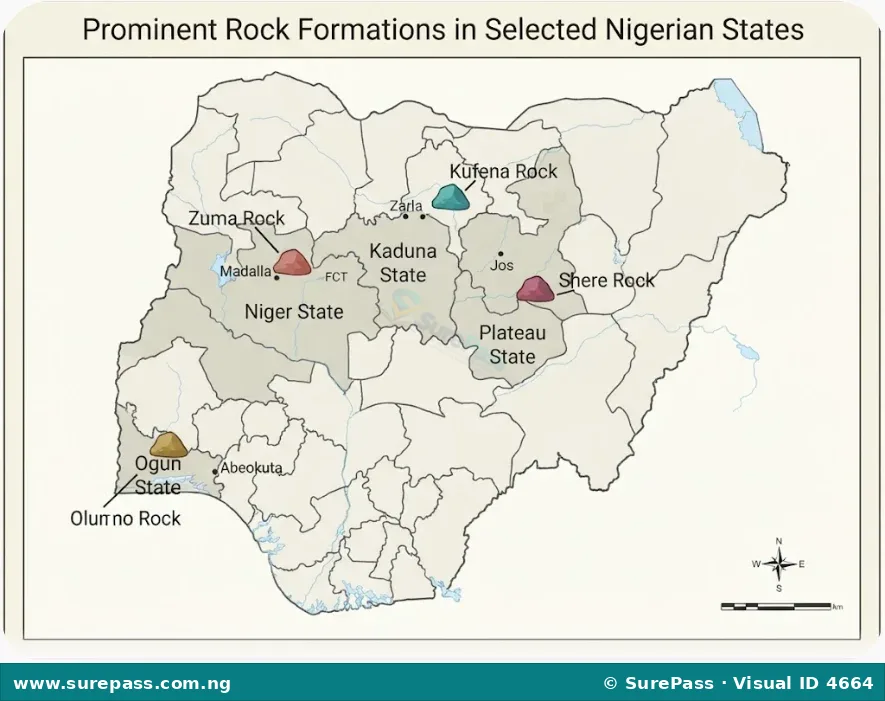
Nigeria is home to several famous and impressive rock formations that are important landmarks. These rocks are often tourist attractions and hold cultural significance.
- Zuma Rock: This is a large monolith, or isolated rock, located in Madalla, Niger State. It is often called the “Gateway to Abuja” and is depicted on the Nigerian 100 Naira banknote. It has a human-like face on one side.
- Shere Rock: Located in Jos, Plateau State, Shere Hills is a range of hills with several rock formations, including Shere Rock. The area is known for its beautiful scenery and cool climate.
- Olumo Rock: Found in Abeokuta, Ogun State, Olumo Rock is a massive granite rock that served as a natural fortress for the Egba people during inter-tribal wars. It is a popular tourist site with caves and ancient carvings.
- Kufena Rock: Situated in Zaria, Kaduna State, Kufena Rock is a prominent inselberg (isolated hill) that stands out in the landscape. It is known for its unique shape and historical significance in the region.
Uses and Importance of Rocks
Rocks are very useful to humans and play an important role in our daily lives and the environment.
- Building Materials: Rocks like granite, marble, and sandstone are cut and shaped to build houses, schools, bridges, and roads. They are strong and durable.
- Making Cement: Limestone, a type of sedimentary rock, is a key ingredient in making cement, which is used to bind building materials together.
- Road Construction: Crushed rocks are used as a base material for building roads, railway lines, and airport runways.
- Decoration: Beautiful rocks like marble and granite are polished and used for floor tiles, countertops, and decorative sculptures.
- Tools: In ancient times, rocks were used to make tools for hunting, farming, and cutting.
- Jewellery: Some rocks contain precious minerals and gemstones that are cut and polished to make jewellery.
- Soil Formation: Over long periods, rocks break down into smaller pieces, forming sand, silt, and clay, which are important components of soil for farming.
- Water Filtration: Layers of rocks and sand naturally filter water as it seeps through the ground, helping to clean it.
- Landmarks and Tourism: Large rock formations like Olumo Rock and Zuma Rock serve as important landmarks and attract tourists, boosting the economy.
Making Models of Different Types of Rocks
Making models of rocks helps to understand their different appearances and textures. You can use simple materials to create these models.
The required materials are:
- Modelling clay or playdough in different colours (e.g., grey, brown, white, black)
- Small pebbles or sand (optional, for texture)
- A flat surface or board
- Small tools like a plastic knife or toothpick (optional)
The procedure involves the following steps:
- For Igneous Rock (e.g., Granite): Take a piece of grey or white modelling clay. Mix in small bits of black or dark-coloured clay without fully blending them, to show the crystal-like specks. Roll it into a rough, solid shape.
- For Metamorphic Rock (e.g., Slate or Marble): Take two different colours of clay (e.g., dark grey and light grey for slate, or white and a hint of another colour for marble). Flatten them into thin layers and press them together. Then, gently fold or twist them slightly to show the banding or changed texture.
- For Sedimentary Rock (e.g., Sandstone): Take a piece of brown or reddish-brown clay. Flatten it into a layer. You can press some sand or tiny pebbles onto the surface or into the clay to represent sediments. Create another layer of a slightly different colour and press it on top to show stratification.
- Allow the models to dry if using air-dry clay.
- Observe the different textures and appearances of your rock models.
Preparing an Album of Different Types of Rocks
An album of rocks is a collection of pictures or actual small rock samples, organised to help you learn about them.
The required materials are:
- An exercise book or a small notebook
- Pictures of different types of rocks (from old magazines, newspapers, or printed from the internet)
- Glue or tape
- Coloured pencils or markers
- Small, safe rock samples (if collecting real rocks)
The procedure involves the following steps:
- Collect pictures of igneous, metamorphic, and sedimentary rocks. You can also collect small, safe rock samples from your environment.
- Open your notebook to a new page for each rock type.
- On the first page, write “Igneous Rocks” as the heading. Glue or tape pictures of igneous rocks onto this page. If you have a small sample, you can tape it securely or draw a picture of it.
- Next, write “Metamorphic Rocks” on another page and add pictures or samples of metamorphic rocks.
- Finally, create a page for “Sedimentary Rocks” and add relevant pictures or samples.
- For each rock, write down its name (if known) and a few of its physical characteristics, such as its colour, how hard it feels, or if it is shiny or dull.
- You can also add notes about where the rock is found or what it is used for.
- Keep your rock album neat and organised. It will be a useful tool for identifying and learning about rocks.


0 comments
Open the discussion when you need it. Comments stay collapsed until requested so the initial article remains light.