


ARTICLE CONTENTSOn this page 9 sections
Production and Service Delivery
Performance Objectives
By the end of the lesson, students should be able to:
- explain the meaning and types of production;
- state the effects of production on environment and society;
- discuss the factors of production;
- explain knowledge and service economy;
- identify opportunities in knowledge and service economy;
- discuss the roles and impacts of robots in production.
Meaning of Production
Production is the process of creating goods and services to satisfy human wants.
It involves taking raw materials or ideas and transforming them into something useful that people need or desire. For example, a farmer grows crops, a tailor sews clothes, and a teacher provides education. All these activities are forms of production.
Types of Production
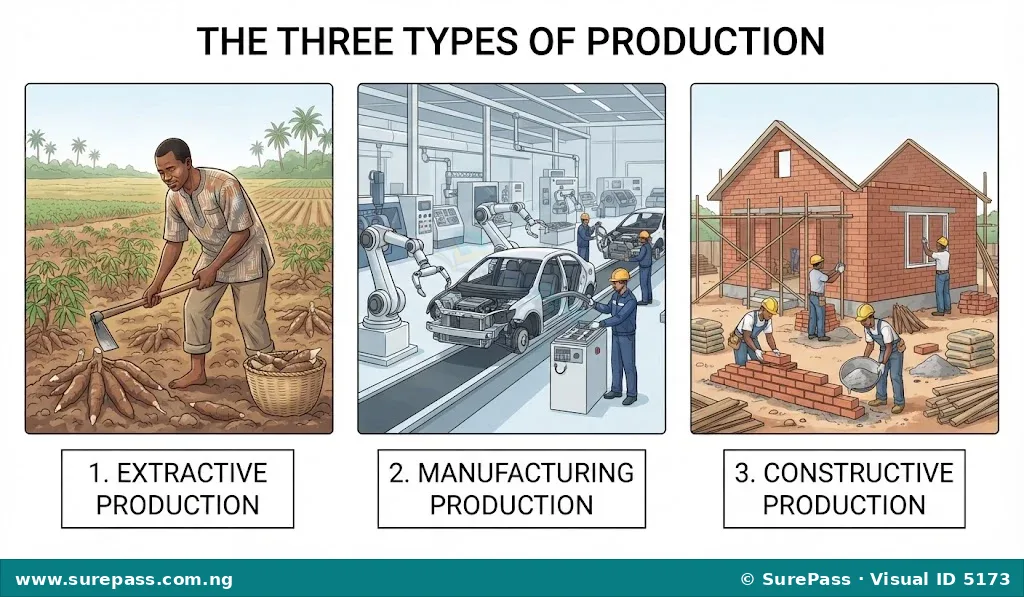
Production can be grouped into different types based on the nature of the activity involved. The main types of production are extractive, manufacturing, and constructive.
Extractive Production
Extractive production involves taking raw materials directly from nature.
These raw materials are then used in other forms of production or consumed directly. Examples of extractive production include farming, fishing, mining, and logging.
- Farming: Growing crops like maize, yam, or cassava, and raising animals like chickens or goats.
- Fishing: Catching fish from rivers, lakes, or the sea.
- Mining: Extracting minerals such as crude oil, coal, or tin from the ground.
- Logging: Cutting down trees for timber.
Manufacturing Production
Manufacturing production involves changing raw materials into finished goods or semi-finished goods.
This type of production often uses machines and factories to transform materials. Examples of manufacturing production include making bread from flour, weaving fabric from cotton, and assembling cars from various parts.
- Baking: Turning flour, water, and yeast into bread.
- Textile production: Converting cotton into cloth.
- Car assembly: Putting together different parts to make a complete car.
- Food processing: Turning fruits into juice or vegetables into canned foods.
Constructive Production
Constructive production involves combining different materials to build structures or infrastructure.
This type of production focuses on creating fixed assets that are usually large and long-lasting. Examples of constructive production include building houses, roads, bridges, and dams.
- Building houses: Using cement, blocks, wood, and iron sheets to construct homes.
- Road construction: Laying asphalt and other materials to create roads.
- Bridge building: Erecting structures over rivers or valleys.
- Dam construction: Building barriers to hold back water.
Effects of Production on the Environment and Society
Production activities have various effects on both the environment and society. These effects can be positive or negative.
Positive Effects of Production
Production brings many benefits to people and communities.
- Creation of Goods and Services: Production provides the goods and services that people need for daily living, such as food, clothes, shelter, and education.
- Job Creation: Production activities create employment opportunities for many people, helping them earn income and improve their standard of living.
- Economic Growth: Increased production leads to more wealth for a country, which can be used to develop infrastructure like roads, hospitals, and schools.
- Improved Standard of Living: When goods and services are readily available and people have jobs, their quality of life generally improves.
Negative Effects of Production
Sometimes, production can also cause harm to the environment and society.
- Environmental Pollution: Factories can release harmful smoke into the air (air pollution) or waste into rivers (water pollution). Mining can damage land and water sources.
- Deforestation: Logging for timber or clearing land for farming can lead to the destruction of forests, which affects wildlife and contributes to climate change.
- Noise Pollution: Heavy machinery used in manufacturing or construction can create loud noises that disturb communities.
- Waste Generation: Production processes often create a lot of waste materials that need to be managed properly to avoid harming the environment.
- Health Issues: Pollution from production can lead to respiratory problems and other health issues for people living nearby.
Factors of Production
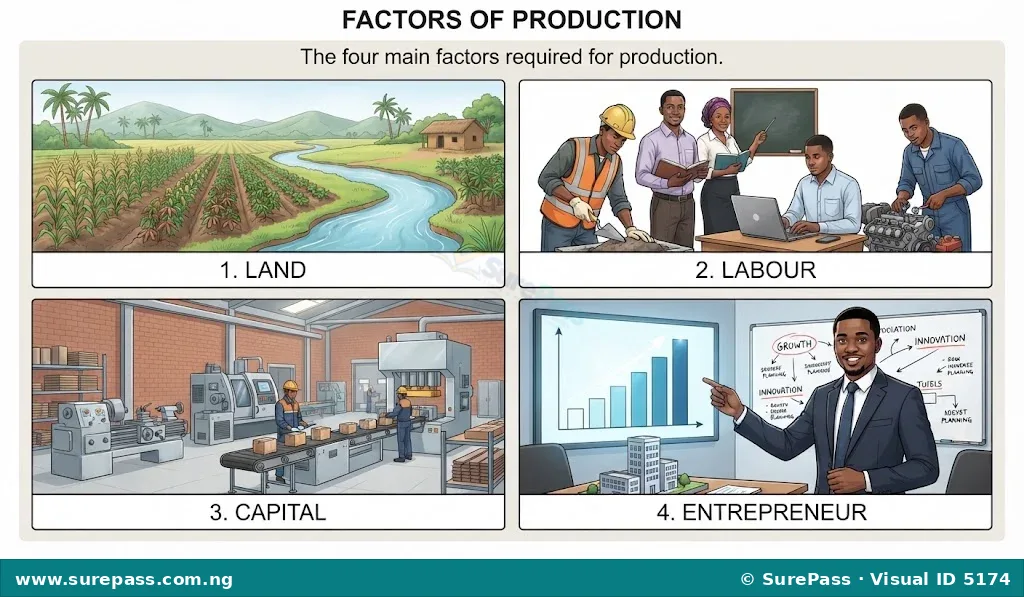
Factors of production are the resources used to produce goods and services.
These resources are essential for any production activity to take place. They are often grouped into four main categories: land, labour, capital, and entrepreneurship.
Land
Land refers to all natural resources provided by nature that are used in production.
This includes not just the physical ground, but also everything found on or under it, such as forests, rivers, minerals, and fertile soil. For example, a farmer needs land to grow crops, and a factory needs land to build its premises.
Labour
Labour refers to the human effort, both physical and mental, used in the production process.
This includes the work done by farmers, factory workers, teachers, doctors, and engineers. The skills, knowledge, and effort of people are crucial for transforming resources into goods and services.
Capital
Capital refers to all man-made resources used in the production of other goods and services.
This includes tools, machinery, buildings, vehicles, and equipment. For example, a farmer uses a hoe or a tractor (capital), a tailor uses a sewing machine (capital), and a factory uses its building and machines (capital).
Entrepreneur
An entrepreneur is a person who organises and combines the other factors of production (land, labour, and capital) to produce goods and services, taking on the risks involved.
The entrepreneur is the innovator and risk-taker who starts and manages a business. They decide what to produce, how to produce it, and how to bring it to the market. For example, the person who starts a bakery, a transport company, or a school is an entrepreneur.
Knowledge and Service Economy
The economy of a country can be influenced by different types of activities. Two important types are the knowledge economy and the service economy.
Meaning of Knowledge Economy
A knowledge economy is an economic system where the production of goods and services is based mainly on knowledge, information, and intellectual capital.
In this type of economy, education, research, innovation, and technology are very important. People who have special skills and knowledge are highly valued. Examples of activities in a knowledge economy include software development, scientific research, and advanced education.
Meaning of Service Economy
A service economy is an economic system where the majority of economic activity involves providing services rather than producing physical goods.
Services are intangible, meaning they cannot be touched or stored. In a service economy, sectors like healthcare, education, banking, tourism, and transportation play a major role. For example, when a person visits a doctor, travels by bus, or gets their hair cut, they are consuming a service.
Opportunities in Knowledge and Service Economy
The knowledge and service economies offer many job and business opportunities.
- Education and Training: Teachers, lecturers, trainers, and educational consultants are needed to create and share knowledge.
- Information Technology (IT): Software developers, web designers, data analysts, and cybersecurity experts are in high demand.
- Healthcare: Doctors, nurses, pharmacists, and medical researchers provide essential services.
- Financial Services: Bankers, accountants, financial advisors, and insurance agents help manage money.
- Tourism and Hospitality: Tour guides, hotel managers, chefs, and travel agents cater to visitors.
- Consulting: Experts who provide advice to businesses and individuals in various fields.
- Creative Industries: Artists, musicians, writers, and designers create intellectual property and services.
Differences Between Production of Goods and Services
Production can result in either goods or services, and there are key differences between them.
Goods
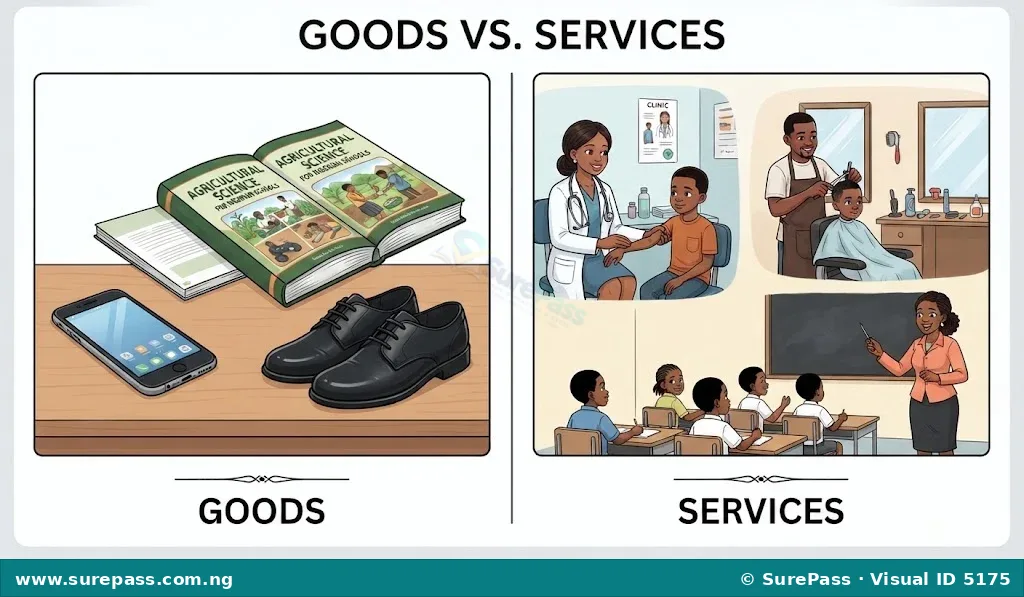
Goods are physical, tangible items that can be seen, touched, and stored.
When a person buys a good, they own it. Examples of goods include food, clothes, cars, books, and mobile phones.
Services
Services are intangible activities or benefits that are provided by one person or group to another.
Services cannot be seen, touched, or stored. When a person pays for a service, they experience it, but they do not own a physical item. Examples of services include a haircut, a bus ride, a doctor’s consultation, or a lesson from a teacher.
Key Differences
- Tangibility: Goods are tangible (can be touched), while services are intangible (cannot be touched).
- Storage: Goods can be stored for later use, but services cannot be stored. A haircut cannot be stored; it is performed at a specific time.
- Ownership: When a good is bought, the buyer becomes its owner. When a service is received, the receiver does not own it; they only experience its benefit.
- Production and Consumption: Goods are often produced first and then consumed later. Services are usually produced and consumed at the same time. For example, a teacher delivers a lesson (production) while students are learning (consumption).
Roles and Impact of Technology in Production
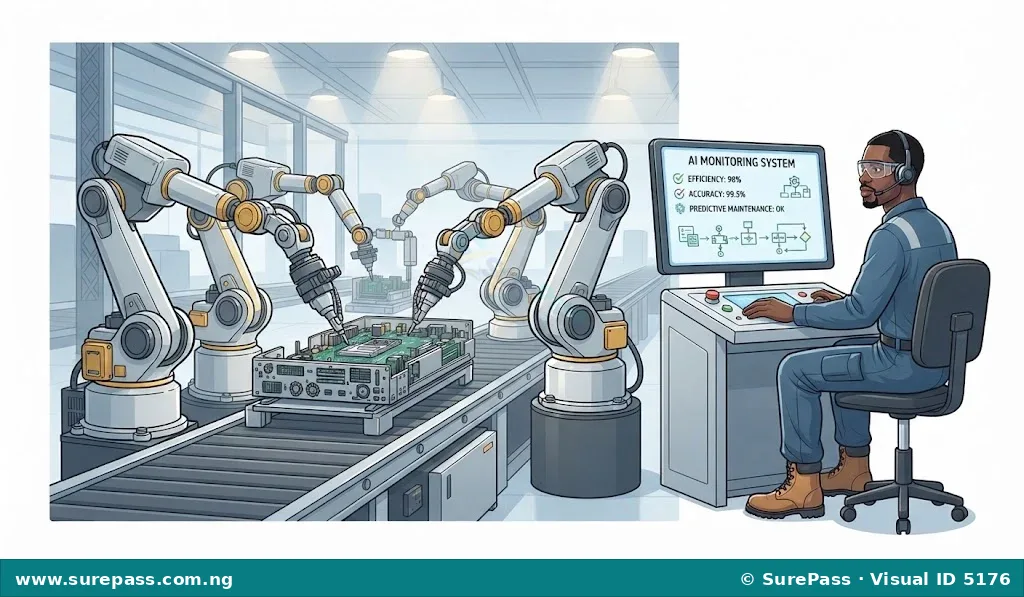
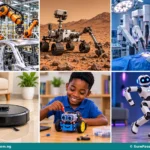
Modern technology, including robots and Artificial Intelligence (AI), is changing how goods and services are produced.
What are Robots?
A robot is a machine designed to carry out tasks automatically or with minimal human control.
Robots are often used in factories to perform repetitive or dangerous jobs. They can be programmed to do specific actions with high precision.
What is Artificial Intelligence (AI)?
Artificial Intelligence (AI) is the ability of a computer system to perform tasks that normally require human intelligence, such as learning, problem-solving, and decision-making.
AI allows machines to “think” and “learn” from data, making them smarter and more capable of complex tasks.
Impact of Robots and AI in Production
Robots and AI have a significant impact on the production sector:
- Increased Efficiency and Speed: Robots can work continuously without getting tired, performing tasks much faster and more consistently than humans. AI can optimise production schedules and processes.
- Improved Accuracy and Quality: Robots can perform tasks with very high precision, reducing errors and improving the quality of products. AI can monitor quality control and identify defects quickly.
- Enhanced Safety: Robots can handle dangerous tasks, such as working with heavy machinery, toxic materials, or in extreme temperatures, protecting human workers from harm.
- Cost Reduction: While the initial investment can be high, robots and AI can reduce long-term labour costs and waste, leading to more affordable products.
- New Job Opportunities: The use of robots and AI creates new jobs in areas like robot programming, maintenance, and AI system development.
- Customisation: AI-powered systems can help produce customised goods more easily, meeting individual customer preferences.



0 comments
Open the discussion when you need it. Comments stay collapsed until requested so the initial article remains light.