



ARTICLE CONTENTSOn this page 8 sections
Digital Technologies in Business
Performance Objectives
By the end of the lesson, students should be able to:
- state the meaning and importance of digital technology in Business;
- identify basic digital tools in business operations;
- discuss the concept of responsible digital citizenship;
- use digital technology in business practices.
Meaning of Digital Technology
Digital technology refers to electronic tools, systems, devices, and resources that generate, store, or process data. These technologies use numbers (digits) to represent information, making it easy to share and use.
Examples of digital technology include computers, smartphones, and the internet. These tools have changed how people live, work, and communicate.
Importance of Digital Technologies in Business Operations
Digital technologies are very important for businesses today. They help businesses to operate more smoothly, reach more customers, and manage their work better.
The importance of digital technologies in business operations includes:
- Faster Communication: Businesses can communicate quickly with customers, suppliers, and employees through email, messaging apps, and video calls. This helps in making decisions faster and solving problems quickly.
- Wider Reach: Digital tools like the internet allow businesses to advertise their products and services to many people, even those in different towns or countries. This helps businesses to find more customers.
- Better Organisation: Digital technologies help businesses keep records, manage appointments, and track sales easily. This makes it simpler to find information and ensures that tasks are completed on time.
- Increased Efficiency: Many tasks that used to take a long time can now be done quickly with digital tools. For example, preparing reports or sending invoices can be done with a few clicks.
- Improved Customer Service: Businesses can use digital tools to respond to customer questions quickly, gather feedback, and offer support. This helps to keep customers happy and loyal.
- Cost Saving: In some cases, digital technologies can help businesses save money. For instance, sending emails is cheaper than sending letters by post, and online meetings can reduce travel costs.
Basic Digital Tools and Applications in Business Organisations
Businesses use many different digital tools and applications to carry out their daily operations. These tools help them to perform various tasks more effectively.
Some basic digital tools and applications used in business organisations include:
Computers and Smartphones
Computers are electronic devices that can store, process, and retrieve information. Smartphones are mobile phones that offer advanced computing capabilities.
In business, computers are used for tasks like typing documents, creating presentations, managing accounts, and designing products. Smartphones allow business owners and employees to work from anywhere, check emails, make calls, and access business applications on the go.
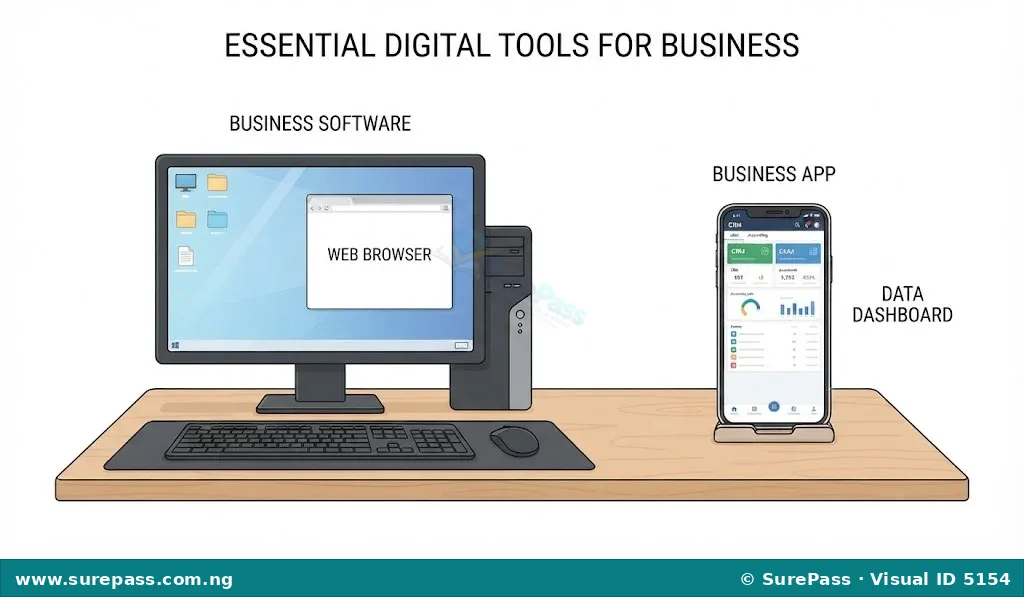
Computers and smartphones are essential digital tools for businesses. Internet and Web Browsers
The internet is a global network that connects computer systems worldwide, allowing for the exchange of information. A web browser is a software application used to access and view websites on the internet.
Businesses use the internet to research information, market their products, communicate with customers, and conduct online transactions. Web browsers like Google Chrome, Mozilla Firefox, and Microsoft Edge are used to access business websites, online banking, and other web-based services.
Email Tools and Services
Email (electronic mail) is a method of exchanging digital messages over the internet. Email tools and services are platforms that allow users to send and receive emails.
Businesses use email for formal communication with customers, suppliers, and partners. It is used to send invoices, proposals, updates, and important announcements. Popular email services include Gmail, Outlook, and Yahoo Mail.
Messaging Apps
Messaging apps are software applications that allow users to send text messages, voice messages, images, and videos over the internet.
Businesses use messaging apps like WhatsApp, Telegram, and Signal for quick and informal communication among employees, or to provide customer support. They are useful for sharing quick updates and coordinating tasks.
Video Conferencing Apps
Video conferencing apps allow people in different locations to hold meetings and communicate face-to-face using video and audio over the internet.
Businesses use video conferencing apps such as Zoom, Google Meet, and Microsoft Teams for online meetings with remote employees, clients, or partners. This saves time and money on travel.
Digital Technologies for Work Management
These are tools designed to help businesses organise tasks, collaborate on projects, and store information efficiently.
- Google Workspace (formerly G Suite): This includes tools like Google Docs (for word processing), Google Sheets (for spreadsheets), Google Slides (for presentations), and Google Drive (for cloud storage). Businesses use these for creating documents, managing data, and collaborating on projects in real-time.
- Microsoft Office Tools: Similar to Google Workspace, this suite includes Microsoft Word, Excel, PowerPoint, and Outlook. These are widely used for creating professional documents, managing data, and email communication.
- Cloud Storage Services: These services allow businesses to store their files and data online, rather than only on physical devices. Examples include Google Drive, Dropbox, and OneDrive. Cloud storage makes it easy to access files from any device with internet access and to share them with others.
- Google Analytics: This is a web analytics service that tracks and reports website traffic. Businesses use it to understand how visitors interact with their websites, which helps them improve their online presence and marketing strategies.
Artificial Intelligence (AI) and Robotics
Artificial intelligence (AI) refers to computer systems that can perform tasks that normally require human intelligence, such as learning, problem-solving, and understanding language. Robotics involves the design, construction, operation, and use of robots.
In business, AI can be used in simple ways like chatbots that answer customer questions automatically, or in recommending products to customers based on their past purchases. Robots can be used in factories for tasks like assembling products or moving heavy items, making work faster and safer.
Selecting Appropriate Digital Technology for Business Operations
Choosing the right digital technology depends on the specific task a business needs to perform. Different tools are best suited for different operations.
Consider the following when selecting digital technology:
- For Communication: If a business needs to send formal documents, email is appropriate. For quick chats among team members, messaging apps are better. For meetings with people in different locations, video conferencing apps are ideal.
- For Document Creation and Data Management: For writing reports or creating presentations, word processors (like Google Docs or Microsoft Word) and presentation software (like Google Slides or Microsoft PowerPoint) are used. For managing numbers and calculations, spreadsheet software (like Google Sheets or Microsoft Excel) is best.
- For Storing and Sharing Files: Cloud storage services are chosen when files need to be accessed from multiple devices or shared easily with others.
- For Understanding Website Performance: Google Analytics is selected to see how many people visit a business’s website and what they do there.
- For Repetitive Tasks or Customer Support: AI-powered chatbots can be used to answer common customer questions, while robots might be used in manufacturing for repetitive physical tasks.
Responsible Digital Citizenship
Responsible digital citizenship means using digital technologies in a safe, ethical, and respectful way. For businesses, this is very important because it affects their reputation and trust with customers.
Key aspects of responsible digital citizenship in business include:
- Protecting Information: Businesses must keep customer data and their own sensitive information safe from hackers. This involves using strong passwords and secure systems.
- Respecting Privacy: Businesses should only collect and use customer information with permission and explain how that information will be used.
- Being Honest Online: Businesses should always provide accurate information about their products and services online. They should avoid misleading advertisements or false claims.
- Respecting Copyright: Businesses must not use images, music, or text from the internet without permission or proper credit, as these are often protected by copyright.
- Positive Online Behaviour: Businesses should maintain a professional and respectful tone in all their online interactions, whether on social media or in emails.
- Avoiding Cyberbullying and Harassment: Businesses and their employees should never use digital platforms to bully, harass, or spread negative information about others.
- Using Technology for Good: Businesses can use digital technology to support their communities, promote good causes, and operate in an environmentally friendly way.
Using Digital Technology to Enhance Operational Efficiency
Operational efficiency means doing business tasks in the best possible way, using the least amount of time, effort, and resources. Digital technologies help businesses achieve this by automating tasks, improving communication, and providing better tools for management.
For example, a small business that sells handmade crafts can use digital technology to enhance its efficiency:
- Creating Product Listings: Instead of writing out product descriptions by hand, the business can use a computer and word processing software (like Google Docs or Microsoft Word) to type, edit, and save descriptions quickly. This ensures consistency and saves time.
- Managing Orders: When a customer places an order, the business can use a spreadsheet application (like Google Sheets or Microsoft Excel) to record the customer’s name, product ordered, price, and delivery address. This helps to track orders and manage inventory.
- Communicating with Customers: If a customer has a question, the business can use email or a messaging app to respond quickly. This provides fast customer service and builds trust.
- Marketing Products: The business can use the internet to create a simple website or social media page to display pictures of their crafts and reach many potential customers without needing a physical shop.
- Online Meetings: If the business owner needs to discuss new craft ideas with a supplier who lives far away, they can use a video conferencing app to have a meeting without travelling.
These examples show how digital tools make business operations smoother, faster, and more organised, leading to greater efficiency.





0 comments
Open the discussion when you need it. Comments stay collapsed until requested so the initial article remains light.