



ARTICLE CONTENTSOn this page 9 sections
Double Entry Book-keeping
Performance Objectives
By the end of the lesson, students should be able to:
- state the meaning of double entry book-keeping;
- identify types of accounts used in double-entry book-keeping;
- differentiate between single and double entry accounting;
- state the advantages of double entry accounting;
- state the basic principle of double entry accounting;
- prepare a double entry account following outlined steps.
Meaning of Double Entry Book-keeping
Double entry book-keeping is an accounting system where every financial transaction is recorded in at least two different accounts.
This system ensures that for every financial event, there is a two-sided effect. One side is recorded as a debit entry, and the other as a credit entry, with both entries having an equal amount. This method forms the foundation of modern accounting and helps businesses maintain accurate and complete records of their financial activities.
Types of Accounts Used in Double Entry Book-keeping
In double entry book-keeping, financial transactions are organised and recorded into different categories called accounts. These accounts help to summarise financial information clearly. The main types of accounts are:
- Assets Account:
An asset is something of value owned by a business or person.
Assets are resources that a business uses to operate and generate future economic benefits. They represent what the business possesses.
Examples of assets include:
- Cash (money held in hand or in a bank account)
- Buildings (such as a shop, office, or factory)
- Vehicles (like cars, vans, or motorcycles used for business)
- Furniture (tables, chairs, and cabinets in the office)
- Goods for sale (also known as stock or inventory)
- Liabilities Account:
A liability is an amount owed by a business to another person or business.
Liabilities represent debts or obligations that the business must pay in the future. They are what the business owes to others.
Examples of liabilities include:
- Loans obtained from a bank or other financial institutions
- Money owed to suppliers for goods or services bought on credit
- Salaries that are due to workers but have not yet been paid
- Expenses Account:
An expense is the cost of operations that a business incurs to generate revenue.
Expenses are the costs of running the business. They reduce the profit of a business because they represent money spent to earn income.
Examples of expenses include:
- Rent paid for using a shop or office space
- Salaries and wages paid to employees
- Electricity bills for power consumption
- Telephone and internet bills
- Cost of fuel for business vehicles
- Equity Account:
Equity represents the owner’s claim on the assets of the business after all liabilities have been paid.
It is also known as owner’s capital or owner’s equity. It shows the amount of money or value the owner has invested in the business, plus any profits retained in the business.
Examples of equity include:
- Money or assets the owner initially invested to start the business
- Profits earned by the business that are kept within the business for future growth
Differences Between Single and Double Entry Accounting
Accounting systems can be categorised based on how transactions are recorded. The two main types are single entry and double entry accounting.
Single entry accounting is a simpler method where each financial transaction is recorded only once. This system typically tracks cash inflows (money coming in) and cash outflows (money going out), similar to a personal chequebook or a simple cash book. It provides a basic record of money movements but does not give a complete financial picture.
Double entry accounting, in contrast, records every financial transaction in at least two accounts. Each transaction results in an equal debit and credit entry, ensuring that the accounting equation remains balanced. This method provides a comprehensive and accurate view of a business’s financial position.
The main differences between single entry and double entry accounting are:
- Number of Entries: In single entry accounting, each transaction has only one entry, usually affecting only cash. In double entry accounting, each transaction has at least two entries: one debit and one credit.
- Completeness of Records: Single entry accounting provides an incomplete record, mainly focusing on cash movements. Double entry accounting offers a full and complete picture of all assets, liabilities, expenses, and owner’s equity.
- Accuracy and Error Detection: Single entry accounting offers limited checks for accuracy, making it harder to detect errors. Double entry accounting has a built-in self-checking mechanism; if total debits do not equal total credits, an error is indicated, making it more accurate.
- Financial Statement Preparation: It is difficult to prepare comprehensive financial statements, such as an income statement or a balance sheet, using single entry accounting. Double entry accounting makes it easy and reliable to prepare these important financial reports.
Advantages of Double Entry Accounting
Double entry accounting is widely used by businesses because it offers significant benefits for managing financial records. These advantages make it a superior method for book-keeping:
- Accuracy: The system provides a high level of accuracy. Since every transaction requires two entries (a debit and a credit of equal value), it creates a self-balancing system. This built-in check helps to ensure that all records are correct.
- Completeness: It provides a complete record of all financial transactions. This means a business can track not only its cash but also everything it owns (assets), everything it owes (liabilities), and the owner’s investment (equity), giving a full financial overview.
- Error Detection: Double entry accounting makes it easier to find mistakes. If a transaction is recorded incorrectly, or if an amount is missed, the total debits will not match the total credits. This imbalance immediately alerts the book-keeper to an error, allowing for quick correction.
- Financial Reporting: The system allows businesses to prepare important financial reports easily. These reports include the income statement (which shows profit or loss over a period) and the balance sheet (which shows the financial position at a specific point in time). These reports are vital for understanding business performance.
- Better Decision Making: With complete, accurate, and well-organised financial information, business owners and managers can make more informed and effective decisions. This includes decisions about investments, spending, pricing, and future business plans.
Basic Principle of Double Entry Accounting
The fundamental principle of double entry accounting is that every financial transaction has two effects on a business’s accounts.
One account receives a benefit or value, and another account gives up a benefit or value. This principle ensures that the accounting equation (Assets = Liabilities + Equity) always remains balanced.
This concept is often summarised by the rule: “For every debit, there is an equal and opposite credit.”
A debit is an entry recorded on the left side of an account. A credit is an entry recorded on the right side of an account. In the double entry system, the total value of all debit entries must always be equal to the total value of all credit entries across all accounts.
For example, if a business buys furniture for ₦20,000 cash, two accounts are affected: the Furniture Account (an asset) and the Cash Account (also an asset). The Furniture Account receives value, so it will be debited with ₦20,000. The Cash Account gives up value, so it will be credited with ₦20,000. This shows the two-sided effect of the transaction.
Steps in Recording Transactions in Double Entry Accounting
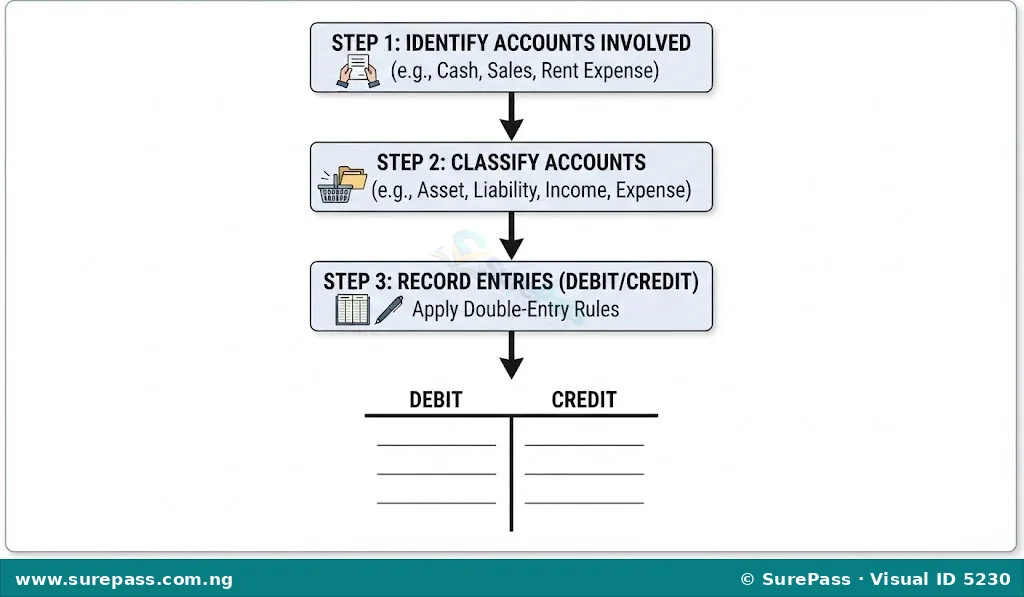
Recording financial transactions using the double entry system follows a structured process to ensure accuracy and completeness. The steps are:
- Identify Accounts Involved: For every financial transaction, the first step is to determine which specific accounts are affected. Remember that at least two accounts will always be involved in any transaction.
- Classify Accounts: After identifying the accounts, classify each one into its type: Asset, Liability, Expense, or Equity. This classification helps in understanding how the transaction affects each account and whether it will be a debit or a credit.
- Record Entries: Finally, record the transaction in the appropriate accounts. For every debit entry made in one account, there must be an equal credit entry made in another account.
How to Prepare a Double Entry Account Manually
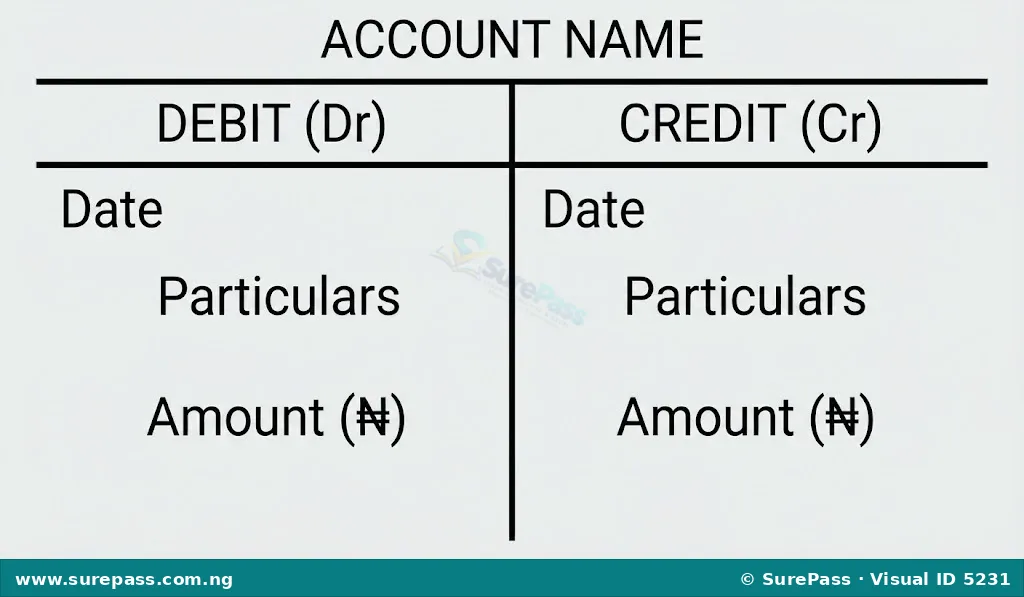
To manually prepare an account in the double entry system, book-keepers use a simple format known as a “T” account. This format is called a “T” account because its shape resembles the letter ‘T’. It clearly separates the debit and credit sides of an account.
The procedure involves the following steps:
- Draw the “T” Account: Draw a large ‘T’ shape on a sheet of paper. Write the name of the specific account (e.g., Cash Account, Capital Account) clearly at the top, centred above the horizontal line of the ‘T’.
- Label the Sides: Label the left side of the ‘T’ as “Debit” (often abbreviated as Dr) and the right side as “Credit” (often abbreviated as Cr).
- Record Debits: When an account needs to be debited, write the date of the transaction, a brief description of what happened (particulars), and the amount of money on the left (Debit) side of the “T” account.
- Record Credits: When an account needs to be credited, write the date, a brief description of the transaction (particulars), and the amount of money on the right (Credit) side of the “T” account.
- Ensure Balance: Always remember the basic principle: for every debit entry made in one account, there must be an equal credit entry made in another account. This ensures the system remains balanced.
Worked Example:
Imagine a business owner, Mr. Emeka, starts a business by investing ₦50,000 cash on January 1, 2024.
Step 1: Identify Accounts Involved
- Cash Account (This is an Asset because the business now owns cash.)
- Capital Account (This is an Equity account, representing the owner’s investment in the business.)
Step 2: Classify Transactions
- The Cash Account is increasing because the business received cash. An increase in an asset is recorded as a debit.
- The Capital Account is increasing because the owner’s investment in the business has grown. An increase in equity is recorded as a credit.
Step 3: Record Entries
The entries would be recorded in the “T” accounts as follows:
Cash Account
Debit (Dr)                                    Credit (Cr)
-------------------------------------------------------------------
Date       Particulars      Amount (₦) | Date       Particulars      Amount (₦)
Jan 1      Capital          50,000     |
Capital Account
Debit (Dr)                                    Credit (Cr)
-------------------------------------------------------------------
Date       Particulars      Amount (₦) | Date       Particulars      Amount (₦)
                                       | Jan 1      Cash             50,000
In this example, the Cash Account is debited with ₦50,000, and the Capital Account is credited with ₦50,000. This clearly shows the double effect of the single transaction, with an equal debit and credit amount.
Double Entry Accounting Software
Double entry accounting software is a computer program designed to help businesses record and manage their financial transactions using the double entry system.
This software automates many of the steps involved in book-keeping. Instead of manually drawing “T” accounts and writing entries, users input transaction details, and the software automatically debits and credits the correct accounts, making the process faster and more efficient.
Using accounting software offers several benefits to businesses:
- Speed: Transactions are recorded much faster compared to manual book-keeping methods, saving valuable time.
- Accuracy: The software significantly reduces the chances of human errors in calculations and in posting entries to the wrong accounts.
- Efficiency: It streamlines the entire accounting process, saving time and effort for businesses, allowing them to focus on other important operational tasks.
- Reporting: Accounting software can quickly generate various financial reports, such as income statements and balance sheets, at any time, providing instant insights into the business’s financial health.
While accounting software handles the technical recording, understanding the basic principles of double entry book-keeping is still very important for anyone using it. This knowledge ensures that transactions are entered correctly and that the financial reports generated are accurate and reliable.




0 comments
Open the discussion when you need it. Comments stay collapsed until requested so the initial article remains light.