


ARTICLE CONTENTSOn this page 4 sections
Forms, Advantages and Disadvantages of Business Organisations for JSS 1
Performance Objectives
By the end of the lesson, students should be able to:
- identify the forms of business organisation;
- explain the features of each form of business organisation;
- enumerate the advantages and disadvantages of each form of business.
What is a Business Organisation?
A business organisation is the way a business is structured and owned. It describes how a business is set up, who owns it, and how it is managed. Different businesses choose different structures based on factors such as the number of owners, the amount of money available, and the level of risk they are willing to take.
Understanding the different forms of business organisations helps people decide the best way to start and operate a business. It also helps them understand how various businesses in their community are structured.
Forms of Business Organisations
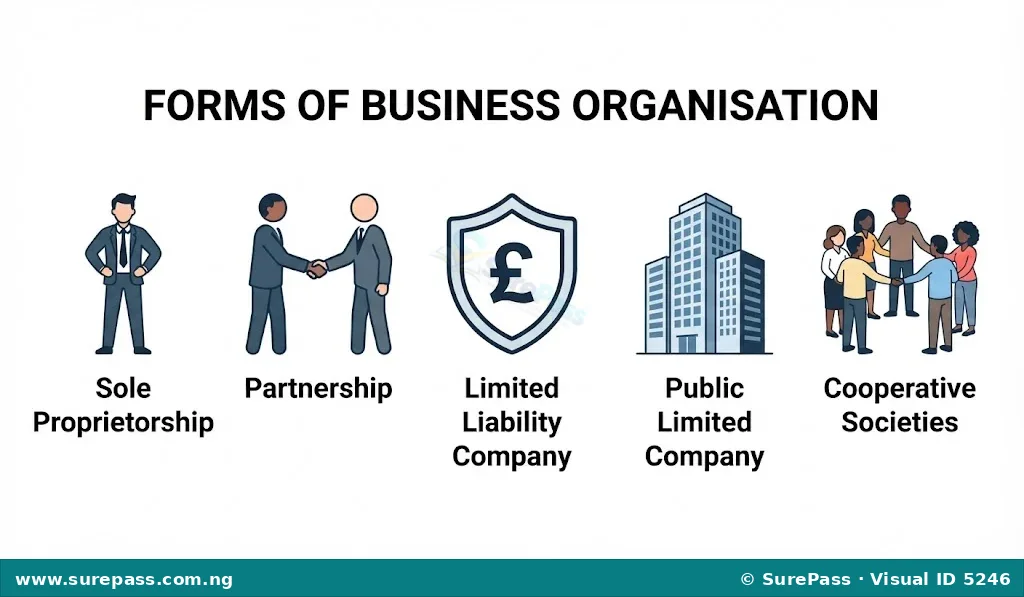
Businesses can be organised in several common ways. Each form has its own unique characteristics, benefits, and drawbacks. The main forms of business organisations that learners should know include:
- Sole Proprietorship
- Partnership
- Limited Liability Company (LLC)
- Public Limited Company (PLC)
- Cooperative Societies
1. Sole Proprietorship
A sole proprietorship is a business that is owned and managed by only one person. This single owner provides all the money (capital) needed to start and run the business. The owner also takes all the profits and is responsible for all the risks and losses.
Features of a Sole Proprietorship
The characteristics of a sole proprietorship include:
- It is owned by a single individual.
- The owner provides all the capital (money) for the business.
- The owner makes all the decisions without needing to consult anyone else.
- The owner takes all the profits and also bears all the losses.
- The business is not seen as a separate legal entity from the owner. This means the owner’s personal belongings, like a house or car, can be used to pay business debts if the business fails. This is called unlimited liability.
- It is generally easy to set up and close down.
Advantages of a Sole Proprietorship
The benefits of operating a business as a sole proprietorship are:
- Easy to Start: It requires few legal steps and can be started quickly with minimal paperwork.
- Owner Keeps All Profits: The single owner enjoys all the money earned by the business after expenses.
- Quick Decision-Making: The owner can make decisions very fast because there is no need to consult other people.
- Direct Control: The owner has full control over every part of the business operations.
- Personal Touch: The owner can build strong, personal relationships with customers, which can help the business grow.
Disadvantages of a Sole Proprietorship
The drawbacks of a sole proprietorship are:
- Unlimited Liability: The owner is personally responsible for all the debts of the business. If the business cannot pay its debts, the owner’s personal assets can be sold to settle them.
- Limited Capital: The amount of money that can be invested in the business is usually limited to what one person can provide or borrow.
- Limited Skills and Expertise: One person may not have all the necessary skills and knowledge to manage every aspect of the business effectively.
- Lack of Continuity: The business may stop operating if the owner becomes sick, retires, or dies.
- Heavy Workload: The owner often has to handle all the tasks, which can lead to long working hours and stress.
Examples of Sole Proprietorships in Nigeria
Common examples of sole proprietorships in Nigeria include:
- A small roadside shop or kiosk.
- A local tailor or seamstress who works alone.
- A single barber or hairdresser.
- A freelance photographer.
- A small farm owned and managed by one person.
- A shoe repairer.
- A roadside food vendor.
2. Partnership
A partnership is a business owned by two or more people, who are called partners. These partners agree to share the profits or losses of a business. The business is carried on by all the partners together, or by one or more of them acting on behalf of all. Partnerships are usually formed through an agreement, which can be written or spoken.
Features of a Partnership
The characteristics of a partnership include:
- It is owned by two or more partners, usually between 2 and 20 people.
- Partners contribute capital (money), skills, and effort to the business.
- Profits and losses are shared among the partners according to the terms of their agreement.
- For general partners, the business is not a separate legal entity from the owners, meaning they have unlimited liability for business debts.
- Decisions are typically made jointly by all the partners.
Advantages of a Partnership
The benefits of a partnership business are:
- More Capital: Partners can combine their money, which allows for more capital to be invested than in a sole proprietorship.
- Shared Workload: Responsibilities and tasks can be divided among the partners, reducing the amount of work each person has to do.
- Combined Skills and Expertise: Partners bring different skills, knowledge, and experience to the business, leading to better management.
- Easy to Start: It is relatively easy to form, often requiring a simple agreement among the partners.
- Better Decision-Making: Decisions can benefit from different ideas and perspectives from multiple partners, leading to more informed choices.
Disadvantages of a Partnership
The drawbacks of a partnership business are:
- Unlimited Liability: General partners are personally responsible for all business debts. Their personal assets can be used to pay off the business’s debts.
- Potential for Disagreements: Partners may have different opinions or ideas, which can lead to conflicts and disputes.
- Slow Decision-Making: Decisions may take longer because all partners need to agree, especially on important matters.
- Lack of Continuity: The partnership can end if a partner leaves, dies, or retires, unless there is a specific agreement to continue.
- Shared Profits: Profits must be shared among all partners, which means each partner gets a smaller share than a sole proprietor.
Examples of Partnerships in Nigeria
Examples of partnership businesses in Nigeria include:
- Small law firms where two or more lawyers practice together.
- Accounting firms owned by several accountants.
- Medical clinics owned by two or more doctors.
- Small architectural practices.
- Some family-owned businesses where multiple family members are active owners.
3. Limited Liability Company (LLC)
A Limited Liability Company (LLC) is a type of business where the personal assets of the owners are protected from the business’s debts. The owners, who are called shareholders, are only responsible for the amount of money they have invested in the company. This means that if the company faces financial problems, their personal property cannot be taken to pay off the company’s debts.
Features of a Limited Liability Company
The characteristics of a limited liability company include:
- It is a separate legal entity from its owners. This means the company can own property, enter into contracts, and sue or be sued in its own name, separate from its owners.
- Owners (shareholders) have limited liability, which means their personal assets are safe from business debts.
- It is more formal to set up than a sole proprietorship or partnership, requiring registration with government bodies like the Corporate Affairs Commission (CAC).
- The company can continue to exist even if its owners change, for example, if shares are sold to new investors.
- Capital is raised by selling shares to a limited number of people, often friends, family, or a small group of investors.
Advantages of a Limited Liability Company
The benefits of a limited liability company are:
- Limited Liability: Owners’ personal assets are protected from business debts, which greatly reduces their financial risk.
- Easier to Raise Capital: It can raise more money by selling shares to investors compared to sole proprietorships or partnerships.
- Continuous Existence: The company continues to operate even if an owner leaves or dies, ensuring stability.
- Professional Image: It often has a more formal and credible image, which can attract more customers and investors.
- Separate Legal Entity: The company can own assets and enter contracts in its own name, giving it legal standing.
Disadvantages of a Limited Liability Company
The drawbacks of a limited liability company are:
- More Complex to Set Up: It involves more legal procedures, paperwork, and higher costs to register compared to simpler business forms.
- More Regulations: It must follow more rules and regulations set by the government, which can be time-consuming.
- Less Direct Control: Owners may have less direct control over daily operations compared to a sole proprietorship, as management might be delegated.
- Higher Operating Costs: There are often more administrative and compliance costs, such as legal and accounting fees.
- Public Disclosure: Some financial information about the company may need to be made public, which some owners might not prefer.
Examples of Limited Liability Companies in Nigeria
Examples of limited liability companies in Nigeria include:
- Many small and medium-sized enterprises (SMEs) that are registered with “Limited” or “Ltd.” in their names (e.g., “ABC Ventures Limited”).
- Family-owned businesses that have chosen to incorporate to protect the personal assets of the family members.
- Start-up companies that are seeking to attract investors and grow.
4. Public Limited Company (PLC)
A Public Limited Company (PLC) is a formal business organisation that is a separate legal entity from its owners (shareholders). Unlike LLCs, PLCs can offer their shares to the general public through a stock exchange. They are typically managed by a board of directors elected by the shareholders.
Features of a Public Limited Company
The characteristics of a public limited company include:
- It is a separate legal entity, meaning it has its own legal rights and responsibilities, distinct from its owners.
- Owners (shareholders) have limited liability, protecting their personal assets.
- It can raise very large amounts of capital by selling shares to many investors, including the general public.
- It has continuous existence, meaning its operations are not affected by changes in ownership (e.g., shareholders buying or selling shares).
- It is managed by a board of directors who are elected by the shareholders.
- It is subject to strict legal and regulatory requirements, especially regarding financial reporting and transparency.
Advantages of a Public Limited Company
The benefits of a public limited company are:
- Ability to Raise Large Capital: PLCs can raise significant funds by selling shares to a large number of investors, including the public, which supports major projects and expansion.
- Limited Liability: Shareholders’ personal assets are protected from business debts, reducing their financial risk.
- Continuous Existence: The company’s life is not affected by the death, retirement, or transfer of shares by its owners, ensuring long-term stability.
- Professional Management: PLCs can afford to hire highly experienced managers and specialists to run the business efficiently.
- Growth Potential: The ability to raise capital easily supports large-scale expansion, diversification, and growth into new markets.
Disadvantages of a Public Limited Company
The drawbacks of a public limited company are:
- Complex and Costly to Set Up: Forming a PLC involves extensive legal procedures, a lot of paperwork, and high registration fees.
- Many Legal Requirements: PLCs must comply with numerous laws and regulations, including regular financial reporting to the public and regulatory bodies.
- Less Direct Control for Shareholders: Individual shareholders, especially in large companies, have little direct say in the daily operations of the business.
- Slow Decision-Making: Important decisions may require approval from the board of directors or shareholders at general meetings, which can be time-consuming.
- Public Scrutiny: PLCs face high levels of public and media attention, and their actions are often closely watched.
Examples of Public Limited Companies in Nigeria
Examples of public limited companies in Nigeria include:
- Large banks (e.g., Zenith Bank Plc, Guaranty Trust Bank Plc).
- Telecommunication companies (e.g., MTN Nigeria Plc, Airtel Nigeria Plc).
- Oil and gas companies (e.g., Seplat Energy Plc).
- Manufacturing companies (e.g., Dangote Cement Plc, Nestle Nigeria Plc).
- Major retail chains that are listed on the Nigerian Exchange (NGX).
5. Cooperative Societies
A cooperative society is an organisation owned and controlled by its members. These members come together voluntarily to meet their common economic, social, and cultural needs and goals. The main purpose of a cooperative is to serve its members, rather than just making a profit for external investors.
Features of a Cooperative Society
The characteristics of a cooperative society include:
- It is owned and democratically controlled by its members, usually following the principle of “one member, one vote,” regardless of how much capital they have contributed.
- Members contribute capital, and any profits are shared based on their participation in the cooperative, not just on the amount of capital they invested.
- The primary aim is to provide services or benefits to its members, such as cheaper goods, access to credit, or shared resources.
- It is a separate legal entity, meaning it can enter contracts and own property in its own name.
- Membership is voluntary and open to all who can use its services and are willing to accept the responsibilities of being a member.
Advantages of Cooperative Societies
The benefits of cooperative societies are:
- Democratic Control: Each member has one vote, which ensures fair decision-making and prevents control by a few wealthy individuals.
- Service to Members: The main focus is on providing benefits and services to members at fair prices, rather than maximising profits.
- Promotes Self-Help: Members work together to achieve common goals, fostering a spirit of cooperation and mutual support.
- Limited Liability: Members’ financial responsibility is usually limited to the amount of capital they have contributed, protecting their personal assets.
- Easy to Form: Registration is relatively simple compared to setting up a public limited company.
Disadvantages of Cooperative Societies
The drawbacks of cooperative societies are:
- Limited Capital: The amount of money available for the cooperative is often limited to the contributions of its members, which may not be very large.
- Lack of Professional Management: Management may be handled by members who might not have professional business skills or experience.
- Slow Decision-Making: Decisions can be slow because they often require consensus or voting among many members.
- Lack of Motivation: Members may lack strong individual motivation if the benefits are not directly tied to their individual effort.
- Internal Conflicts: Disagreements can sometimes arise among members due to different opinions or interests.
Examples of Cooperative Societies in Nigeria
Examples of cooperative societies in Nigeria include:
- Thrift and credit cooperative societies, such as “Esusu” groups or “Ajo” groups, where members save money together and lend to each other.
- Farmers’ cooperative societies, which help farmers buy inputs like seeds and fertilisers, or sell their produce together.
- Consumer cooperative societies, where groups of people buy goods in bulk to get lower prices for their members.
- Housing cooperative societies, which help members acquire land or build houses together.
- Staff cooperative societies in workplaces, which provide loans or goods to employees.



0 comments
Open the discussion when you need it. Comments stay collapsed until requested so the initial article remains light.