



ARTICLE CONTENTSOn this page 9 sections
Meaning, Origin, Types and Uses of Money
Performance Objectives
By the end of the lesson, students should be able to:
- explain the meaning of money;
- trace the origin of money;
- identify the different types of money;
- state the sources of money;
- discuss the uses of money;
- explain money as a resource.
- Demonstrate good behaviour around money
Meaning of Money
Money is anything generally accepted as a medium of exchange for goods and services.
It is a tool that makes buying and selling easier. Instead of exchanging goods directly, people use money to pay for what they need. This makes trade smoother and more convenient for everyone.
Origin of Money
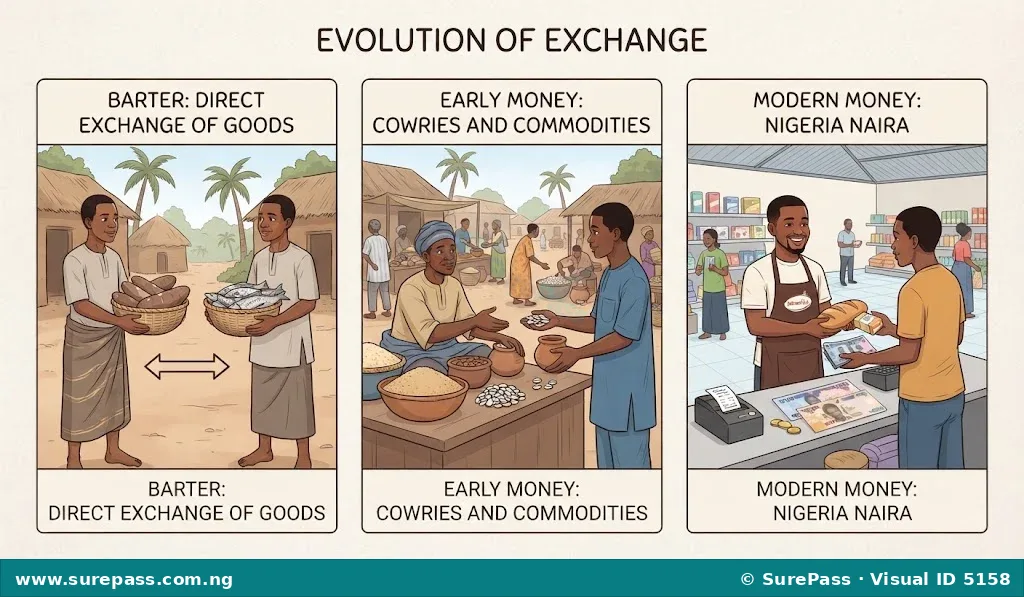
Before money was invented, people exchanged goods and services directly through a system called trade by barter.
Trade by barter involved swapping one item for another. For example, a farmer with yam might exchange it for a fisherman’s fish. However, this system had many problems. A major problem was the “double coincidence of wants,” meaning both people had to want what the other person had. If the farmer wanted fish but the fisherman did not want yam, no trade could happen.
Other problems with barter included difficulty in dividing some goods (like a cow) and storing perishable items. To solve these problems, people started using certain items as a common medium of exchange. These items were generally accepted and had value to everyone.
Early forms of money included cowries, salt, beads, and precious metals like gold and silver. Over time, these evolved into the coins and banknotes used today.
Types of Money
Throughout history and even today, different forms of money have been used. The main types of money include cowries, coins, and banknotes.
Cowries
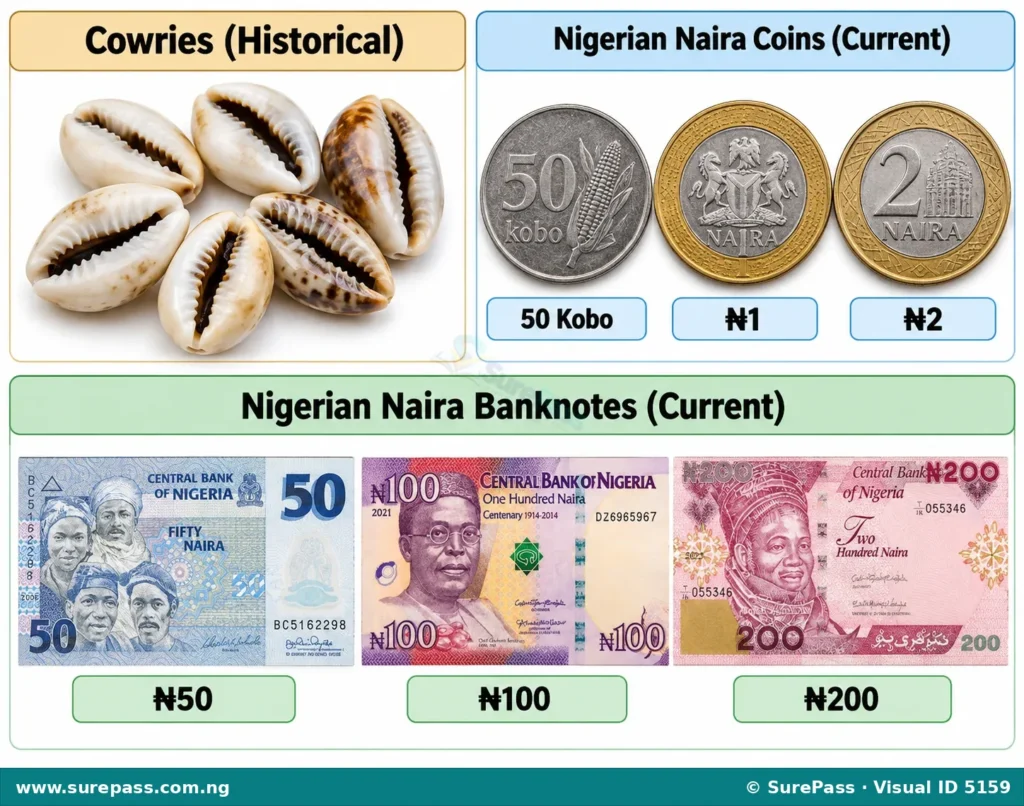
Cowries are small, shiny shells that were once widely used as money in many parts of Africa, including Nigeria. They were valuable because they were durable, easy to carry, and generally accepted by many communities.
Cowries were a form of commodity money, meaning they had their own intrinsic value and were also used as currency. They were used for buying goods, paying taxes, and and as bride price.
Coins
Coins are small, flat, round pieces of metal used as money. They are usually made of durable metals like copper, nickel, or steel, and have specific values stamped on them.
Coins are durable and can last for a long time. They are often used for smaller transactions. In Nigeria, examples of coins include the 50 kobo, 1 Naira, and 2 Naira coins.
Banknotes
Banknotes are pieces of paper or polymer issued by a central bank, representing a certain value of money. They are also known as currency notes.
Banknotes are convenient for carrying larger sums of money because they are lighter and more compact than an equivalent value in coins. In Nigeria, banknotes include the 5 Naira, 10 Naira, 20 Naira, 50 Naira, 100 Naira, 200 Naira, 500 Naira, and 1000 Naira notes.
Differences Between Types of Money
Each type of money has distinct features:
- Material: Cowries are natural shells, coins are made of metal, and banknotes are made of paper or polymer.
- Durability: Coins are generally more durable than banknotes, while cowries are also quite durable but can break.
- Value: Banknotes typically represent higher values than coins, which are used for smaller denominations. Cowries had varying values depending on their availability and local customs.
- Issuing Authority: Modern coins and banknotes are issued and controlled by the central bank of a country (e.g., Central Bank of Nigeria), while cowries were naturally occurring and their value was determined by common acceptance.
Sources of Money
People get money from various sources. For students, common sources of money are usually from family members or through small tasks.
The main sources of money include:
- Parents or Guardians: Many students receive money from their parents or guardians for school needs, transport, or pocket money.
- Gifts: Money can be received as gifts from relatives or friends during birthdays, holidays, or special occasions.
- Allowance: Some students receive a regular allowance from their parents for helping with chores at home.
- Savings: Money saved from previous earnings or gifts can also be a source when needed.
- Small Jobs: Older students or those with permission might earn money from small jobs like helping neighbours, running errands, or assisting in family businesses.
Uses of Money
Money serves several important purposes in daily life. It makes economic activities possible and convenient.
The primary uses of money include:
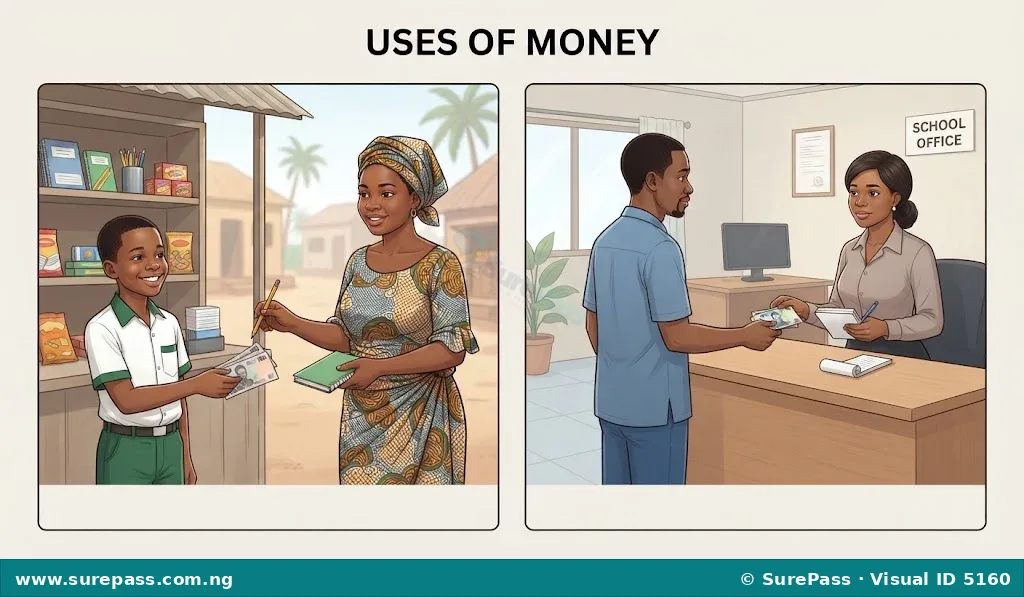
- Buying Goods: Money is used to purchase physical items that people need or want. Examples include buying food, clothes, sandals, pencils, books, and sweets from markets or shops.
- Paying for Services: Money is used to pay for services, which are actions or work performed by others. Examples include paying school fees, transport fares, electricity bills, medical consultation fees, or fees for a barber or hairdresser.
- Saving: Money can be saved for future use. People keep money aside in banks or at home to use for larger purchases, emergencies, or investments later.
- Measuring Value: Money helps to determine the value or price of goods and services. For example, a pencil might cost N50, and a pair of sandals might cost N2,000. This allows people to compare the worth of different items.
Money as a Resource
A resource is anything that can be used to achieve a goal or satisfy a need. Money is considered a valuable resource because it helps individuals and families meet their needs and achieve their goals.
Money allows people to acquire other resources like food, shelter, education, and healthcare. It can be used to start a business, invest in property, or save for retirement. Without money, it would be very difficult to obtain many of the things necessary for life and progress.
For example, a family needs money to pay for school fees (a service) so that children can get an education (a goal). Money is also used to buy food (a good) to keep the family healthy (a need). Therefore, money is a tool that helps manage and improve life.
Good Behaviour Around Money
Good behaviour around money refers to responsible ways of handling money. It involves showing respect for money and using it wisely.
Demonstrating good behaviour around money includes:
- Handling Money Carefully: Always keep banknotes neat and clean. Avoid tearing, crumpling, or writing on them. Handle coins without dropping them carelessly.
- Spending Wisely: Think before spending money. Prioritise needs over wants and avoid wasting money on unnecessary items.
- Saving Regularly: Develop the habit of saving a portion of any money received. This helps build funds for future needs or emergencies.
- Being Honest: Always be truthful about money. If lost money is found, try to return it to its owner. Do not steal or cheat to get money.
- Being Polite in Transactions: When buying or selling, be polite to vendors and customers. Count change carefully and respectfully.
- Keeping Money Safe: Store money in a safe place, such as a wallet, purse, or savings box. Avoid displaying large amounts of money openly.




0 comments
Open the discussion when you need it. Comments stay collapsed until requested so the initial article remains light.