


ARTICLE CONTENTSOn this page 8 sections
Principles, Terms and Risks in Insurance for JSS 1
Performance Objectives
By the end of the lesson, students should be able to:
- discuss the principles of insurance;
- explain the common terms used in insurance;
- explain the risks in insurance;
- differentiate between insurable and uninsurable risks,
- explain the compulsory insurances in Nigerian law.
What is Insurance?
Insurance is a way of protecting people and businesses from financial losses that can happen due to unexpected events. When a person or business buys insurance, they pay a small amount of money regularly to an insurance company. In return, the insurance company promises to pay a larger sum of money if a specific bad event, like an accident, fire, or theft, occurs.
The main idea behind insurance is to share risks. Many people pay into a common fund, so that when one person suffers a loss, they can be compensated from that fund. This helps to reduce the financial burden on any single individual or business when something unexpected happens.
Principles of Insurance
Insurance works based on certain important principles. These principles ensure that insurance is fair and effective for both the person buying the insurance and the insurance company.
1. Principle of Utmost Good Faith (Uberrimae Fidei)
This principle means that both the person buying the insurance (the insured) and the insurance company (the insurer) must be completely honest with each other. The insured must tell the insurance company all important facts about the risk they want to insure. The insurance company must also provide all necessary information about the policy.
For example, if someone is buying car insurance, they must tell the insurance company if they have had any accidents in the past or if their car has been modified. If they hide important information, the insurance policy might become invalid, and the insurance company may refuse to pay a claim.
2. Principle of Insurable Interest
The principle of insurable interest means that the person buying insurance must stand to lose financially if the insured item or person is damaged or lost. They must have a legal right to protect the item or person.
For instance, a person can insure their own car because they would suffer a financial loss if it was stolen or damaged. They cannot insure their neighbour’s car because they do not have a direct financial interest in it. Parents have an insurable interest in their children, and a business owner has an insurable interest in their property.
3. Principle of Indemnity
The principle of indemnity means that insurance aims to put the insured person back in the same financial position they were in just before the loss occurred. The insurance company will compensate for the actual loss suffered, but not more than the actual loss.
For example, if a car worth N2,000,000 is completely damaged in an accident, the insurance company will pay N2,000,000 (or the agreed value in the policy) to replace it. They will not pay N3,000,000, because that would mean the insured person gains from the loss, which is against the principle of indemnity.
Common Terms Used in Insurance
When dealing with insurance, certain words and phrases are used often. Understanding these terms helps in understanding how insurance works.
Insurer
The insurer is the insurance company that provides the insurance cover. This is the company that promises to pay compensation if a loss occurs.
Insured
The insured is the person or business that buys the insurance policy and is protected against financial loss.
Policy
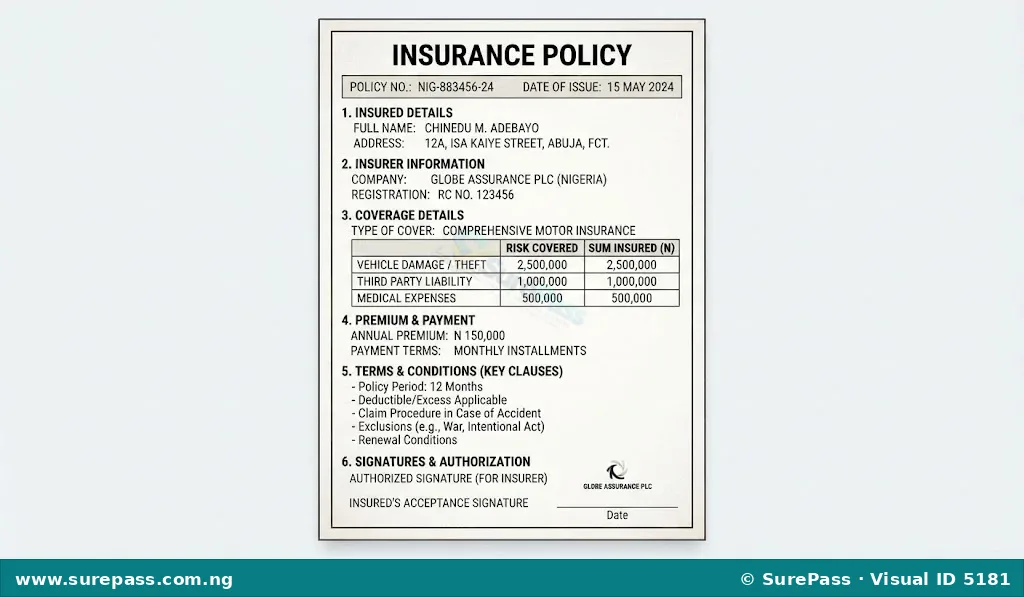
An insurance policy is a legal document that contains the contract between the insured and the insurer. It states all the terms and conditions of the insurance cover, including what is covered, how much will be paid, and the period of cover.
Premium
The premium is the amount of money the insured pays to the insurance company for the insurance cover. This payment is usually made regularly, such as monthly, quarterly, or annually.
For example, a person might pay a premium of N5,000 every month for their car insurance.
Peril
A peril is the cause of a possible loss or damage. It is the event that the insurance policy protects against.
Examples of perils include:
- Fire
- Theft
- Flood
- Accident
- Death
Warranty
In insurance, a warranty is a promise made by the insured that certain facts are true or that certain conditions will be met. If a warranty is breached (broken), the insurance company may not be liable to pay a claim.
For example, a warranty in a fire insurance policy might state that a building must have working smoke detectors. If a fire occurs and there were no working smoke detectors, the insurance company might refuse to pay.
Claim
A claim is a formal request made by the insured to the insurance company for payment when a loss covered by the policy has occurred.
For example, after a car accident, the insured person files a claim with their car insurance company to get money for repairs.
Sum Assured / Policy Amount
This is the maximum amount of money the insurance company will pay out under an insurance policy if a covered event occurs. It is agreed upon when the policy is purchased.
Risks in Insurance
A risk, in the context of insurance, is the possibility of suffering a loss or damage. Insurance is all about managing these risks. People and businesses buy insurance to protect themselves from the financial impact of risks that might happen.
Risks can be categorised in different ways, but for insurance, the most important distinction is whether they can be insured or not.
Insurable and Uninsurable Risks
Not all risks can be covered by insurance. It is important to understand the difference between risks that insurance companies are willing to cover and those they are not.
Insurable Risks
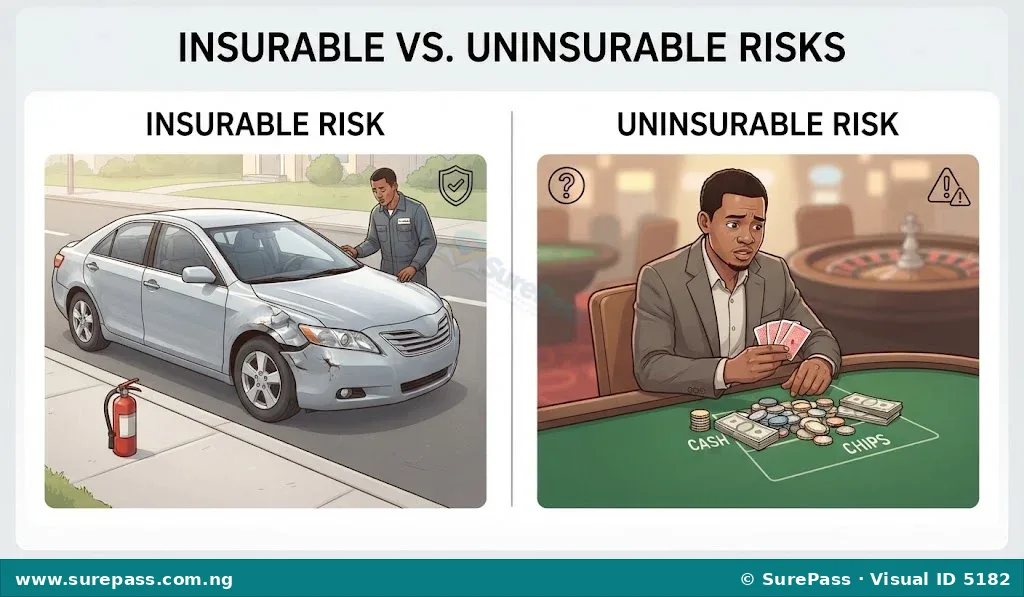
Insurable risks are those risks that an insurance company is willing to cover. For a risk to be insurable, it usually needs to meet certain conditions:
- It must be accidental: The loss must be unexpected and unintentional.
- It must be measurable: The financial value of the loss must be able to be estimated.
- It must be specific: The cause and time of the loss must be clear.
- It must affect many people: Many people must be exposed to the same risk, but only a few should suffer losses at any given time. This allows the insurance company to spread the risk.
- It must not be catastrophic for everyone at once: The risk should not affect all insured people at the same time, like a widespread war or a major natural disaster that affects an entire country.
Examples of insurable risks include:
- Fire damage to a building
- Theft of a car
- Accidental damage to property
- Illness or death
- Loss of goods during transportation
Uninsurable Risks
Uninsurable risks are those risks that insurance companies are generally not willing to cover. These risks often do not meet the conditions for insurable risks.
Reasons why a risk might be uninsurable include:
- Too predictable or certain: If a loss is certain to happen, it cannot be insured. For example, the natural wear and tear of an old car is certain to happen over time.
- Too uncertain or speculative: Risks where there is a chance of gain or loss, like gambling or business ventures, are usually not insurable.
- Catastrophic and widespread: Risks that could affect a very large number of insured people at the same time, such as war, nuclear attacks, or widespread pandemics, are often excluded.
- Illegal activities: Losses arising from illegal activities are not insurable.
Examples of uninsurable risks include:
- Losses from gambling
- Changes in fashion or market trends that cause a business to lose money
- Losses due to war or civil unrest
- Normal wear and tear of property
- Losses from illegal trade
Compulsory Insurance in Nigerian Law
In Nigeria, certain types of insurance are made compulsory by law. This means that individuals or organisations must have these insurance policies to protect themselves and others. The government makes these insurances compulsory to ensure public safety and financial protection.
The main reason for compulsory insurance is to protect third parties (people who are not directly involved in the insurance contract but might be affected by an event) and to ensure that victims of certain incidents receive compensation.
Some compulsory insurances in Nigerian law include:
1. Third Party Motor Insurance
This is the most common type of compulsory insurance. Every vehicle owner in Nigeria must have at least Third Party Motor Insurance. This insurance protects other people (third parties) who might be injured or whose property might be damaged by the insured vehicle in an accident.
It does not cover damage to the insured vehicle itself or injury to the driver of the insured vehicle. It ensures that if a driver causes an accident, the victims (passengers in other cars, pedestrians, or owners of damaged property) can receive compensation.

2. Employer’s Liability Insurance (Workmen’s Compensation)
This insurance is compulsory for employers. It protects employees who might suffer injuries, illness, or death while at work. If an employee gets hurt or falls ill because of their job, this insurance ensures they receive compensation for medical expenses, loss of income, or in case of death, their family receives benefits.
This is compulsory to ensure that workers are protected and that employers take responsibility for the safety and well-being of their staff.
3. Occupiers’ Liability Insurance (Public Buildings)
Owners or occupiers of public buildings (like schools, hospitals, offices, and shopping malls) are required to have this insurance. It covers liability for death, injury, or property damage suffered by members of the public who are on the premises due to the owner’s negligence.
This is compulsory to protect members of the public who visit these buildings from harm and to ensure they can be compensated if an accident occurs due to the building owner’s fault.


0 comments
Open the discussion when you need it. Comments stay collapsed until requested so the initial article remains light.