


ARTICLE CONTENTSOn this page 6 sections
Generating and Selecting Business Ideas
Performance Objectives
By the end of the lesson, students should be able to:
- explain the meaning of business ideas;
- explain the steps involved in generating business ideas;
- discuss the criteria for selecting ideas for enterprise;
- generate viable business ideas.
Meaning of Business Ideas
A business idea is a concept or thought that can be developed into a product or service that people will want to buy.
It is the starting point for any business. Every business, whether big or small, began with an idea. This idea aims to solve a problem, meet a need, or provide something valuable to customers.
Examples of business ideas include:
- Selling snacks and drinks.
- Offering laundry services.
- Providing home tutoring.
- Making and selling handmade crafts.
- Repairing mobile phones.
Steps in Generating Business Ideas
Generating business ideas means coming up with many different thoughts about what kind of business could be started. This process usually involves two main steps:
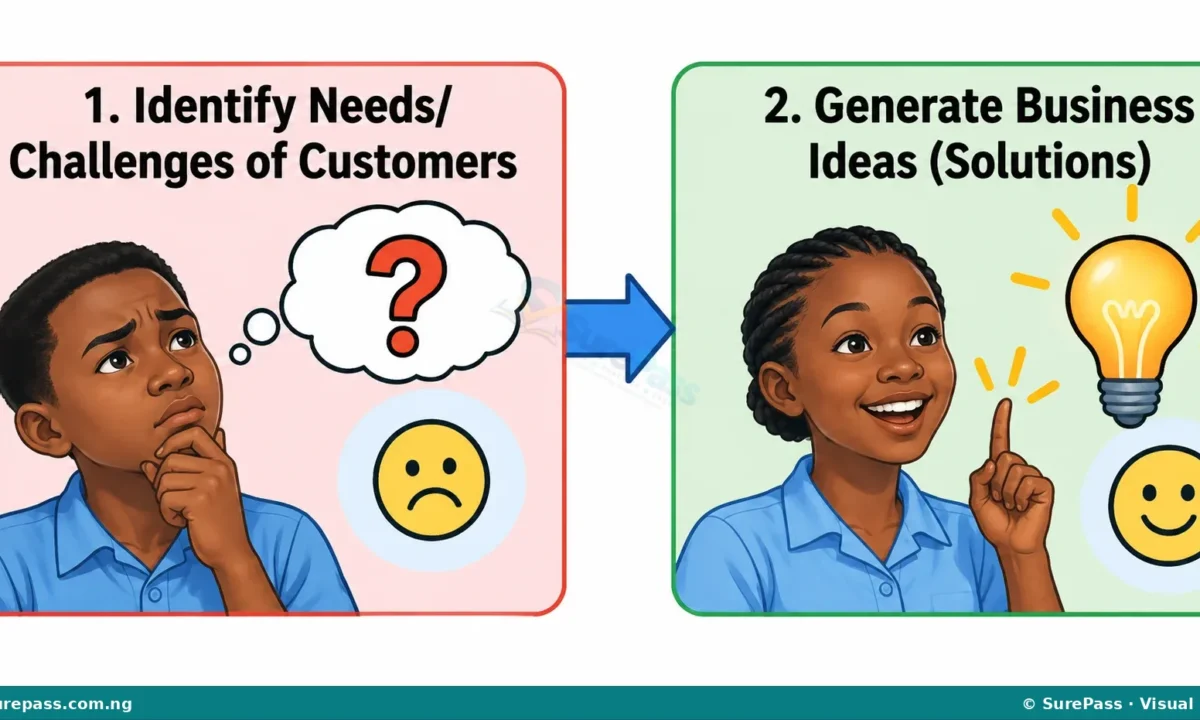
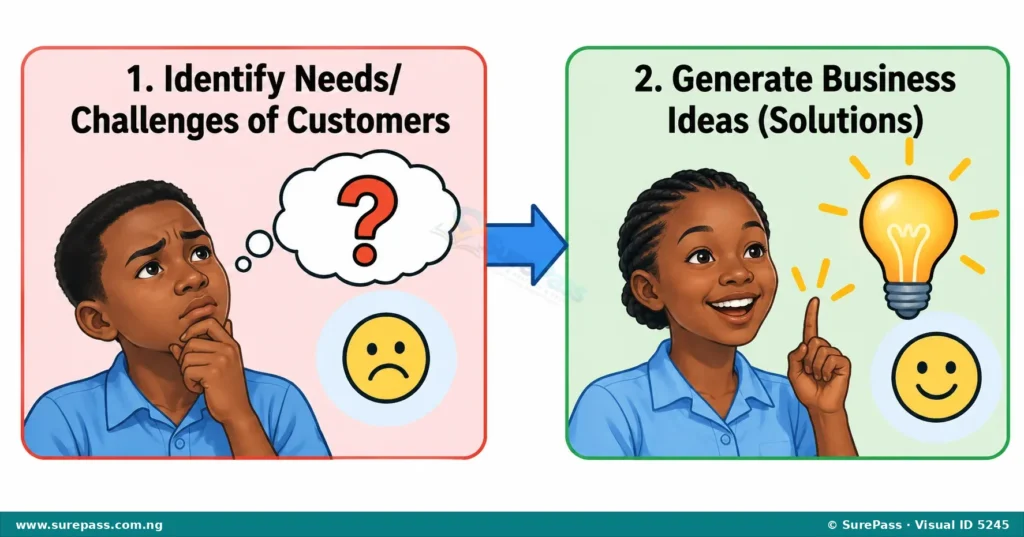
1. Identifying Needs and Challenges of Customers
The first step in generating business ideas is to look around and observe what people need or what problems they face. Customers are people who buy goods or services. A successful business often provides a solution to a customer’s problem or satisfies a customer’s desire.
Needs are things people require to live comfortably or to achieve their goals. Challenges are problems or difficulties that people experience.
To identify needs and challenges, a person can:
- Observe people: Watch what people do, what they complain about, or what they wish they had.
- Listen to conversations: Pay attention to what friends, family, and neighbours talk about regarding their daily struggles or desires.
- Look at existing businesses: See what other businesses are doing and identify areas where they might not be meeting all customer needs.
- Think about personal experiences: Consider problems or needs that a person has experienced themselves.
Examples of common needs and challenges include:
- People need food and drinks.
- Students need school supplies like pens, notebooks, and textbooks.
- Homes need cleaning.
- Clothes get dirty and need washing.
- People need to travel from one place to another.
- Children need safe places to play.
2. Generating Business Ideas to Provide Solutions
Once needs and challenges are identified, the next step is to think of different ways to solve those problems or meet those needs. This involves brainstorming various business ideas that could offer the best possible solutions.
For each identified need or challenge, a person can ask: “How can I provide a product or service that helps with this?”
Consider the following examples:
-
Need/Challenge: People need food and drinks.
Business Ideas: Start a small restaurant, sell snacks and soft drinks, bake bread, sell fresh fruits, offer catering services.
-
Need/Challenge: Students need school supplies.
Business Ideas: Open a stationery shop, sell textbooks, offer photocopying and printing services, sell school bags.
-
Need/Challenge: Homes need cleaning.
Business Ideas: Start a cleaning service, sell cleaning products, offer carpet washing.
-
Need/Challenge: Clothes get dirty and need washing.
Business Ideas: Open a laundry service, sell detergents, offer ironing services.
Criteria for Selecting Ideas for Enterprise
After generating many business ideas, the next important step is to choose the best one. This process is called screening business ideas. It involves using certain standards or rules, known as criteria, to evaluate each idea and select the most promising one for an enterprise.
An enterprise is another word for a business or a project, especially one that requires effort and initiative.
Important criteria for selecting business ideas include:
-
Customer Demand: This criterion asks if there are enough people who actually need or want the product or service. A business idea is viable if many customers are willing to pay for the solution it offers. If there is no demand, the business will not succeed.
For example, selling warm clothes in a very hot region might not have high customer demand.
-
Feasibility (Can it be done?): This criterion checks if the idea can actually be put into practice. It considers whether the necessary resources, skills, and tools are available or can be easily obtained. A business idea is feasible if it is practical to start and operate.
For example, starting a large factory might not be feasible for someone with limited money and no experience.
-
Profitability (Can money be made?): This criterion focuses on whether the business idea can make money. A business needs to earn more money than it spends to be successful. This means considering the cost of making the product or providing the service, and how much customers will be willing to pay.
For example, if it costs N500 to make a product, but customers are only willing to pay N300, the idea is not profitable.
-
Personal Interest and Skills: This criterion considers if the person starting the business has an interest in the idea and possesses the necessary skills or can learn them. It is often easier to succeed in a business that a person enjoys and is good at.
For example, someone who loves baking and is good at it might find a baking business more suitable than a car repair business.
Generating Viable Business Ideas
Generating viable business ideas means coming up with ideas that are likely to succeed because they meet customer needs, can be done, and can make money. This involves applying the steps and criteria discussed earlier.
Practical Steps for Generating and Screening Business Ideas
The procedure involves the following steps:
-
Observe and Identify Needs: Look around your home, school, or community. What problems do people face? What do they often wish for? Write down at least three different needs or challenges observed.
Example:
- Many students forget their lunch at home.
- The school field is often dirty with litter.
- People in the community need help carrying heavy items from the market.
-
Brainstorm Solutions (Generate Ideas): For each identified need, think of at least two different business ideas that could solve the problem or meet the need. Do not worry about how good the ideas are at this stage; just write them down.
Example:
-
Need: Students forget lunch.
Ideas:
- Sell simple, affordable snacks and drinks during break time.
- Offer a lunch delivery service from nearby food vendors to the school.
-
Need: School field is dirty.
Ideas:
- Start a small cleaning service for the school field after school hours.
- Sell small, easy-to-use litter pickers to students.
-
Need: Carrying heavy items from the market.
Ideas:
- Offer a wheelbarrow service to help carry goods.
- Start a small delivery service using a bicycle or tricycle.
-
-
Screen Ideas Using Criteria: Now, take each business idea generated and evaluate it using the selection criteria: Customer Demand, Feasibility, Profitability, and Personal Interest/Skills. Give each idea a simple rating (e.g., Good, Average, Poor) for each criterion.
Example Evaluation (for “Sell simple, affordable snacks and drinks during break time”):
- Customer Demand: Good (Many students get hungry during break).
- Feasibility: Good (Easy to buy snacks, can sell from a small table).
- Profitability: Good (Can buy snacks wholesale and sell at a higher price).
- Personal Interest/Skills: Good (Enjoy interacting with people, can manage small sales).
Example Evaluation (for “Offer a lunch delivery service from nearby food vendors to the school”):
- Customer Demand: Good (Students need lunch, some prefer hot meals).
- Feasibility: Average (Requires agreement with vendors, transport, and managing orders).
- Profitability: Average (Need to cover transport costs and vendor fees).
- Personal Interest/Skills: Average (Requires good organisation and communication skills).
-
Select the Best Idea: Based on the evaluation, choose the idea that scores highest across most of the criteria. This will be the most viable business idea.
In the example above, “Sell simple, affordable snacks and drinks during break time” appears to be more viable for a JSS1 student due to its higher feasibility and simpler operation.


0 comments
Open the discussion when you need it. Comments stay collapsed until requested so the initial article remains light.