



ARTICLE CONTENTSOn this page 7 sections
Book-keeping
Performance Objectives
By the end of the lesson, students should be able to:
- state the meaning of book-keeping;
- discuss with examples, the importance of book-keeping;
- describe the essential qualities of a book-keeper;
- explain the common book-keeping practices;
- select digital tools for book keeping practices.
Meaning of Book-keeping
Book-keeping is the process of recording all the financial transactions of a business or an individual in an organised way.
It involves keeping a careful record of every time money is spent or received. This helps to track where money comes from and where it goes. Imagine keeping a diary for money matters, where every naira spent or earned is written down. This helps to keep track of financial activities clearly.

Importance of Book-keeping
Book-keeping is very important for many reasons, whether for a small business, a school club, or even for personal finances. It helps people and organisations manage their money well and understand their financial situation.
The importance of book-keeping includes:
- Tracking Money: Book-keeping helps to know exactly how much money has been received and how much has been spent over a period. For example, a shop owner can use book-keeping to know how much money was made from sales each day and how much was spent on buying new goods.
- Making Decisions: With clear financial records, a business owner or an individual can make smart decisions. If records show that a business is spending too much on transportation, the owner can decide to find cheaper ways to move goods.
- Planning for the Future: Good book-keeping records help in planning for future expenses or savings. A family can use book-keeping to plan how to save money for school fees, a new house, or a special project.
- Showing Proof: Book-keeping records act as proof of transactions. If there is a disagreement about a payment made to a supplier, the records can show exactly when and how much money was paid. This helps to resolve disputes.
- Knowing Profit or Loss: For a business, book-keeping helps to calculate if the business is making a profit (earning more money than it spends) or a loss (spending more money than it earns). This information is crucial for the survival and growth of any business.
Essential Qualities of a Book-keeper
A book-keeper is the person responsible for keeping accurate financial records. To perform this job effectively, a book-keeper needs to possess certain important qualities.
The essential qualities of a book-keeper include:
- Accuracy: A book-keeper must be very careful and precise when recording numbers and details. Even a small mistake, like writing N1,000 instead of N10,000, can cause big problems and lead to incorrect financial information.
- Honesty: All records kept by a book-keeper must be truthful and correct. A book-keeper must be trustworthy and never change figures or hide financial information, as this can lead to serious consequences for the business or individual.
- Diligence: Book-keeping requires consistent hard work and close attention to detail. Records must be kept up-to-date regularly, perhaps daily or weekly, and not just once in a while. This ensures that information is always current and reliable.
- Organisational Skills: Financial records and documents need to be kept in a neat and orderly manner. This means arranging receipts, invoices, and ledgers in a way that information can be found quickly and easily when needed.
- Confidentiality: Financial information is often private and sensitive. A book-keeper must keep all financial details secret and not share them with unauthorised persons. This builds trust and protects the privacy of the business or individual.
Common Book-keeping Practices
Book-keeping involves several basic practices to ensure that all financial transactions are properly recorded and managed. These practices help to keep track of money coming in and money going out of a business or personal account.
Common book-keeping practices include:
- Recording Transactions: This is the most fundamental practice, where every financial event is written down. This includes all sales made, goods purchased, payments received from customers, and payments made to suppliers. Each transaction is recorded with its date, amount, and a brief description.
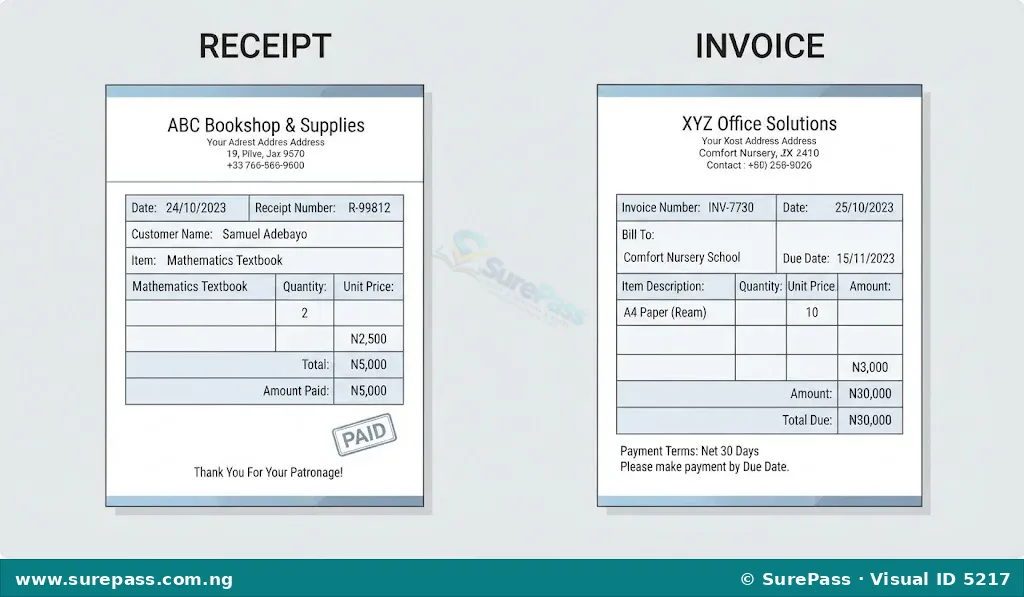
- Using Source Documents: Book-keepers rely on source documents to get accurate information about transactions. These documents are original pieces of evidence that prove a transaction occurred. Examples include receipts for payments, invoices for goods sold or bought, bank statements, and payment vouchers.
- Keeping Records in Books: Traditionally, transactions are recorded in special books called ledgers or journals. Each type of transaction might have its own specific book or section within a book. For example, there might be a sales book for all sales and a purchases book for all purchases.
- Balancing Records: Regularly, a book-keeper checks if the money recorded as received matches the money recorded as spent, or if the cash balance in the records matches the actual cash available. This process, known as balancing, helps to identify any errors or discrepancies.
- Filing Documents: Receipts, invoices, bank statements, and other important financial papers are kept safely and organised. Proper filing ensures that these documents can be easily found and referred to later, especially when balancing records or resolving disputes.
Observe the examples of common book-keeping documents below.
Digital Tools for Book-keeping
In modern times, book-keeping is often done using digital tools. These tools are computer software or applications that help to record, manage, and analyse financial information. They make the process faster, easier, and more accurate than manual methods.
Digital tools that facilitate book-keeping include:
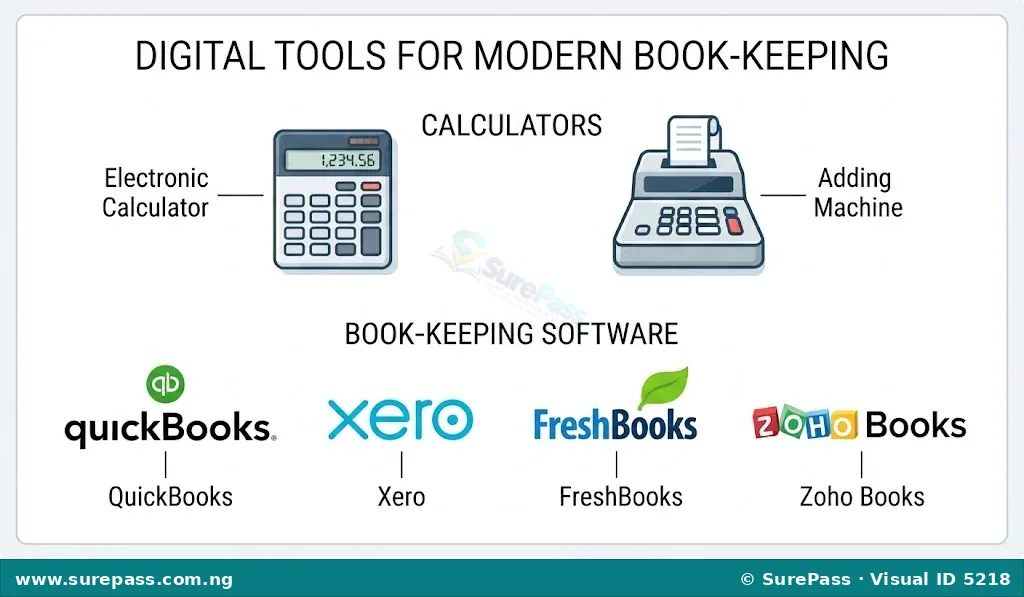
- Calculators and Adding Machines: These are basic digital tools used for quick and accurate calculations. They help book-keepers to add, subtract, multiply, and divide numbers correctly, reducing the chance of mathematical errors.
- Book-keeping Software: These are computer programs specifically designed for managing financial records. They can automatically record transactions, track expenses, generate reports, and even help with invoicing. Examples of such software include:
- QuickBooks: This is a very popular software used by many small and medium-sized businesses. It helps them manage their finances, track income and expenses, and prepare financial statements.
- Xero: Another widely used online accounting software. Xero helps businesses with tasks like invoicing customers, reconciling bank transactions, and managing payroll.
- FreshBooks: This software is often used by freelancers and small businesses, especially for creating and sending invoices, tracking time spent on projects, and managing expenses.
- Zoho Books: A comprehensive online accounting software that helps businesses manage their finances, automate business workflows, and handle various types of transactions from sales to purchases.
These digital tools help book-keepers to:
- Enter transactions quickly and efficiently.
- Organise financial data automatically into different categories.
- Reduce errors in calculations and record-keeping.
- Access financial information from different devices and locations, making it flexible.



0 comments
Open the discussion when you need it. Comments stay collapsed until requested so the initial article remains light.