



ARTICLE CONTENTSOn this page 8 sections
Meaning, Importance, Types and Classes of Insurance for JSS 1
Performance Objectives
By the end of the lesson, students should be able to:
- state the meaning and importance of insurance;
- describe insurance services;
- identify types of insurance;
- differentiate among the classes of insurance;
- differentiate life and general insurance.
What is Insurance?
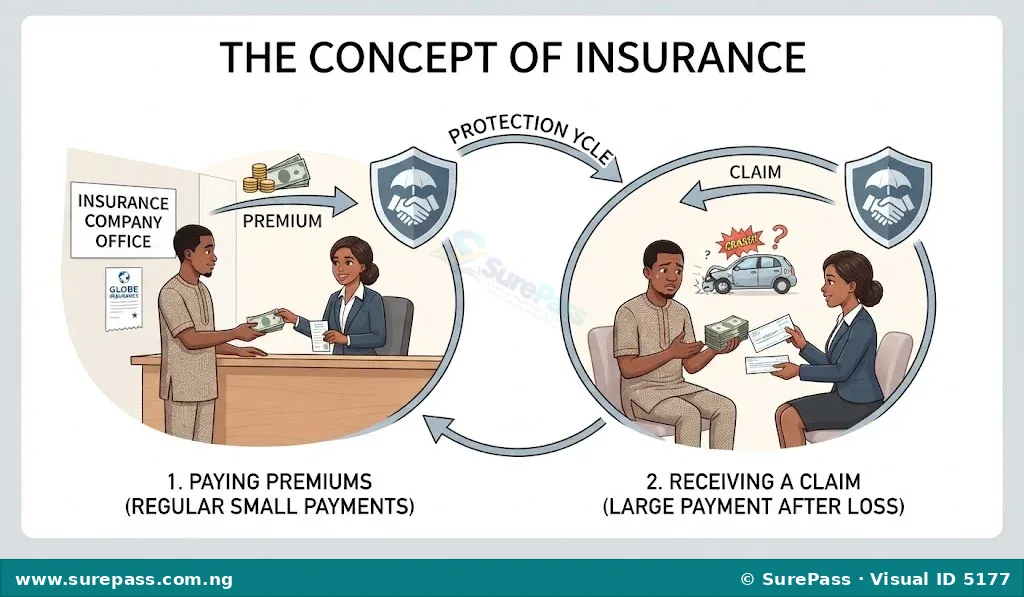
Insurance is an agreement where one party, called the insurer, promises to pay another party, called the insured, a sum of money if a specific event happens.
In return for this promise, the insured pays a regular amount of money called a premium to the insurer. The main purpose of insurance is to protect people and businesses from financial losses that can happen due to unexpected events like accidents, fire, theft, or even death.
Imagine a situation where a person’s house catches fire. Without insurance, the person would have to pay for all the repairs or rebuilding from their own pocket, which can be very expensive. With fire insurance, the insurance company helps to cover these costs, reducing the financial burden on the homeowner.
Importance of Insurance
Insurance is very important for individuals, families, and businesses because it provides financial protection and peace of mind. It helps people manage the risks of everyday life and unexpected events.
The importance of insurance includes the following:
- Protection from Financial Loss: Insurance helps people recover money lost due to unexpected events. For example, if a car is damaged in an accident, motor insurance can cover the repair costs. If a shop is burgled, burglary insurance can help replace the stolen goods.
- Peace of Mind: Knowing that there is financial protection in place helps people worry less about future uncertainties. This allows individuals and businesses to plan for the future with more confidence, knowing they are prepared for potential problems.
- Security for Loans: Banks often require insurance for properties or assets that are used as collateral for loans. For instance, a house bought with a loan might need fire insurance to protect the bank’s investment in case of fire damage.
- Encourages Savings: Some types of life insurance policies can also act as a form of savings. They can provide a lump sum payment after a certain period or upon retirement, helping people save for their future goals.
- Supports Economic Growth: Insurance companies collect premiums from many people and businesses. They invest these large sums of money in various businesses and projects, which helps to create jobs, build infrastructure, and contribute to the overall growth of the economy.
Insurance Services
Insurance companies provide various services to their customers. These services are designed to help people manage risks and protect their assets from financial harm.
The main services offered by insurance companies include:
- Risk Assessment: Before offering an insurance policy, companies evaluate the risks involved. They study how likely an event (like an accident or fire) is to happen and how much it might cost if it does. This helps them decide the premium to charge.
- Policy Issuance: After assessing the risk and agreeing on the terms, the insurance company issues an insurance policy. This is a legal document that clearly states the agreement between the insurer and the insured, including what is covered and for how much.
- Premium Collection: Insurance companies collect regular payments, called premiums, from the insured. These premiums are usually paid monthly, quarterly, or annually, depending on the agreement.
- Claims Processing: When an insured event occurs (e.g., a car accident), the insured makes a claim to the insurance company. The company then investigates the claim to ensure it is valid and, if it is, pays the agreed amount of money to the insured to cover the loss.
- Customer Support: Insurance companies provide support and advice to their customers. This includes answering questions about their policies, guiding them through the claims process, and helping with other insurance-related matters.
Types of Insurance
Insurance can be categorised into different types based on its principles and how it operates. These types reflect different approaches to providing financial protection.
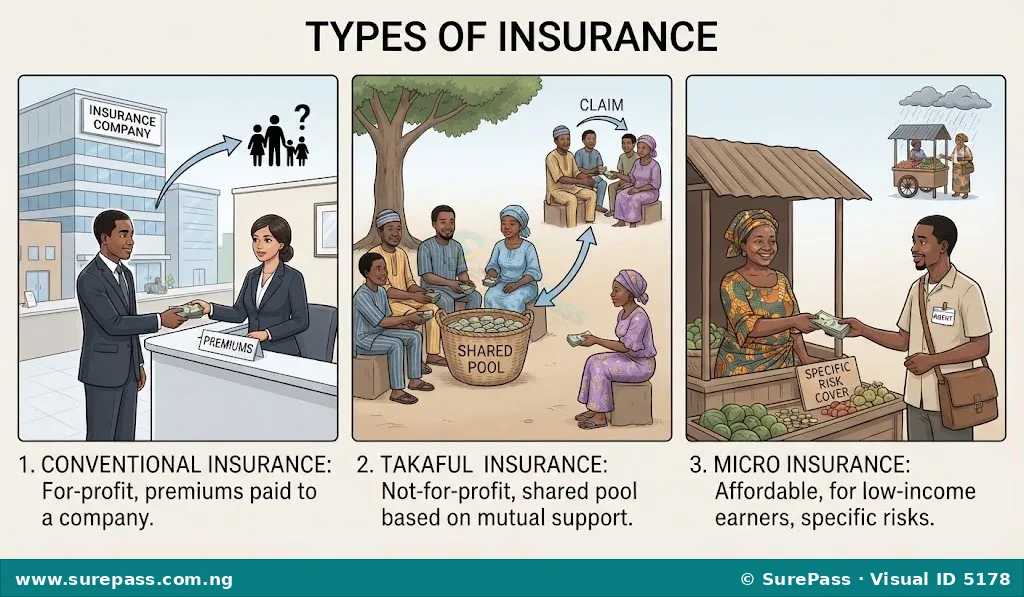
The main types of insurance are:
- Conventional Insurance: This is the most common type of insurance. It involves a contract between the insurer and the insured, where the insured pays premiums and the insurer promises to pay a claim if a specified event occurs. The main goal is to transfer risk from the individual to the insurance company. Most insurance policies in Nigeria fall under this type.
- Takaful Insurance: Takaful is a type of Islamic insurance based on the principles of mutual cooperation and shared responsibility. Participants contribute to a common fund, and if any participant suffers a loss, money is paid from this fund. It avoids interest (riba) and uncertainty (gharar), which are prohibited in Islamic finance. It is like a community helping its members.
- Micro Insurance: Micro insurance is designed to provide insurance coverage to low-income individuals and families, especially in developing countries. It typically offers small coverage amounts with very affordable premiums. This type of insurance protects against specific risks like illness, death, or damage to small assets, making insurance accessible to those who might not afford conventional policies.
Classes of Insurance
Insurance policies are also grouped into different classes based on the type of risk they cover. These classes help to organise the wide range of insurance products available and make it easier to understand what each policy protects against.
Life Assurance
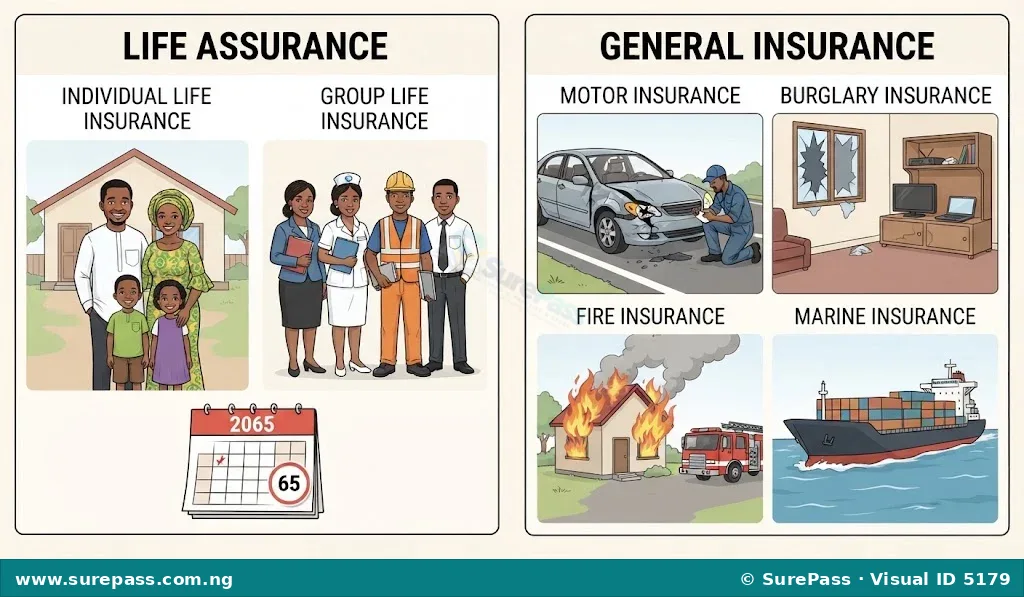
Life assurance, also known as life insurance, provides financial protection against the risk of death or for a specified period of time. It ensures that a sum of money is paid to beneficiaries (the people chosen by the insured) upon the death of the insured, or to the insured themselves after a certain number of years, for example, at retirement.
Types of life assurance include:
- Individual Life Insurance: This policy covers one person. The benefits are paid to the person’s family or chosen beneficiaries when the insured person dies. It is a personal contract.
- Group Life Insurance: This policy covers a group of people, usually employees of a company, under a single contract. It provides life insurance benefits to the employees without them having to buy individual policies, making it easier for employers to provide benefits.
- Whole Life Insurance: This policy provides coverage for the entire lifetime of the insured person. It pays a death benefit to the beneficiaries whenever the insured person dies, as long as premiums are paid regularly.
- Annuity: An annuity is a contract that provides regular payments to the insured person for a fixed period or for the rest of their life, usually starting at retirement. It is a way to ensure a steady income in later years, providing financial security after working life.
General Insurance (Non-Life)
General insurance covers risks other than death. It protects against losses or damages to property, health, and other assets. These policies are usually for a short period, typically one year, and must be renewed annually to continue coverage.
Types of general insurance include:
- Motor Vehicle Insurance: This insurance covers damages to a vehicle or damages caused by a vehicle to other people or property. In Nigeria, it is compulsory to have at least third-party motor insurance, which covers damages to other people and their property.
- Burglary Insurance: This policy protects against losses due to theft or burglary. It covers the value of stolen items or damages caused to a property during a break-in.
- Fire Insurance: Fire insurance protects against financial losses caused by fire. It covers damages to buildings, goods, and other properties due to fire, lightning, or explosions.
- Marine Insurance: This insurance covers losses or damages to ships, cargo, and other property during sea voyages. It is important for businesses that import or export goods, protecting them from risks like sinking, piracy, or damage to goods during transit.
Composite Insurance
Composite insurance is offered by insurance companies that are licensed to provide both life assurance and general insurance policies. This means a single company can offer a wide range of insurance products to its customers, covering both life-related risks and property/casualty risks. This makes it convenient for customers to get all their insurance needs from one provider.
Reinsurance
Reinsurance is insurance for insurance companies. When an insurance company takes on a very large risk, it might transfer part of that risk to another insurance company, called a reinsurer. This helps the original insurance company to reduce its own potential losses and allows it to cover larger risks than it could alone. It is a way for insurance companies to share big risks.
Differences Between Life and General Insurance
Life assurance and general insurance are two main categories of insurance, and they have several key differences in what they cover and how they operate.
The differences between life and general insurance are:
- Subject Matter: Life assurance covers the life of a human being. General insurance covers property, assets, or liabilities (responsibilities for harm to others).
- Duration: Life assurance policies can be for a long term, often for the entire life of the insured, or for a very long fixed period (e.g., 20 years). General insurance policies are usually for a short term, typically one year, and require renewal annually.
- Claim Event: In life assurance, the claim is paid upon the death of the insured or at the end of a specified period (e.g., when the policy matures). In general insurance, the claim is paid only if a specific event (like fire, theft, or accident) causes a loss or damage during the policy period.
- Payment of Claim: In life assurance, the claim amount is usually certain and will be paid at some point, either upon death or maturity. In general insurance, the claim payment is uncertain and depends on whether the insured event occurs and causes a loss.
- Insurable Interest: For life assurance, insurable interest (a financial stake in the person’s life) must exist at the time the policy is taken out. For general insurance, insurable interest must exist both at the time the policy is taken out and at the time of the loss.
- Savings Element: Some life assurance policies, like whole life insurance, can have a savings or investment component, where a portion of the premium contributes to a cash value. General insurance policies typically do not have a savings component; they are purely for protection against specific risks.





0 comments
Open the discussion when you need it. Comments stay collapsed until requested so the initial article remains light.