



ARTICLE CONTENTSOn this page 8 sections
Ndị Igbo na Asụsụ Ha
Performance Objectives
By the end of the lesson, students should be able to:
- explain who the Igbo people are (ịkọwa ndị bụ ndị Igbo);
- identify the towns and states where Igbo is spoken, as well as the neighbours of the Igbo people (izipụta obodo na steeti ebe a na-asụ Igbo na agbataobi ndị Igbo);
- narrate different stories about the origin of the Igbo people (ịkọ akụkọ dị iche iche gbasara mmalite ndị Igbo);
- identify the different ways of recognizing Igbo people through their language, dressing, or by pointing them out on a map (ịmata ụzọ dị iche iche e si ama ndị Igbo site n’asụsụ, ejiji ha maọbụ ịrụgosi ha na maapụ).
Who Are the Igbo People? (Nkọwa Ndị Bụ Ndị Igbo)
The Igbo people (Ndị Igbo) are an indigenous ethnic group primarily located in the southeastern region of Nigeria, bound together by a common language, culture, and ancestral heritage.
The Igbo people speak the Igbo language (Asụsụ Igbo), which belongs to the Benue-Congo branch of the Niger-Congo language family. Historically, the Igbo did not operate a centralized monarchical system like some other major ethnic groups in Nigeria. Instead, they practiced a highly democratic, decentralized system of government often referred to as Igbo republicanism (Ọha nze na ọzo). This system relied on village assemblies, age grades, and title societies to maintain law and order. The Igbo are widely recognized for their industrious nature, business acumen, farming skills, and rich cultural traditions.
Igbo States, Towns, and Neighbours (Steeti, Obodo na Ndị Agbataobi Ndị Igbo)
The Igbo homeland is geographically situated east of the lower River Niger, extending to parts of the west of the river. The population is spread across several administrative states in modern Nigeria.
The five core states in Nigeria where the Igbo language is predominantly spoken as the native tongue are:
- Abia State
- Anambra State
- Ebonyi State
- Enugu State
- Imo State
Other states in Nigeria with significant indigenous Igbo-speaking populations include:
- Delta State (specifically Delta North, often referred to as Anioma)
- Rivers State (specifically communities such as Ikwerre, Etche, Ogba, and Egbema)
Prominent towns and cities where the Igbo language is actively spoken include:
- Onitsha (Anambra State)
- Owerri (Imo State)
- Enugu (Enugu State)
- Aba (Abia State)
- Abakaliki (Ebonyi State)
- Asaba (Delta State)
- Umuahia (Abia State)
The Igbo homeland is surrounded by several neighbouring ethnic groups, which include:
- The Igala, Tiv, and Idoma ethnic groups to the north
- The Ibibio, Efik, and Annang ethnic groups to the east and south-east
- The Ijaw and Ogoni ethnic groups to the south
- The Edo, Urhobo, and Yoruba ethnic groups to the west
Observe the map below to see the geographic distribution of the Igbo-speaking states and their neighbours.
Origins of the Igbo People (Akụkọ Gbasara Mmalite Ndị Igbo)
There are various historical accounts and oral traditions regarding how the Igbo people originated. Two of the most prominent accounts are the Eri/Hebrew Origin Theory and the Autochthonous/Indigenous Origin Theory.
The Eri/Hebrew Origin Theory (Akụkọ Mmalite si na Ndị Ju/Eri)
This account suggests that the Igbo people migrated from the Middle East, specifically Israel. According to this tradition, Eri, a son of Gad (who was a son of Jacob in biblical history), migrated from Egypt and traveled down the River Niger. He eventually settled at the confluence of the Anambra and Niger rivers in an area known as Aguleri. From this settlement, his descendants spread across the southeastern region, establishing various Igbo communities. This theory is often cited to explain certain cultural similarities between ancient Hebrew customs and traditional Igbo practices, such as circumcision on the eighth day and purification rites.
The Autochthonous/Indigenous Origin Theory (Akụkọ Mmalite si n’Ala)
This account states that the Igbo people did not migrate from any distant land. Instead, they are indigenous to their current geographic location. Archaeological evidence, such as the ancient bronze artifacts discovered in Igbo-Ukwu, supports the view that human settlements have existed continuously in the Igbo heartland (specifically the Nri-Awka and Orlu uplands) for thousands of years. This theory emphasizes that the Igbo developed their unique culture, social structures, and language directly within their forest-savannah environment without external migration.
Identity Markers of the Igbo People (Njirimara Ndị Igbo)
The Igbo people can be identified through distinct cultural markers, which include their language, traditional attire, and geographic location on the map.
Language (Asụsụ)
The primary marker of identity is the Igbo language (Asụsụ Igbo). It is a tonal language, meaning that the pitch or tone used to pronounce a word can change its meaning. For example, the word “Ákwá” (high-high tone) means “cry”, “Àkwá” (low-high tone) means “egg”, and “Àkwà” (low-low tone) means “bed”.
Common Igbo expressions and greetings include:
- Kedu? – How are you?
- Nnọọ – Welcome
- Daalụ – Thank you / Well done
- I bọọla chi? – Have you woken up? (Good morning)
- Ka ọ dị – Goodbye
Dressing (Ejiji)
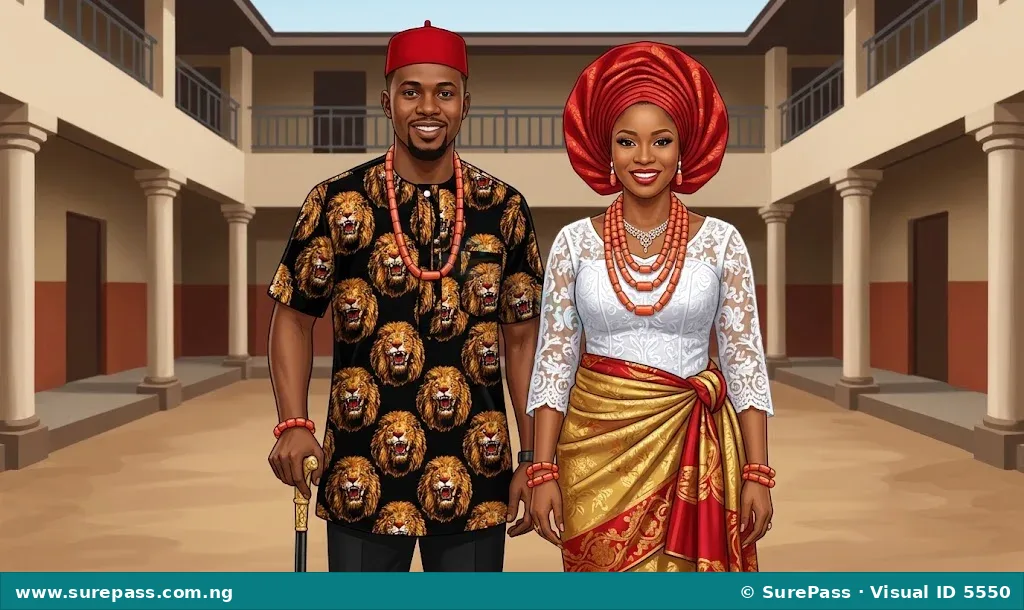
Traditional attire is a highly visible marker of Igbo identity, worn during festivals, weddings, and cultural ceremonies.
The traditional attire for Igbo men typically consists of:
- Isiagu: A high-quality pullover shirt patterned with lion heads, symbolizing strength and leadership.
- Woko or Senator attire: Long-sleeved shirts worn over trousers or wrappers.
- Okpu mmee: A red cap, which symbolizes authority, honor, and cultural standing.
- Opara / Mkpọrọ: A walking stick used by elders and titled men.
The traditional attire for Igbo women typically consists of:
- Double wrappers (Akwa mgbụgbo): Two pieces of matching George, Ankara, or wax fabric tied around the waist.
- Blouse (Ụfe): A beautifully embroidered lace or cotton blouse.
- Gele / Ichafu: A matching headtie styled elegantly.
- Ife-atụ / Akolo: Coral beads worn around the neck, wrists, and ankles during festive occasions.
Look at the illustration below to observe traditional Igbo attire.
Practical Activity: Mapping the Igbo Homeland (Nka Ọrụ Maapụ)
This activity helps learners develop the skill of identifying and mapping out the Igbo-speaking states of Nigeria.
The required materials for this activity are:
- An outline map of Nigeria showing state boundaries
- A blue or green coloring pencil
- A black pen for labeling
The procedure involves the following steps:
- Place the outline map of Nigeria on a flat, clean surface.
- Locate the southeastern region of Nigeria, situated east of the River Niger.
- Identify the five core Igbo states: Abia, Anambra, Ebonyi, Enugu, and Imo.
- Use the coloring pencil to shade these five states gently.
- Identify and shade the neighboring parts of Delta State (Delta North) and Rivers State where Igbo is also spoken.
- Write the names of the five core states clearly inside their respective boundaries using the black pen.
- Label the neighboring states (such as Kogi, Benue, Cross River, Akwa Ibom, and Edo) to show the boundaries of the Igbo homeland.
Evaluation Guide
Review questions to assess understanding include:
- Explain who the Igbo people are.
- List five states in Nigeria that are predominantly Igbo-speaking.
- List three prominent towns where the Igbo language is spoken.
- State four distinct ways of identifying an Igbo person.
- Narrate two different stories concerning the origin of the Igbo people.
- Draw an outline map of Nigeria and shade the five core Igbo states.


0 comments
Open the discussion when you need it. Comments stay collapsed until requested so the initial article remains light.