


ARTICLE CONTENTSOn this page 8 sections
Qualities of a Good Business Opportunity
Performance Objectives
By the end of the lesson, students should be able to:
- describe the qualities of a good business opportunity;
- assess and rank business opportunities.
Meaning of a Business Opportunity
A business opportunity is a favorable set of circumstances that creates a need for a new product, service or business.
In the solar photovoltaic (PV) sector, an opportunity arises when there is a gap between the demand for clean, reliable electricity and the available supply of solar products or installation services. For an entrepreneur or technician, recognizing this gap is the first step toward establishing a successful enterprise.
A solar PV business opportunity is a commercial opening in the renewable energy market where a technician or entrepreneur can provide solar products or installation and maintenance services to meet an existing energy demand.
Not every business idea is a genuine business opportunity. An idea only becomes an opportunity when it is commercially viable, realistic, and capable of generating sustainable income over a long period.
Qualities of a Good Solar PV Business Opportunity
To distinguish a mere idea from a viable business opportunity, certain characteristics must be present. These qualities ensure that the business can survive, grow, and remain profitable in the competitive Nigerian energy market.
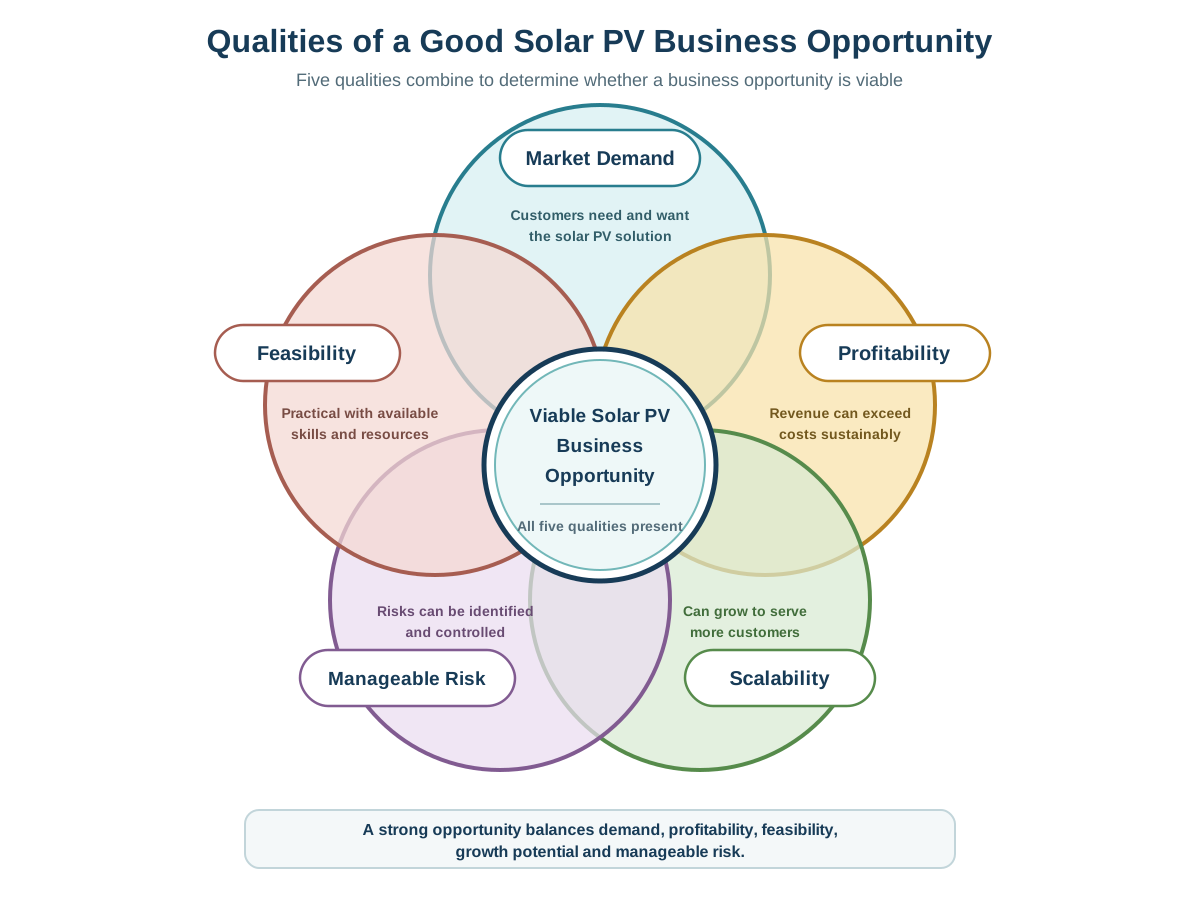
The essential qualities of a good solar PV business opportunity include:
- High Market Demand: There must be a clear and urgent need for the product or service. In Nigeria, frequent power grid failures and the high cost of generator fuel create a massive demand for alternative energy sources like solar PV systems.
- Profitability: The opportunity must be capable of generating more revenue than the cost of setting up and running the business. The profit margin must be high enough to sustain the business and reward the owner.
- Technical Feasibility: The business must be practical to execute. This means the required technical skills, tools, solar panels, inverters, batteries, and accessories must be accessible, and the technician must possess the capability to install and maintain them safely.
- Scalability: A good opportunity allows the business to start small and expand over time. For example, a business that starts by installing small solar home systems (SHS) should be able to scale up to installing larger commercial solar systems for schools, hospitals, and factories.
- Manageable Risk: Every business has risks, but a good opportunity has risks that can be calculated, minimized, or managed. In solar installation, risks such as falling from roofs, electrical shocks, or component damage can be managed through safety training, insurance, and quality control.
- Sustainability: The opportunity must be long-lasting rather than a temporary trend. Since solar panels have a lifespan of 25 years or more, the need for maintenance, battery replacements, and system upgrades ensures a continuous, long-term market.
Observe the diagram below to understand how these qualities interconnect to form a viable business opportunity.
Assessing and Ranking Solar PV Business Opportunities
In the solar energy sector, there are several business paths an entrepreneur can choose. Because resources like capital, time, and skilled labor are limited, it is necessary to assess and rank these opportunities to select the most viable one.
Common business opportunities in the solar PV sector include:
- Solar PV Installation Services: Designing, sizing, and mounting solar arrays, inverters, and battery banks for residential and commercial customers.
- Solar PV Maintenance and Cleaning Services: Offering routine washing of solar panels, testing battery health, tightening electrical connections, and troubleshooting system faults.
- Retail of Solar Components: Sourcing and selling solar panels, deep-cycle batteries, charge controllers, inverters, and solar cables to installers and end-users.
- Solar-Powered Appliance Sales: Retailing specialized direct current (DC) appliances such as solar water pumps, solar streetlights, solar fans, and solar refrigerators.
To assess these opportunities, entrepreneurs use specific criteria to score each option. This process is called market assessment. By assigning scores to each criterion, different business ideas can be compared objectively.
The standard criteria used to assess solar business opportunities are:
- Market Demand Score: How many people in the target area need and can afford the service?
- Start-up Capital Requirement: How much money is needed to start? (A lower capital requirement is often ranked higher for beginners).
- Skill Requirement: Does the entrepreneur already have the technical expertise, or will they need expensive specialized training?
- Profit Potential: What is the expected return on investment?
How to Assess and Rank Solar PV Business Opportunities
This practical activity guides learners on how to use cardboard sheets and assessment tables to evaluate and rank different solar PV business opportunities. This skill helps in making informed, data-driven business decisions.
The required materials for this activity are:
- Cardboard papers (A1 or A2 size)
- Rulers and pencils
- Colored marker pens
- Calculators
The procedure involves the following steps:
- Draw a large assessment table on the cardboard paper using a ruler and marker pens.
- List the selected solar PV business ideas in the first column of the table.
- Create columns for the key assessment criteria: Market Demand, Low Capital Requirement, Technical Feasibility, and Profitability.
- Establish a scoring scale from 1 to 5, where:
- 1 represents Very Low / Unfavorable
- 2 represents Low / Slightly Unfavorable
- 3 represents Moderate / Neutral
- 4 represents High / Favorable
- 5 represents Very High / Highly Favorable
- Discuss each business idea as a group and assign scores for each criterion based on local market conditions.
- Calculate the total score for each business idea by adding up the scores across the row.
- Rank the business opportunities based on their total scores. The idea with the highest score is ranked 1st, the next is 2nd, and so on.
The table below shows a completed assessment and ranking matrix for four solar PV business opportunities:
| Solar Business Opportunity | Market Demand (1-5) | Low Capital Requirement (1-5) | Technical Feasibility (1-5) | Profitability (1-5) | Total Score | Rank |
|---|---|---|---|---|---|---|
| Solar PV Installation Services | 5 | 2 | 3 | 5 | 15 | 2nd |
| Solar Panel Cleaning & Maintenance | 4 | 5 | 5 | 3 | 17 | 1st |
| Retail of Solar Components | 4 | 1 | 4 | 5 | 14 | 3rd |
| Solar-Powered Appliance Sales | 3 | 3 | 4 | 3 | 13 | 4th |
Based on the ranking table above, Solar Panel Cleaning & Maintenance ranks first. This is because it requires very low start-up capital and has high technical feasibility (it is easy to learn and execute), making it an excellent entry-point business for a new SS1 graduate or technician, despite having slightly lower profit margins than large-scale installations.
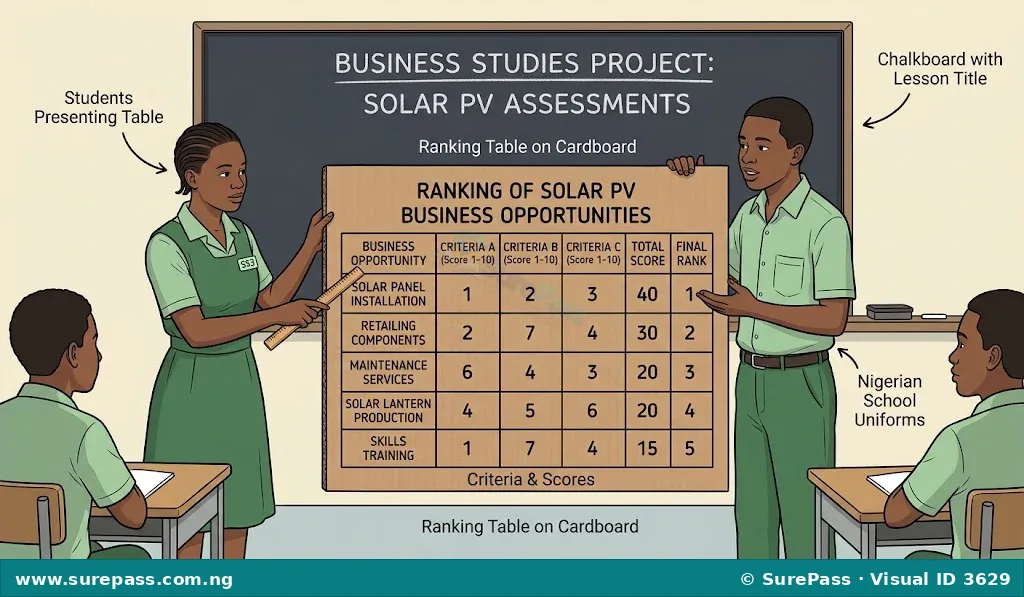
Observe the image below to see how students present their completed ranking tables on cardboard during a business planning session.
Procedure for Identifying a Good Business Opportunity
To successfully identify and launch a solar PV business, a systematic procedure must be followed. This prevents the entrepreneur from investing money and time into a business that is bound to fail.
The systematic procedure for identifying a viable solar PV business opportunity consists of the following steps:
- Identify Community Energy Needs: Observe the local environment to identify energy challenges. For example, notice if shop owners spend too much on petrol generators or if homes experience constant darkness.
- Brainstorm Solar Solutions: Generate a list of potential solar business ideas that can solve the identified problems (e.g., solar generator rentals, solar installation, or battery sales).
- Conduct Market Research: Gather information about potential customers. Find out if they are willing to pay for solar energy and how much they can afford. Also, check if there are competitors offering the same services in the area.
- Assess Technical and Financial Requirements: Determine the tools, equipment, and skills needed for each idea. Calculate the cost of purchasing basic tools like multimeters, solar crimping tools, and ladders.
- Apply the Ranking Matrix: Use an assessment table to score each business idea against key criteria such as demand, capital, feasibility, and profitability.
- Select the Best Opportunity: Choose the business idea that achieves the highest rank and aligns with the available capital and technical skills.
- Develop a Basic Business Plan: Write down how the business will operate, how customers will be reached, and how profits will be made.
Summary
Establishing a successful solar PV business requires more than just technical installation skills; it demands the ability to recognize and evaluate business opportunities. By analyzing qualities such as market demand, profitability, feasibility, and scalability, and by using structured ranking tables, prospective solar technicians can minimize business risks and choose the most viable path to financial independence.



0 comments
Open the discussion when you need it. Comments stay collapsed until requested so the initial article remains light.