



ARTICLE CONTENTSOn this page 8 sections
Ƙa’idojin Rubutun Hausa da Matakan Rubuta Labari
Performance Objectives
By the end of the lesson, students should be able to:
- amfani da matakan rubutu:
- samar kan labari
- samar da muhallin labari
- jera tunani
- rubuta labari
- yin bita
- kammalawa.
Gabatarwa ga Rubutun Labari
Story writing is a way of expressing thoughts, ideas, and events in written words.
Writing stories helps to share knowledge, entertain readers, and improve language skills. To write a good story, certain rules of the Hausa language and specific writing steps must be followed. This ensures that the story is clear, interesting, and easy for others to read.
Ƙa’idojin Rubutun Hausa
Before beginning to write a story, it is important to understand the general rules of Hausa writing. These rules help to make the writing neat, readable, and meaningful.
The main rules of Hausa writing are:
- Rubutu a Sarari (Proper Spacing): Words must be separated from each other with clear spaces. There should also be enough space between lines of writing so that the text does not look crowded.
- Amfani da Manyan Haruffa (Use of Capital Letters): Every sentence must begin with a capital letter. Capital letters are also used for proper nouns, such as the names of people, towns, countries, and days of the week.
- Amfani da Alamomin Rubutu (Use of Punctuation Marks): Punctuation marks are symbols used in writing to make sentences clear and easy to understand.
- Tsara Saki Layi (Paragraphing): Writing should be divided into paragraphs. Each paragraph must focus on one main idea to keep the story organized.
Punctuation marks are symbols used in writing to make sentences clear and easy to understand.
Common punctuation marks in Hausa include:
- Aya (.): The full stop is used at the end of a complete sentence that is not a question or an exclamation.
- Wakafi (,): The comma is used to separate words in a list or to show a short pause in a sentence.
- Alamar Tambaya (?): The question mark is used at the end of a sentence that asks a question.
The table below shows examples of incorrect and correct Hausa writing based on these rules:
| Kuskure (Incorrect) | Gyara (Correct) | Dalilin Gyara (Reason for Correction) |
|---|---|---|
| musayanasandajiyaje gona | Musa yana sauri jiya ya je gona. | Added spacing, capitalised “Musa”, and added a full stop. |
| ina tsohuwar take tafiya | Ina tsohuwar take tafiya? | Capitalised the first letter and added a question mark. |
| musa da ali da sani sun zo | Musa, da Ali, da Sani sun zo. | Capitalised names and added commas to separate the names. |
Matakan Rubuta Gajeren Labari
Writing a story requires a step-by-step process to ensure that the ideas are well-organized and the message is clear. Following these steps helps a writer build a story from a simple idea into a finished piece of writing.
The steps for writing a short story are:
- Samar da Kan Labari (Idea Generation)
- Samar da Muhallin Labari (Setting the Scene)
- Jera Tunani (Organising Thoughts)
- Rubuta Labari (Drafting)
- Yin Bita (Reviewing and Editing)
- Kammalawa (Finalising)
1. Samar da Kan Labari (Idea Generation)
This is the first step where the writer decides what the story will be about. The idea can be based on a real-life event or a completely made-up situation. It is best to choose an interesting topic that will capture the reader’s attention.
Examples of story topics in Hausa include:
- “Yadda Musa ya Taimaki Tsohuwa” (How Musa Helped an Old Woman)
- “Tafiyata zuwa Gona” (My Trip to the Farm)
- “Abokina Kare” (My Friend the Dog)
2. Samar da Muhallin Labari (Setting the Scene)
The setting of a story is the place and time where the events happen.
In this step, the writer decides where and when the story takes place. The setting helps the reader picture the events clearly in their mind.
Common settings for a story include:
- Wuri (Place): gida (home), makaranta (school), kasuwa (market), daji (forest), or titi (road).
- Lokaci (Time): da safe (morning), da rana (afternoon), da dare (night), lokacin damina (rainy season), or lokacin rani (dry season).
For example, if the topic is “Yadda Musa ya Taimaki Tsohuwa,” the setting could be on a busy road (titi) during a hot afternoon (da rana).
3. Jera Tunani (Organising Thoughts)
After choosing the topic and setting, the writer must arrange the main events of the story in a logical order from the beginning to the end. This creates a simple outline that prevents the writer from getting confused while writing.
The outline of events for the story of Musa includes:
- Musa is walking home from school.
- He sees an old woman carrying a very heavy basket.
- The old woman trips, and her goods spill onto the ground.
- Musa runs to help her gather her items.
- Musa carries the basket and walks her safely to her home.
- The old woman thanks Musa and blesses him.
4. Rubuta Labari (Drafting)
In this stage, the writer begins to write the complete story using the outline. The story should be written in paragraphs, using simple words and clear sentences. At this stage, the writer focuses on getting all the ideas down on paper without worrying too much about spelling or grammar mistakes.
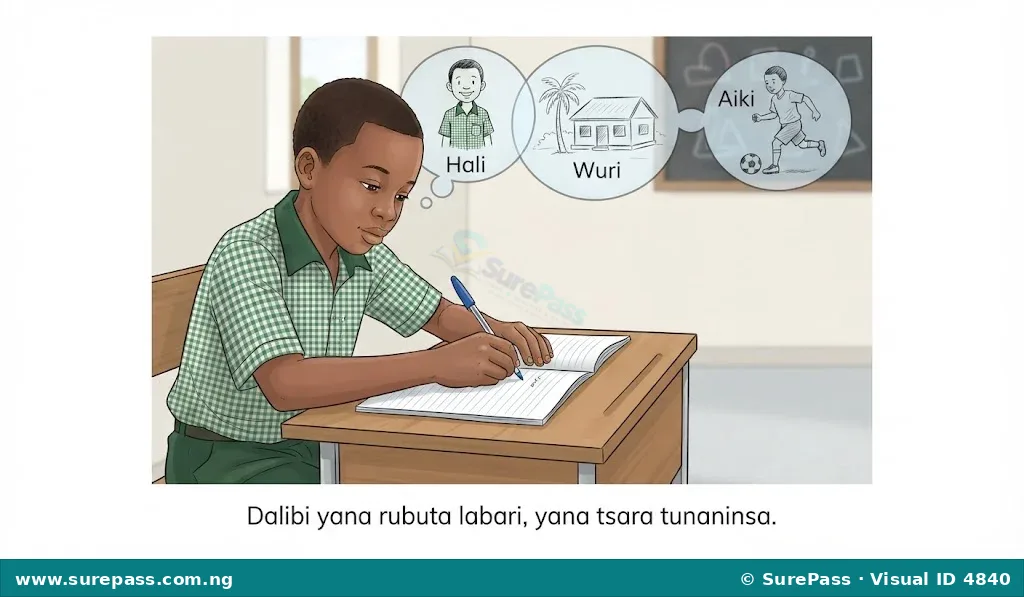
5. Yin Bita (Reviewing and Editing)
Once the draft is complete, the writer reads through the story carefully to find and correct mistakes. This step is crucial for making the story polished and correct.
During the editing stage, writers check for:
- Kurakuran rubutu (spelling errors).
- Kurakuran nahawu (grammar errors).
- Proper use of punctuation marks (aya, wakafi, and alamar tambaya).
- Proper use of capital letters at the beginning of sentences and for names.
- The overall flow and meaning of the story.
6. Kammalawa (Finalising)
This is the final step. After reviewing and correcting all errors, the writer copies the story neatly onto a clean sheet of paper or into a notebook. This final version is now ready to be read by others or presented to the class.
Aiwatarwa: Rubuta Gajeren Labari (Model Story)
Below is a complete model of a short story written by following the six steps of story writing.
Kan Labari (Topic): Yadda Musa ya Taimaki Tsohuwa
Muhalli (Setting): A kan hanya da rana (On the road, in the afternoon)
Labarin (The Story):
Wata rana da rana, Musa yana tafiya gida daga makaranta. Rana tana da zafi sosai, kuma kowa yana sauri ya isa gida domin ya huta.
Yana cikin tafiya, sai ya hango wata tsohuwa tana ɗauke da babban kwando cike da kayan gwari. Kwandon yana da nauyi sosai, kuma tsohuwar tana tafiya a hankali tana numfashi da kyar saboda gajiya.
Ba zato ba tsammani, sai tsohuwar ta tafi tuntuɓe da wani dutse. Kwandon ya faɗi, kuma dukkan kayan cikin kwandon suka warware a ƙasa. Tsohuwar ta zauna a ƙasa tana kuka saboda takaici.
Musa ya gudu da sauri ya taimaka mata. Ya fara tattara tumatur da albasa da sauran kayan ya mayar cikin kwandon. Bayan ya gama, ya taimaka wa tsohuwar ta tashi tsaye.
Musa ya ɗauki kwandon a kansa ya raka tsohuwar har gidanta. Tsohuwar ta yi farin ciki sosai. Ta yi masa addu’a kuma ta ba shi godiya mai yawa. Musa ya koma gida yana mai farin ciki saboda ya taimaki wani.
Ayyukan Ɗalibai (Class Activity)
Learners will work in small groups to write their own short story using the steps of story writing.
The steps for the group writing activity are:
- Zaɓi Kan Labari: Each group must choose one simple topic. It can be about an event at school, at home, or in the market.
- Tsara Muhalli: Discuss and write down where and when the story takes place.
- Jera Abubuwan da Zasu Faru: Write down a simple outline of the events from the beginning to the end.
- Rubuta Labarin Farko: Write the first draft of the story together. Every group member should contribute ideas.
- Bita da Gyara: Read the draft together. Check for spelling, grammar, capital letters, and punctuation. Correct any mistakes found.
- Rubuta Labarin Ƙarshe: Copy the corrected story neatly into a notebook.
- Karanta Labarin: One representative from each group will read the finished story aloud to the class.
Tambayoyin Gwada Ilimi (Exercises)
Review questions to test understanding include:
- Mene ne ma’anar rubutun labari?
- Kawo ƙa’idoji guda uku na rubutun Hausa da aka koya.
- A wane lokaci ake amfani da babban harafi a rubutun Hausa?
- Mene ne amfanin aya (.) da alamar tambaya (?) a cikin jimla?
- Guda nawa ne matakan rubuta gajeren labari? Ka rera su daki-daki.
- Mene ne ake nufi da “Muhallin Labari”? Ka ba da misali guda biyu na wuri da lokaci.
- Me yasa yake da muhimmanci a yi bita (reviewing and editing) kafin a kammala rubuta labari?



0 comments
Open the discussion when you need it. Comments stay collapsed until requested so the initial article remains light.