


ARTICLE CONTENTSOn this page 7 sections
Rubutun Insha’i
Performance Objectives
By the end of the lesson, students should be able to:
- gano ire-i ren rubutu • labari mai labartawa siffantawa;
- Rubuta ƙirƙirerren labari ta hanyar amfani da matakan;
- Karanta labarin da aka rubuta.
What is Insha’i?
Insha’i is a form of writing where a person expresses thoughts, opinions, or a story about a particular topic.
Writing an essay helps learners practice how to organize thoughts in written form and express ideas clearly in the Hausa language.
Types of Essay Writing
There are two main types of essay writing taught at this level:
- Insha’i Mai Labartawa (Narrative Essay)
- Insha’i Mai Siffantawa (Descriptive Essay)
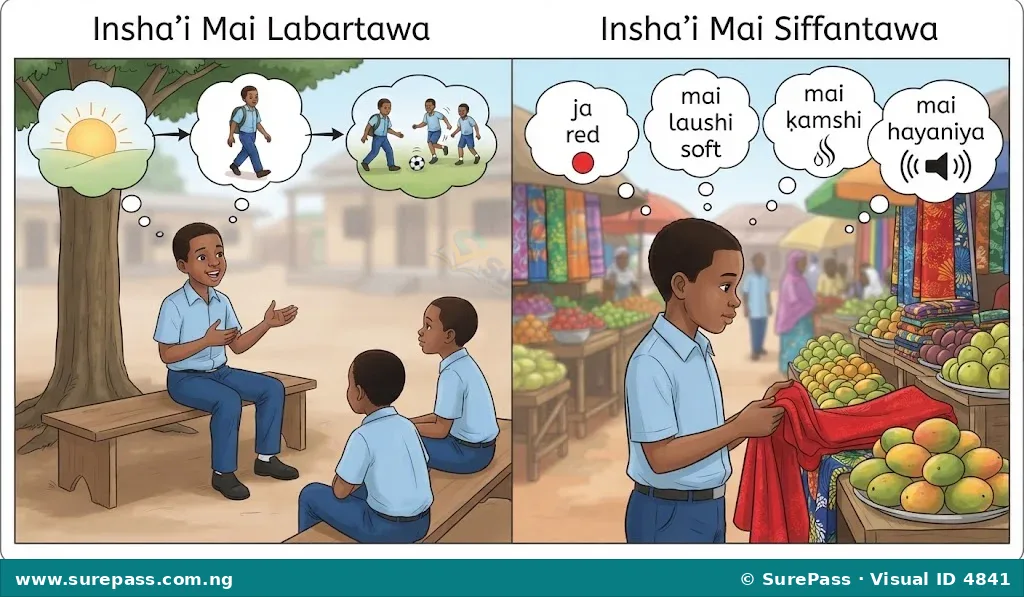
1. Insha’i Mai Labartawa (Narrative Essay)
Insha’i mai labartawa is a type of writing that tells a story or recounts an event that happened.
It has a beginning, a middle, and an end. It explains what happened, where it happened, when it happened, who was involved, and how it happened.
Examples of narrative essay topics in Hausa include:
- Ranar Kasuwa (Market Day)
- Tafiyata zuwa Gida (My Journey Home)
- Abin da ya faru a Makaranta (What Happened at School)
- Yadda Na Taimaki Wani (How I Helped Someone)
2. Insha’i Mai Siffantawa (Descriptive Essay)
Insha’i mai siffantawa is a type of writing that describes an object, a place, or a person in a way that allows the reader to picture, hear, or feel it in their mind.
It uses descriptive words to show how something looks, feels, sounds, or smells.
Examples of descriptive essay topics in Hausa include:
- Gidana (My House)
- Malamina (My Teacher)
- Kasuwa (The Market)
- Bishiyar Mangoro (The Mango Tree)
- Motar Babana (My Father’s Car)
Steps of Writing a Narrative Essay
To write a good narrative essay, there are steps that should be followed. These steps help to organize thoughts and write effectively:
- Tsara Tunani (Planning)
- Rubuta Daftari (Drafting)
- Gyara (Revising)
- Bincika Kuskure (Editing)
- Rubuta Na Ƙarshe (Finalizing)
1. Tsara Tunani (Planning)
This is the first step. Before writing, a person must think carefully about what to write.
The main areas to plan include:
- Zaɓin Batu (Choosing a Topic): What story does the writer want to tell?
- Muhallin Labari (Setting): Where does the story take place? (For example: at home, at school, in the market, or on the farm).
- Waɗanda Abin Ya Shafa (Characters): Who will be in the story? (For example: the writer, friends, parents, or a teacher).
- Abin da Ya Faru (Plot): What happens at the beginning, middle, and end of the story?
- Saƙon Labari (Message): What lesson or message should the story pass across?
Thinking deeply during this stage helps to create a meaningful and well-structured story.
2. Rubuta Daftari (Drafting)
After planning, the writer begins to write down the story. At this stage, the writer does not need to worry too much about spelling or grammar mistakes.
The main goal is to get all the planned ideas onto paper from beginning to end. The writer should try to use descriptive words to make the story interesting.
3. Gyara (Revising)
After drafting, the writer reads the story carefully. At this stage, the writer checks if the story makes sense, flows well, and if there are details to add or remove.
The main areas to check during revision include:
- Does the story have a clear beginning, middle, and end?
- Are the setting and characters clearly described?
- Does the story convey a meaningful message?
- Are there words or sentences that can be improved to make the story more interesting?
4. Bincika Kuskure (Editing)
This is the stage for checking spelling and grammar mistakes. After revising, the writer reads the story again to ensure there are no errors.
The main areas to check during editing include:
- Spelling mistakes (Kuskuren rubutu).
- Grammar mistakes (Kuskuren nahawu).
- Punctuation marks (Alamar rubutu), such as full stops (.), question marks (?), and exclamation marks (!).
- Capital letters (Manyan haruffa) at the beginning of sentences and for proper nouns.
Using correct words and understanding their meanings helps in writing without errors.
5. Rubuta Na Ƙarshe (Finalizing)
After editing, the writer writes the final, clean version of the story. This is the copy to be presented or shared.
The final copy should be neat, clear, and free of errors.
How to Write a Creative Narrative Essay
An example of how to write a narrative essay using the topic “Ranar Kasuwa” involves the following steps:
-
Tsara Tunani (Planning):
- Batu (Topic): Ranar Kasuwa.
- Muhalli (Setting): Kasuwar garinmu (Our town’s market).
- Waɗanda Abin Ya Shafa (Characters): Ni (Me), Mamana (My mother), and other people in the market.
- Abin da Ya Faru (Plot):
- Farko (Beginning): My mother told me we were going to the market, and I was very happy.
- Tsakiya (Middle): We went to the market. I saw many things like vegetables, fruits, and clothes. The market was very noisy. My mother bought food items.
- Ƙarshe (End): We returned home with the items we bought. I enjoyed going to the market.
- Saƙo (Message): The market is an important place for buying and selling.
-
Rubuta Daftari (Drafting):
Wata rana Mamana ta ce za mu je kasuwa. Na yi murna sosai. Mun shirya muka tafi. A kasuwa na ga mutane da yawa. Kayan lambu da ‘ya’yan itatuwa sun yi yawa. Akwai tumatir, albasa, mangoro, da ayaba. Kasuwar tana da hayaniya. Mamana ta sayi shinkafa da wake. Mun dawo gida da kayanmu. Na ji daɗin ranar kasuwa.
-
Gyara da Bincika Kuskure (Revising and Editing):
During this stage, the writer expands the sentences to make them more descriptive and corrects any spelling or punctuation errors.
-
Rubuta Na Ƙarshe (Finalizing):
Ranar Kasuwa
Wata Asabar da safe, Mamana ta kira ni ta ce, “Aisha, yau za mu je kasuwa!” Na yi tsalle saboda murna. Na shirya da sauri, muka fita. Rana tana haskawa sosai, kuma iska mai daɗi tana kaɗawa.
Da muka isa kasuwa, na ga mutane da yawa suna saye da sayarwa. Kasuwar tana cike da hayaniya da motsi. Akwai rumfuna masu yawa cike da kayan lambu masu launi daban-daban kamar tumatir ja, albasa fari, da attarugu kore. Na ga ‘ya’yan itatuwa masu daɗi kamar mangoro rawaya da ayaba mai zaki. Mamana ta sayi shinkafa, wake, da kuma sabbin kifi. Na taimaka mata ɗaukar wasu kayan.
Bayan mun gama sayayya, mun dawo gida. Na gaji amma na ji daɗin zuwa kasuwa. Na koyi cewa kasuwa wuri ne mai muhimmanci inda mutane ke haduwa don saye da sayar da abubuwa masu amfani.
Reading the Written Story
After writing a story, it is important to read it aloud. Reading helps the writer understand what was written and find any remaining mistakes.
The guidelines for reading a story well include:
- Karanta a Fili (Read Aloud): Reading the story aloud helps to hear how it sounds.
- Fahimtar Ma’ana (Understand the Meaning): The reader should ensure every sentence and word is understood. If there is an unfamiliar word, the meaning should be found.
- Amfani da Murya (Use Voice Expression): The reader can change the voice tone to show emotions or represent different characters in the story.
- Karanta a Hankali (Read Slowly): The reader should not rush, allowing the audience to understand.
- Karatu a Rukuni (Read in Groups): Reading in groups helps learners learn from each other and improve their reading skills.
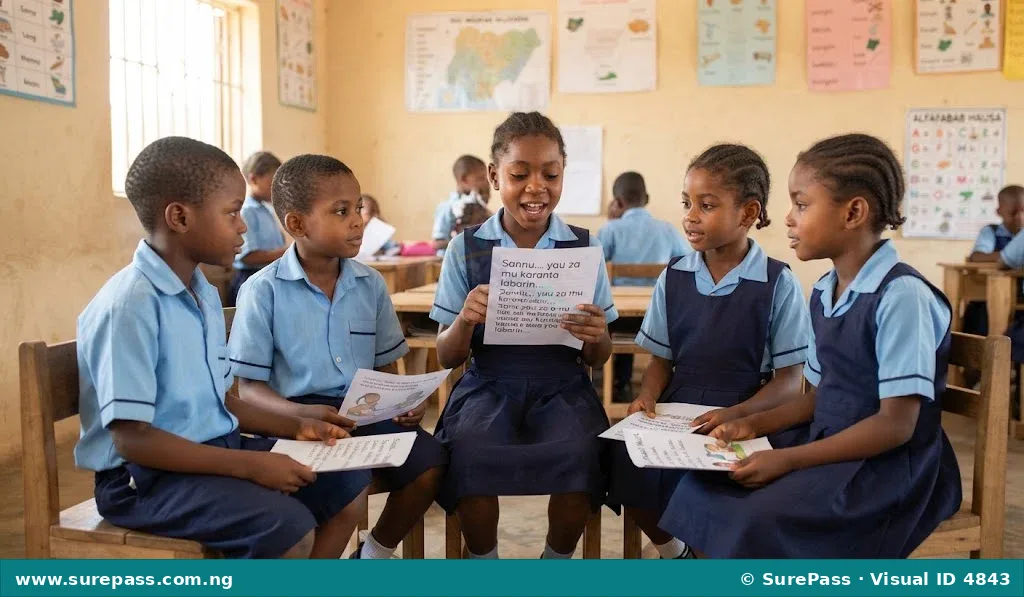
Reading aloud builds confidence and deepens the understanding of the story.


0 comments
Open the discussion when you need it. Comments stay collapsed until requested so the initial article remains light.