



ARTICLE CONTENTSOn this page 7 sections
Azuzuwan Kalmomin Hausa
Performance Objectives
By the end of the lesson, students should be able to:
- bayanin azuzuwan kalmomin Hausa(suna, wakilin suna, aikatau, siffatau, bayanau),
- rubuta ire-iren Hausa a manyan takardu;
- karanta ire-iren Hausa.
- kawo misalan ire-iren
- bincike a kan kalmomin Hausa a intanet
Ma’anar Azuzuwan Kalmomin Hausa
Azuzuwan kalmomi are the different classes or categories of words used to build correct sentences in the Hausa language.
Every word in a sentence has a specific role to play. Understanding these word classes helps in knowing how words work together to produce clear and correct meanings in Hausa.
Ire-iren Azuzuwan Kalmomin Hausa
In the Hausa language, there are five major parts of speech studied at this level. The five main parts of speech in Hausa are:
- Suna (Noun)
- Wakilin Suna (Pronoun)
- Aikatau (Verb)
- Siffatau (Adjective)
- Bayanau (Adverb)
1. Suna (Noun)
Suna is a word used to name a person, place, thing, or animal.
Nouns are the names of everything around us. In Hausa, nouns can represent people, locations, physical objects, or animals.
Examples of nouns in Hausa include:
- Mutum (Person): yaro (boy), yarinya (girl), Malam (teacher/Mr), Audu, Fatima
- Wuri (Place): gida (house), makaranta (school), kasuwa (market), Abuja, Kano
- Abu (Thing): littafi (book), alkalami (pen), kujera (chair), mota (car), ruwa (water)
- Dabba (Animal): kare (dog), kyanwa (cat), saniya (cow), akuya (goat), zaki (lion)
Examples of nouns used in sentences include:
- Audu ya zo gida. (Audu has come home.)
- Littafi yana kan tebur. (The book is on the table.)
2. Wakilin Suna (Pronoun)
Wakilin suna is a word used in place of a noun in a sentence to avoid repetition.
Pronouns make speech and writing smoother by replacing nouns that have already been mentioned.
Common pronouns in Hausa include:
- Shi: (He/It – masculine singular)
- Ita: (She/It – feminine singular)
- Su: (They – plural)
- Mu: (We – plural)
- Kai: (You – masculine singular)
- Ke: (You – feminine singular)
- Ku: (You – plural)
Examples of pronouns used in sentences include:
- Shi ya tafi makaranta. (He went to school.)
- Su suna wasa a fili. (They are playing in the field.)
- Mu za mu ci abinci. (We will eat food.)
3. Aikatau (Verb)
Aikatau is a word that expresses an action, occurrence, or state of being.
Verbs are action words. They tell us what the noun or pronoun is doing in a sentence.
Common verbs in Hausa include:
- ci (eat)
- sha (drink)
- gudu (run)
- rubuta (write)
- karanta (read)
- tashi (stand up/leave)
- zauna (sit down)
Examples of verbs used in sentences include:
- Yarinya tana karanta littafi. (The girl is reading a book.)
- Yaro ya gudu da sauri. (The boy ran quickly.)
4. Siffatau (Adjective)
Siffatau is a word that describes or qualifies a noun or a pronoun.
Adjectives give more information about a noun, such as its size, colour, quality, or appearance.
Common adjectives in Hausa include:
- mai kyau (beautiful/good)
- babba (big)
- karami (small)
- ja (red)
- fari (white)
- doguwa (tall/long – feminine)
- gajere (short – masculine)
Examples of adjectives used in sentences include:
- Audu yana da mota ja. (Audu has a red car.)
- Wannan gida babba ne. (This house is big.)
5. Bayanau (Adverb)
Bayanau is a word that describes how, when, or where an action takes place.
Adverbs modify verbs, telling us more about the action. They answer questions like “how?”, “when?”, or “where?”.
Types of adverbs in Hausa include:
- Bayanau na Yadda (Adverb of Manner – How): da sauri (quickly), a hankali (slowly), da kyau (well)
- Bayanau na Yaushe (Adverb of Time – When): yanzu (now), gobe (tomorrow), jiya (yesterday), kullum (always)
- Bayanau na Wuri (Adverb of Place – Where): nan (here), can (there), sama (up), kasa (down)
Examples of adverbs used in sentences include:
- Ya yi rubutu da kyau. (He wrote well.)
- Za mu tafi makaranta gobe. (We will go to school tomorrow.)
- Suna zaune nan. (They are sitting here.)
Karatu da Rubutu da Azuzuwan Kalmomi
To master Hausa parts of speech, pupils must practice reading sentences and identifying the word classes. Pupils should also practice writing sentences and labeling each word class.
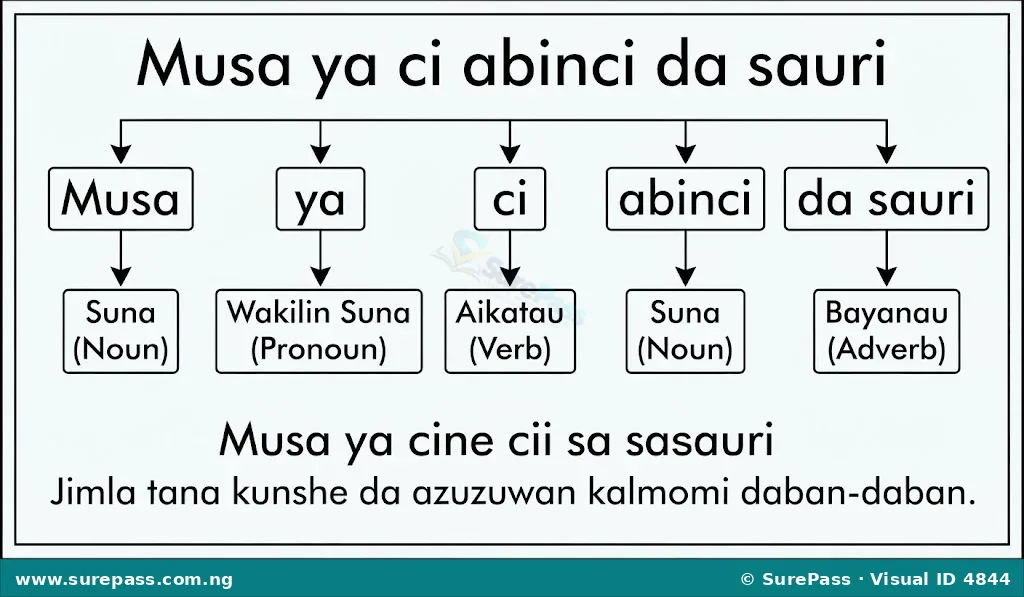
The following table shows how sentences are broken down into different parts of speech:
| Jimla (Sentence) | Kalma (Word) | Azuzuwan Kalma (Part of Speech) |
|---|---|---|
| Musa ya ci abinci. (Musa ate food.) | Musa | Suna (Noun) |
| ya | Wakilin Suna (Pronoun) | |
| ci | Aikatau (Verb) | |
| abinci | Suna (Noun) | |
| Yarinya tana tafiya a hankali. (The girl is walking slowly.) | Yarinya | Suna (Noun) |
| tana | Wakilin Suna (Pronoun) | |
| tafiya | Aikatau (Verb) | |
| a hankali | Bayanau (Adverb) |
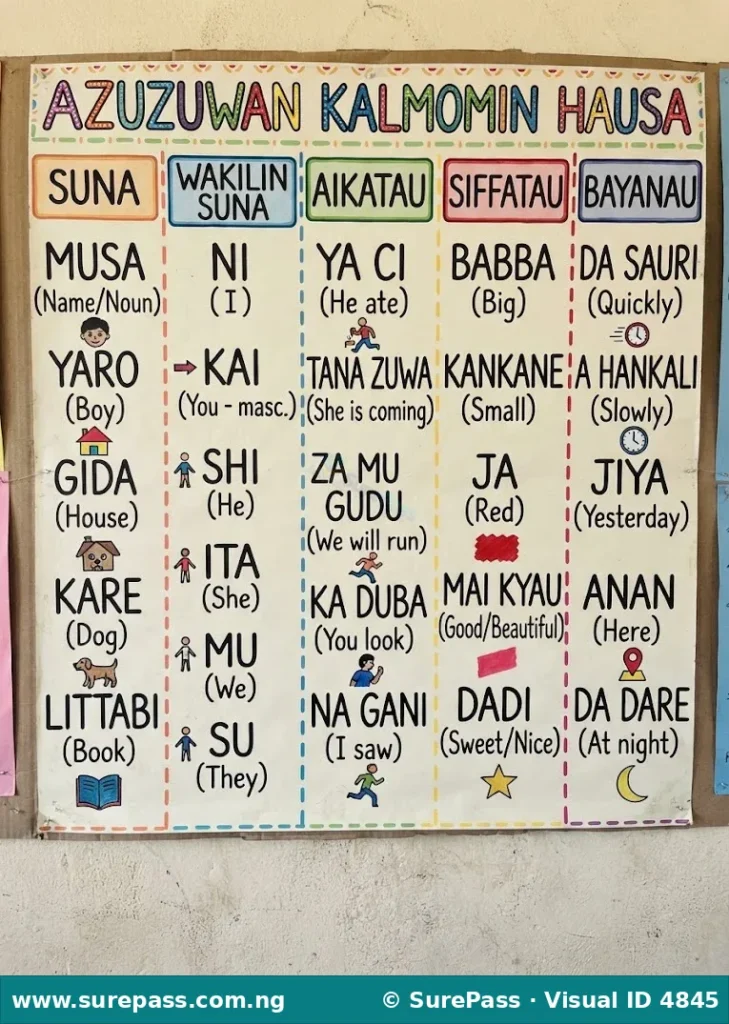
How to Create a Hausa Parts of Speech Chart on Large Paper
Creating a educational chart on large paper helps pupils to memorize and display the parts of speech in the classroom.
The required materials for creating a parts of speech chart are:
- A large sheet of cardboard or poster paper
- Coloured marker pens
- A ruler
- A pencil and eraser
The procedure for creating the chart involves the following steps:
- Place the large sheet of cardboard flat on a clean table.
- Use a ruler and pencil to draw five columns on the cardboard.
- Write the title “AZUZUWAN KALMOMIN HAUSA” in bold capital letters at the top of the cardboard using a dark marker.
- Label the top of each column with one of the five parts of speech: Suna, Wakilin Suna, Aikatau, Siffatau, and Bayanau.
- Write three clear examples under each column using a different coloured marker.
- Draw a small illustration or write a simple sentence at the bottom of each column to show how the words are used.
- Hang the completed chart on the classroom wall for daily reading practice.
Bincike a Kan Kalmomin Hausa a Intanet
The internet is a valuable tool for learning more about Hausa grammar and vocabulary. Pupils can use computers or mobile phones under adult supervision to search for word meanings and sentence examples.
The required tools for online research are:
- A computer, tablet, or smartphone
- An active internet connection
- A web browser or online Hausa dictionary application
The procedure for searching for Hausa words involves the following steps:
- Open the web browser on the device.
- Type the address of a search engine or an online Hausa dictionary.
- Enter the Hausa word to be researched in the search bar.
- Add keywords such as “meaning in English” or “misalin jimla” to find definitions and sentence examples.
- Press the search button and read the results carefully.
- Write down the meaning and examples in a notebook.


0 comments
Open the discussion when you need it. Comments stay collapsed until requested so the initial article remains light.