



ARTICLE CONTENTSOn this page 10 sections
Exprimer le besoin
Performance Objectives
By the end of the lesson, students should be able to:
- Exprimer ses souhaits en termes de besoins dans un français simple.
Pourquoi exprimer ses besoins en français?
In daily life, people frequently need to state what they require or what they desire. Learning to express these needs in French is an important communication skill. It allows learners to interact clearly with teachers, classmates, family members and friends who speak French.
Un besoin is a necessity or something required to complete a task, maintain health or survive.
Un souhait is a wish or a desire for something that is wanted but not strictly necessary.
Knowing how to express needs and wishes helps a person to ask for assistance, request school materials, or share physical feelings like hunger and tiredness. This unit teaches simple French phrases and vocabulary to express these concepts clearly.
Mots et Phrases pour Exprimer le Besoin
Specific French phrases are used to express what a person needs or wants. The most common expressions are “J’ai besoin de…”, “Je veux…” and “J’aimerais…”.
J’ai besoin de… (I need…)
The phrase “J’ai besoin de…” is used to express a necessity. The word “de” changes form depending on whether the following word is singular, plural, or begins with a vowel sound.
Examples of using “J’ai besoin de…” with singular items include:
- J’ai besoin d’un livre. (I need a book.)
- J’ai besoin d’une gomme. (I need an eraser.)
Examples of using “J’ai besoin de…” with plural or general items include:
- J’ai besoin de stylos. (I need pens.)
- J’ai besoin d’eau. (I need water.)
Je veux… (I want…)
The phrase “Je veux…” is used to express a direct desire or a strong wish for an object or an action.
Examples of using “Je veux…” with singular items include:
- Je veux un crayon. (I want a pencil.)
- Je veux une règle. (I want a ruler.)
Examples of using “Je veux…” with plural items or actions include:
- Je veux des biscuits. (I want some biscuits.)
- Je veux manger. (I want to eat.)
J’aimerais… (I would like…)
The phrase “J’aimerais…” is a polite way to express a wish or a desire. It is often used when making requests to teachers or elders.
Examples of using “J’aimerais…” include:
- J’aimerais un jus. (I would like a juice.)
- J’aimerais une pomme. (I would like an apple.)
Écouter et Comprendre
To understand what another person needs, close attention must be paid to the specific words they use. When a speaker says “J’ai besoin de…” or “Je veux…”, the noun that follows reveals their exact need or wish.
Key vocabulary words to listen for include:
- un sac (a bag)
- un livre (a book)
- de l’eau (water)
- un stylo (a pen)
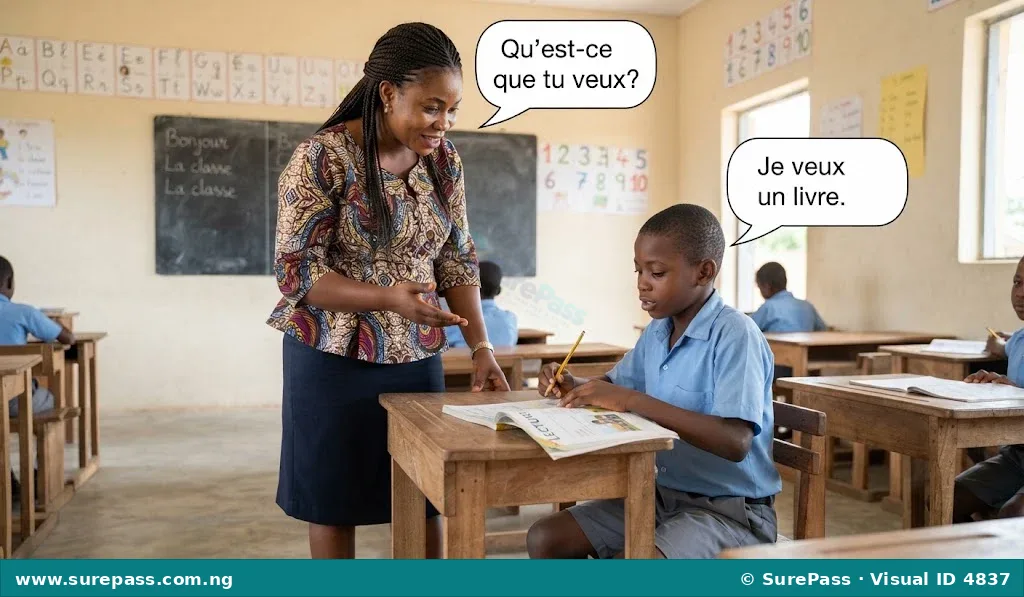
Observe the image below to see how a student communicates a need to a teacher.
Lecture des Phrases Simples des Besoins
Reading simple sentences aloud helps to recognise how needs are expressed in written French. This practice builds familiarity with sentence structures.
Simple sentences expressing needs and wishes include:
- J’ai besoin d’un stylo. (I need a pen.)
- Je veux une banane. (I want a banana.)
- J’ai besoin d’un cahier. (I need a notebook.)
- Je veux de l’eau. (I want water.)
- J’aimerais un gâteau. (I would like a cake.)
- J’ai besoin de dormir. (I need to sleep.)
S’exprimer à l’Oral: Prononcer les Mots et les Phrases
Correct pronunciation ensures that spoken French is easily understood by others. Practising the sounds of French words helps to build speaking confidence.
The procedure for practising pronunciation involves the following steps:
- Listen carefully to a French speaker or teacher pronouncing the phrases.
- Repeat each phrase slowly, focusing on copying the correct vowel and consonant sounds.
- Repeat the phrases at a normal speaking speed while maintaining clear pronunciation.
- Practise speaking with a classmate, taking turns to express different needs.
The pronunciation guide for common French phrases and words includes:
- J’ai besoin de… (pronounced: zhay buh-ZWAN duh)
- Je veux… (pronounced: zhuh VUH)
- J’aimerais… (pronounced: zhay-MEH-reh)
- un livre (pronounced: uhn LEE-vruh)
- une gomme (pronounced: ewn GOM)
- un crayon (pronounced: uhn KRAY-yon)
- de l’eau (pronounced: duh LOH)
- manger (pronounced: mahn-ZHAY)
- dormir (pronounced: dor-MEER)
S’exprimer à l’Écrit: L’Usage des Mots pour Exprimer le Besoin
Writing sentences helps to reinforce vocabulary and master French sentence structures. Writing practice ensures that spelling and grammar rules are applied correctly.
The procedure for writing sentences to express needs involves the following steps:
- Identify the specific object or action that is needed or wanted.
- Select the appropriate French phrase: “J’ai besoin de…”, “Je veux…”, or “J’aimerais…”.
- Find the correct French noun or verb for the item or action, ensuring the correct gender (masculine or feminine) is used.
- Write the complete sentence clearly, starting with a capital letter and ending with a full stop.
For example, to express the need for a pencil, the written sentence is: “J’ai besoin d’un crayon.”
Practice writing French sentences for the following English expressions:
- I need a bag.
- I want a biscuit.
- I would like a juice.
- I need to drink.
- I want to play.
Poser des Questions sur les Besoins
To find out what another person needs or wants, specific questions can be asked. This allows for helpful interactions in the classroom or at home.
Qu’est-ce que tu veux? (What do you want?)
This question is used to ask someone directly about their wishes or desires.
An example of this question and its response is:
- Question: Qu’est-ce que tu veux?
- Answer: Je veux un stylo. (I want a pen.)
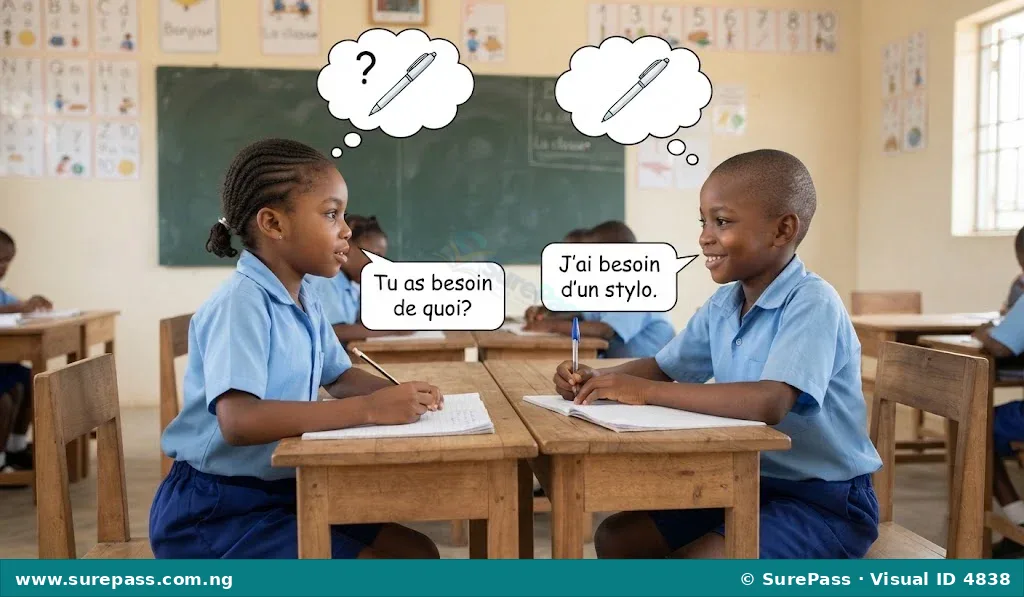
Tu as besoin de quoi? (What do you need?)
This question is used to ask someone directly about their necessities or requirements.
An example of this question and its response is:
- Question: Tu as besoin de quoi?
- Answer: J’ai besoin d’un cahier. (I need a notebook.)
Look at the illustration below to see how children ask and answer questions about their needs.
Exprimer ses Souhaits et Besoins
Combining the learned phrases and vocabulary allows learners to express various physical needs, school requirements and personal wishes in simple French sentences.
Common expressions categorized by specific needs include:
- Pour la faim (For hunger):
- J’ai besoin de manger. (I need to eat.)
- Je veux un sandwich. (I want a sandwich.)
- Pour la soif (For thirst):
- J’ai besoin de boire. (I need to drink.)
- Je veux de l’eau. (I want water.)
- Pour les fournitures scolaires (For school supplies):
- J’ai besoin d’un livre. (I need a book.)
- Je veux un nouveau crayon. (I want a new pencil.)
- Pour le repos (For rest):
- J’ai besoin de dormir. (I need to sleep.)
- J’aimerais me reposer. (I would like to rest.)
Practising these phrases regularly helps to develop fluent communication skills in French.


0 comments
Open the discussion when you need it. Comments stay collapsed until requested so the initial article remains light.