


ARTICLE CONTENTSOn this page 6 sections
Se saluer/ saluer quelqu’un et se présenter
Performance Objectives
By the end of the lesson, students should be able to:
- S’exprimer dans une situation de salutation en français simple et correcte.
- Saluer leurs parents et les autres avec des bonnes prononciations en français simple.
- Se présenter
L’importance des salutations en français
In French culture, just like in Nigeria, greetings are very important. They show respect and politeness when you meet someone. Learning how to greet people and introduce yourself in French helps you communicate and make new friends.
Les Salutations (Greetings)
There are different ways to greet people in French, depending on the time of day and whether you are meeting someone or saying goodbye.
Salutations du matin, de l’après-midi et du soir
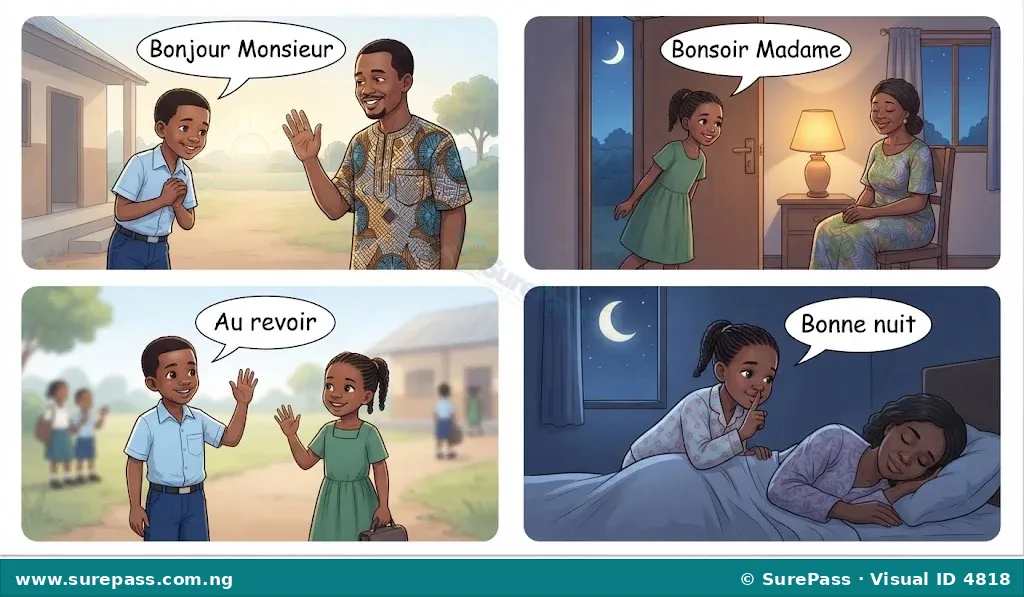
When you meet someone during the day, you use “Bonjour”. This word means “good day” and can be used from morning until late afternoon.
Bonjour: Good morning / Good day
In the evening, when the sun starts to set, you use “Bonsoir”.
Bonsoir: Good evening
If you are wishing someone a pleasant evening, you can say “Bonne soirée”.
Bonne soirée: Have a good evening
Salutation de la nuit
When it is late at night and you are going to bed, or someone else is going to bed, you say “Bonne nuit”.
Bonne nuit: Good night
Salutations formelles
When you greet adults or people you do not know very well, you can add “Monsieur”, “Madame”, or “Mademoiselle” after “Bonjour” or “Bonsoir”.
- Monsieur: Sir / Mr. (for a man)
- Madame: Ma’am / Mrs. (for a married woman)
- Mademoiselle: Miss (for an unmarried woman)
Examples:
- Bonjour Monsieur. (Good morning, Sir.)
- Bonsoir Madame. (Good evening, Ma’am.)
- Bonjour Mademoiselle. (Good morning, Miss.)
Prendre congé (Taking Leave)
When you are leaving someone, there are different ways to say goodbye.
Au revoir: Goodbye (This is the most common way to say goodbye.)
À demain: See you tomorrow
Adieu: Farewell (This is used when you do not expect to see the person again for a very long time, or ever. It is less common in daily use.)
Rencontrer quelqu’un (Meeting Someone)
When you meet someone new, you can say “Enchanté(e)” to express that you are pleased to meet them.
Enchanté(e): Pleased to meet you
The extra ‘e’ in parentheses (e) means that if a girl or woman is saying it, she adds an ‘e’ at the end, but it sounds the same.
Conseils de prononciation (Pronunciation Tips)
Pronouncing French words correctly is important. Here are some tips for the greetings:
- Bonjour: Say “bon-zhoor”. The ‘j’ sounds like the ‘s’ in “measure”.
- Bonsoir: Say “bon-swar”.
- Bonne nuit: Say “bon-nwee”.
- Au revoir: Say “oh ruh-vwar”.
- Enchanté(e): Say “on-shahn-tay”. The ‘en’ sounds like ‘on’ in “song”.
Se Présenter (Introducing Yourself)
After greeting someone, you might want to introduce yourself. This means telling them your name.
Demander et dire son nom (Asking and Stating Your Name)
To ask someone their name, you can say “Comment tu t’appelles?”. This is an informal way to ask.
Comment tu t’appelles?: What is your name? (informal)
To say your name, you use “Je m’appelle…” followed by your name.
Je m’appelle…: My name is…
You can also say “Je suis…” followed by your name.
Je suis…: I am…
Examples:
- Comment tu t’appelles? (What is your name?)
- Je m’appelle Amina. (My name is Amina.)
- Je suis David. (I am David.)
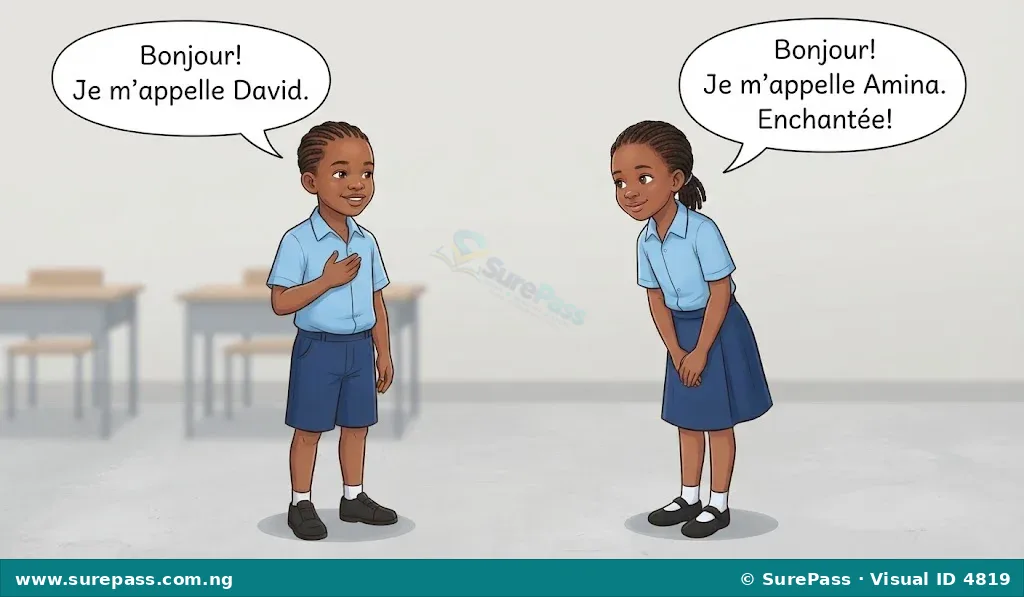
Dialogue simple pour se présenter (Simple Dialogue for Self-Introduction)
Here is an example of a simple conversation when two people meet and introduce themselves:
Amina: Bonjour!
David: Bonjour!
Amina: Comment tu t’appelles?
David: Je m’appelle David. Et toi, comment tu t’appelles?
Amina: Je m’appelle Amina. Enchantée!
David: Enchanté!
Let’s see what they are saying in English:
Amina: Good day!
David: Good day!
Amina: What is your name?
David: My name is David. And you, what is your name?
Amina: My name is Amina. Pleased to meet you!
David: Pleased to meet you!
Pratiquer les salutations et les présentations (Practising Greetings and Introductions)
To become good at speaking French, you need to practise. You can practise with your family, friends, or classmates.
Saluer les membres de la famille
Practise greeting your family members at different times of the day. For example:
- When you wake up, say “Bonjour Maman” or “Bonjour Papa”.
- In the evening, say “Bonsoir Maman” or “Bonsoir Papa”.
- When you go to bed, say “Bonne nuit Maman” or “Bonne nuit Papa”.
- When you leave for school, say “Au revoir Maman” or “Au revoir Papa”.
Se présenter avec un dialogue
Practise introducing yourself and asking for someone else’s name. You can do this with a partner. Take turns being Amina and David from the example dialogue. Remember to use good pronunciation.
The procedure for practising a simple introduction is:
- One person starts by saying “Bonjour!”
- The other person responds with “Bonjour!”
- The first person asks, “Comment tu t’appelles?”
- The second person replies, “Je m’appelle [their name]. Et toi, comment tu t’appelles?”
- The first person replies, “Je m’appelle [their name]. Enchanté(e)!”
- The second person replies, “Enchanté(e)!”



0 comments
Open the discussion when you need it. Comments stay collapsed until requested so the initial article remains light.