


ARTICLE CONTENTSOn this page 9 sections
Les jours de la semaine
Performance Objectives
By the end of the lesson, students should be able to:
- Lister les jours de la semaine en langue français.
- Prononcer correctement les jours de la semaine.
- Identifier ces jours.
Introduction aux jours de la semaine
A week is a period of seven consecutive days.
Every week has seven days. These days help to organise time for school, play, and rest. In French, just like in English, each day has a special name. Learning the days of the week in French helps learners to talk about schedules and understand when events happen.
Les noms des jours de la semaine
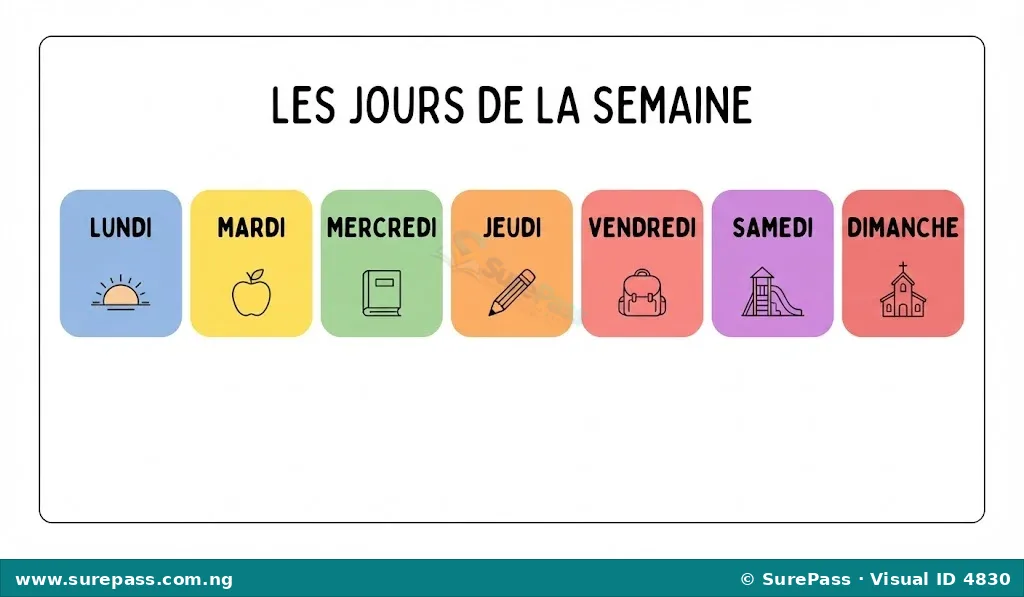
There are seven days in a week. The names of these days in French, along with their English meanings, are:
- Lundi (Monday)
- Mardi (Tuesday)
- Mercredi (Wednesday)
- Jeudi (Thursday)
- Vendredi (Friday)
- Samedi (Saturday)
- Dimanche (Sunday)
In French, the days of the week do not start with a capital letter unless they are at the beginning of a sentence. For example, one writes “lundi” in the middle of a sentence, but “Lundi” at the start. Additionally, the week in France and many French-speaking countries traditionally starts with Monday (lundi), rather than Sunday (dimanche).
Prononciation des jours de la semaine
Correct pronunciation is important when speaking French. Listening carefully and repeating the names of the days helps to build speaking skills. A guide to pronouncing each day includes:
- Lundi (Luhn-dee) – The ‘un’ sounds like the ‘uhn’ in ‘fun’.
- Mardi (Mahr-dee) – The ‘ar’ sounds like the ‘ar’ in ‘car’.
- Mercredi (Mehr-kruh-dee) – The ‘er’ sounds like the ‘ehr’ in ‘her’.
- Jeudi (Juh-dee) – The ‘eu’ sounds like the ‘uh’ in ‘up’.
- Vendredi (Vahn-druh-dee) – The ‘en’ sounds like the ‘ahn’ in ‘want’.
- Samedi (Sahm-dee) – The ‘a’ sounds like the ‘ah’ in ‘father’.
- Dimanche (Dee-mahnsh) – The ‘im’ sounds like the ‘eem’ in ‘team’, and ‘an’ sounds like ‘ahn’ in ‘want’.
Practising these words aloud helps to master the correct French sounds.
Les jours de la semaine et le calendrier
A calendar helps to show all the days of the week and month. On a French calendar, the days are listed from lundi to dimanche. This helps in planning activities for each day.
For example, if today is mardi, then yesterday was lundi, and tomorrow will be mercredi.
Useful words for identifying days on a calendar include:
- Aujourd’hui (Today)
- Hier (Yesterday)
- Demain (Tomorrow)
- Le jour (The day)
- La semaine (The week)
Identifier les jours avec les activités
Different activities are performed on different days of the week. Associating each day with specific activities helps in remembering the days. Examples of common activities include:
- Le lundi: Les élèves vont à l’école. (On Monday: Students go to school.)
- Le mardi: Les élèves étudient les mathématiques. (On Tuesday: Students study mathematics.)
- Le mercredi: Les élèves jouent au football après l’école. (On Wednesday: Students play football after school.)
- Le jeudi: Les élèves lisent des livres. (On Thursday: Students read books.)
- Le vendredi: Les élèves rentrent à la maison pour le week-end. (On Friday: Students go home for the weekend.)
- Le samedi: Les familles visitent leurs amis. (On Saturday: Families visit their friends.)
- Le dimanche: Les familles vont à l’église ou se reposent. (On Sunday: Families go to church or rest.)
To talk about personal activities, the structure “Le [day], je [activity]” is used. For example, “Le lundi, je vais à l’école” means “On Mondays, I go to school.”
Chanson des jours de la semaine
Singing songs is an effective way to learn and remember new words. A simple song about the days of the week in French can be sung to a familiar tune, such as “Frère Jacques” or “Twinkle, Twinkle Little Star”:
Les Jours de la Semaine
Lundi, Mardi, Mercredi,
Jeudi, Vendredi, Samedi,
Dimanche aussi,
Sept jours dans la semaine,
Chaque jour est une joie,
Lundi, Mardi, Mercredi,
Jeudi, Vendredi, Samedi,
Dimanche aussi.
Exercices
Answer the following questions to practice the lesson:
- List the seven days of the week in French in the correct order starting from Monday.
- What is the French word for “Wednesday”?
- What is the French word for “Sunday”?
- Translate this sentence into English: “Le samedi, les familles visitent leurs amis.”
- If today is jeudi, what day is tomorrow in French?



0 comments
Open the discussion when you need it. Comments stay collapsed until requested so the initial article remains light.