



ARTICLE CONTENTSOn this page 7 sections
L’usage de masculin et féminin
Performance Objectives
By the end of the lesson, students should be able to:
- Différencier les genres masculin et féminin en langue française à travers des phrases.
- Former des phrases masculins/ féminins
Le genre des noms en français
In French, every noun, which is a word for a person, place, animal or thing, has a gender. This gender is either masculine (masculin) or feminine (féminin). This is a key difference from English, where most objects do not have a gender. Understanding the gender of a French noun is very important because it affects other words that are used with it, such as articles like “a” or “an”.
Les articles “un” et “une”
The words “un” and “une” are used in French to mean “a” or “an”. These are called indefinite articles. The choice between “un” and “une” depends entirely on the gender of the noun that follows it.
- Un: This article is used for masculine singular nouns.
- Une: This article is used for feminine singular nouns.
For example, the word “garçon” (boy) is a masculine noun, so it is always used with “un” to form “un garçon”. The word “fille” (girl) is a feminine noun, so it is always used with “une” to form “une fille”.
Identifier le genre avec “un” et “une”
It is important for learners to know the gender of each new noun they learn in French. Sometimes, the ending of a word can give a clue about its gender, but this is not always a reliable rule. For Primary 4, the focus is on learning common words with their correct article, “un” or “une”.
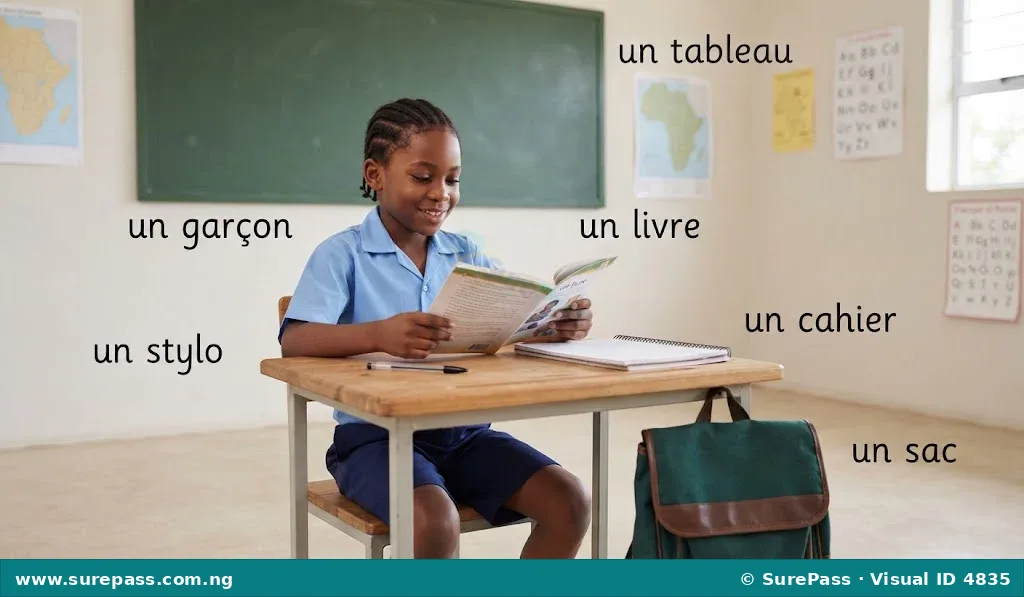
Examples of masculine words that use “un” include:
- un garçon (a boy)
- un stylo (a pen)
- un livre (a book)
- un tableau (a board)
- un cahier (a notebook)
- un sac (a bag)
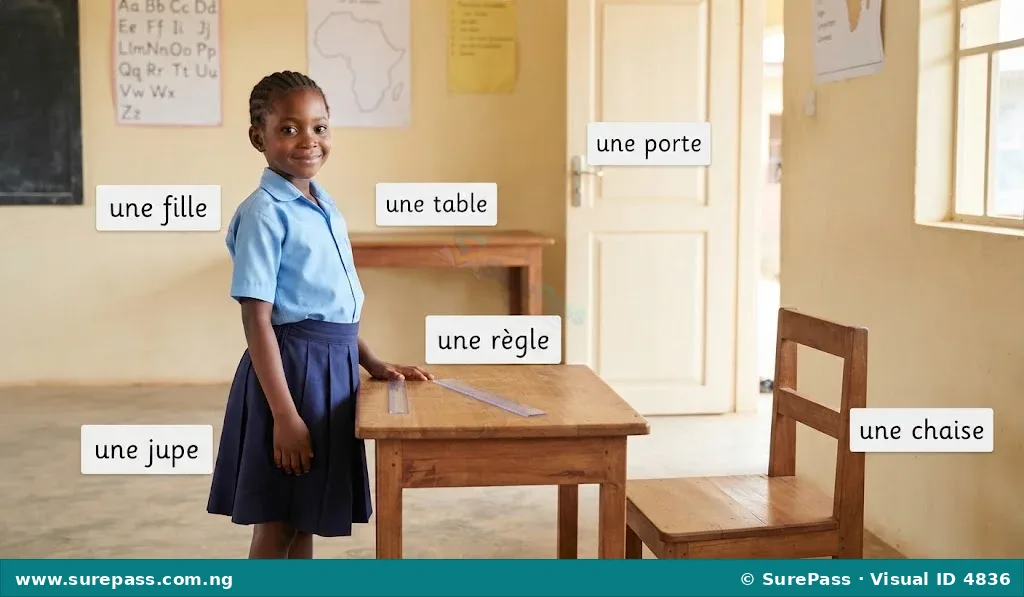
Examples of feminine words that use “une” include:
- une fille (a girl)
- une jupe (a skirt)
- une règle (a ruler)
- une chaise (a chair)
- une table (a table)
- une porte (a door)
Différencier les genres masculin et féminin à travers des phrases
To tell the difference between masculine and feminine words in sentences, learners should pay close attention to the article “un” or “une” used before the noun. This article is the main clue that tells you the gender of the noun.
Observe the following sentences and identify the gender of the underlined words based on the article:
- C’est un garçon. (It is a boy.) – “garçon” is masculine because “un” is used.
- C’est une fille. (It is a girl.) – “fille” is feminine because “une” is used.
- Voilà un stylo. (Here is a pen.) – “stylo” is masculine because “un” is used.
- Voilà une règle. (Here is a ruler.) – “règle” is feminine because “une” is used.
- Il est un élève. (He is a student.) – “élève” is masculine here because “un” is used and “il” refers to a boy.
- Elle est une élève. (She is a student.) – “élève” is feminine here because “une” is used and “elle” refers to a girl.
Former des phrases masculines et féminines
To form simple sentences using masculine and feminine words correctly, learners need to choose the right article (“un” or “une”) for the noun they are using. Simple phrases like “C’est…” (It is…) or “Voilà…” (Here is…) can be used to build these sentences.
The procedure for forming sentences with correct gender includes the following steps:
- Choose a noun you want to use, for example, “livre” (book).
- Determine its gender. “Livre” is a masculine noun.
- Choose the correct article for its gender: “un” for masculine. This gives “un livre”.
- Form a simple sentence using the noun and its article: “C’est un livre.” (It is a book.)
Let’s try another example with a feminine noun:
- Choose a noun: “gomme” (eraser).
- Determine its gender. “Gomme” is a feminine noun.
- Choose the correct article for its gender: “une” for feminine. This gives “une gomme”.
- Form a simple sentence using the noun and its article: “Voilà une gomme.” (Here is an eraser.)
Rédiger des phrases avec les genres corrects
Writing sentences with the correct gender involves applying the knowledge of “un” and “une” to different nouns. This practice helps to strengthen the understanding of masculine and feminine forms in French.
Write sentences for the following words, making sure to use the correct article (“un” or “une”) based on their gender:
- crayon (pencil)
- chaise (chair)
- sac (bag)
- porte (door)
- tableau (board)
- fenêtre (window)
Here are examples of how to write sentences for these words:
- Crayon: “Un crayon” (masculine). Sentence: “C’est un crayon.” (It is a pencil.)
- Chaise: “Une chaise” (feminine). Sentence: “Voilà une chaise.” (Here is a chair.)
- Sac: “Un sac” (masculine). Sentence: “J’ai un sac.” (I have a bag.)
- Porte: “Une porte” (feminine). Sentence: “C’est une porte.” (It is a door.)
- Tableau: “Un tableau” (masculine). Sentence: “Le professeur écrit sur un tableau.” (The teacher writes on a board.)
- Fenêtre: “Une fenêtre” (feminine). Sentence: “Il y a une fenêtre dans la classe.” (There is a window in the classroom.)


0 comments
Open the discussion when you need it. Comments stay collapsed until requested so the initial article remains light.