



ARTICLE CONTENTSOn this page 8 sections
Le verbe être au présent
Performance Objectives
By the end of the lesson, students should be able to:
- Utiliser le verbe être dans des phrases.
- Décrire les différentes formes du verbe être.
Introduction au verbe être
In French, just like in English, verbs are words that describe actions or states of being. They help to form sentences and express ideas. One of the most important verbs in French is “être”.
The verb “être” means “to be” in English. It is used very often to say who someone is, what something is, or how someone feels. Understanding “être” is key to speaking and writing simple French sentences.
La signification du verbe être (Meaning of the verb ‘to be’)
The verb “être” is used to express existence, identity, characteristics, and states. It helps to form many basic sentences in French. For example, when a person wants to say “I am a student” or “She is happy”, the verb “être” is used in French.
This verb helps to describe people, animals, and objects. It tells us about their nature or their current condition.
Les différentes formes du verbe être (Different forms of the verb ‘to be’)
In French, verbs change their form depending on the subject pronoun. This change is called conjugation. The verb “être” is an irregular verb, which means its forms do not follow a regular pattern that other verbs might use.
The subject pronouns tell us who is performing the action or who is being described. Here are the main subject pronouns in French:
- Je (I)
- Tu (You – singular, used for friends, family, or children)
- Il (He)
- Elle (She)
- Nous (We)
- Vous (You – plural, used for more than one person, or singular, used formally for adults or strangers)
- Ils (They – used for a group of males or a mixed group of males and females)
- Elles (They – used for a group of females only)
Now, observe how the verb “être” is conjugated in the present tense with these pronouns. Each pronoun has a specific form of “être” that goes with it.
The conjugated forms of “être” in the present tense are:
- Je suis (I am)
- Tu es (You are – singular, informal)
- Il est (He is)
- Elle est (She is)
- Nous sommes (We are)
- Vous êtes (You are – plural, or singular, formal)
- Ils sont (They are – masculine or mixed)
- Elles sont (They are – feminine)
Utiliser le verbe être dans des phrases (Using the verb ‘être’ in sentences)
The verb “être” is used to describe many things in French. Here are some common ways to use it in sentences, with examples:
1. Pour décrire l’identité (To describe identity)
This use helps to say who someone is or what something is. It tells us about a person’s role or the nature of an object.
- Je suis un élève. (I am a student.)
- Tu es mon ami. (You are my friend.)
- Il est un garçon. (He is a boy.)
- Elle est une fille. (She is a girl.)
- Nous sommes des enfants. (We are children.)
- Vous êtes des professeurs. (You are teachers.)
- Ils sont des hommes. (They are men.)
- Elles sont des femmes. (They are women.)
2. Pour décrire la nationalité (To describe nationality)
This use helps to say where someone is from, or their country of origin.
- Je suis Nigérian(e). (I am Nigerian.)
- Tu es Français(e). (You are French.)
- Il est Américain. (He is American.)
- Elle est Anglaise. (She is English.)
- Nous sommes Africains. (We are Africans.)
- Vous êtes Chinois(es). (You are Chinese.)
3. Pour décrire les sentiments ou l’état (To describe feelings or state)
This use helps to say how someone feels or their current condition or location.
- Je suis content(e). (I am happy.)
- Tu es fatigué(e). (You are tired.)
- Il est malade. (He is sick.)
- Elle est triste. (She is sad.)
- Nous sommes en classe. (We are in class.)
- Vous êtes à la maison. (You are at home.)
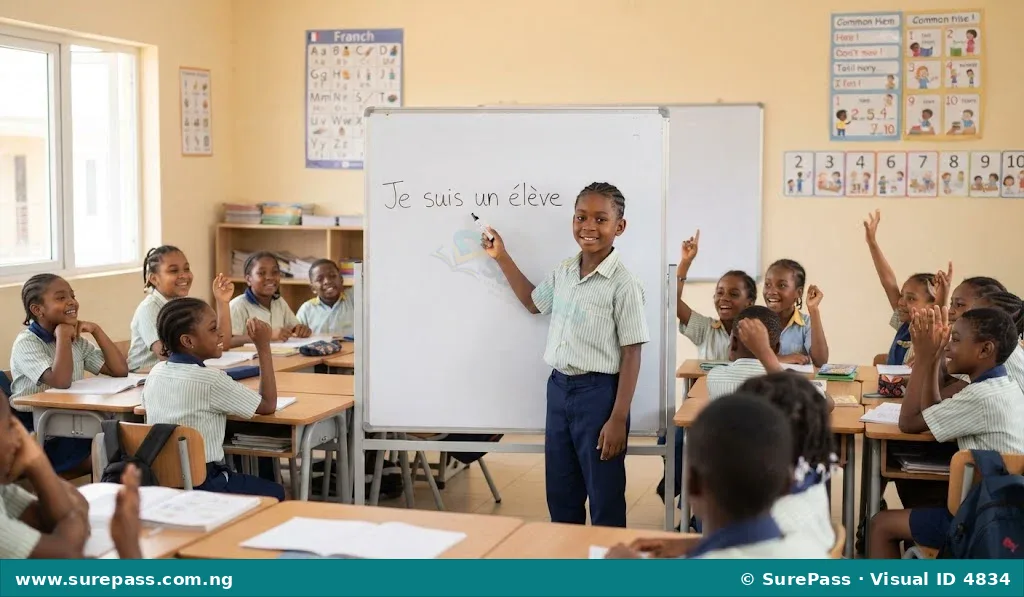
Pratique orale: Conjugaison et expression (Oral practice: Conjugation and expression)
Practising the conjugation of “être” out loud helps to remember its forms and how to use them. Try saying the forms with the pronouns and then in full sentences.
A teacher may ask questions like “Qui es-tu?” (Who are you?) or “Comment est-elle?” (How is she?). Learners can answer using the correct form of “être”.
Practice saying the following sentences aloud:
- Say “Je suis…” and complete the sentence with your name or what you are. For example: “Je suis David,” or “Je suis un élève.”
- Say “Tu es…” and complete the sentence about a friend. For example: “Tu es mon ami,” or “Tu es gentil.”
- Say “Il est…” or “Elle est…” and describe a boy or a girl. For example: “Il est grand,” or “Elle est belle.”
- Say “Nous sommes…” and describe your group. For example: “Nous sommes des amis,” or “Nous sommes en classe.”
- Say “Vous êtes…” and describe your teachers or a group of people. For example: “Vous êtes intelligents,” or “Vous êtes des professeurs.”
- Say “Ils sont…” or “Elles sont…” and describe a group of boys or girls. For example: “Ils sont heureux,” or “Elles sont Nigérianes.”
Pratique écrite: Écrire des phrases avec le verbe être (Written practice: Writing sentences with the verb ‘être’)
Writing sentences helps to solidify understanding of the verb “être” and its different forms. Complete the following exercises in your notebook.
Complete the following sentences by choosing the correct form of “être” (suis, es, est, sommes, êtes, sont):
- Je __ un garçon.
- Tu __ une fille.
- Il __ mon frère.
- Elle __ ma sœur.
- Nous __ des élèves.
- Vous __ des amis.
- Ils __ grands.
- Elles __ petites.
- Le livre __ sur la table.
- Les chaises __ dans la salle.
Write five original sentences using different forms of the verb “être” to describe people or things around you. Remember to use a different subject pronoun for each sentence.
- (Example: Je suis content.)
- (Your sentence)
- (Your sentence)
- (Your sentence)
- (Your sentence)
- (Your sentence)


0 comments
Open the discussion when you need it. Comments stay collapsed until requested so the initial article remains light.