



ARTICLE CONTENTSOn this page 8 sections
Literature: Songs and Poems for Primary 4
Performance Objectives
By the end of the lesson, students should be able to:
- recite poems and sing songs as instruments of speech training;
- memorize and recite poems;
- sing and enjoy songs;
- discuss meaning and effect of poem; and
- identify the themes of poems.
Introduction to Songs and Poems
Songs and poems are special ways of using words to express feelings, ideas, and stories. They often have a rhythm and sometimes rhyme, making them enjoyable to listen to and say. Both songs and poems are very useful for improving speech.
When people recite poems or sing songs, they learn to speak clearly, pronounce words correctly, and use different tones of voice. This practice helps to make speech better and more interesting.
Reciting Poems
Reciting a poem means saying it aloud from memory or by reading it, using expression and feeling. It is like acting out the words of the poem.
Reciting poems helps to train speech in several ways:
- Clear Pronunciation: Saying each word carefully helps to pronounce words correctly.
- Rhythm and Flow: Poems have a natural beat or rhythm. Practising this rhythm helps to speak more smoothly.
- Expression: Poems often express emotions. Reciting them helps to use different tones of voice to show happiness, sadness, excitement, or calm.
- Memory: Memorising poems helps to improve memory skills.
How to Recite a Poem
Reciting a poem well involves several steps:
- Read the Poem Aloud: Read the poem several times to understand its meaning and feel its rhythm.
- Practise Pronunciation: Say each word clearly. If there are difficult words, practise them slowly.
- Feel the Emotion: Think about what the poem is trying to say and how it makes a person feel. Try to show these feelings with the voice.
- Use Your Voice: Speak loudly enough for everyone to hear. Change the tone of voice to make the poem interesting. For example, speak softly for a quiet part and a little louder for an exciting part.
- Use Body Language: Stand straight and look at the audience. Simple hand gestures can also add to the recitation.
- Memorise: Once the poem is understood, try to memorise it line by line or stanza by stanza.
Singing Songs
Singing a song means using the voice to produce musical sounds with words. Songs also have rhythm and melody, which is the tune.
Singing helps to train speech by:
- Improving Breath Control: Singing requires good breath control, which also helps with speaking for longer periods without running out of breath.
- Clear Articulation: Singers must make sure their words are clear so listeners can understand the message. This improves articulation in speech.
- Rhythm and Timing: Songs have a strong beat and timing. Following this helps to develop a good sense of rhythm in spoken language.
- Vocal Range: Singing helps to use different pitches and tones, making the speaking voice more flexible and expressive.
How to Sing a Song Clearly
Singing a song clearly involves these steps:
- Listen to the Song: Listen to the song many times to learn the tune and the words.
- Understand the Words: Make sure to know what each word means.
- Breathe Deeply: Take a deep breath before starting to sing and between phrases. This helps to sing without straining the voice.
- Open Your Mouth: Open the mouth enough to let the sound come out clearly. Do not mumble.
- Pronounce Words Carefully: Pay attention to how each word sounds. Try to make every word understandable.
- Sing with Expression: Just like with poems, try to show the feelings of the song with the voice.
Understanding Poems
Poems are more than just words arranged in lines. They carry messages and ideas. To truly enjoy a poem, it is important to understand its parts.
Subject Matter of a Poem
The subject matter of a poem is what the poem is about. It is the main topic or idea that the poet writes about. For example, a poem might be about a beautiful tree, a busy market, a child’s pet, or a rainy day.
To find the subject matter, ask: “What is this poem talking about?”
Themes of Poems
The theme of a poem is the main message or lesson that the poet wants to share. It is a deeper idea than the subject matter. For example, a poem about a beautiful tree might have a theme of “the beauty of nature” or “the importance of caring for the environment.”
Common themes in poems for Primary 4 include:
- Friendship: Poems about being a good friend or the joy of having friends.
- Nature: Poems about animals, plants, weather, or beautiful landscapes.
- Family: Poems about parents, siblings, or the love within a family.
- Bravery: Poems about being courageous or overcoming challenges.
- Hard Work: Poems about the value of effort and perseverance.
To find the theme, ask: “What lesson or message is the poet trying to teach me?”
Features of Poems
Poems have special features that make them different from ordinary stories or sentences. These features help to create rhythm, sound, and structure.
-
Lines: Poems are written in lines. Unlike sentences that fill a whole page, poem lines often stop before the end of the page.
Observe the example below:
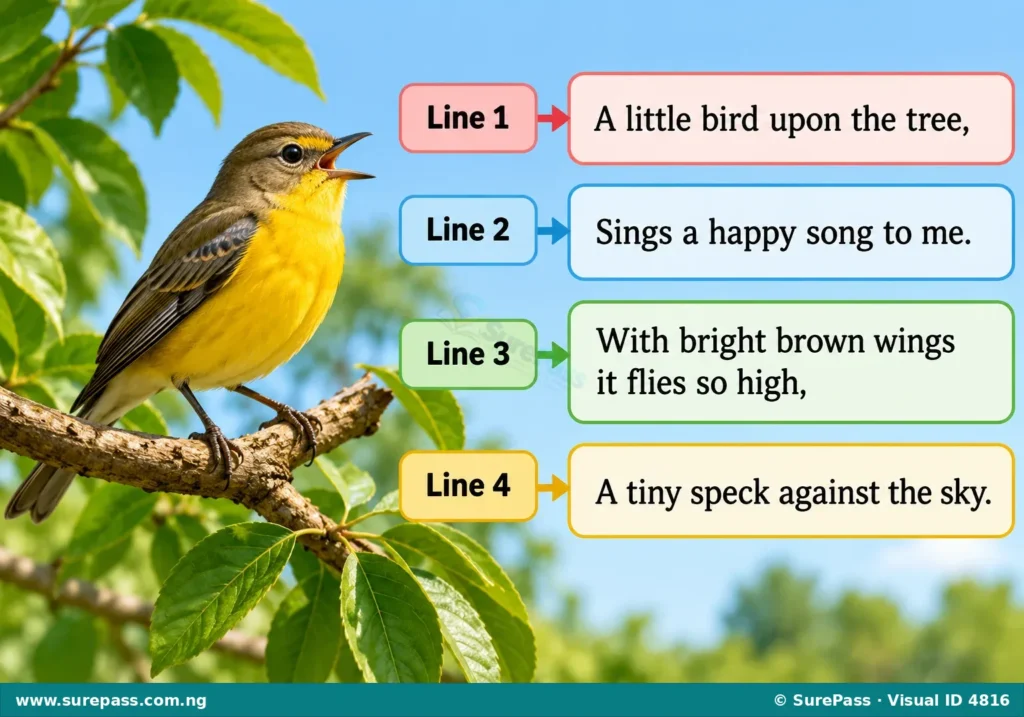
Poems are made up of lines. -
Stanzas: A stanza is a group of lines in a poem, like a paragraph in a story. Stanzas are usually separated by a space.
Look at the poem below, divided into stanzas:
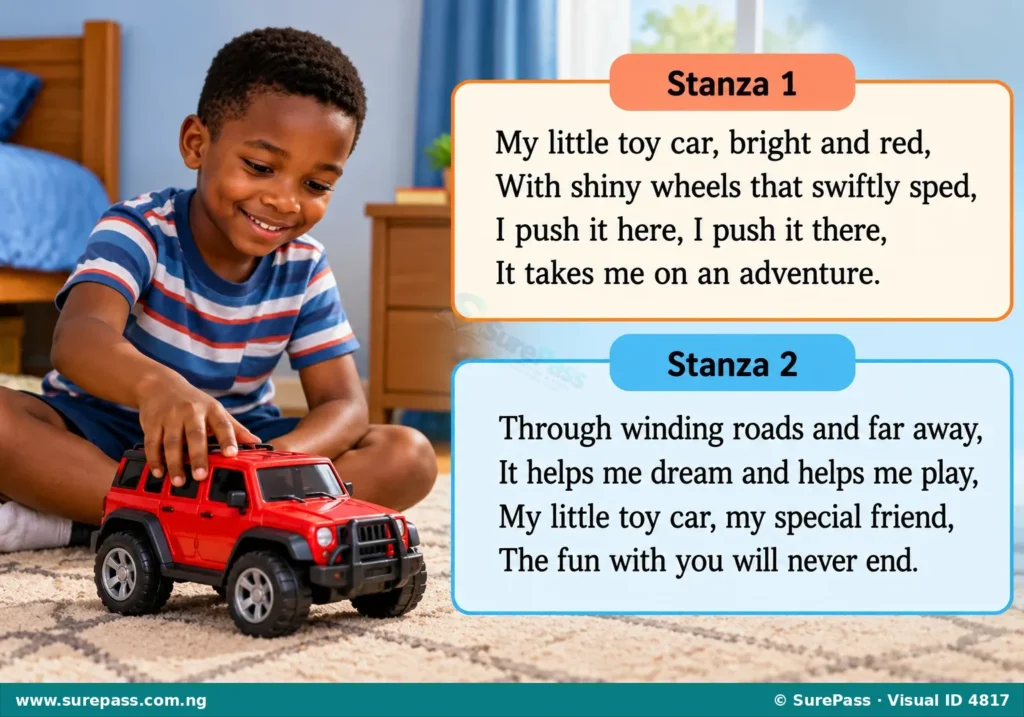
Stanzas are like paragraphs in a poem. -
Rhyme: Rhyme is when words have the same ending sound. For example, “cat” and “hat,” or “tree” and “free.” Rhyme often makes poems sound musical and memorable.
Examples of rhyming words include:
- day, play
- bright, light
- run, fun
- sleep, deep
-
Rhythm: Rhythm is the beat or musical flow of a poem. It is the pattern of stressed and unstressed sounds in the lines. When a poem has a strong rhythm, it can be easy to tap a foot or clap hands to its beat.
For example, in the line “Twinkle, twinkle, little star,” there is a clear, steady beat.
Discussing the Meaning and Effect of a Poem
After reading a poem, it is important to think about what it means and how it makes a person feel. This is called discussing the meaning and effect.
Consider the following short poem:
My Little Dog
My little dog, a furry friend,
With wagging tail until the end.
He barks with joy, he loves to play,
And chases squirrels throughout the day.
He keeps me safe, he keeps me warm,
A loyal friend through sun and storm.
His happy barks, a cheerful sound,
The best companion can be found.
Discussion of “My Little Dog”
- Subject Matter: The poem is about a child’s pet dog.
- Theme: The main message or theme is the joy and loyalty of a pet dog, and the special bond between a child and their pet.
- Meaning: The poem describes a dog that is a good friend, playful, protective, and brings happiness to its owner. It shows how much the owner loves their dog.
- Effect: The poem makes the reader feel happy, warm, and perhaps reminds them of their own pets or friends. It creates a feeling of love and companionship.
- Features:
- It has two stanzas, each with four lines.
- It uses rhyme: “friend” rhymes with “end,” “play” rhymes with “day,” “warm” rhymes with “storm,” and “sound” rhymes with “found.”
- It has a gentle, happy rhythm that makes it pleasant to read.
Memorising Poems
Memorising a poem means learning it by heart so it can be recited without looking at the words. This helps to remember new words and improve speaking skills.
Tips for Memorising a Poem
- Read it Many Times: Read the poem aloud several times to get familiar with it.
- Understand the Meaning: It is easier to remember something that is understood.
- Break it Down: Learn one line at a time, then two lines, then a whole stanza.
- Repeat Aloud: Say the lines over and over again.
- Use Actions: Sometimes, making small actions for different parts of the poem can help memory.
- Practise Regularly: Practise a little bit each day instead of trying to learn it all at once.





0 comments
Open the discussion when you need it. Comments stay collapsed until requested so the initial article remains light.