




ARTICLE CONTENTSOn this page 6 sections
Listening and Speaking: Aural Discrimination in Vowels and Consonants
Performance Objectives
By the end of the lesson, students should be able to:
- Discriminate between vowel sounds in words e.g. /˄/ and /3:/
- Discriminate between consonant sounds in words e.g. /ʧ / and /ʃ/
- Distinguish between voiced and voiceless consonant sounds.
Understanding Sounds in English
Listening and speaking are important skills in English. To speak clearly and understand others well, it is important to hear the differences between sounds. Sometimes, sounds can be very similar, but they change the meaning of a word.
English words are made up of different sounds. These sounds can be divided into two main groups: vowel sounds and consonant sounds.
Vowel Sounds
Vowel sounds are made when air flows freely from the mouth without any blockage. The tongue and lips change position to make different vowel sounds.
Consonant Sounds
Consonant sounds are made when the airflow from the mouth is blocked or partly blocked by the tongue, teeth, or lips. This blockage creates different sounds.
Discriminating Between Vowel Sounds: /˄/ and /3:/
Some vowel sounds can be easily confused. It is important to hear the difference between them. Two common vowel sounds that can be tricky are /˄/ and /3:/.
The /˄/ Sound
The /˄/ sound is a short ‘uh’ sound. It is like the sound in the word “up” or “sun”. To make this sound, the mouth is slightly open, and the tongue is relaxed in the middle of the mouth.
The /3:/ Sound
The /3:/ sound is a longer ‘er’ sound. It is like the sound in the word “bird” or “turn”. To make this sound, the lips are slightly rounded, and the tongue is pulled back slightly in the mouth.
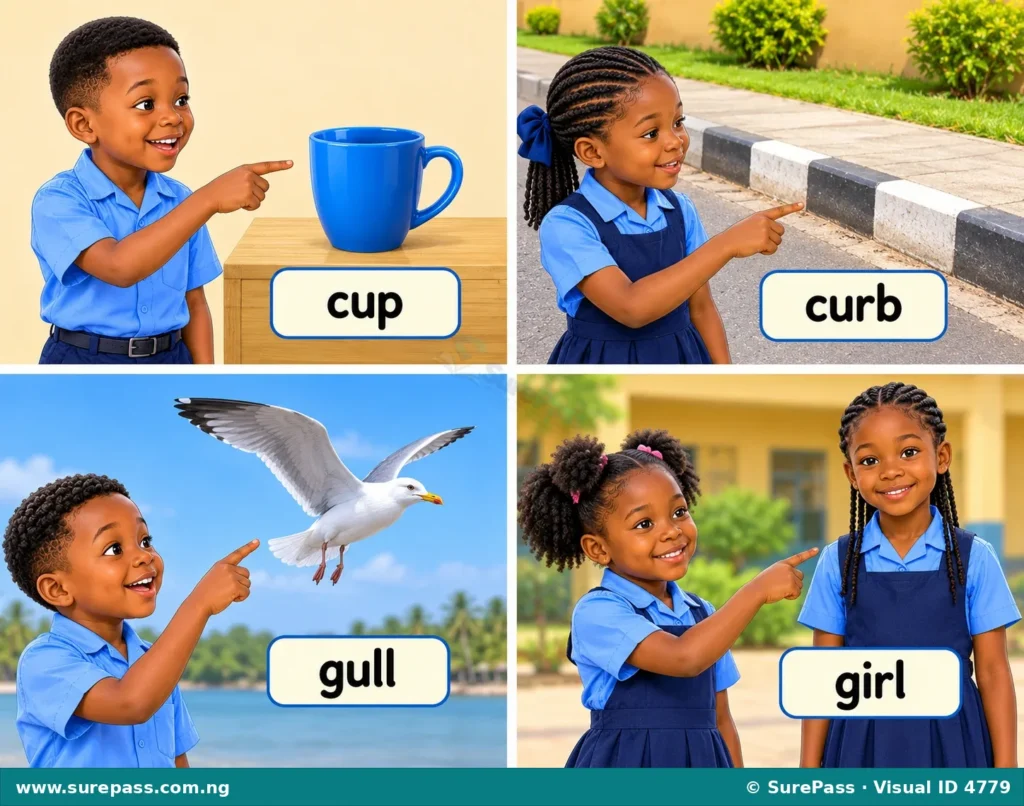
Listen carefully to the following pairs of words. The difference in the vowel sound changes the meaning of the word:
- cup (/k˄p/) and curb (/k3:b/)
- luck (/l˄k/) and lurk (/l3:k/)
- gull (/g˄l/) and girl (/g3:l/)
- bust (/b˄st/) and burst (/b3:st/)
In each pair, the first word has the short /˄/ sound, and the second word has the longer /3:/ sound. Practise saying these words and listening for the difference.
Discriminating Between Consonant Sounds: /ʧ / and /ʃ/, /v/ and /f/
Just like vowel sounds, consonant sounds can also be very similar. Hearing and making the correct consonant sound is important for clear communication.
The /ʧ / Sound and the /ʃ/ Sound
The /ʧ / sound is the ‘ch’ sound, like in “chair” or “church”. It is a short, sharp sound made by quickly releasing air after the tongue touches the roof of the mouth.
The /ʃ/ sound is the ‘sh’ sound, like in “shoe” or “wash”. It is a softer, longer sound made by pushing air through a wider opening in the mouth, with the tongue raised towards the roof of the mouth.
Listen to these word pairs and notice the difference between /ʧ / and /ʃ/:
- chin (/ʧɪn/) and shin (/ʃɪn/)
- chop (/ʧɒp/) and shop (/ʃɒp/)
- catch (/kæʧ/) and cash (/kæʃ/)

The /v/ Sound and the /f/ Sound
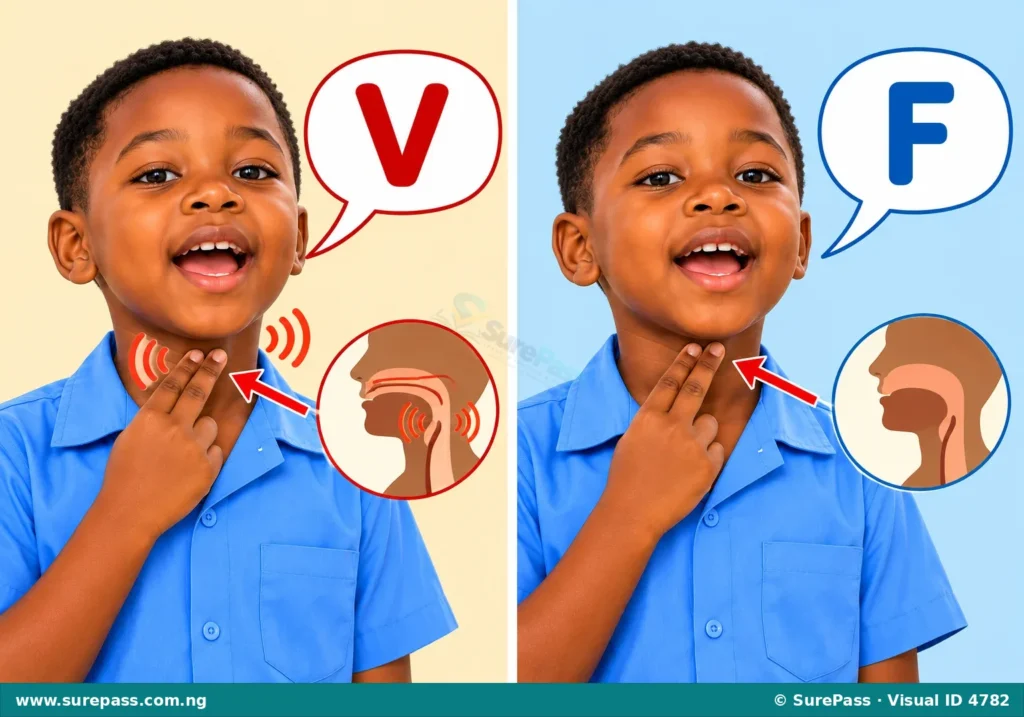
The /v/ sound is the ‘v’ sound, like in “van” or “vote”. To make this sound, the upper teeth lightly touch the lower lip, and air is pushed out while the vocal cords vibrate.
The /f/ sound is the ‘f’ sound, like in “fan” or “fish”. To make this sound, the upper teeth lightly touch the lower lip, and air is pushed out without the vocal cords vibrating.
Listen to these word pairs and hear the difference between /v/ and /f/:
- Vest (/vɛst/) and first (/f3:st/)
- Very (/vɛri/) and ferry (/fɛri/)
- have (/hæv/) and half (/hɑ:f/)

Distinguishing Between Voiced and Voiceless Consonant Sounds
Consonant sounds can also be grouped based on whether the vocal cords vibrate when the sound is made. This helps to understand how different sounds are produced.
Voiced Consonant Sounds
Voiced consonant sounds are made when the vocal cords vibrate. You can feel this vibration by placing your fingers on your throat while making the sound.
Examples of voiced consonant sounds include:
- /b/ as in ball
- /d/ as in dog
- /g/ as in goat
- /v/ as in van
- /z/ as in zoo
Voiceless Consonant Sounds
Voiceless consonant sounds are made when the vocal cords do not vibrate. When you place your fingers on your throat, you will not feel any vibration.
Examples of voiceless consonant sounds include:
- /p/ as in pen
- /t/ as in top
- /k/ as in kite
- /f/ as in fish
- /s/ as in sun
How to Feel the Difference
The procedure involves the following steps:
- Place your hand gently on your throat, just above your Adam’s apple (the bump in your throat).
- Say the sound /v/ (as in “van”). You should feel a vibration in your throat. This means /v/ is a voiced sound.
- Now, say the sound /f/ (as in “fan”). You should not feel any vibration. This means /f/ is a voiceless sound.
- Try with other pairs like /b/ and /p/. Say /b/ (as in “ball”) and feel the vibration. Then say /p/ (as in “pen”) and notice there is no vibration.
- Repeat with /d/ (as in “dog”) and /t/ (as in “top”). Feel the vibration for /d/ and no vibration for /t/.
This simple activity helps to distinguish between voiced and voiceless consonant sounds.




0 comments
Open the discussion when you need it. Comments stay collapsed until requested so the initial article remains light.