



ARTICLE CONTENTSOn this page 7 sections
Grammar and Vocabulary: Using past, present and future tenses
Performance Objectives
By the end of the lesson, students should be able to:
- correctly use past tense
- correctly use present tense
- correctly use Future tense.
What Is Tense?
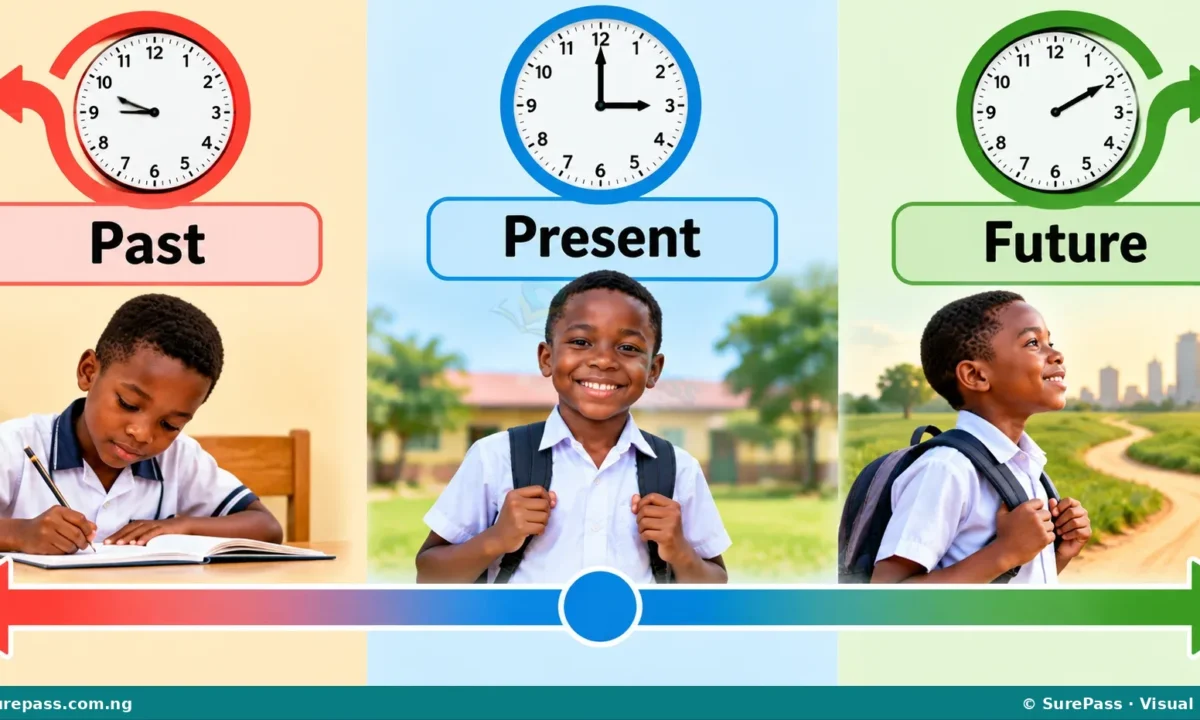
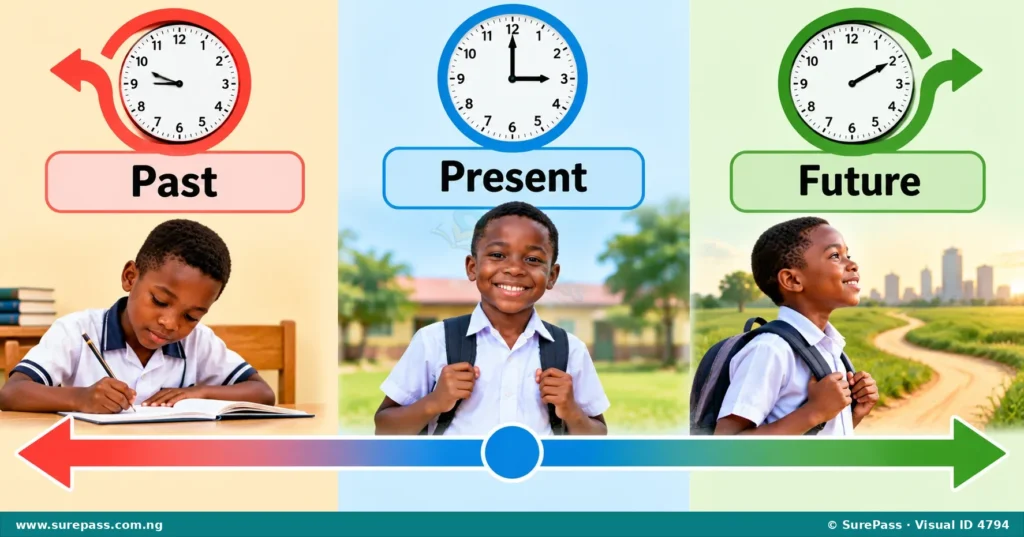
Tense tells us when an action happens. It shows if an action happened in the past, is happening now in the present, or will happen in the future.
The form of the verb changes to show the tense. For example, the verb “eat” changes to “ate” for the past and “will eat” for the future.
The Past Tense
The past tense tells us about actions that have already happened. These actions are finished.
Words like “yesterday,” “last week,” “ago,” “earlier,” and “last night” often tell us that an action happened in the past.
To form the past tense, the verb often changes. For many verbs, we add “-ed” to the end. For example, “walk” becomes “walked,” and “play” becomes “played.” However, many verbs change their form completely. For example, “eat” becomes “ate,” and “go” becomes “went.”
Examples of sentences in the past tense include:
- I ate yesterday.
- She walked to school last morning.
- They played football an hour ago.
- My mother cooked jollof rice for lunch.
- The dog slept under the tree.
Practice: Using the Past Tense
Complete the following sentences by changing the verb in the bracket to the past tense:
- My brother (visit) visited his friend last Saturday.
- We (watch) watched a movie last night.
- The bird (fly) flew away quickly.
- She (sing) sang a beautiful song at the party.
- The children (laugh) laughed loudly at the joke.
The Present Tense
The present tense tells us about actions that are happening now, actions that happen regularly, or things that are generally true.
Words like “every day,” “now,” “often,” “always,” and “usually” often tell us that an action is in the present tense.
For most verbs in the present tense, the base form of the verb is used (e.g., “eat,” “play”). When the subject is “he,” “she,” “it,” or a singular noun, “-s” or “-es” is added to the verb (e.g., “he eats,” “she plays,” “it rains”).
Examples of sentences in the present tense include:
- I eat rice every day.
- He walks to school every morning.
- They play football in the evening.
- My mother cooks delicious meals.
- The sun shines brightly.
Practice: Using the Present Tense
Complete the following sentences by changing the verb in the bracket to the correct present tense form:
- My sister (read) reads books every night.
- We (go) go to school from Monday to Friday.
- The cat (chase) chases mice.
- He (help) helps his father in the farm.
- Birds (sing) sing in the morning.
The Future Tense
The future tense tells us about actions that will happen later. These actions have not happened yet.
Words like “tomorrow,” “next week,” “later,” “soon,” and “tonight” often tell us that an action will happen in the future.
To form the future tense, “will” is usually added before the base form of the verb. For example, “eat” becomes “will eat,” and “go” becomes “will go.”
Examples of sentences in the future tense include:
- I will eat salad tomorrow.
- She will walk to school next week.
- They will play football later.
- My mother will cook soup tonight.
- The children will visit the zoo soon.
Practice: Using the Future Tense
Complete the following sentences by changing the verb in the bracket to the future tense:
- We (travel) will travel to Abuja next month.
- She (finish) will finish her homework after dinner.
- The teacher (explain) will explain the lesson again tomorrow.
- I (buy) will buy a new book soon.
- They (build) will build a new house next year.
Identifying and Using Tenses
It is important to know how to identify the tense of a verb in a sentence and how to use the correct tense when speaking or writing.
Here is a summary of how some common verbs change in different tenses:
- Eat:
- Past: ate
- Present: eat / eats
- Future: will eat
- Play:
- Past: played
- Present: play / plays
- Future: will play
- Go:
- Past: went
- Present: go / goes
- Future: will go
- Read:
- Past: read
- Present: read / reads
- Future: will read
Combined Practice: Identify and Use Tenses
Part 1: Identify the Tense
Read each sentence and write down whether the verb is in the Past Tense, Present Tense, or Future Tense.
- My father drove to work yesterday. Past Tense
- Birds sing beautifully in the morning. Present Tense
- We will visit our grandparents next holiday. Future Tense
- The baby cried loudly last night. Past Tense
- She drinks water every hour. Present Tense
- They will build a new school in our community. Future Tense
- I watched a cartoon on TV. Past Tense
- He always helps his friends. Present Tense
- The pupils will learn about plants tomorrow. Future Tense
- My mother bought new clothes. Past Tense
Part 2: Use the Correct Tense
Rewrite each sentence using the correct tense for the verb in the bracket, based on the time word in the sentence.
- My friend (come) will come to my house tomorrow.
- We (eat) eat yam and egg for breakfast every morning.
- She (finish) finished her homework an hour ago.
- The children (play) are playing outside now.
- I (travel) will travel to Lagos next week.
- He (write) wrote a letter to his aunt last month.
- They (watch) watch the news every evening.
- The dog (bark) barked at the stranger yesterday.
- We (sing) will sing a song in class later.
- My teacher (teach) teaches us English.





0 comments
Open the discussion when you need it. Comments stay collapsed until requested so the initial article remains light.