




ARTICLE CONTENTSOn this page 6 sections
Introduction to Stress
Performance Objectives
By the end of the lesson, students should be able to:
- state the meaning of stress;
- discuss the types of stress
- apply simple stress placement rules for common word types
What is Stress?
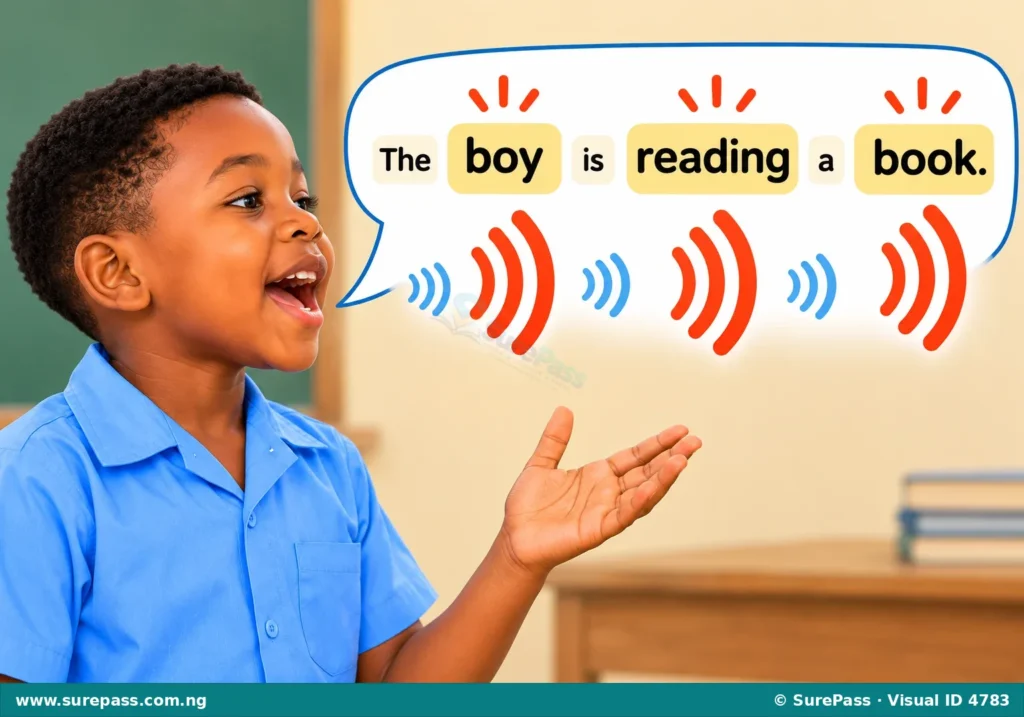
Stress in English speech means giving more force or emphasis to a particular syllable in a word, or to a particular word in a sentence.
When a syllable or word is stressed, it sounds louder, longer, and higher in pitch compared to the other syllables or words around it. This emphasis helps to make speech clear and can also change the meaning of what is being said.
Imagine you are tapping your foot to a rhythm. Some taps are stronger than others. In English, some parts of words or sentences are like those stronger taps.
Types of Stress
There are two main types of stress that help us understand and speak English clearly:
- Word Stress
- Sentence Stress
- ‘TAble’ (The ‘TA’ is stressed)
- ‘WRIting’ (The ‘WRI’ is stressed)
- ‘BEAutiful’ (The ‘BEAU’ is stressed)
- ‘COMputer’ (The ‘COM’ is stressed)
- ‘NAIja’ (The ‘NAI’ is stressed)
- “I DIDN’T say he stole it.” (This means someone else said it, not me.)
- “I didn’t say HE stole it.” (This means someone else stole it, not him.)
- “I didn’t SAY he stole it.” (This means I might have implied it, but I didn’t use the word ‘say’.)
- “I didn’t say he STOLE it.” (This means he might have taken it, but not necessarily stolen it.)
- “I didn’t say he stole IT.” (This means he stole something else, not that particular item.)
- ‘TAble’
- ‘HAPpy’
- ‘TEAcher’
- ‘YELlow’
- ‘WAter’
- ‘PREtty’
- ‘FAther’
- ‘CLEver’
- ‘aRRIVE’
- ‘beGIN’
- ‘rePEAT’
- ‘aBOVE’
- ‘beLOW’
- ‘exPLAIN’
- ‘deCIDE’
- ‘aROUND’
- ‘BLACKboard’ (black + board)
- ‘FOOTball’ (foot + ball)
- ‘SUNshine’ (sun + shine)
- ‘RAINbow’ (rain + bow)
- ‘TOOTHbrush’ (tooth + brush)
- ‘overCOME’ (over + come)
- ‘underSTAND’ (under + stand)
- ‘outRUN’ (out + run)
- ‘foreCAST’ (fore + cast)
- ‘reWRITE’ (re + write)
- ‘happy’
- ‘arrive’
- ‘teacher’
- ‘begin’
- ‘football’
- ‘explain’
- ‘yellow’
- ‘understand’
- “She DIDN’T eat the cake.”
- “She didn’t EAT the cake.”
- “She didn’t eat the CAKE.”
- ‘present’ (noun)
- ‘present’ (verb)
- ‘classroom’
- ‘below’
- ‘overlook’
- ‘pencil’
- ‘behind’
- ‘sunrise’
Word Stress
Word stress is the emphasis placed on a specific syllable within a word. Every word with more than one syllable has one syllable that is pronounced more strongly than the others.
When a syllable is stressed, it stands out. For example, in the word ‘teacher’, the first syllable ‘TEA’ is stressed, making it sound like ‘TEA-cher’, not ‘tea-CHER’.
Here are some examples of words with their stressed syllables:
Sentence Stress
Sentence stress is the emphasis placed on certain words within a sentence. Not all words in a sentence are equally important. The words that carry the main meaning are usually stressed, while less important words are often unstressed.
Changing which word is stressed in a sentence can change the meaning or focus of the sentence. This helps the listener understand what is most important in the message.
Consider these examples:
Notice how the meaning changes just by stressing a different word. This shows how important sentence stress is for clear communication.
Simple Rules for Stress Placement
Learning some simple rules can help in placing stress correctly on words. These rules apply to many common English words.
Two-Syllable Nouns and Adjectives
For most words that have two syllables and are either nouns (names of people, places, things) or adjectives (words that describe nouns), the stress is usually on the first syllable.
Examples of two-syllable nouns and adjectives with stress on the first syllable include:
Two-Syllable Verbs and Prepositions
For most words that have two syllables and are either verbs (action words) or prepositions (words that show position or direction), the stress is usually on the second syllable.
Examples of two-syllable verbs and prepositions with stress on the second syllable include:
Compound Words
Compound words are words made by joining two or more smaller words together (e.g., ‘black’ + ‘board’ = ‘blackboard’). The stress placement in compound words depends on whether the compound word is a noun or a verb.
Compound Nouns
For most compound nouns, the stress is usually on the first part of the word.
Examples of compound nouns with stress on the first part include:
Compound Verbs
For most compound verbs, the stress is usually on the second part of the word.
Examples of compound verbs with stress on the second part include:
Practising Stress Placement
Practising stress helps to improve speaking and listening skills. The following activities can help learners apply stress placement rules.
Activity 1: Identifying Word Stress
Read the following words aloud. Listen carefully to which syllable sounds stronger. Then, say the word again, making sure to stress the correct syllable.
Activity 2: Changing Sentence Meaning with Stress
Read each sentence aloud, stressing the word in capital letters. Notice how the meaning or focus of the sentence changes each time.
Try saying the sentences again, stressing a different word each time to see how the meaning shifts.
Activity 3: Applying Stress Rules
For each word below, identify if it is a two-syllable noun/adjective, a two-syllable verb/preposition, a compound noun, or a compound verb. Then, say the word aloud, applying the correct stress rule.





0 comments
Open the discussion when you need it. Comments stay collapsed until requested so the initial article remains light.