


ARTICLE CONTENTSOn this page 11 sections
Adjectives and Adverbs
Performance Objectives
By the end of the lesson, students should be able to:
- explain the meanings of adjectives and adverbs;
- identify the various types of adjectives and adverbs;
- use adjective in various degree;
- use adjectives and adverbs in making sentences.
What Are Adjectives?
An adjective is a word that describes a noun or a pronoun.
Adjectives tell us more about people, animals, places or things. They answer questions like “What kind?”, “Which one?”, or “How many?”.
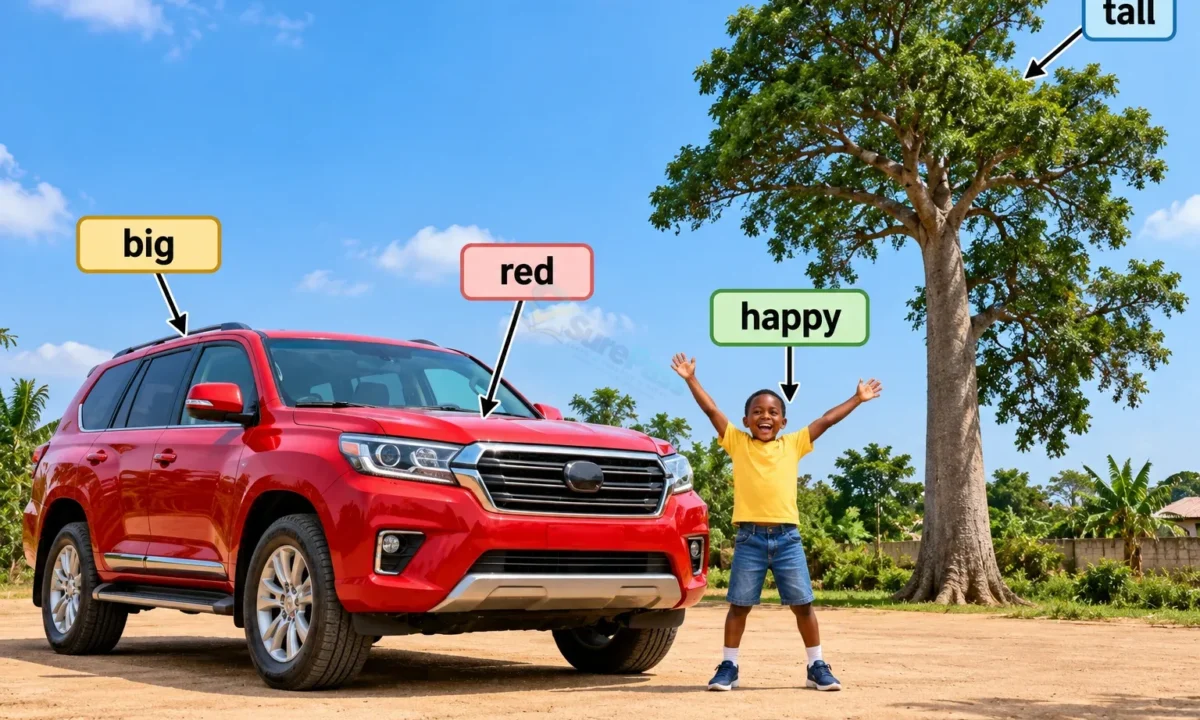
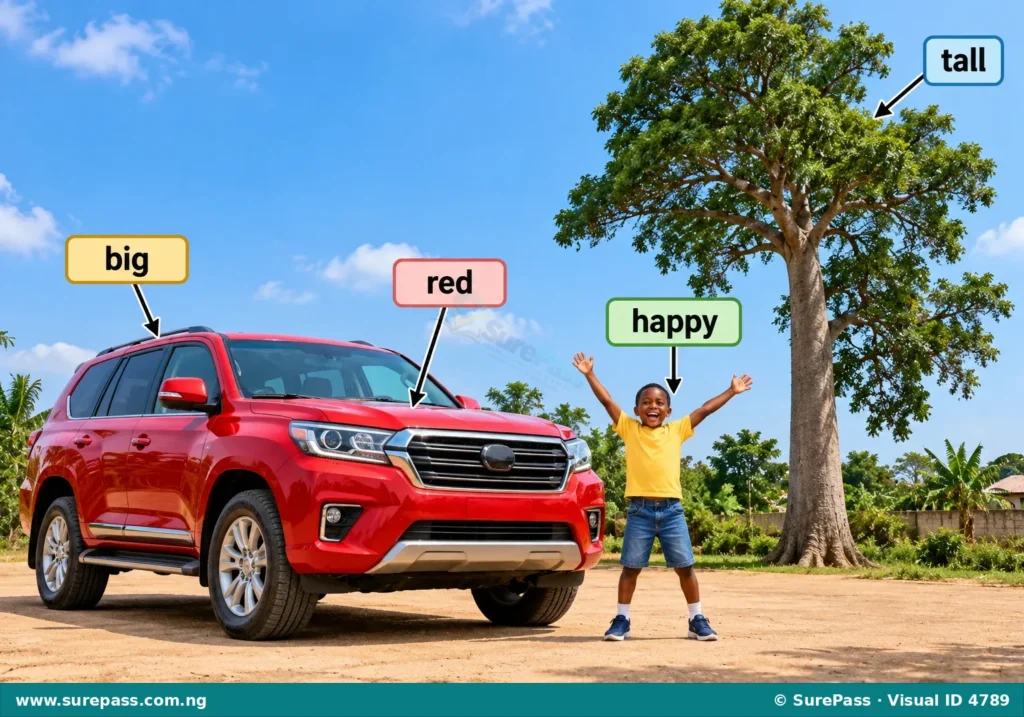
Examples of adjectives include:
- Big house
- Red car
- Happy child
- Three books
- Tall tree
Types of Adjectives
Adjectives can be grouped into different types based on what they describe or how they are used. Understanding these types helps in using them correctly.
Quantitative Adjectives
Quantitative adjectives tell us about the quantity or amount of a noun.
They answer the question “How much?” or “How many?”.
Examples of quantitative adjectives include:
- Many children (How many children?)
- Some water (How much water?)
- Five mangoes (How many mangoes?)
- Much sugar (How much sugar?)
Qualitative Adjectives
Qualitative adjectives describe the quality or characteristic of a noun.
They answer the question “What kind?”.
Examples of qualitative adjectives include:
- Beautiful flower (What kind of flower?)
- Kind teacher (What kind of teacher?)
- Soft pillow (What kind of pillow?)
- Delicious food (What kind of food?)
Demonstrative Adjectives
Demonstrative adjectives point out specific nouns.
They tell us “Which one?” or “Which ones?”. The main demonstrative adjectives are ‘this’, ‘that’, ‘these’, and ‘those’.
Examples of demonstrative adjectives include:
- This book is mine.
- That house is old.
- These shoes are new.
- Those birds are flying high.
Interrogative Adjectives
Interrogative adjectives are used to ask questions about nouns.
They include ‘which’, ‘what’, and ‘whose’. These words must be followed by a noun to act as an adjective.
Examples of interrogative adjectives include:
- Which colour do you like?
- What game are you playing?
- Whose pen is this?
Possessive Adjectives
Possessive adjectives show ownership or possession of a noun.
They tell us “Whose?” something is. Common possessive adjectives are ‘my’, ‘your’, ‘his’, ‘her’, ‘its’, ‘our’, and ‘their’.
Examples of possessive adjectives include:
- My bag is heavy.
- Is that your bicycle?
- His father is a doctor.
- Their school is far.
Comparative Adjectives
Comparative adjectives are used to compare two nouns or pronouns.
They show which of the two has more of a certain quality. Many comparative adjectives end in ‘-er’ (e.g., taller, faster), or use ‘more’ before the adjective (e.g., more intelligent, more beautiful).
Examples of comparative adjectives include:
- Janelle is taller than her friend.
- Bimpe is more intelligent than Ola.
- A tortoise is slower than a rabbit.
- This book is more interesting than that one.
Comparative Forms of Adjectives
Adjectives change their form when comparing things. This is called the degree of comparison. At Primary 4, we focus on comparing two things.
For most short adjectives, we add ‘-er’ to the end to make them comparative.
Examples include:
- tall → taller
- short → shorter
- fast → faster
- small → smaller
For longer adjectives, we use the word ‘more’ before the adjective.
Examples include:
- intelligent → more intelligent
- beautiful → more beautiful
- difficult → more difficult
- expensive → more expensive
Some adjectives have irregular comparative forms that do not follow these rules.
Examples include:
- good → better
- bad → worse
When using comparative adjectives, the word ‘than’ often follows to show what is being compared.
Examples of sentences using comparative adjectives:
- My brother is taller than me.
- This story is more interesting than the last one.
- The red car is faster than the blue car.
- Learning English is better than not learning at all.
Order of Adjectives
Sometimes, more than one adjective is used to describe a single noun. When this happens, adjectives usually follow a particular order.
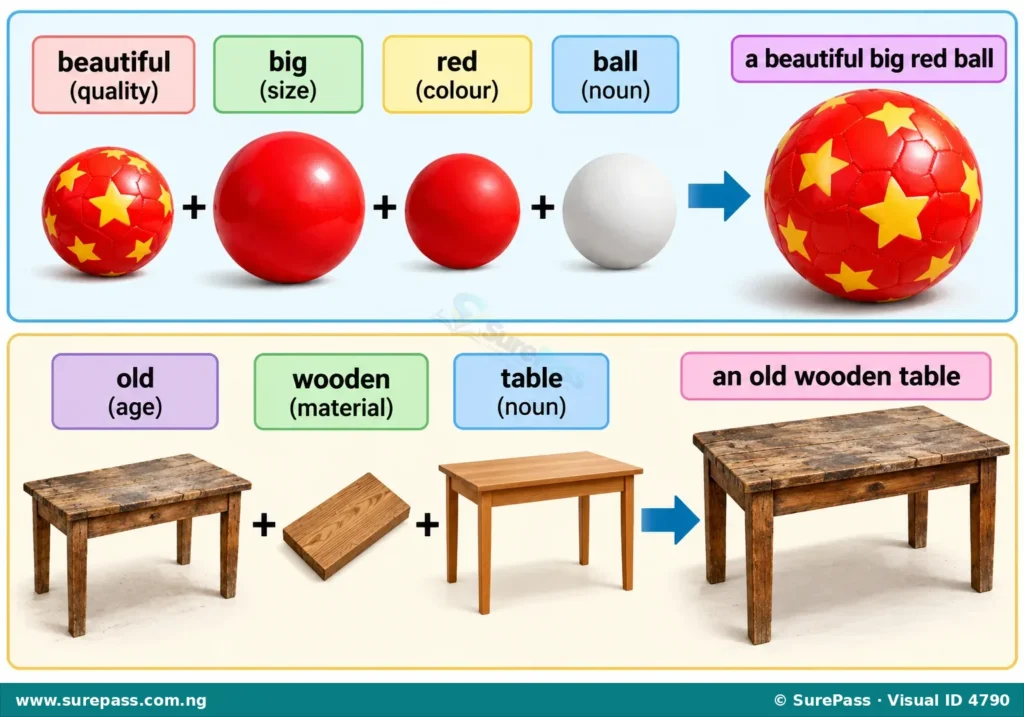
A common order for adjectives before a noun is:
- Quantity (e.g., two, many)
- Quality/Opinion (e.g., beautiful, kind)
- Size (e.g., big, small)
- Age (e.g., old, new)
- Colour (e.g., red, blue)
- Origin (e.g., Nigerian, French)
- Material (e.g., wooden, plastic)
It is rare to use many adjectives at once. Usually, two or three are enough.
Examples of adjectives in order:
- A beautiful big red ball. (Quality, Size, Colour)
- The old wooden table. (Age, Material)
- A small black Nigerian dog. (Size, Colour, Origin)
- Her new blue plastic ruler. (Age, Colour, Material)
What Are Adverbs?
An adverb is a word that describes a verb, an adjective, or another adverb.
Adverbs tell us more about how, when, where, or to what extent an action is performed or a quality exists.
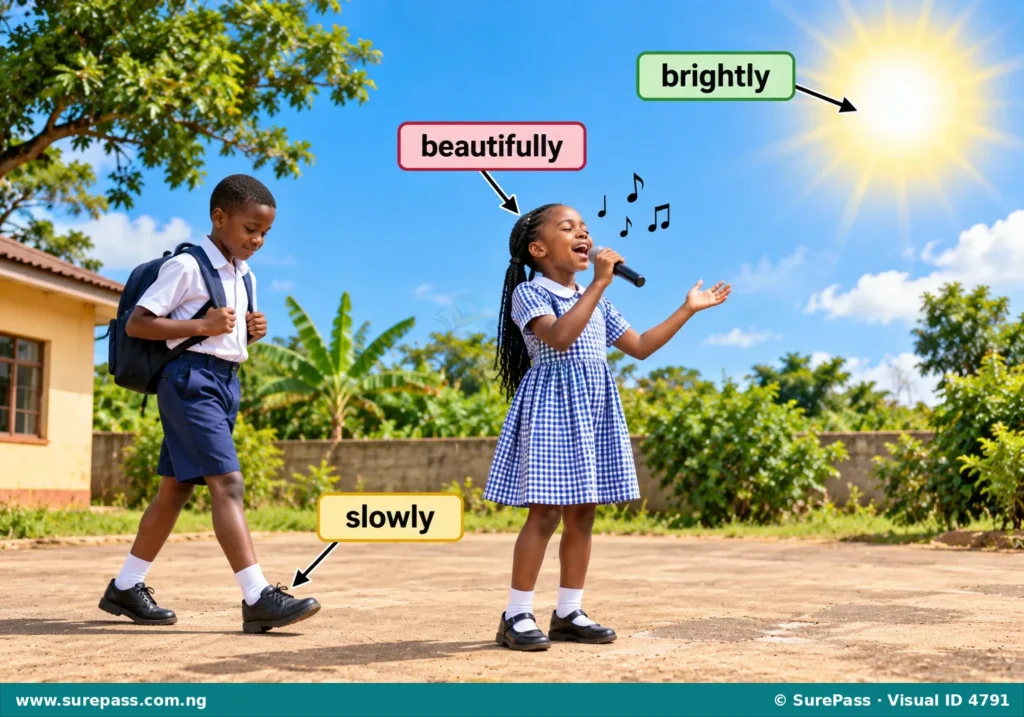
Examples of adverbs include:
- He walks slowly. (Describes the verb ‘walks’)
- She sings beautifully. (Describes the verb ‘sings’)
- The sun shines brightly. (Describes the verb ‘shines’)
- He is very happy. (Describes the adjective ‘happy’)
- She ran quite fast. (Describes the adverb ‘fast’)
Types of Adverbs
Adverbs can be classified based on the kind of information they provide. For Primary 4, we will look at some common types.
Adverbs of Manner
Adverbs of manner tell us how an action is performed.
Many adverbs of manner end in ‘-ly’.
Examples of adverbs of manner include:
- He writes neatly.
- She speaks softly.
- They played happily.
- The dog barked loudly.
Adverbs of Place
Adverbs of place tell us where an action happens.
Examples of adverbs of place include:
- The children are playing outside.
- Please come here.
- My book is there.
- The ball rolled down the hill.
Adverbs of Time
Adverbs of time tell us when an action happens.
Examples of adverbs of time include:
- I will go to school tomorrow.
- She arrived early.
- We eat breakfast daily.
- He finished his homework yesterday.
Adverbs of Frequency
Adverbs of frequency tell us how often an action happens.
Examples of adverbs of frequency include:
- I always brush my teeth.
- She often visits her grandmother.
- He never tells lies.
- We sometimes play football.
Comparative Forms of Adverbs
Just like adjectives, adverbs can also change their form to compare two actions. This is called the comparative form of adverbs.
For most adverbs, especially those ending in ‘-ly’, we use the word ‘more’ before the adverb to make it comparative.
Examples include:
- slowly → more slowly
- carefully → more carefully
- beautifully → more beautifully
- loudly → more loudly
Some short adverbs, like ‘fast’ or ‘hard’, can add ‘-er’ to form their comparative, just like adjectives.
Examples include:
- fast → faster
- hard → harder
Some adverbs have irregular comparative forms.
Examples include:
- well → better
- badly → worse
When using comparative adverbs, the word ‘than’ often follows to show what is being compared.
Examples of sentences using comparative adverbs:
- Ahmed walks more slowly than Eze.
- She sings more beautifully than her sister.
- The new car runs faster than the old one.
- He works harder than anyone else.
Using Adjectives and Adverbs in Sentences
Adjectives and adverbs make sentences more interesting and descriptive. They add details that help the reader or listener understand better.
Using Adjectives in Sentences
Adjectives are placed before the noun they describe or after a linking verb (like ‘is’, ‘are’, ‘was’, ‘were’).
Examples of adjectives in sentences:
- The small bird sang a sweet song. (Describes ‘bird’ and ‘song’)
- The girl is happy. (Describes ‘girl’)
- We saw three big red apples. (Describes ‘apples’)
- My mother bought a new blue dress. (Describes ‘dress’)
Using Adverbs in Sentences
Adverbs can be placed in different positions in a sentence, depending on what they are describing and for emphasis.
Examples of adverbs in sentences:
- The boy ran quickly to school. (Describes ‘ran’)
- She always smiles brightly. (Describes ‘smiles’)
- He spoke very softly. (Describes the adverb ‘softly’)
- The children played happily outside. (Describes ‘played’)
Identifying Adjectives and Adverbs in Texts
To identify adjectives and adverbs, look for words that add more information to nouns, verbs, adjectives, or other adverbs.
When reading a sentence, ask yourself:
- Does this word describe a noun or pronoun? If yes, it is likely an adjective.
- Does this word describe a verb, an adjective, or another adverb? If yes, it is likely an adverb.
Let us look at an example text:
The little brown dog barked loudly. It ran quickly towards the tall green tree. The dog was very excited to see its owner.
In this text:
- little (adjective, describes ‘dog’)
- brown (adjective, describes ‘dog’)
- loudly (adverb, describes ‘barked’)
- quickly (adverb, describes ‘ran’)
- tall (adjective, describes ‘tree’)
- green (adjective, describes ‘tree’)
- very (adverb, describes ‘excited’)
- excited (adjective, describes ‘dog’)




0 comments
Open the discussion when you need it. Comments stay collapsed until requested so the initial article remains light.