


ARTICLE CONTENTSOn this page 7 sections
Listening and Speaking: Conversations and dialogues using appropriate modal auxiliaries
Performance Objectives
By the end of the lesson, students should be able to:
- identify modal auxiliary verbs (can, could, shall, should, will, would, etc);
- use modal auxiliary verbs in sentences;
- discuss emerging issues using modal auxiliary verbs.
What Are Modal Auxiliaries?
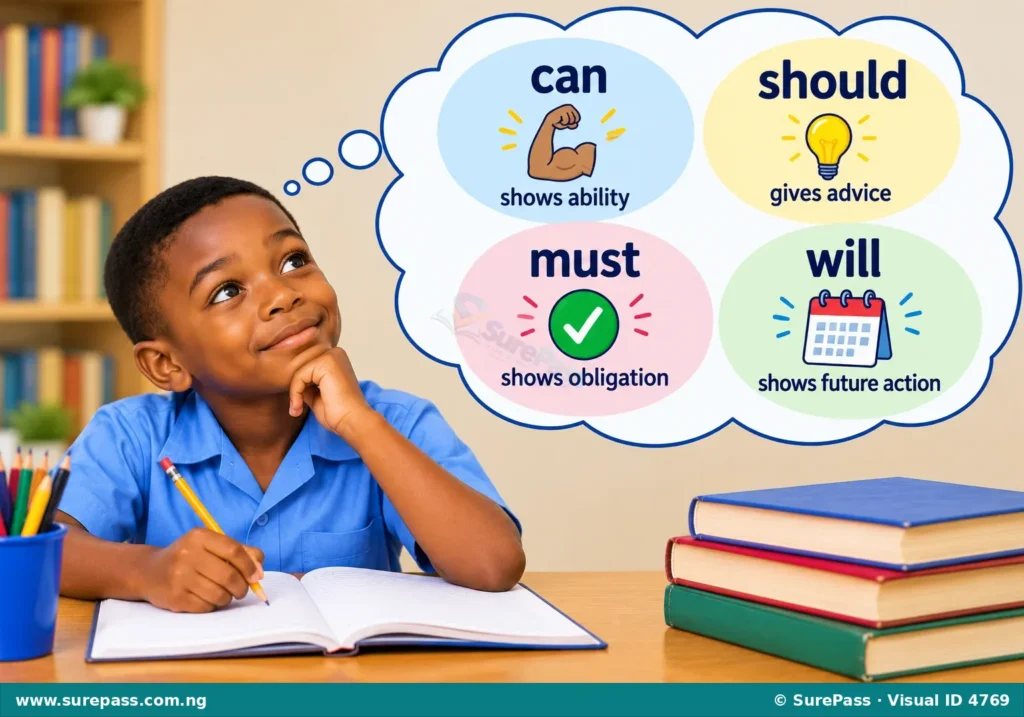
Modal auxiliaries are special helping verbs that add more meaning to the main verb in a sentence. They show things like ability, permission, possibility, obligation, advice, or future actions.
These verbs always come before the main verb and do not change their form, no matter who is performing the action. For example, we say “I can swim” and “He can swim,” not “He cans swim.”
Common Modal Auxiliaries and Their Uses
Here are some common modal auxiliaries and how they are used:
Can and Could
The modal auxiliary ‘can’ is used to express ability or permission.
- Ability: To show that someone is able to do something.
Examples:
- Aisha can sing very well.
- Birds can fly.
- Permission: To ask for or give permission (often informal).
Examples:
- You can play outside after your homework.
- Can I borrow your pencil?
The modal auxiliary ‘could’ is the past form of ‘can’. It is used to express past ability, possibility, or to make a polite request.
- Past Ability: To show what someone was able to do in the past.
Examples:
- When I was younger, I could run very fast.
- My grandmother could tell many stories.
- Possibility: To suggest something might happen.
Examples:
- It could rain later today.
- We could visit the market tomorrow.
- Polite Request: To ask for something politely.
Examples:
- Could you please pass the salt?
- Could you help me with this book?
Shall and Should
The modal auxiliary ‘shall’ is used to express future actions, often in formal situations, or to make suggestions.
- Future Action: To talk about something that will happen (often with ‘I’ or ‘we’ in formal English).
Examples:
- I shall meet you at the park.
- We shall overcome this challenge.
- Suggestion: To ask for advice or make a suggestion.
Examples:
- Shall we go for a walk?
- What shall I do next?
The modal auxiliary ‘should’ is used to give advice or to express a mild obligation.
- Advice: To tell someone what is a good idea to do.
Examples:
- You should eat healthy food.
- Children should listen to their teachers.
- Obligation: To show that something is expected or necessary.
Examples:
- We should arrive on time for school.
- Everyone should follow the rules.
Will and Would
The modal auxiliary ‘will’ is used to express future actions, willingness, or predictions.
- Future Action: To talk about something that will happen.
Examples:
- The sun will rise tomorrow.
- My brother will visit next week.
- Willingness: To show that someone is willing to do something.
Examples:
- I will help you with your chores.
- She will share her toys.
- Prediction: To say what is expected to happen.
Examples:
- It will be a sunny day.
- I think he will win the race.
The modal auxiliary ‘would’ is the past form of ‘will’. It is used to make polite requests, talk about past habits, or in hypothetical situations.
- Polite Request: To ask for something very politely.
Examples:
- Would you please open the door?
- Would you like some water?
- Past Habit: To describe actions that happened regularly in the past but do not happen now.
Examples:
- Every morning, my father would read the newspaper.
- When we were young, we would play football after school.
May and Might
The modal auxiliary ‘may’ is used to express permission (more formal than ‘can’) or possibility.
- Permission: To ask for or give permission (formal).
Examples:
- You may enter the classroom now.
- May I use your computer?
- Possibility: To suggest something is possible.
Examples:
- It may rain this evening.
- She may come to the party.
The modal auxiliary ‘might’ is used to express a weaker possibility than ‘may’.
- Possibility: To suggest something is possible, but less certain.
Examples:
- I might go to the market if I finish my work.
- He might be late for the meeting.
Must and Ought To
The modal auxiliary ‘must’ is used to express strong obligation, necessity, or strong certainty.
- Strong Obligation/Necessity: To show that something is very important or required.
Examples:
- You must complete your assignments.
- We must obey our parents.
- Strong Certainty: To show that something is almost certainly true.
Examples:
- She must be tired after such a long journey.
- That must be the correct answer.
The modal auxiliary ‘ought to’ is used to give advice or express a moral obligation, similar to ‘should’ but often with a stronger sense of what is right.
- Advice/Moral Obligation: To suggest what is the right or proper thing to do.
Examples:
- You ought to apologise for your mistake.
- We ought to help those in need.
Need To, Used To, and Dare
The modal auxiliary ‘need to’ is used to express necessity or requirement.
- Necessity: To show that something is required.
Examples:
- I need to study for my exams.
- They need to finish the project by Friday.
The modal auxiliary ‘used to’ is used to talk about habits or states that happened regularly in the past but do not happen now.
- Past Habit/State: To describe something that was true or happened repeatedly in the past.
Examples:
- My family used to live in a small village.
- He used to play football every day.
The modal auxiliary ‘dare’ is used to challenge someone or to express courage, often in negative sentences or questions.
- Challenge/Courage: To question someone’s bravery or to challenge them.
Examples:
- How dare you speak to me like that!
- He dare not tell a lie.
Conversation Etiquette
Conversation etiquette refers to the polite rules and good manners that people follow when talking to each other. Observing these rules makes conversations pleasant and effective.
Important rules for good conversation include:
- Listen Carefully: Pay attention when others are speaking. Do not interrupt them.
- Take Turns: Allow everyone a chance to speak. Do not talk over others.
- Speak Clearly: Use words that can be easily understood and speak at a moderate pace.
- Be Polite: Use polite words like “please,” “thank you,” and “excuse me.”
- Respect Others’ Opinions: Even if you do not agree, listen to what others have to say without arguing rudely.
- Maintain Eye Contact: Look at the person you are talking to.
- Stay on Topic: Try to keep the conversation focused on the main subject.

Engaging in Conversations Using Modal Auxiliaries
Modal auxiliaries are very useful in everyday conversations, especially when discussing important topics. They help us express our thoughts clearly, give advice, or talk about possibilities.
Discussing National Values
National values are the important beliefs and principles that guide the people of a country. These include honesty, respect, hard work, and unity. We can use modal auxiliaries to discuss how we should uphold these values.
Examples of conversations:
-
Child A: We should always respect our elders, don’t you think?
Child B: Yes, we must show respect to everyone, especially those older than us. It’s a very important national value.
-
Child A: I think we ought to be honest in all our dealings.
Child B: Absolutely. Honesty can build trust in our community.
Discussing Safety and Security
Safety and security are important for everyone. We can use modal auxiliaries to talk about how to stay safe and what actions people should take.
Examples of conversations:
-
Child A: We must be careful when walking alone in the evening.
Child B: Yes, and children should not talk to strangers. We could tell an adult if we feel unsafe.
-
Child A: What should we do if we see something suspicious?
Child B: You must report it to an adult or a security guard immediately. They will know what to do.
Discussing Saving Money
Learning to save money is a good habit. Modal auxiliaries can help us discuss financial responsibility.
Examples of conversations:
-
Child A: I can save some of my pocket money every week.
Child B: That’s a good idea! We should all learn to save. It might help us buy something important later.
-
Child A: My parents say we ought to avoid wasting money.
Child B: Yes, we need to be careful with how we spend. We could put some money aside for future needs.
Discussing Honesty and Fairness
Corruption is a problem that affects many societies. Discussing honesty and fairness helps us understand how to build a better community. We can use modal auxiliaries to talk about these issues.
Examples of conversations:
-
Child A: People should not take things that do not belong to them.
Child B: Exactly. We must always be honest and fair in everything we do. How dare anyone try to cheat others?
-
Child A: What will happen if people are not honest?
Child B: If people are not honest, trust could be broken, and the community might suffer. We need to encourage fairness.
Practice Using Modal Auxiliaries
To become good at using modal auxiliaries, practice is important. Try to identify them in sentences and use them in your own conversations.
Activity 1: Identifying Modal Auxiliaries
Read the following sentences and identify the modal auxiliary verb in each one:
- My sister can speak three languages.
- You should always tell the truth.
- We will go to the market tomorrow.
- May I come in?
- You must finish your homework before playing.
- When I was young, I could climb trees easily.
- We ought to help our neighbours.
- He used to live in Lagos.
- How dare you challenge me?
- I need to buy new books.
Activity 2: Using Modal Auxiliaries in Sentences
Complete the following sentences by choosing the most appropriate modal auxiliary from the box below. You may use each word more than once.
The available modal auxiliaries are:
- can
- should
- will
- must
- could
- may
The sentences to complete are:
- I __ swim across the river.
- You __ respect your elders.
- It __ rain later today.
- __ I borrow your pen, please?
- We __ obey the traffic rules.
- When I was five, I __ not reach the top shelf.
- They __ visit us next weekend.
- You __ try harder to achieve your goals.
- He __ be very tired after working all day.
- We __ leave now or we will be late.
Activity 3: Role-Play Conversation
Work with a partner to create a short conversation (dialogue) about one of the following topics. Make sure to use at least three different modal auxiliary verbs in your conversation.
The topics are:
- How children can help keep their school clean.
- What we should do to stay healthy.
- How we can be good citizens in our community.




0 comments
Open the discussion when you need it. Comments stay collapsed until requested so the initial article remains light.