



ARTICLE CONTENTSOn this page 7 sections
Reading: Reading passages and using contextual clues to get meanings of words for Primary 4
Performance Objectives
By the end of the lesson, students should be able to:
- read passages on various issues such as taxation, achieving academic excellence, skill acquisition, building good character/manners, etc;
- answer literal, inferential and critical questions;
- use contextual clues to get the meanings of unfamiliar words;
- use the unfamiliar words appropriately in sentences.
Understanding Reading Comprehension
Reading comprehension is the ability to understand what is read. It means not just reading the words, but also understanding the message, ideas and information the writer wants to share. Good comprehension helps learners learn new things, follow instructions and enjoy stories.
To understand a passage well, it is important to read carefully and think about what the words mean and how they connect to each other.
Reading Passages
Reading different types of passages helps to improve comprehension. Passages can be about many topics, such as how to succeed in school, learning new skills, or how to be a good person. Reading widely helps to build vocabulary and general knowledge.
Read the passage below carefully:

The Path to Academic Excellence
Achieving academic excellence is a goal many students strive for. It means doing very well in school and getting good grades. This does not happen by magic; it requires hard work, dedication, and smart study habits. Students who excel often have a strong desire to learn and are committed to their studies.
One important step is to attend classes regularly and pay close attention to the teacher. Asking questions when something is unclear is also very helpful. Active participation in class discussions can deepen understanding of topics.
Another key habit is consistent revision. This means reviewing notes and textbooks often, not just before exams. Creating a study timetable and sticking to it can make revision more effective. It helps to break down large amounts of information into smaller, manageable parts.
Furthermore, developing good character is also vital for academic success. Being honest in assignments, respectful to teachers and classmates, and disciplined in following school rules contribute to a positive learning environment. These qualities help students to focus better and build strong relationships with others.
Finally, skill acquisition, such as learning how to research or solve problems, enhances academic performance. These skills are invaluable tools that help students tackle difficult tasks and think critically. With effort and the right approach, every student can achieve their full potential and experience the joy of academic excellence.
Answering Questions on Passages
After reading a passage, answering questions helps to check understanding. There are different types of questions that require different ways of thinking.
Literal Questions
Literal questions ask for information that is directly stated in the passage. The answers can be found word-for-word or very clearly in the text. These questions test the ability to recall facts.
Examples of literal questions from “The Path to Academic Excellence” include:
- What is one important step mentioned for achieving academic excellence?
- What does consistent revision mean?
- What qualities contribute to a positive learning environment?
Inferential Questions
Inferential questions ask for information that is not directly stated but can be figured out from the clues in the passage. Learners need to “read between the lines” and use their own knowledge along with the text to find the answer. These questions test the ability to make logical guesses or conclusions.
Examples of inferential questions from “The Path to Academic Excellence” include:
- Why is it important to ask questions when something is unclear?
- What might happen if a student does not revise consistently?
- How does developing good character help a student academically?
Critical Questions
Critical questions ask for opinions, judgments or evaluations based on the passage. Learners need to think deeply about the information, compare it to their own experiences or knowledge, and form a reasoned response. These questions test the ability to analyse and evaluate the text.
Examples of critical questions from “The Path to Academic Excellence” include:
- Do you agree that academic excellence requires hard work? Explain your answer.
- Which of the study habits mentioned do you think is most important and why?
- What advice would you give to a friend who wants to achieve academic excellence, based on this passage?
Using Contextual Clues to Get Meanings of Unfamiliar Words
Sometimes, while reading, a word might be encountered that is not known. Instead of stopping to use a dictionary immediately, it is helpful to look for clues in the sentences around the unfamiliar word. These clues are called contextual clues.
Contextual clues are hints that an author gives to help define a difficult or unusual word. The clue may appear within the same sentence as the unfamiliar word or in a nearby sentence.
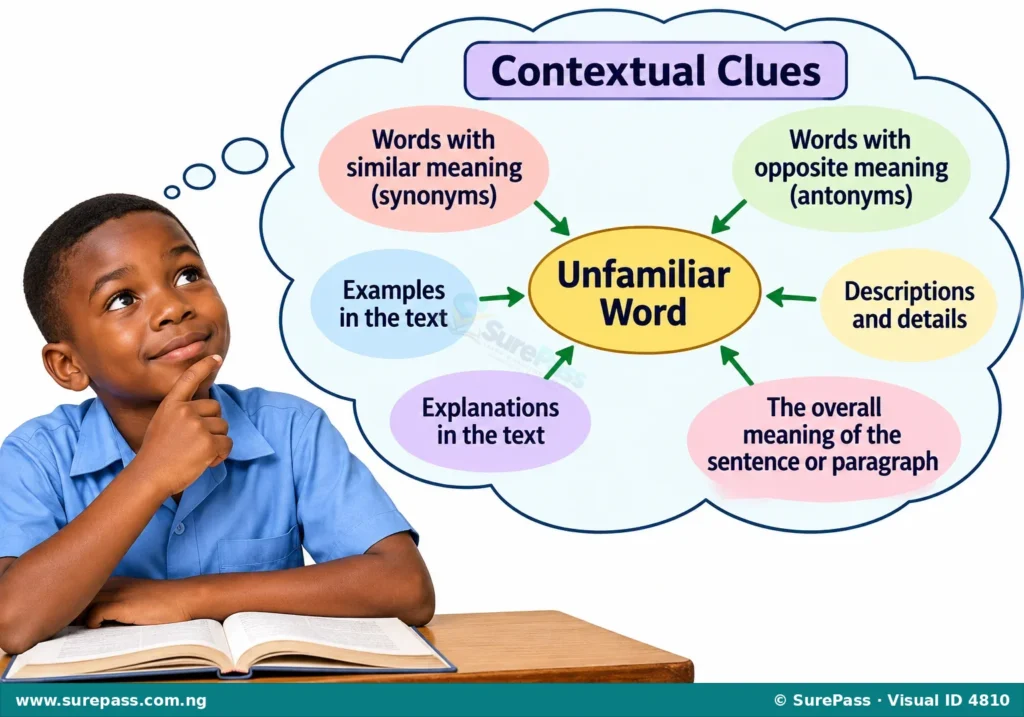
There are different types of contextual clues:
-
Definition/Explanation Clues: The meaning of the unfamiliar word is directly explained in the sentence or the next sentence.
Example from the passage: “Achieving academic excellence is a goal many students strive for. It means doing very well in school and getting good grades.”
Here, “academic excellence” is explained as “doing very well in school and getting good grades.”
-
Synonym Clues: A word with a similar meaning is used nearby.
Example: “Students who excel often have a strong desire to learn and are committed to their studies.”
The word “excel” means to do very well, which is similar to “doing very well in school” mentioned earlier. “Committed” is similar to “dedicated” which was also used.
-
Example Clues: Examples are given that illustrate the meaning of the unfamiliar word.
Example: “Furthermore, developing good character is also vital for academic success. Being honest in assignments, respectful to teachers and classmates, and disciplined in following school rules contribute to a positive learning environment.”
The examples “being honest,” “respectful,” and “disciplined” help to understand what “good character” means.
-
General Sense Clues: The meaning of the word can be understood from the overall meaning of the sentence or paragraph.
Example: “Active participation in class discussions can deepen understanding of topics.”
Even if “participation” is unfamiliar, the phrase “active… in class discussions” suggests being involved or taking part, which helps to understand its meaning.
How to Use Contextual Clues
The procedure involves the following steps:
- Read the sentence: Read the sentence containing the unfamiliar word carefully.
- Read the sentences around it: Read the sentences before and after the word.
- Look for hints: Search for definitions, examples, synonyms, antonyms (opposite words), or general ideas that explain the word.
- Guess the meaning: Based on the hints, make an educated guess about the word’s meaning.
- Check your guess: Replace the unfamiliar word with your guessed meaning. Does the sentence still make sense?
Practice with some words from the passage:
-
Dedication: “It requires hard work, dedication, and smart study habits.”
The words “hard work” and “smart study habits” are used with “dedication.” This suggests that dedication means being committed and putting in a lot of effort. It is a strong commitment to a task.
-
Consistent: “Another key habit is consistent revision. This means reviewing notes and textbooks often, not just before exams.”
The phrase “reviewing notes and textbooks often, not just before exams” explains what “consistent” means. It means doing something regularly or steadily.
-
Invaluable: “These skills are invaluable tools that help students tackle difficult tasks and think critically.”
The sentence says these skills “help students tackle difficult tasks and think critically.” This shows that the skills are very useful and important. So, “invaluable” means extremely useful or precious.
Using Unfamiliar Words in Sentences
Once the meaning of an unfamiliar word is understood, it is important to practice using it. This helps to remember the word and make it part of everyday vocabulary.
Here are examples of how to use the words in new sentences:
-
Dedication:
Meaning: Strong commitment or effort.
Sentence: Mary showed great dedication to her studies by always completing her homework.
-
Consistent:
Meaning: Doing something regularly or steadily.
Sentence: For good health, it is important to have consistent exercise.
-
Invaluable:
Meaning: Extremely useful or precious.
Sentence: The advice from my teacher was invaluable in helping me prepare for the exam.



0 comments
Open the discussion when you need it. Comments stay collapsed until requested so the initial article remains light.