


ARTICLE CONTENTSOn this page 8 sections
Reading: Reading to Identify Main and Supporting Ideas
Performance Objectives
By the end of the lesson, students should be able to:
- read class-appropriate informational texts on some topical issues, e.g. owning shares, health and hygiene, environmental safety, consumer rights, human trafficking, charitable donations, etc.;
- identify the main ideas in the texts; and
- identify the supporting facts in the texts.
Understanding Informational Texts
Reading is an important skill that helps people learn new things and understand the world around them. When reading, it is helpful to understand the most important points and the details that explain them.
Informational texts are written to give facts, details, and explanations about a topic. These texts can be found in books, newspapers, magazines, and online articles. They teach about real things, people, places, or events.
What is a Main Idea?
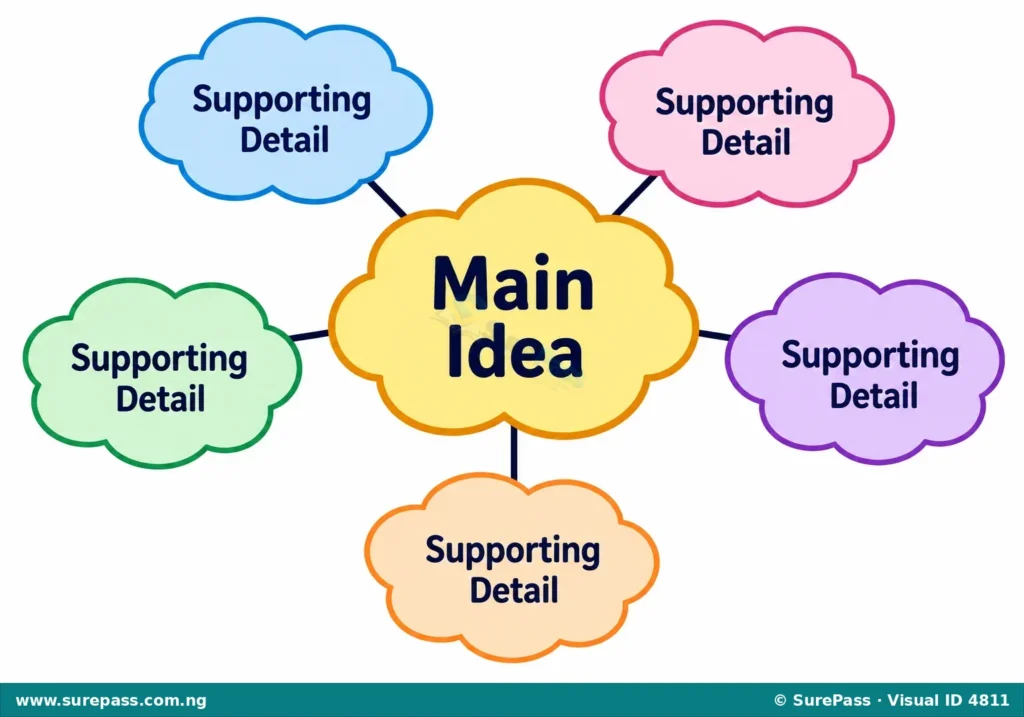
The main idea is the most important point or message an author wants to share about a topic. It is the central message of a paragraph or a whole text.
Think of the main idea as the “big picture” or the “heart” of what is being read. All other sentences and details in the text relate to this main idea.
How to Identify the Main Idea
Finding the main idea helps a reader understand what a text is truly about. Here are some ways to find the main idea:
- Look for the Topic Sentence: The main idea is often stated in one sentence, usually at the beginning or end of a paragraph. This is called the topic sentence.
- Ask a Question: After reading a paragraph, ask: “What is the most important thing the author wants to communicate about this topic?” or “What is this paragraph mostly about?”
- Look for Repeated Words: Sometimes, the main idea is not directly stated. Look for words or phrases that are repeated often. These repeated words can give clues about the main topic and its main idea.
- Summarise the Paragraph: Try to summarise the paragraph in one short sentence. This sentence will often be the main idea.
What are Supporting Ideas?
Supporting ideas are facts, examples, reasons, descriptions, or details that explain, prove, or give more information about the main idea.
Supporting ideas “support” or “hold up” the main idea, just like pillars hold up a roof. Without supporting ideas, the main idea would not be fully understood or believed.
How to Identify Supporting Ideas
Once the main idea is found, identifying supporting ideas becomes easier. Supporting ideas answer questions about the main idea. Look for details that answer:
- Who? (Who is involved?)
- What? (What happened? What is it like?)
- When? (When did it happen?)
- Where? (Where did it happen?)
- Why? (Why did it happen? What are the reasons?)
- How? (How does it work? How is it done?)
Supporting ideas often include specific examples, statistics, explanations, or descriptions that make the main idea clearer.
Practice Passages
The following passages are examples of informational texts. The main idea and supporting ideas for each passage are identified to show how these concepts work.
Passage 1: Healthy Eating for Strong Bodies
Eating healthy food is very important for children. When children eat a balanced diet, their bodies grow strong and they have enough energy to play and learn. Healthy foods include fruits like oranges and mangoes, vegetables like spinach and carrots, and protein from beans and fish. These foods provide important vitamins and minerals that help the body fight sickness. Eating too much sugary food or snacks can make children feel tired and can harm their teeth. Therefore, choosing healthy meals and snacks helps children stay active and well.
The main idea and supporting ideas in Passage 1 are:
- Main Idea: Eating healthy food is very important for children.
- Supporting Ideas:
- When children eat a balanced diet, their bodies grow strong and they have enough energy to play and learn.
- Healthy foods include fruits like oranges and mangoes, vegetables like spinach and carrots, and protein from beans and fish.
- These foods provide important vitamins and minerals that help the body fight sickness.
- Eating too much sugary food or snacks can make children feel tired and can harm their teeth.
- Choosing healthy meals and snacks helps children stay active and well.
Passage 2: Understanding Pollution
Pollution is the presence of harmful substances in the environment. These substances can damage the air, water, and land, making them unsafe for living things. One type is air pollution, caused by smoke from factories and vehicles. This smoke can make people sick and harm plants. Another type is water pollution, which happens when waste from homes and industries is dumped into rivers and oceans. Polluted water is dangerous to drink and kills fish. Land pollution occurs when rubbish like plastic bags and old tyres are thrown carelessly on the ground. To reduce pollution, people can use less plastic, plant more trees, and dispose of waste properly.
The main idea and supporting ideas in Passage 2 are:
- Main Idea: Pollution is the presence of harmful substances in the environment that can damage air, water, and land.
- Supporting Ideas:
- Air pollution is caused by smoke from factories and vehicles, which makes people sick and harms plants.
- Water pollution happens when waste from homes and industries is dumped into rivers and oceans, making water dangerous and killing fish.
- Land pollution occurs when rubbish like plastic bags and old tyres are thrown carelessly on the ground.
- To reduce pollution, people can use less plastic, plant more trees, and dispose of waste properly.
Passage 3: The Importance of Charitable Donations
Giving to charity means helping people who are in need. It is an important act of kindness that makes a big difference in the lives of others. When people donate money, clothes, or food, they help those who do not have enough. For example, donations can provide food for hungry families, books for children who cannot afford them, or medicine for the sick. Charitable giving also helps build schools and hospitals in poor communities. By donating, people show care and support, making their communities stronger and happier. Even small donations can add up to make a large impact.
The main idea and supporting ideas in Passage 3 are:
- Main Idea: Giving to charity is an important act of kindness that helps people in need and makes a big difference.
- Supporting Ideas:
- Donations of money, clothes, or food help those who do not have enough.
- Donations can provide food for hungry families, books for children, or medicine for the sick.
- Charitable giving also helps build schools and hospitals in poor communities.
- By donating, people show care and support, making their communities stronger and happier.
- Even small donations can add up to make a large impact.


0 comments
Open the discussion when you need it. Comments stay collapsed until requested so the initial article remains light.