



ARTICLE CONTENTSOn this page 8 sections
Sense Relations: Synonyms, Antonyms, Homonyms, and Hyponyms for Primary 4
Performance Objectives
By the end of the lesson, students should be able to:
- explain the meanings of synonyms antonyms homonyms and hyponyms
- give examples of synonyms antonyms homonyms and hyponyms;
- use synonyms, antonyms, homonyms, and hyponyms in written and spoken communication effectively.
Understanding Sense Relations
Words in the English language are connected to each other in many ways. These connections are called sense relations. Understanding these relationships helps people to use words more accurately and make their communication clearer and more interesting.
Some important sense relations include synonyms, antonyms, homonyms, and hyponyms. Each type of relation describes a different way words can be linked by their meanings.
Synonyms
A synonym is a word that has the same or nearly the same meaning as another word.
Synonyms allow people to express similar ideas using different words. This helps to make sentences more varied and engaging.
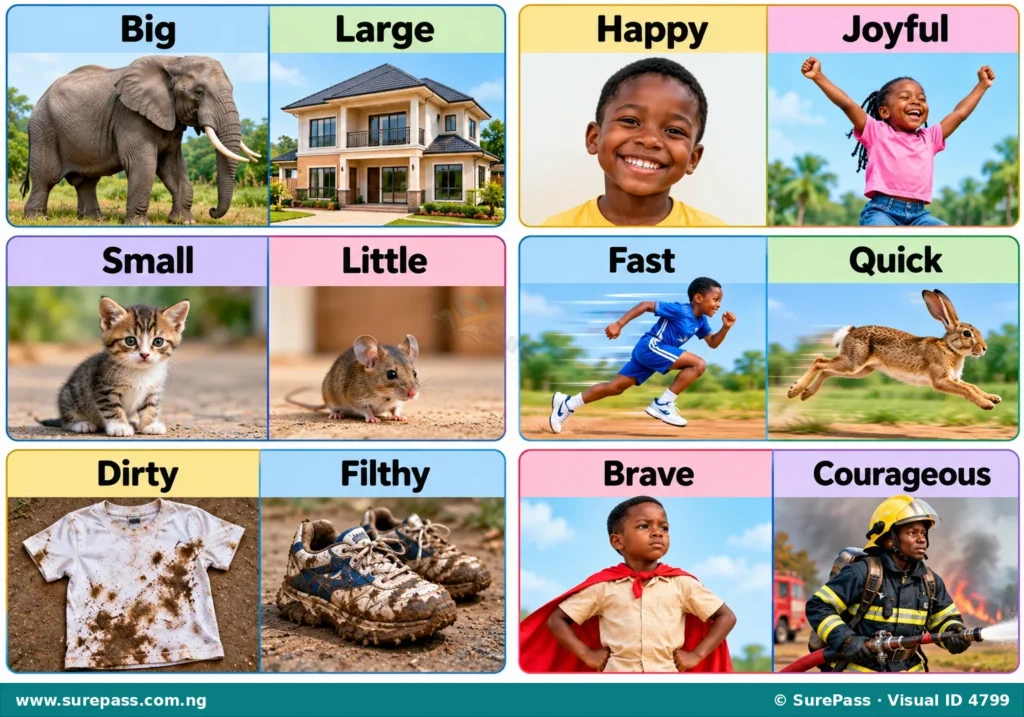
Examples of synonyms include:
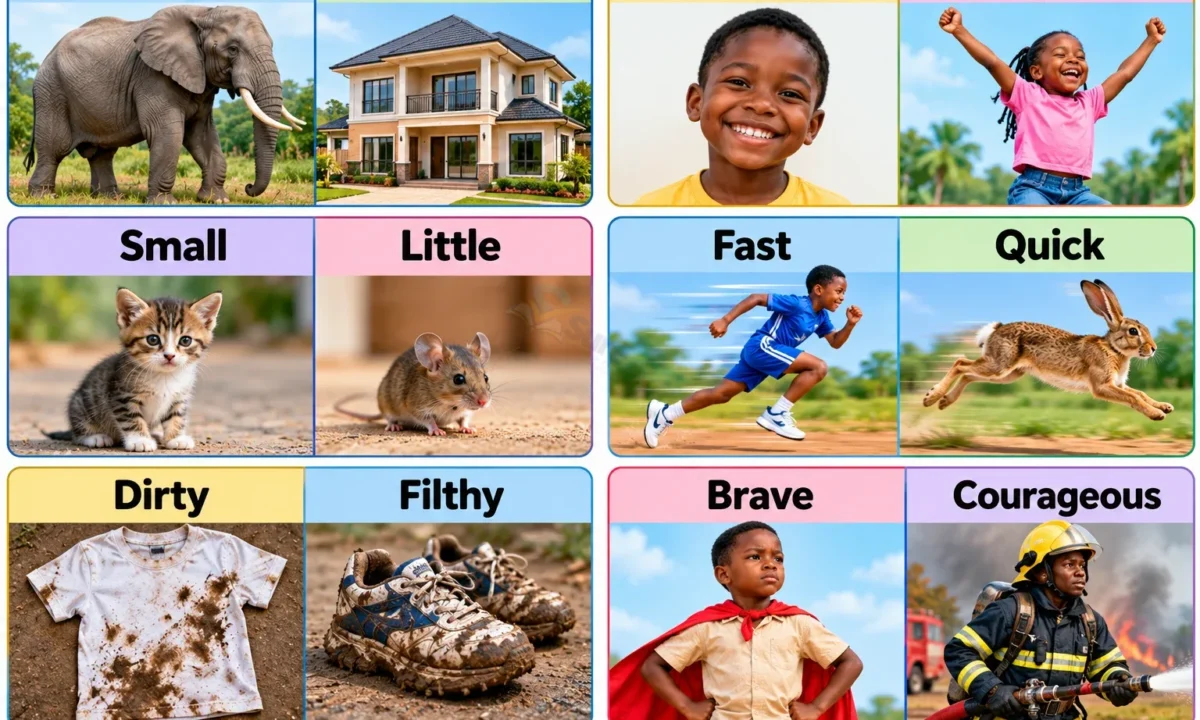
- Big and Large (meaning great in size)
- Happy and Joyful (meaning feeling or showing pleasure)
- Fast and Quick (meaning moving or doing something at high speed)
- Begin and Start (meaning to commence an action or event)
- Small and Tiny (meaning of a size that is less than normal or usual)
- Beautiful and Pretty (meaning pleasing to the senses or mind)
Observe the pairs of synonyms below.
Uses of Synonyms
Synonyms are useful for several reasons:
- Avoiding Repetition: Using different words with similar meanings prevents sentences from sounding boring or repetitive. For example, instead of saying “The boy was happy, and he felt happy all day,” one can say, “The boy was happy, and he felt joyful all day.”
- Adding Variety: Synonyms make writing and speaking more interesting and colourful.
- Choosing the Best Word: Sometimes, different synonyms have slightly different shades of meaning. Knowing many synonyms helps a person choose the most suitable word for a specific context.
Antonyms
An antonym is a word that has the opposite meaning of another word.
Antonyms are used to show contrast or difference between things. They help to describe things in terms of their opposites.
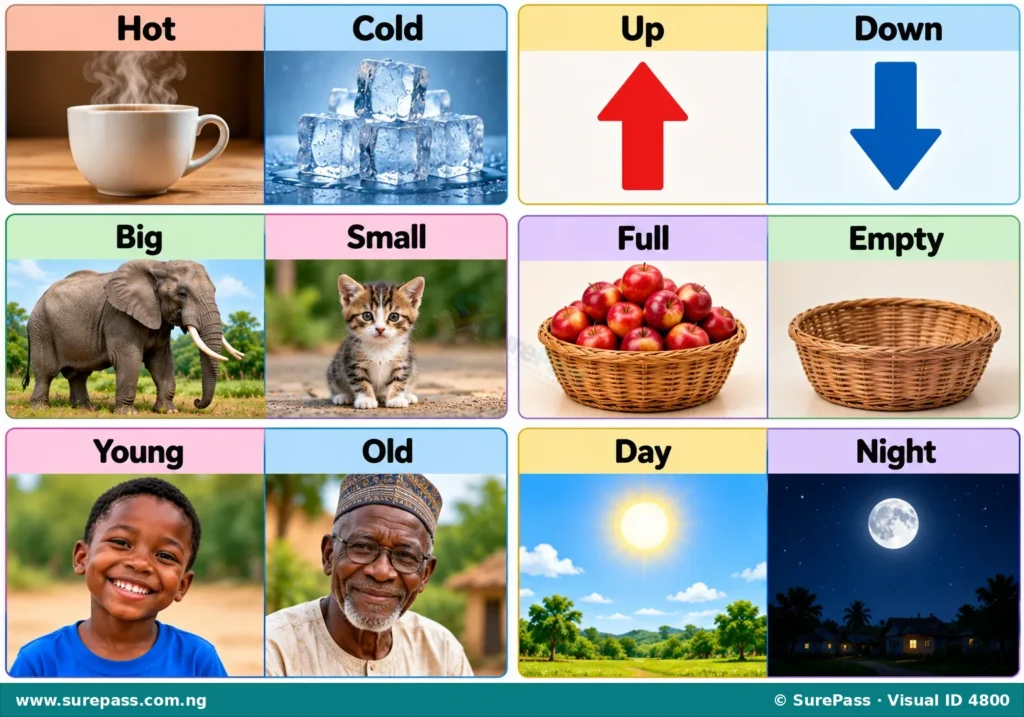
Examples of antonyms include:
- Hot and Cold (opposite temperatures)
- Up and Down (opposite directions)
- Day and Night (opposite times of a 24-hour period)
- Open and Close (opposite actions)
- Old and New (opposite in age or condition)
- Tall and Short (opposite in height)
Look at the pairs of antonyms shown below.
Uses of Antonyms
Antonyms are important for:
- Showing Contrast: They help to highlight differences clearly. For example, “The road was wide, but the path was narrow.”
- Describing Opposites: Antonyms are used to describe things that are at opposite ends of a scale or completely different from each other.
- Giving Clear Descriptions: Using antonyms can make descriptions more precise by showing what something is not, as well as what it is.
Homonyms
A homonym is a word that is spelled the same and sounds the same as another word, but has a different meaning.
Homonyms can sometimes be confusing because the same word form can refer to completely different things. The meaning must be understood from the way the word is used in a sentence.
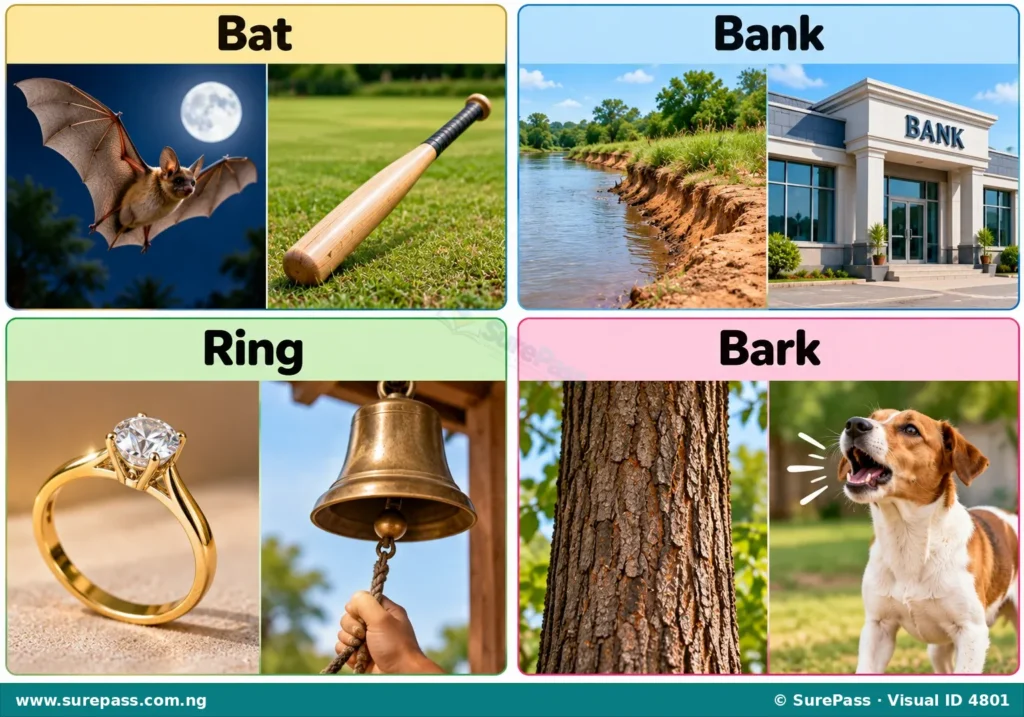
Examples of homonyms include:
- Bat: (an animal that flies) and Bat: (a piece of wood used in sports like baseball or cricket).
- Bank: (the land alongside a river) and Bank: (a place where money is kept).
- Right: (correct or true) and Right: (the opposite direction of left).
- Bear: (a large furry animal) and Bear: (to carry or tolerate something).
- Match: (a game or contest) and Match: (a small stick used to light a fire).
Observe the different meanings of homonyms below.
Uses of Homonyms
Understanding homonyms is important for:
- Understanding Context: People need to pay attention to the rest of the sentence to know which meaning of a homonym is intended.
- Avoiding Misunderstanding: Knowing that a word can have multiple meanings helps to avoid confusion in communication.
- Wordplay and Jokes: Homonyms are often used in riddles, puns, and jokes because of their multiple meanings.
Hyponyms
A hyponym is a word whose meaning is a more specific type of a broader, more general word.
The general word is called a hypernym (or superordinate). Hyponyms help to group words and show how specific items fit into larger categories.
Examples of hyponyms include:
- Animal (hypernym): Dog, Cat, Lion, Bird (hyponyms).
- Colour (hypernym): Red, Blue, Green, Yellow (hyponyms).
- Fruit (hypernym): Apple, Orange, Banana, Mango (hyponyms).
- Vehicle (hypernym): Car, Bus, Bicycle, Train (hyponyms).
- Furniture (hypernym): Chair, Table, Bed, Wardrobe (hyponyms).
The diagram below illustrates the relationship between a hypernym and its hyponyms.
Uses of Hyponyms
Hyponyms are useful for:
- Grouping Words: They help to organise vocabulary into categories, making it easier to learn and remember related words.
- Being Specific or General: People can choose to use a general word (hypernym) or a more specific word (hyponym) depending on how much detail they want to give. For example, saying “I saw an animal” is general, while “I saw a dog” is specific.
- Building Vocabulary: Understanding hyponyms helps in expanding vocabulary by learning words within the same category.
Using Sense Relations in Communication
Understanding synonyms, antonyms, homonyms, and hyponyms helps people to communicate more effectively in both speaking and writing.
- For Synonyms: When writing a story, instead of always saying “The man walked,” one can use synonyms like “The man strolled,” “The man hurried,” or “The man ambled” to show different ways of walking. This makes the story more descriptive.
- For Antonyms: To describe a character, one might say, “She was a kind person, not a cruel one.” Using the antonym “cruel” helps to clearly define her kindness by showing its opposite.
- For Homonyms: When someone says, “I saw a bat,” the listener needs to understand from the rest of the conversation whether they mean the flying animal or the sports equipment. For example, “I saw a bat flying in the night sky” makes it clear it’s the animal.
- For Hyponyms: If someone asks, “What is your favourite fruit?” a person can answer with a specific hyponym like “Mango” or “Orange,” rather than just the general hypernym “fruit.” This provides more precise information.
By using these sense relations, people can choose words carefully to make their messages clear, interesting, and accurate.




0 comments
Open the discussion when you need it. Comments stay collapsed until requested so the initial article remains light.