


ARTICLE CONTENTSOn this page 6 sections
Nouns and pronouns
Performance Objectives
By the end of the lesson, students should be able to:
- identify nouns and pronouns; and
- use nouns and pronouns in making sentences.
Understanding Nouns
A noun is a word that names a person, an animal, a place, or a thing.
Nouns are naming words. Everything that can be seen, touched, or spoken about has a name. These names allow people to identify and talk about the world around them. People, animals, places, and objects encountered daily all have names, and these names are nouns.
Categories of Nouns
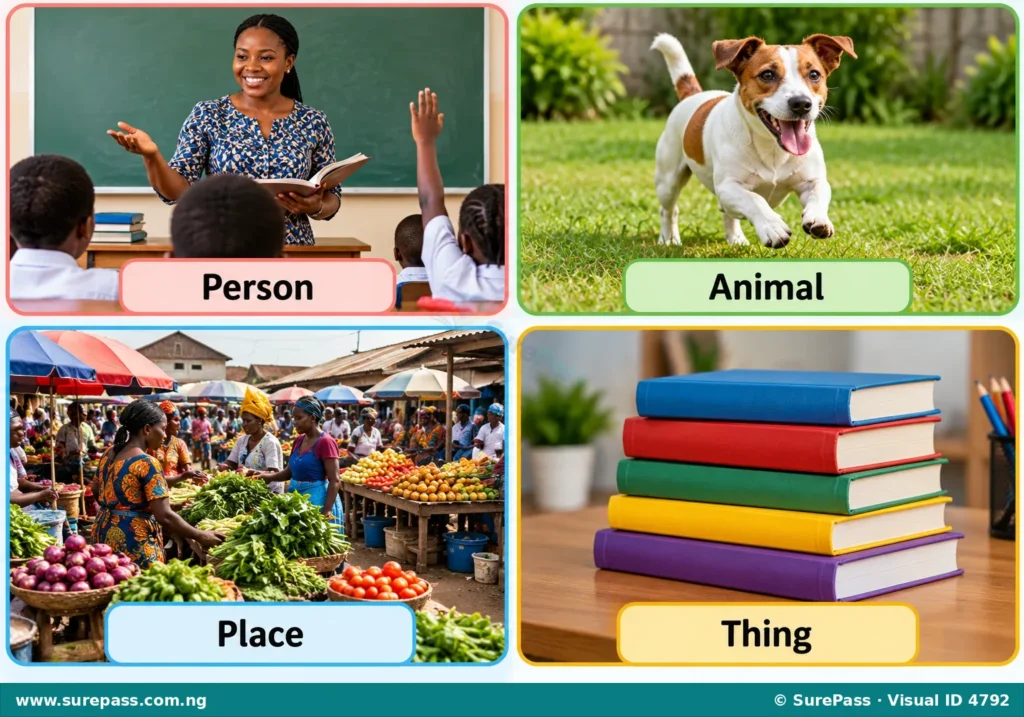
Nouns are grouped into four main categories:
- People
- Animals
- Places
- Things
Names of People
These are nouns used to name human beings, including family members, professions, and personal names. Examples of nouns for people include:
- teacher
- doctor
- father
- girl
- Chike
- mother
Names of Animals
These are nouns used to name living creatures that are not human. Examples of nouns for animals include:
- dog
- cat
- goat
- lion
- bird
- fish
Names of Places
These are nouns used to name locations, cities, countries, or buildings. Examples of nouns for places include:
- school
- market
- Lagos
- house
- park
- Nigeria
Names of Things
These are nouns used to name non-living objects or items. Examples of nouns for things include:
- book
- table
- chair
- ball
- pencil
- car
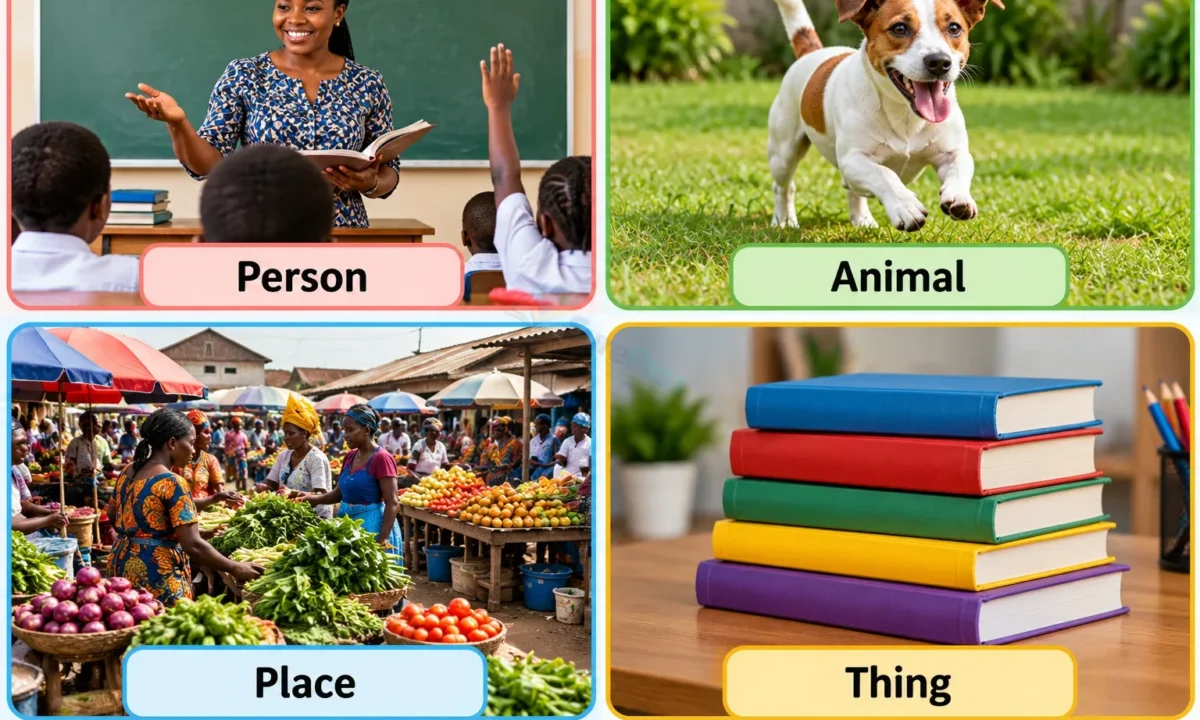
Observe the image below showing different examples of nouns.
Understanding Pronouns
A pronoun is a word that takes the place of a noun.
Pronouns are used to avoid repeating the same noun multiple times in sentences. Using pronouns makes speech and writing flow more naturally.
For example, instead of repeating a name like “Emeka” multiple times, a pronoun can be used to make sentences flow better: “Emeka is playing. He is happy. He likes football.” The pronoun “He” replaces the noun “Emeka”.
Common Pronouns
Common pronouns used in sentences include:
- I
- you
- he
- she
- it
- we
- they
The following list shows how specific pronouns replace nouns in sentences:
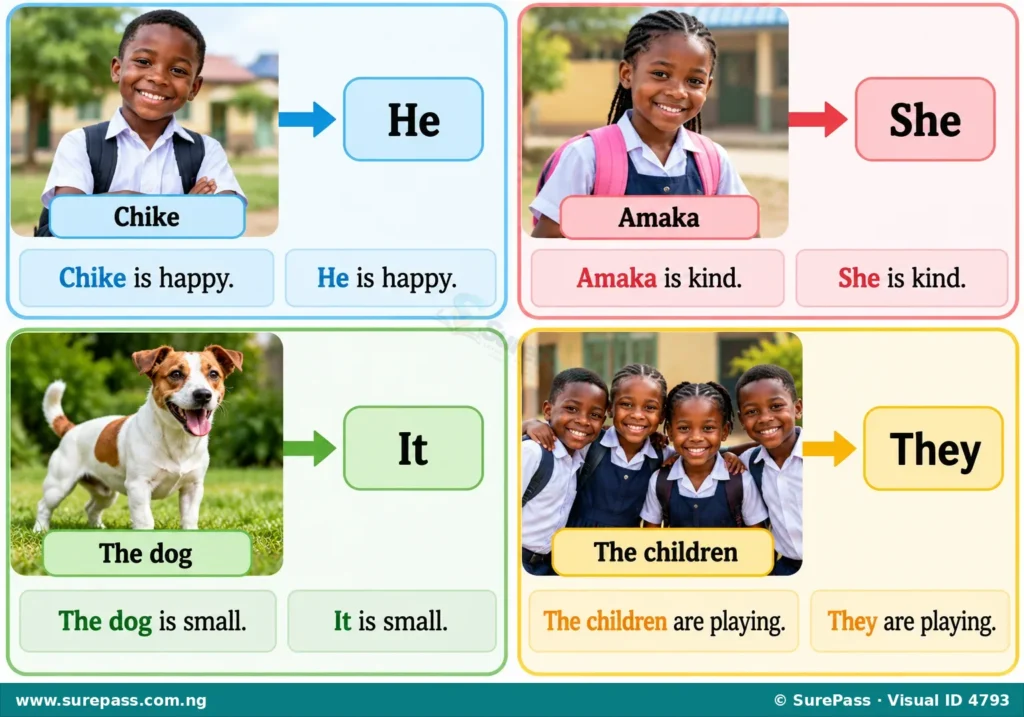
- He: This pronoun replaces the name of a boy or a man. For example, “Chike is tall” becomes “He is tall.”
- She: This pronoun replaces the name of a girl or a woman. For example, “Amaka is singing” becomes “She is singing.”
- It: This pronoun replaces the name of an animal or a non-living thing. For example, “The dog is barking” becomes “It is barking.”
- They: This pronoun replaces the names of multiple people, animals, or things. For example, “Boys are playing” becomes “They are playing,” and “The books are new” becomes “They are new.”
- We: This pronoun replaces a group of people that includes the speaker. For example, “My friends and I are going to school” becomes “We are going to school.”
- I: This pronoun is used when the speaker refers to themselves. For example, “My name is Bola” becomes “I am Bola.”
- You: This pronoun is used when addressing one person or a group of people directly. For example, “John, are you ready?” becomes “You, are you ready?”
The diagram below shows how pronouns replace nouns in sentences.
Identifying Nouns and Pronouns
Identifying nouns and pronouns requires reading a sentence carefully to locate words that name entities (nouns) and words that substitute for those names (pronouns).
Practice in Identification
The following sentences contain nouns and pronouns for identification practice:
- The girl plays with a ball.
- He went to the market.
- They saw a big elephant.
- My mother bought a new dress.
- It is sleeping under the tree.
- We live in Abuja.
- I like to read books.
- The teacher gave him a pencil.
The identified nouns and pronouns from the sentences above are:
- Sentence 1: “girl” and “ball” are nouns.
- Sentence 2: “He” is a pronoun; “market” is a noun.
- Sentence 3: “They” is a pronoun; “elephant” is a noun.
- Sentence 4: “mother” and “dress” are nouns.
- Sentence 5: “It” is a pronoun; “tree” is a noun.
- Sentence 6: “We” is a pronoun; “Abuja” is a noun.
- Sentence 7: “I” is a pronoun; “books” are nouns.
- Sentence 8: “teacher” and “pencil” are nouns; “him” is a pronoun.
Using Nouns and Pronouns to Make Sentences
Nouns and pronouns are essential building blocks of sentences. They function as subjects that perform actions or objects that receive actions.
Constructing Sentences with Nouns
The procedure for constructing a sentence with a noun involves the following steps:
- Select a noun to be the subject of the sentence, such as “student”.
- Determine an action or description for the noun, such as “reads a book”.
- Combine the noun and the action to form a complete sentence: “The student reads a book.”
Examples of sentences constructed using nouns include:
- The boy is running.
- The car is red.
- Lagos is a big city.
- The goat eats grass.
- My father works hard.
Constructing Sentences with Pronouns
The procedure for constructing a sentence with a pronoun involves the following steps:
- Select a pronoun to represent a person, animal, place, or thing, such as “She”.
- Determine an action or description for the pronoun, such as “is singing beautifully”.
- Combine the pronoun and the action to form a complete sentence: “She is singing beautifully.”
Examples of sentences constructed using pronouns include:
- He is playing football.
- She is my sister.
- It is a sunny day.
- They are going to school.
- We are learning English.
- I am happy.
- You are a good student.



0 comments
Open the discussion when you need it. Comments stay collapsed until requested so the initial article remains light.