


ARTICLE CONTENTSOn this page 6 sections
Business Ideas and Opportunities
Performance Objectives
By the end of the lesson, students should be able to:
- explain the meaning of business ideas, business opportunities and gainful activities;
- identify business opportunities in their locality;
- identify sources of business ideas, opportunities and gainful activities.
Meaning of Key Concepts
To establish and manage a successful livestock enterprise, an entrepreneur must understand the fundamental concepts that drive agricultural commerce. These concepts include business ideas, business opportunities, and gainful activities.
Business Idea
A business idea is a concept or thought that can be used to generate financial gain, typically centered around a product or service that can be offered for money.
In livestock farming, a business idea is the initial creative thought of how to solve a problem or meet a need using farm animals or their by-products. For example, a person might think of rearing grasscutters in a backyard to supply meat to local restaurants. At this stage, the idea is simply a mental concept that has not yet been tested for profitability or market demand.
Business Opportunity
A business opportunity is a proven or highly probable chance to start a successful business because there is a real demand from customers who are willing to pay for the product or service.
An idea only becomes an opportunity when it is evaluated and found to be commercially viable. For instance, if a community has a high demand for fresh eggs but lacks a local supplier, starting a poultry egg production farm in that area is a business opportunity. A viable business opportunity must have a clearly identified target market, access to resources, and the potential to generate profit.
Gainful Activity
A gainful activity is any productive work, employment, or trade that provides an individual with a regular income, livelihood, or financial return.
In the agricultural sector, gainful activities include the actual day-to-day operations that generate revenue. Examples include feeding birds, cleaning pens, processing milk, transporting livestock feed, or selling veterinary drugs. These activities keep the business running and ensure that the owner and employees earn a living.
The Relationship Between Ideas, Opportunities, and Gainful Activities
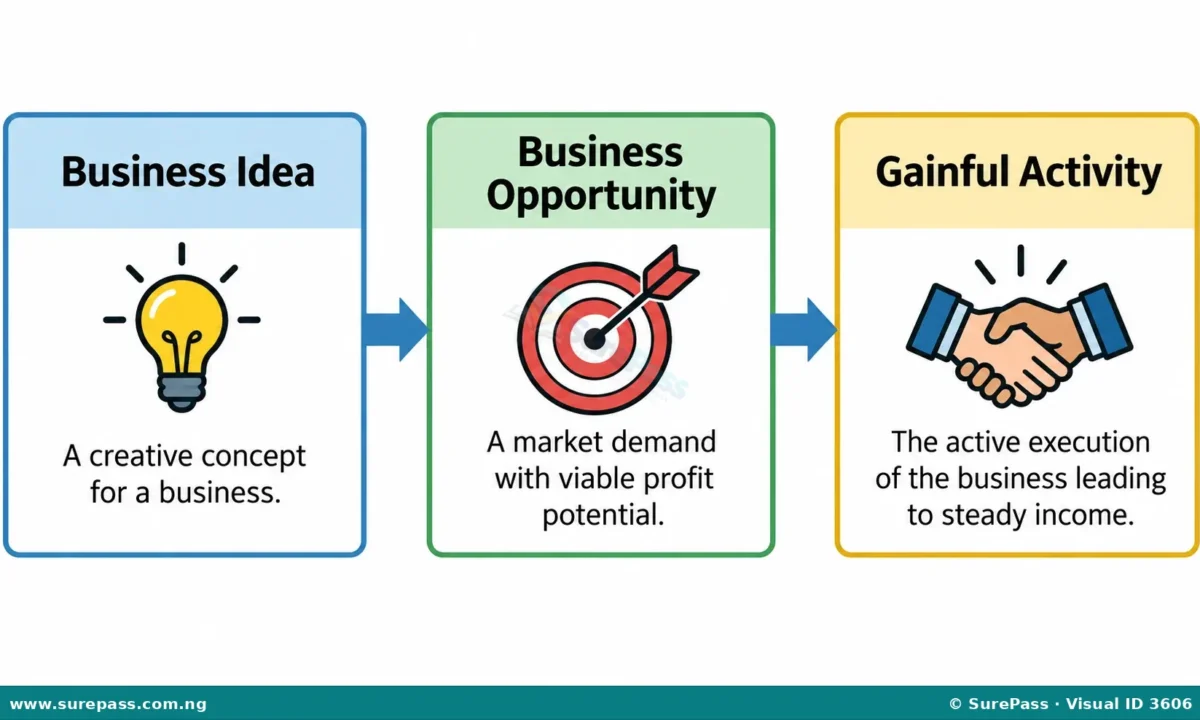
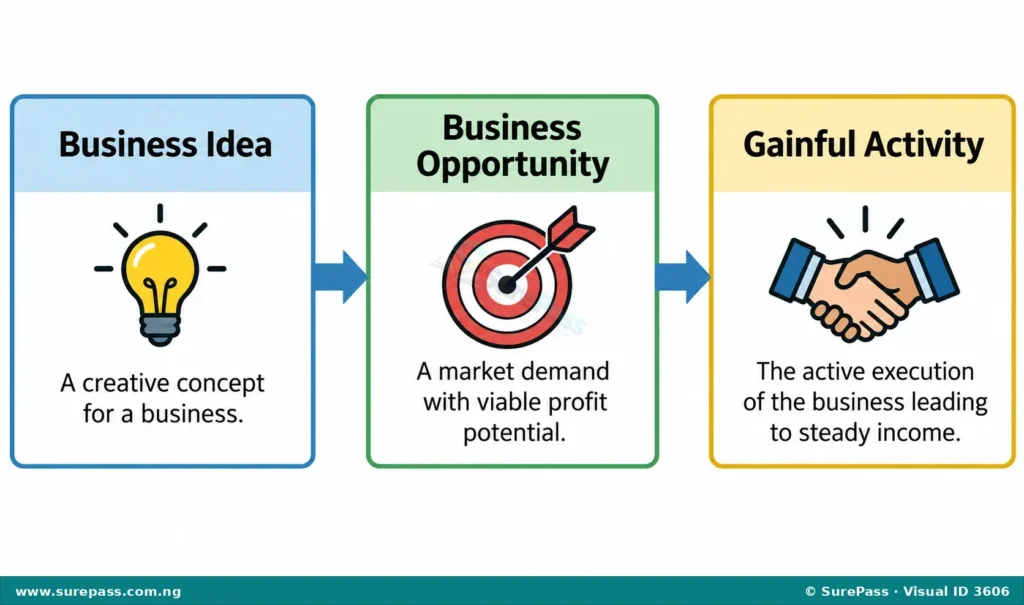
There is a direct progression from a business idea to a gainful activity. The process begins with a creative thought (the business idea). This idea is then analyzed against market realities to see if it can succeed (the business opportunity). Once the opportunity is validated and put into action, the daily operations of running that business become the gainful activities that generate income.
Business Opportunities in the Locality
Local communities in Nigeria present numerous livestock business opportunities due to the constant demand for animal protein, organic manure, and raw materials for agro-industries. Entrepreneurs can exploit these opportunities based on the specific needs of their environment.
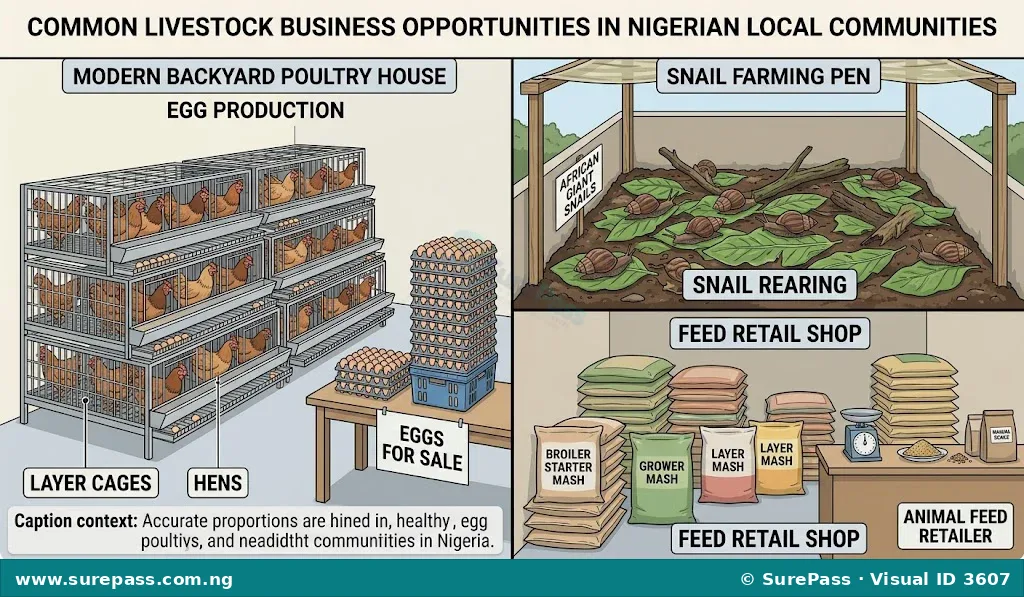
Common livestock business opportunities found in local communities include:
- Poultry Production: Rearing chickens, turkeys, or ducks for meat (broilers) or eggs (layers). This is highly popular due to the rapid growth rate of poultry birds and the daily demand for eggs in households, bakeries, and hotels.
- Micro-Livestock Farming: Rearing smaller animals such as rabbits, snails, or grasscutters. These animals require minimal land space, have low feed consumption rates, and are highly prolific, making them ideal for urban and suburban localities.
- Livestock Feed Production and Marketing: Formulating, milling, or retailing animal feeds. Farmers constantly require high-quality feed for poultry, pigs, and fish. Operating a feed depot or a small-scale feed mill is a highly profitable venture.
- Value Addition and Processing: Processing raw livestock products into refined forms. Examples include slaughtering and packaging frozen chicken, processing fresh cow milk into local cheese (wara) or yoghurt, and smoking fish for preservation.
- Organic Manure Supply: Collecting, drying, and packaging livestock waste, such as poultry droppings or cattle dung, to sell to crop farmers as organic fertilizer. This promotes sustainable agriculture and turns waste into wealth.
- Livestock Equipment Fabrication: Constructing and selling essential farm structures and tools. Local artisans can build wooden or metal cages for rabbits and poultry, feed troughs, and nesting boxes.
- Veterinary and Input Supply Services: Operating a retail shop that sells veterinary drugs, vaccines, disinfectants, feeders, and drinkers to local farmers.
Sources of Business Ideas, Opportunities, and Gainful Activities
Identifying a viable business idea or opportunity requires deliberate observation, research, and interaction with the environment. Successful agricultural entrepreneurs gather ideas from various reliable sources.
The primary sources of livestock business ideas and opportunities include:
- Personal Interests, Hobbies, and Skills: Many successful livestock businesses start from personal passions. A person who enjoys caring for animals as a hobby can easily transition into commercial rabbitry or poultry farming. Prior training or experience gained while working on a family farm also serves as a strong foundation.
- Market Research and Consumer Complaints: Observing the local market helps identify gaps between supply and demand. Listening to consumer complaints about the scarcity of fresh fish, the high cost of beef, or the poor quality of local eggs can inspire a business idea to solve those specific problems.
- Government Policies and Programmes: Government initiatives often create new business opportunities. For example, a ban on the importation of frozen poultry products encourages local production. Similarly, agricultural loan schemes and youth empowerment grants make it easier to secure capital for livestock ventures.
- Agricultural Exhibitions, Trade Fairs, and Farmers’ Field Days: Attending agricultural shows exposes potential entrepreneurs to modern farming technologies, improved animal breeds, and innovative processing methods. Interacting with established farmers at these events provides practical insights into profitable ventures.
- Mass Media and the Internet: Agricultural journals, textbooks, television documentaries, and online platforms are rich sources of information. Researching online can reveal modern livestock trends, such as automated poultry systems or black soldier fly larvae production for cheap animal feed.
- Environmental and Social Challenges: Problems within a community can be converted into business opportunities. For instance, the accumulation of offensive-smelling poultry waste in a neighborhood can inspire an entrepreneur to start a waste-to-manure processing business, solving an environmental hazard while making a profit.
Developing a Livestock Business Idea
Developing a livestock business idea is a systematic process of transforming a basic mental concept into a structured, workable plan. It involves evaluating the feasibility of the idea to ensure that time and capital are not wasted on an unprofitable venture.
The procedure for developing a livestock business idea involves the following steps:
- Identify the Core Idea: Choose a specific livestock branch based on personal interest, skills, and local demand. For example, decide to focus on “Local Production of Table Eggs.”
- Conduct a Feasibility Study: Research the market to determine if the idea is viable. Find out who the competitors are, where the feed will be sourced, who the target buyers are, and what price they are willing to pay.
- Assess Resource Requirements: Determine the physical and financial resources needed to start. This includes land or space for pens, access to clean water, source of electricity, initial capital for purchasing day-old chicks, feed, vaccines, and labor.
- Analyze Potential Risks: Identify the challenges associated with the chosen livestock. In poultry farming, major risks include disease outbreaks (such as Newcastle disease), high cost of feed, and egg breakage during transportation. Develop strategies to minimize these risks, such as strict biosecurity measures and routine vaccinations.
- Formulate a Simple Business Plan: Write down a clear description of the business, the production targets, the marketing strategy, and the financial projections (expected expenses and income). This plan serves as a guide for running the business and can be used to seek financial assistance.
Practical Activity: Developing a Backyard Poultry Business Idea
This practical exercise guides learners through the process of conceptualizing and planning a small-scale poultry egg production unit using local resources.
The required materials are:
- Writing materials (notebooks and pens)
- A simple calculator
- Sample price lists of day-old chicks, point-of-lay birds, and poultry feed from local agro-dealers
The procedure involves the following steps:
- Define the Scale of Operation: Decide on a manageable starting capacity, such as rearing fifty point-of-lay birds in a backyard space.
- Estimate the Startup Capital: Calculate the cost of purchasing fifty point-of-lay birds, constructing a simple wooden chicken coop, and buying feeders and drinkers.
- Calculate Operational Expenses: Estimate the cost of feeding fifty birds daily for a period of six months, including the cost of routine veterinary drugs and vaccines.
- Project the Revenue: Assuming a conservative laying rate of eighty percent, calculate the number of crates of eggs the birds will produce weekly. Multiply this by the current market price of a crate of eggs in the locality to find the weekly income.
- Evaluate Profitability: Subtract the weekly operational expenses from the weekly projected revenue to determine the estimated net profit.
- Document the Plan: Write a two-page business proposal summarizing the findings, highlighting how the eggs will be packaged and sold to local households or retailers.




0 comments
Open the discussion when you need it. Comments stay collapsed until requested so the initial article remains light.