




ARTICLE CONTENTSOn this page 7 sections
Livestock Nutrition
Performance Objectives
By the end of the lesson, students should be able to:
- Explain the meaning of livestock nutrition.
- State the importance of livestock nutrition.
- Classify nutrients into their major groups.
- Discuss the functions of each nutrient in livestock.
Meaning of Livestock Nutrition
Livestock nutrition is the science that deals with the study of how farm animals obtain, ingest, digest, absorb, and utilise food substances to support their body maintenance, growth, reproduction, and production.
In livestock farming, feed refers to the mixture of food substances given to animals, while nutrients are the specific chemical components within the feed that the animal’s body absorbs and uses to carry out life processes. Proper nutrition is essential because farm animals, unlike wild animals, rely almost entirely on the farmer to provide a balanced ration that meets all their physiological needs.
Importance of Livestock Nutrition
Providing farm animals with the correct quantity and quality of nutrients is fundamental to successful livestock enterprise. The main reasons for ensuring proper livestock nutrition include:
- Maintenance of Body Tissues: Animals require nutrients to repair worn-out cells and maintain basic life functions such as respiration, blood circulation, and body temperature regulation when at rest.
- Promotion of Growth: Young animals need adequate nutrients, especially proteins and minerals, to build muscles, bones, and organs, allowing them to reach market weight rapidly.
- Production of Livestock Products: Nutrients are directly converted into valuable human food and industrial raw materials, including meat, milk, eggs, wool, and hides.
- Reproduction: Proper nutrition ensures high fertility rates, successful gestation, healthy birth weights of offspring, and sufficient milk production (lactation) to feed the young.
- Disease Resistance: Well-nourished animals have stronger immune systems, making them less susceptible to infections, parasites, and environmental stress.
- Provision of Energy: Livestock require energy to move, graze, and perform draft work such as pulling ploughs or carts on the farm.
Classification of Nutrients
Nutrients are grouped into six major classes based on their chemical composition and the roles they play in the animal body. These classes are:
- Carbohydrates
- Proteins
- Fats and Lipids
- Vitamins
- Minerals
- Water
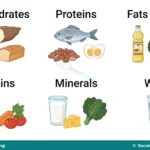
Observe the diagram below showing the classification of livestock nutrients and common Nigerian feed sources.
Detailed Study of Nutrient Classes
1. Carbohydrates
Carbohydrates are organic compounds made up of carbon, hydrogen, and oxygen that serve as the primary source of energy for livestock.
They form the largest component of livestock feeds, particularly for herbivores and omnivores. Carbohydrates are broken down during digestion into simple sugars, mainly glucose, which are absorbed into the bloodstream.
Common sources of carbohydrates in Nigeria include:
- Cereal grains such as maize, guinea corn (sorghum), millet, and rice.
- Root and tuber crops such as cassava, sweet potatoes, and yam peels.
- Agro-industrial by-products such as wheat offal, rice bran, and maize bran.
- Forage grasses such as elephant grass, guinea grass, and giant star grass.
The functions of carbohydrates in livestock include:
- Providing energy for daily physical activities and metabolic processes.
- Generating body heat to maintain constant body temperature.
- Serving as the raw material for the synthesis of body fat and milk sugar (lactose).
Deficiency of carbohydrates leads to general body weakness, rapid weight loss, slow growth, and a significant drop in milk and egg production.
2. Proteins
Proteins are complex organic compounds made up of amino acids, containing carbon, hydrogen, oxygen, nitrogen, and sometimes sulphur or phosphorus, which are essential for building body tissues.
Proteins are the building blocks of the animal body. Since animals cannot synthesise nitrogen-containing compounds from scratch, they must obtain amino acids directly from their feed. Young, growing animals and lactating mothers have the highest protein requirements.
Common sources of proteins in Nigeria include:
- Plant protein concentrates such as groundnut cake (GNC), soybean meal, palm kernel cake (PKC), and cotton seed cake.
- Animal protein concentrates such as fish meal, blood meal, meat meal, and poultry offal meal.
- Leguminous forages such as Centrosema pubescens, Stylosanthes gracilis, and cowpea vines.
The functions of proteins in livestock include:
- Building new body tissues during growth and repairing damaged or worn-out tissues.
- Synthesising essential body chemicals such as enzymes, hormones, and antibodies.
- Forming major components of animal products like lean meat, egg white (albumen), and milk protein (casein).
- Serving as an emergency source of energy when carbohydrates and fats are deficient in the diet.
Deficiency of proteins results in stunted growth, muscle wasting, poor feathering in poultry, low egg and milk yields, and increased susceptibility to diseases.
3. Fats and Lipids
Fats and lipids are organic compounds composed of carbon, hydrogen, and oxygen that provide a highly concentrated source of energy and act as carriers for fat-soluble vitamins.
Fats contain much less oxygen than carbohydrates, which makes them highly concentrated. On equal weight basis, fats yield about 2.25 times more energy than carbohydrates when oxidised in the body.
Common sources of fats in Nigeria include:
- Oilseeds such as sunflower seeds, sesame (benniseed), and soybeans.
- Agro-industrial by-products like palm kernel cake and coconut meal.
- Animal fats such as lard, tallow, and fish oil.
The functions of fats and lipids in livestock include:
- Providing a highly concentrated source of reserve energy.
- Aiding the absorption of fat-soluble vitamins (Vitamins A, D, E, and K).
- Insulating the body against extreme cold by forming a subcutaneous fat layer.
- Protecting vital internal organs such as the kidneys and heart from physical shock.
Deficiency of fats can lead to skin irritation, scaly skin, poor hair coat, reproductive failure, and a deficiency of fat-soluble vitamins.
4. Vitamins
Vitamins are organic substances required by livestock in very small quantities to regulate metabolic processes and maintain general health.
Vitamins do not provide energy or build tissues directly, but they act as catalysts in biochemical reactions. They are classified into two main groups: fat-soluble vitamins and water-soluble vitamins.
The classification of vitamins is structured as follows:
- Fat-Soluble Vitamins: These are soluble in fats and organic solvents. They include Vitamin A, Vitamin D, Vitamin E, and Vitamin K. They can be stored in the liver of the animal.
- Water-Soluble Vitamins: These are soluble in water and cannot be stored in large quantities in the body. They include the Vitamin B-complex group (such as Thiamine, Riboflavin, Niacin, and Cobalamin) and Vitamin C.
Common sources of vitamins in Nigeria include:
- Fresh green pastures and silage.
- Synthetic vitamin premixes added to commercial feeds.
- Fish liver oil and yeast.
- Sunlight (which stimulates the synthesis of Vitamin D in the skin).
The functions and deficiency symptoms of key vitamins are detailed below:
- Vitamin A: Essential for good vision, healthy skin, and mucous membranes. Deficiency causes night blindness and reproductive failure.
- Vitamin D: Promotes the absorption of calcium and phosphorus for bone formation. Deficiency causes rickets in young animals and osteomalacia in adult animals.
- Vitamin E: Acts as an antioxidant and supports reproductive health. Deficiency causes reproductive failure and muscular dystrophy (crazy chick disease in poultry).
- Vitamin K: Essential for blood clotting. Deficiency leads to prolonged bleeding from minor wounds and internal haemorrhage.
- Vitamin B-Complex: Aids in energy metabolism and nervous system function. Deficiency causes loss of appetite, polyneuritis, and curled-toe paralysis in chicks.
5. Minerals
Minerals are inorganic elements required by livestock to build skeletal structures, regulate body fluids, and facilitate metabolic processes.
Minerals do not contain carbon and are not energy sources. They are divided into two categories based on the quantity required by the animal: macro-minerals (needed in relatively large amounts) and micro-minerals or trace minerals (needed in very small amounts).
The table below outlines the classification of minerals:
| Mineral Category | Elements Included | Primary Sources in Nigeria |
|---|---|---|
| Macro-minerals | Calcium (Ca), Phosphorus (P), Magnesium (Mg), Sodium (Na), Potassium (K), Chlorine (Cl), Sulphur (S) | Bone meal, oyster shell, dicalcium phosphate, common salt (sodium chloride) |
| Micro-minerals (Trace) | Iron (Fe), Copper (Cu), Zinc (Zn), Manganese (Mn), Iodine (I), Cobalt (Co), Selenium (Se) | Mineral premixes, salt licks, trace mineralised salt blocks |
The functions of minerals in livestock include:
- Forming the structural framework of bones and teeth (mainly Calcium and Phosphorus).
- Regulating osmotic pressure and acid-base balance in body fluids (Sodium, Potassium, and Chlorine).
- Facilitating oxygen transport in the blood (Iron is a key component of haemoglobin).
- Activating various enzyme systems involved in digestion and metabolism.
Deficiency of minerals leads to specific health disorders:
- Calcium and Phosphorus deficiency: Causes rickets, osteomalacia, and milk fever (acute calcium deficiency in high-producing dairy cows shortly after calving).
- Iron deficiency: Causes anaemia, especially in young piglets kept on concrete floors without access to soil.
- Iodine deficiency: Causes goitre (enlargement of the thyroid gland) and birth of hairless, weak offspring.
6. Water
Water is a simple inorganic compound made of hydrogen and oxygen that serves as the universal solvent and medium for all biochemical reactions in the livestock body.
Water is the most abundant single component of the animal body, making up about 60% to 80% of the body weight of live animals. Animals can survive longer without food than without water.
Common sources of water for livestock include:
- Clean drinking water provided in troughs.
- Moisture contained in succulent feeds such as fresh pasture, silage, and root crops.
- Metabolic water produced inside the body during the oxidation of nutrients.
The functions of water in livestock include:
- Serving as a medium for digestion, absorption, and transport of nutrients.
- Regulating body temperature through sweating and panting.
- Excreting waste products from the body through urine and faeces.
- Forming a major component of animal products, especially milk (which is about 87% water) and eggs.
- Maintaining the shape and turgidity of body cells.
Deficiency of water leads to rapid dehydration, a sharp decline in feed intake, a drastic drop in milk and egg production, and ultimately death if water is withheld for a few days.
Observe the diagram below showing the impact of water availability on livestock health and productivity.
Summary of Nutrient Functions and Sources
To ensure high productivity, farmers must formulate balanced rations containing correct proportions of all six classes of nutrients. The table below provides a quick-reference summary of the sources and primary functions of each nutrient class:
| Nutrient Class | Primary Local Sources | Major Functions |
|---|---|---|
| Carbohydrates | Maize, guinea corn, cassava, wheat offal | Provide energy and maintain body temperature |
| Proteins | Groundnut cake, fish meal, soybean meal, legumes | Growth, tissue repair, enzyme and hormone synthesis |
| Fats and Lipids | Oilseeds, palm kernel cake, animal fats | Concentrated energy, absorption of fat-soluble vitamins |
| Vitamins | Green pasture, synthetic premixes, sunlight | Regulate body processes, boost immunity |
| Minerals | Bone meal, oyster shell, salt licks | Bone formation, fluid balance, oxygen transport |
| Water | Drinking water, succulent forage | Temperature regulation, digestion, waste excretion |



0 comments
Open the discussion when you need it. Comments stay collapsed until requested so the initial article remains light.