


ARTICLE CONTENTSOn this page 12 sections
Elements, Compounds and Mixtures
Performance Objectives
By the end of the lesson, students should be able to:
- define the elements, compounds and mixtures;
- explain the differences between elements, compounds and mixtures;
- group substances as elements, compounds and mixtures;
- write the chemical formula of simple compounds;
- separate mixtures into their constituent elements;
- determine the:
- percentage composition of elements in a compound,
- empirical and molecular formulae of simple compounds.
Introduction to Matter
Everything around us, from the air we breathe to the water we drink and the ground we walk on, is made of matter. Matter is anything that has mass and occupies space. Chemists classify matter into different categories based on its composition and properties. The three main classifications of matter are elements, compounds, and mixtures.
Elements
An element is a pure substance that cannot be broken down into simpler substances by ordinary chemical or physical means.
Elements are the fundamental building blocks of all matter. Each element is made up of only one type of atom. For example, a piece of pure gold contains only gold atoms, and a tank of oxygen gas contains only oxygen atoms. There are currently over 100 known elements, many of which occur naturally on Earth, while others have been created in laboratories.
Examples of Common Elements
Common examples of elements include:
- Oxygen
- Hydrogen
- Nitrogen
- Carbon
- Iron
- Gold
- Silver
- Copper
- Aluminium
- Sodium
- Chlorine
Chemical Symbols of Elements
Each element is represented by a unique chemical symbol, which is usually one or two letters derived from its English or Latin name. The first letter of a symbol is always capitalised, and the second letter (if present) is always lowercase.
The Periodic Table of Elements organises all known elements based on their atomic number and chemical properties. It is an essential tool for chemists.
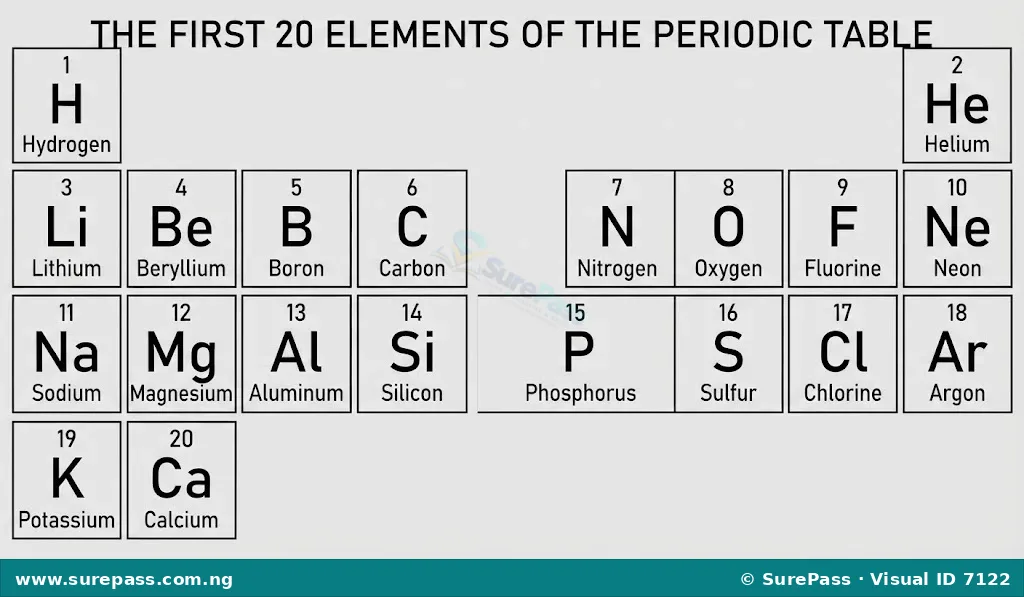
Examples of elements and their symbols include:
- Hydrogen (H)
- Helium (He)
- Lithium (Li)
- Beryllium (Be)
- Boron (B)
- Carbon (C)
- Nitrogen (N)
- Oxygen (O)
- Fluorine (F)
- Neon (Ne)
- Sodium (Na)
- Magnesium (Mg)
- Aluminium (Al)
- Silicon (Si)
- Phosphorus (P)
- Sulphur (S)
- Chlorine (Cl)
- Argon (Ar)
- Potassium (K)
- Calcium (Ca)
- Iron (Fe)
- Copper (Cu)
- Gold (Au)
- Silver (Ag)
Compounds
A compound is a pure substance formed when two or more different elements are chemically combined in a fixed ratio by mass.
When elements combine to form a compound, they lose their individual properties and form a new substance with entirely different properties. For example, hydrogen is a flammable gas and oxygen supports combustion, but when they combine, they form water (H2O), which is a liquid used to extinguish fires. Compounds can only be broken down into their constituent elements by chemical reactions, not by physical means.
Examples of Common Compounds
Common examples of compounds include:
- Water (H2O)
- Carbon dioxide (CO2)
- Sodium chloride (NaCl, common salt)
- Sugar (C12H22O11)
- Sulphuric acid (H2SO4)
- Ammonia (NH3)
- Methane (CH4)
- Calcium carbonate (CaCO3, limestone)
Chemical Formulae of Compounds
The chemical formula of a compound shows the types of elements present and the exact number of atoms of each element in one molecule of the compound. Subscripts are used to indicate the number of atoms.
Writing Chemical Formulae of Simple Compounds
Chemical formulae are written using the symbols of the elements and their valencies. Valency is the combining power of an element.
The steps for writing chemical formulae are:
- Write the symbols of the elements or radicals side by side.
- Write their valencies as superscripts above the symbols.
- Swap the valencies (criss-cross method) and write them as subscripts.
- If the valencies are the same, they cancel out.
- If the valencies have a common factor, divide by the common factor to get the simplest ratio.
- If a radical is involved and its subscript is more than one, enclose the radical in a bracket before writing the subscript.
Worked Example: Writing the Formula for Water
Water is formed from hydrogen (H) and oxygen (O).
- Symbols: H O
- Valencies: H1 O2
- Swap valencies: H2O1
- Simplify: H2O
Therefore, the chemical formula for water is H2O.
Worked Example: Writing the Formula for Calcium Chloride
Calcium chloride is formed from calcium (Ca) and chlorine (Cl).
- Symbols: Ca Cl
- Valencies: Ca2 Cl1
- Swap valencies: Ca1Cl2
- Simplify: CaCl2
Therefore, the chemical formula for calcium chloride is CaCl2.
Worked Example: Writing the Formula for Aluminium Sulphate
Aluminium sulphate is formed from aluminium (Al) and the sulphate radical (SO4).
- Symbols: Al SO4
- Valencies: Al3 (SO4)2
- Swap valencies: Al2(SO4)3
Therefore, the chemical formula for aluminium sulphate is Al2(SO4)3.
Mixtures
A mixture is a substance containing two or more substances (elements or compounds) that are physically combined but not chemically bonded.
In a mixture, the individual components retain their original properties. They can be separated by physical means. The ratio of components in a mixture is not fixed and can vary. For example, air is a mixture of gases like nitrogen, oxygen, and argon, each retaining its properties. Salt water is a mixture of salt and water; the salt still tastes salty, and the water is still water.
Types of Mixtures
Mixtures can be classified into two main types:
-
Homogeneous Mixtures: These mixtures have a uniform composition and appearance throughout. The components are evenly distributed, and it is difficult to distinguish them visually. Examples include salt dissolved in water, sugar dissolved in water, and air.
-
Heterogeneous Mixtures: These mixtures do not have a uniform composition. The components are not evenly distributed and can often be seen as separate phases. Examples include sand and water, oil and water, and a mixture of rice and beans.
Examples of Common Mixtures
Common examples of mixtures include:
- Air (mixture of gases)
- Salt water (salt and water)
- Sand and iron filings
- Crude oil (mixture of hydrocarbons)
- Milk
- Blood
- Soft drinks
- Soil
Differences Between Elements, Compounds, and Mixtures
The table below summarises the key differences between elements, compounds, and mixtures.
| Feature | Element | Compound | Mixture |
|---|---|---|---|
| Composition | Made of only one type of atom. | Made of two or more different elements chemically combined. | Made of two or more substances physically combined. |
| Nature of Combination | Not combined with other substances. | Chemically bonded in a fixed ratio. | Physically combined in variable ratios. |
| Properties | Retains its own unique properties. | Has new properties different from its constituent elements. | Components retain their individual properties. |
| Separation | Cannot be broken down into simpler substances by chemical or physical means. | Can only be separated into elements by chemical reactions. | Can be separated into components by physical methods. |
| Formula/Symbol | Represented by a chemical symbol (e.g., O, Fe). | Represented by a chemical formula (e.g., H2O, NaCl). | No fixed chemical formula. |
| Energy Change | No energy change during formation (it is a fundamental substance). | Energy is usually absorbed or released during formation. | No significant energy change during formation. |
| Melting/Boiling Point | Fixed melting and boiling points. | Fixed melting and boiling points. | Variable melting and boiling points. |
Atomic Structure, Atomic Number, Mass Number, and Valencies
Atomic Structure
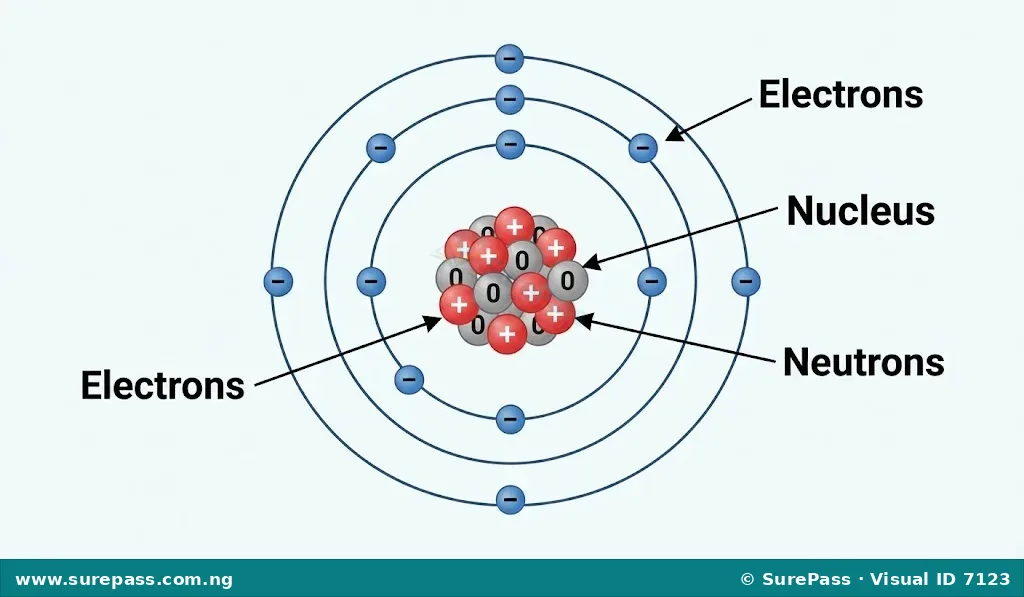
An atom is the smallest unit of an element that retains the chemical identity of that element. Atoms are made up of even smaller particles called subatomic particles.
The main subatomic particles are:
-
Protons: Positively charged particles found in the nucleus of an atom.
-
Neutrons: Neutral (no charge) particles also found in the nucleus.
-
Electrons: Negatively charged particles that orbit the nucleus in specific energy levels or shells.
The nucleus is the dense, central part of an atom, containing protons and neutrons. The electrons occupy the space around the nucleus.
Atomic Number (Z)
The atomic number (Z) of an element is the number of protons in the nucleus of an atom of that element.
The atomic number determines the identity of an element. All atoms of a particular element have the same atomic number. In a neutral atom, the number of electrons is equal to the number of protons.
Mass Number (A)
The mass number (A) of an atom is the total number of protons and neutrons in its nucleus.
The mass number is approximately the mass of the atom, as protons and neutrons are much heavier than electrons. The number of neutrons in an atom can be calculated by subtracting the atomic number from the mass number: Number of neutrons = Mass Number (A) – Atomic Number (Z).
Example: Carbon Atom
A carbon atom has an atomic number of 6 and a mass number of 12.
- Number of protons = 6
- Number of electrons = 6 (in a neutral atom)
- Number of neutrons = Mass number – Atomic number = 12 – 6 = 6
Valency
Valency is the combining power of an element or radical. It represents the number of hydrogen atoms that can combine with or replace one atom of the element.
Valency is determined by the number of electrons an atom gains, loses, or shares to achieve a stable electron configuration (usually a full outer shell). Elements in the same group of the Periodic Table often have the same valency.
Valencies of Common Elements and Radicals
Common valencies include:
- Valency 1: Hydrogen (H), Sodium (Na), Potassium (K), Chlorine (Cl), Hydroxide (OH–), Nitrate (NO3–)
- Valency 2: Oxygen (O), Magnesium (Mg), Calcium (Ca), Zinc (Zn), Sulphate (SO42-), Carbonate (CO32-)
- Valency 3: Aluminium (Al), Nitrogen (N) (in some compounds), Phosphate (PO43-)
- Valency 4: Carbon (C), Silicon (Si)
Empirical and Molecular Formulae of Simple Compounds
Empirical Formula
The empirical formula is the simplest whole-number ratio of atoms of each element in a compound.
It shows the relative number of atoms of each element present in a compound, but not necessarily the actual number of atoms in a molecule. For ionic compounds, the empirical formula is often the only formula written.
Examples:
- The empirical formula of glucose (C6H12O6) is CH2O (dividing by 6).
- The empirical formula of hydrogen peroxide (H2O2) is HO (dividing by 2).
- The empirical formula of water (H2O) is H2O, as it is already in its simplest ratio.
Molecular Formula
The molecular formula shows the actual number of atoms of each element present in one molecule of a compound.
The molecular formula is a multiple of the empirical formula. The relationship is: Molecular Formula = (Empirical Formula)n, where ‘n’ is a whole number.
Examples:
- The molecular formula of glucose is C6H12O6. Its empirical formula is CH2O, and n = 6.
- The molecular formula of hydrogen peroxide is H2O2. Its empirical formula is HO, and n = 2.
Calculations Involving Compounds
Percentage Composition of Elements in a Compound
The percentage composition of an element in a compound is the mass of that element present in 100 parts by mass of the compound.
To calculate the percentage composition, the following formula is used:
Percentage composition of an element = (Total mass of the element in the compound / Molar mass of the compound) × 100%
Worked Example: Percentage Composition of Water (H2O)
Given atomic masses: H = 1, O = 16.
-
Calculate the molar mass of H2O:
Molar mass = (2 × 1) + (1 × 16) = 2 + 16 = 18 g/mol
-
Calculate the percentage of Hydrogen:
Percentage of H = (Mass of H in H2O / Molar mass of H2O) × 100%
Percentage of H = (2 / 18) × 100% = 11.11%
-
Calculate the percentage of Oxygen:
Percentage of O = (Mass of O in H2O / Molar mass of H2O) × 100%
Percentage of O = (16 / 18) × 100% = 88.89%
Calculating Empirical and Molecular Formulae
Steps to Determine Empirical Formula from Percentage Composition or Mass Data
-
Assume 100 g of the compound: If given percentage composition, convert percentages directly to mass in grams.
-
Convert mass to moles: Divide the mass of each element by its atomic mass to find the number of moles.
-
Find the simplest mole ratio: Divide the number of moles of each element by the smallest number of moles calculated in step 2.
-
Convert to whole numbers: If the ratios are not whole numbers, multiply all ratios by the smallest integer that converts them into whole numbers. This gives the subscripts for the empirical formula.
Worked Example: Empirical Formula Calculation
A compound contains 40.0% Carbon, 6.7% Hydrogen, and 53.3% Oxygen. Determine its empirical formula. (Atomic masses: C = 12, H = 1, O = 16)
-
Assume 100 g:
Mass of C = 40.0 g
Mass of H = 6.7 g
Mass of O = 53.3 g
-
Convert mass to moles:
Moles of C = 40.0 g / 12 g/mol = 3.33 mol
Moles of H = 6.7 g / 1 g/mol = 6.7 mol
Moles of O = 53.3 g / 16 g/mol = 3.33 mol
-
Find the simplest mole ratio (divide by smallest, which is 3.33):
Ratio of C = 3.33 / 3.33 = 1
Ratio of H = 6.7 / 3.33 = 2.01 ≈ 2
Ratio of O = 3.33 / 3.33 = 1
-
Empirical Formula: CH2O
Steps to Determine Molecular Formula from Empirical Formula
-
Calculate the empirical formula mass: Sum the atomic masses of all atoms in the empirical formula.
-
Determine the factor ‘n’: Divide the given molar mass (or molecular mass) of the compound by the empirical formula mass.
n = Molar Mass / Empirical Formula Mass
-
Multiply the subscripts: Multiply all the subscripts in the empirical formula by ‘n’ to get the molecular formula.
Worked Example: Molecular Formula Calculation
A compound has an empirical formula of CH2O and a molar mass of 180 g/mol. Determine its molecular formula. (Atomic masses: C = 12, H = 1, O = 16)
-
Calculate the empirical formula mass (CH2O):
Empirical formula mass = (1 × 12) + (2 × 1) + (1 × 16) = 12 + 2 + 16 = 30 g/mol
-
Determine the factor ‘n’:
n = Molar Mass / Empirical Formula Mass = 180 g/mol / 30 g/mol = 6
-
Multiply the subscripts in the empirical formula by ‘n’:
Molecular Formula = (CH2O)6 = C(1×6)H(2×6)O(1×6) = C6H12O6
Separation of Mixtures into Constituents
Mixtures can be separated into their individual components using various physical methods. The choice of separation technique depends on the physical properties of the components in the mixture, such as particle size, density, boiling point, solubility, and magnetic properties.
Common Separation Techniques
-
Decantation: This method is used to separate an insoluble solid from a liquid, or two immiscible liquids (liquids that do not mix). The heavier component settles at the bottom, and the lighter component is carefully poured off.
Example: Separating sand from water, or oil from water.
-
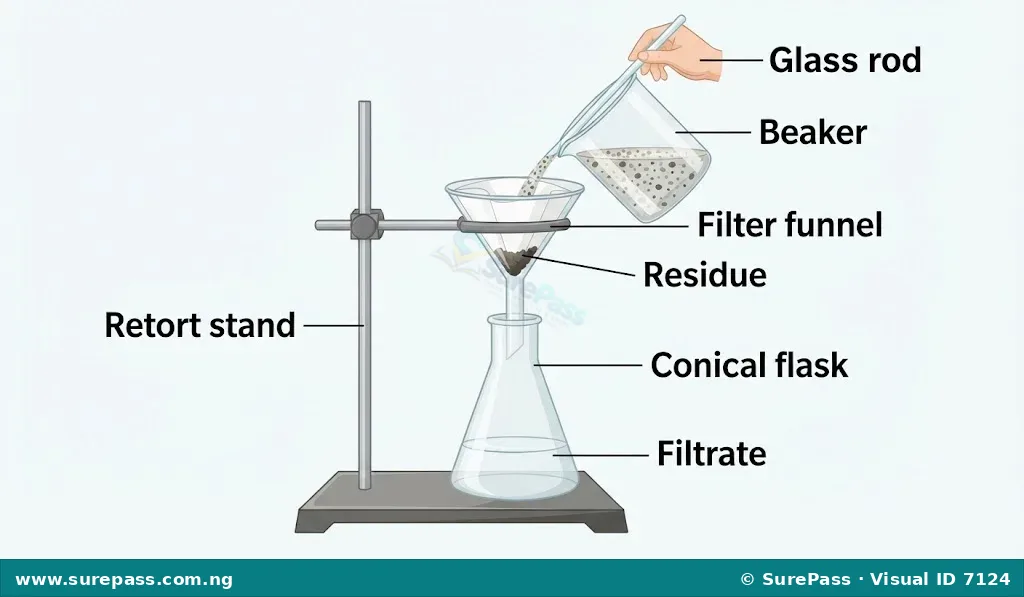
Filtration: This technique separates an insoluble solid from a liquid using a filter medium (like filter paper) that allows the liquid (filtrate) to pass through but retains the solid (residue).
Example: Separating sand from water, or chalk powder from water.
-
Evaporation: This method is used to separate a soluble solid from a liquid solvent. The liquid is heated and allowed to evaporate, leaving the solid behind.
Example: Obtaining salt from salt water.
-
Simple Distillation: This technique separates a soluble solid from a liquid, or two liquids with significantly different boiling points. The liquid is heated to its boiling point, vaporises, then the vapour is cooled and condensed back into a liquid (distillate), leaving the non-volatile solid or higher boiling point liquid behind.
Example: Obtaining pure water from salt water.
-
Sublimation: This method separates a solid that sublimes (changes directly from solid to gas without passing through a liquid phase) from a non-subliming solid.
Example: Separating iodine from sand, or ammonium chloride from common salt.
-
Magnetism: This technique is used to separate magnetic substances from non-magnetic substances.
Example: Separating iron filings from sand.
-
Sieving: This method separates solid particles of different sizes using a sieve with appropriate mesh openings.
Example: Separating garri from chaff, or sand from gravel.
-
Chromatography (e.g., Paper Chromatography): This technique separates components of a mixture based on their differential movement through a stationary phase (e.g., filter paper) by a mobile phase (e.g., solvent). Components that are more soluble in the mobile phase and less adsorbed by the stationary phase travel further.
Example: Separating colours in ink or plant pigments.
Handling Apparatus for the Separation of Mixtures
Setting up and handling laboratory apparatus correctly is crucial for successful and safe separation of mixtures. The specific setup depends on the separation technique being used.
General Guidelines for Handling Apparatus
-
Cleanliness: Ensure all apparatus is clean and dry before use.
-
Stability: Set up apparatus on a stable surface. Use retort stands and clamps to secure items like funnels, flasks, and condensers.
-
Correct Assembly: Assemble apparatus according to the specific requirements of the experiment. For example, ensure filter paper is correctly folded in a funnel for filtration.
-
Safety: Always wear safety goggles. Handle glassware carefully to avoid breakage. Be cautious when using heat sources.
-
Heating: When heating liquids, use a tripod stand and gauze mat. Heat gently and evenly. Never heat a closed system.
-
Disposal: Dispose of chemical waste properly as instructed by the teacher.
Setting Up Apparatus for Filtration
Filtration is a common technique for separating an insoluble solid from a liquid.
The procedure involves the following steps:
-
Gather the required materials: a beaker containing the mixture (e.g., sand and water), a clean conical flask or beaker to collect the filtrate, a filter funnel, and filter paper.
-
Fold the filter paper into a cone shape. First, fold it in half, then fold it in half again to form a quadrant. Open one layer of the folded paper to form a cone.
-
Place the folded filter paper cone inside the filter funnel. Moisten the filter paper with a small amount of distilled water to make it stick to the funnel walls.
-
Place the stem of the filter funnel into the neck of the conical flask or collection beaker. Ensure the tip of the funnel stem touches the side of the receiving vessel to prevent splashing.
-
Carefully pour the mixture to be filtered into the filter funnel, guiding it with a glass rod to prevent splashing and ensure it flows smoothly into the filter paper. Do not fill the filter paper beyond its top edge.
-
Observe the liquid (filtrate) passing through the filter paper into the conical flask, leaving the solid (residue) on the filter paper.
-
Once all the liquid has passed through, carefully remove the filter paper with the residue and the conical flask with the filtrate.
Recording Apparatus Set-up (Drawing)
Drawing the apparatus set-up is an important skill in chemistry. It helps in understanding the experiment and communicating the procedure.
The steps for drawing apparatus set-up are:
-
Use a pencil and ruler: Draw clear, neat lines. Avoid freehand drawing for apparatus.
-
Proportion: Draw the apparatus to scale, ensuring components are in correct proportion to each other.
-
Labels: Label all parts of the apparatus clearly using straight lines that do not cross each other.
-
Contents: Indicate the contents of beakers, flasks, and other containers (e.g., “mixture,” “filtrate,” “residue”).
-
Direction of flow: Use arrows to show the direction of flow of liquids or gases, especially in processes like distillation.
-
Title: Give the drawing a clear and descriptive title.




0 comments
Open the discussion when you need it. Comments stay collapsed until requested so the initial article remains light.