


ARTICLE CONTENTSOn this page 9 sections
Atomic Structure
Performance Objectives
By the end of the lesson, students should be able to:
- state the fundamental constituents of atoms;
- discuss the properties of subatomic particles;
- describe the arrangement of electrons around the nucleus and orbitals;
- differentiate among atomic number, mass number, and isotopes;
- calculate relative atomic masses.
Fundamental Constituents of the Atom
An atom is the smallest particle of an element that can take part in a chemical reaction.
For many years, early scientists believed that the atom was indivisible. However, modern scientific experiments have established that the atom is made up of smaller, subatomic particles. The three primary subatomic particles that constitute the atom are protons, neutrons, and electrons.
The structure of an atom can be divided into two main regions:
- The Nucleus: This is the extremely dense, positively charged central core of the atom. It contains the protons and the neutrons. Together, protons and neutrons are referred to as nucleons. Almost all the mass of the atom is concentrated in the nucleus.
- The Electron Cloud: This is the vast, mostly empty space surrounding the nucleus. Electrons move rapidly around the nucleus in defined pathways called shells or energy levels.
Properties of Subatomic Particles
The three subatomic particles differ significantly in their mass, electrical charge, and location within the atom. Understanding these properties is essential for analyzing chemical behavior and bonding.
Protons
Protons are positively charged particles located inside the nucleus of the atom. A proton has a relative charge of +1. Its actual physical mass is extremely small, so scientists use a relative scale where the mass of a proton is assigned a value of 1 atomic mass unit (amu).
Neutrons
Neutrons are electrically neutral particles, meaning they carry no charge. Like protons, they are located inside the nucleus. The relative mass of a neutron is also 1 atomic mass unit (amu), which is approximately equal to the mass of a proton.
Electrons
Electrons are negatively charged particles that revolve around the nucleus in specific energy levels. An electron carries a relative charge of -1. The mass of an electron is extremely small compared to that of a proton or a neutron. It is approximately \(\frac{1}{1840}\) of the mass of a proton. Because this mass is so negligible, it is usually approximated to 0 amu when calculating the mass of an atom.
The properties of these subatomic particles are summarized in the table below:
| Subatomic Particle | Symbol | Location in Atom | Relative Mass (amu) | Relative Charge | Actual Charge (Coulombs) |
|---|---|---|---|---|---|
| Proton | p | Inside the nucleus | 1 | +1 | \(+1.6 \times 10^{-19}\) |
| Neutron | n | Inside the nucleus | 1 | 0 (Neutral) | 0 |
| Electron | e | Outside the nucleus (Shells) | \(\frac{1}{1840}\) (or 0) | -1 | \(-1.6 \times 10^{-19}\) |
Atomic Number, Mass Number, and Isotopes
To identify and distinguish atoms of different elements, chemists use specific terms based on the composition of their subatomic particles.
Atomic Number
The atomic number of an element is the number of protons in the nucleus of an atom of that element.
The atomic number is represented by the symbol Z. Since a neutral atom has no net electrical charge, the number of positively charged protons must equal the number of negatively charged electrons. Therefore, for any neutral atom:
\(\text{Atomic Number (Z)} = \text{Number of Protons} = \text{Number of Electrons}\)
The atomic number is the unique identity of an element. No two different elements can have the same atomic number.
Mass Number
The mass number of an element is the total number of protons and neutrons in the nucleus of an atom of that element.
The mass number is represented by the symbol A. It is also known as the nucleon number. Since electrons have negligible mass, the entire mass of an atom is determined by its protons and neutrons. The relationship is expressed as:
\(\text{Mass Number (A)} = \text{Number of Protons (Z)} + \text{Number of Neutrons (n)}\)
To find the number of neutrons in an atom, the atomic number is subtracted from the mass number:
\(\text{Number of Neutrons (n)} = A – Z\)
Nuclide Notation
A specific atom characterized by its nuclear composition is called a nuclide. It is represented symbolically as:
\(^{A}_{Z}\text{X}\)
The components of this notation are:
- X: The chemical symbol of the element (e.g., H, He, Na).
- A: The mass number, written as a superscript on the top left.
- Z: The atomic number, written as a subscript on the bottom left.
For example, the nuclide notation for a sodium atom is \(^{23}_{11}\text{Na}\). This notation reveals that the sodium atom has:
- An atomic number (Z) of 11, meaning it has 11 protons and 11 electrons.
- A mass number (A) of 23, meaning the sum of protons and neutrons is 23.
- A neutron count of \(23 – 11 = 12\) neutrons.
Isotopes
Isotopes are atoms of the same element with the same atomic number but different mass numbers, due to a difference in the number of neutrons.
Because isotopes have the same number of protons and electrons, they exhibit identical chemical properties. However, because they have different numbers of neutrons, they have different physical properties, such as density and boiling point. This phenomenon of an element having atoms with different mass numbers is called isotopy.
Common examples of elements that exhibit isotopy include:
- Hydrogen: It has three isotopes:
- Protium (\(^{1}_{1}\text{H}\)) with 1 proton and 0 neutrons.
- Deuterium (\(^{2}_{1}\text{H}\)) with 1 proton and 1 neutron.
- Tritium (\(^{3}_{1}\text{H}\)) with 1 proton and 2 neutrons.
- Chlorine: It has two common isotopes:
- Chlorine-35 (\(^{35}_{17}\text{Cl}\)) with 17 protons and 18 neutrons.
- Chlorine-37 (\(^{37}_{17}\text{Cl}\)) with 17 protons and 20 neutrons.
- Carbon: It has three common isotopes:
- Carbon-12 (\(^{12}_{6}\text{C}\)) with 6 protons and 6 neutrons.
- Carbon-13 (\(^{13}_{6}\text{C}\)) with 6 protons and 7 neutrons.
Relative Atomic Mass
Relative atomic mass is the average mass of one atom of an element compared to one-twelfth of the mass of an atom of carbon-12.
The relative atomic mass is represented by the symbol \(A_r\). Because most elements exist naturally as a mixture of isotopes, the relative atomic mass is a weighted average that takes into account the natural percentage abundance of each isotope.
Calculating Relative Atomic Mass
To calculate the relative atomic mass of an element, the mass of each isotope is multiplied by its fractional or percentage abundance, and the products are summed up.
The general formula for an element with two isotopes is:
\(A_r = \left( \frac{\text{Mass of Isotope 1} \times \text{Abundance of Isotope 1}}{100} \right) + \left( \frac{\text{Mass of Isotope 2} \times \text{Abundance of Isotope 2}}{100} \right)\)
Worked Example 1
Chlorine exists naturally as a mixture of two isotopes: \(^{35}_{17}\text{Cl}\) with a relative abundance of 75%, and \(^{37}_{17}\text{Cl}\) with a relative abundance of 25%. Calculate the relative atomic mass of chlorine.
Solution:
The given values are:
- Mass of Isotope 1 (\(^{35}\text{Cl}\)) = 35; Abundance = 75%
- Mass of Isotope 2 (\(^{37}\text{Cl}\)) = 37; Abundance = 25%
Applying the formula:
\(A_r = \left( \frac{35 \times 75}{100} \right) + \left( \frac{37 \times 25}{100} \right)\)
\(A_r = 26.25 + 9.25\)
\(A_r = 35.5\)
Therefore, the relative atomic mass of chlorine is 35.5.
Worked Example 2
An element, Neon, has two isotopes: \(^{20}_{10}\text{Ne}\) with an abundance of 90%, and \(^{22}_{10}\text{Ne}\) with an abundance of 10%. Calculate the relative atomic mass of Neon.
Solution:
The given values are:
- Mass of Isotope 1 (\(^{20}\text{Ne}\)) = 20; Abundance = 90%
- Mass of Isotope 2 (\(^{22}\text{Ne}\)) = 22; Abundance = 10%
Applying the formula:
\(A_r = \left( \frac{20 \times 90}{100} \right) + \left( \frac{22 \times 10}{100} \right)\)
\(A_r = 18.0 + 2.2\)
\(A_r = 20.2\)
Therefore, the relative atomic mass of Neon is 20.2.
Arrangement of Electrons in Atoms
Electrons are not scattered randomly around the nucleus. Instead, they are arranged in specific energy levels called shells, and within those shells, they occupy specific regions called orbitals.
Electron Shells (Energy Levels)
Electron shells are concentric pathways around the nucleus where electrons revolve. These shells are designated by letters K, L, M, N, etc., or by principal quantum numbers \(n = 1, 2, 3, 4\), starting from the shell closest to the nucleus.
Each shell has a maximum capacity of electrons it can hold, determined by the formula:
\(\text{Maximum Capacity} = 2n^2\)
The capacities of the first four shells are:
- K Shell (\(n = 1\)): can hold a maximum of \(2(1)^2 = 2\) electrons.
- L Shell (\(n = 2\)): can hold a maximum of \(2(2)^2 = 8\) electrons.
- M Shell (\(n = 3\)): can hold a maximum of \(2(3)^2 = 18\) electrons (though it is stable with 8 electrons for the first 20 elements).
- N Shell (\(n = 4\)): can hold a maximum of \(2(4)^2 = 32\) electrons.
Atomic Orbitals
An atomic orbital is a three-dimensional region in space around the nucleus where there is a high probability of finding an electron.
Unlike shells, which are simple circular paths, orbitals represent the actual wave-like behavior of electrons. The main types of orbitals are designated by letters: \(s, p, d,\) and \(f\).
- s-orbital: Spherical in shape. Each shell has one \(s\)-orbital, which can hold a maximum of 2 electrons.
- p-orbital: Dumbbell-shaped. Starting from the L shell (\(n=2\)), there are three \(p\)-orbitals (\(p_x, p_y, p_z\)), which can hold a total maximum of 6 electrons.
Rules for Electronic Configuration
To write the electronic configuration of an atom, electrons are filled into orbitals according to specific principles:
- Aufbau Principle: Electrons fill the lowest energy orbitals first before moving to higher energy levels. The order of filling is: \(1s \rightarrow 2s \rightarrow 2p \rightarrow 3s \rightarrow 3p \rightarrow 4s\).
- Pauli Exclusion Principle: An orbital can hold a maximum of two electrons, and they must have opposite spins.
- Hund’s Rule of Maximum Multiplicity: When filling degenerate orbitals (orbitals of the same energy, like the three \(p\)-orbitals), electrons must occupy them singly first with parallel spins before pairing up.
Electronic Configuration of the First 20 Elements
The table below shows the atomic number, symbol, shell-by-shell electron arrangement, and orbital configuration for the first 20 elements of the periodic table:
| Atomic Number (Z) | Element | Symbol | Shell Configuration (K, L, M, N) | Orbital Configuration (\(s, p\) notation) |
|---|---|---|---|---|
| 1 | Hydrogen | H | 1 | \(1s^1\) |
| 2 | Helium | He | 2 | \(1s^2\) |
| 3 | Lithium | Li | 2, 1 | \(1s^2 2s^1\) |
| 4 | Beryllium | Be | 2, 2 | \(1s^2 2s^2\) |
| 5 | Boron | B | 2, 3 | \(1s^2 2s^2 2p^1\) |
| 6 | Carbon | C | 2, 4 | \(1s^2 2s^2 2p^2\) |
| 7 | Nitrogen | N | 2, 5 | \(1s^2 2s^2 2p^3\) |
| 8 | Oxygen | O | 2, 6 | \(1s^2 2s^2 2p^4\) |
| 9 | Fluorine | F | 2, 7 | \(1s^2 2s^2 2p^5\) |
| 10 | Neon | Ne | 2, 8 | \(1s^2 2s^2 2p^6\) |
| 11 | Sodium | Na | 2, 8, 1 | \(1s^2 2s^2 2p^6 3s^1\) |
| 12 | Magnesium | Mg | 2, 8, 2 | \(1s^2 2s^2 2p^6 3s^2\) |
| 13 | Aluminium | Al | 2, 8, 3 | \(1s^2 2s^2 2p^6 3s^2 3p^1\) |
| 14 | Silicon | Si | 2, 8, 4 | \(1s^2 2s^2 2p^6 3s^2 3p^2\) |
| 15 | Phosphorus | P | 2, 8, 5 | \(1s^2 2s^2 2p^6 3s^2 3p^3\) |
| 16 | Sulfur | S | 2, 8, 6 | \(1s^2 2s^2 2p^6 3s^2 3p^4\) |
| 17 | Chlorine | Cl | 2, 8, 7 | \(1s^2 2s^2 2p^6 3s^2 3p^5\) |
| 18 | Argon | Ar | 2, 8, 8 | \(1s^2 2s^2 2p^6 3s^2 3p^6\) |
| 19 | Potassium | K | 2, 8, 8, 1 | \(1s^2 2s^2 2p^6 3s^2 3p^6 4s^1\) |
| 20 | Calcium | Ca | 2, 8, 8, 2 | \(1s^2 2s^2 2p^6 3s^2 3p^6 4s^2\) |
How to Make Models of Electronic Configuration of Atoms
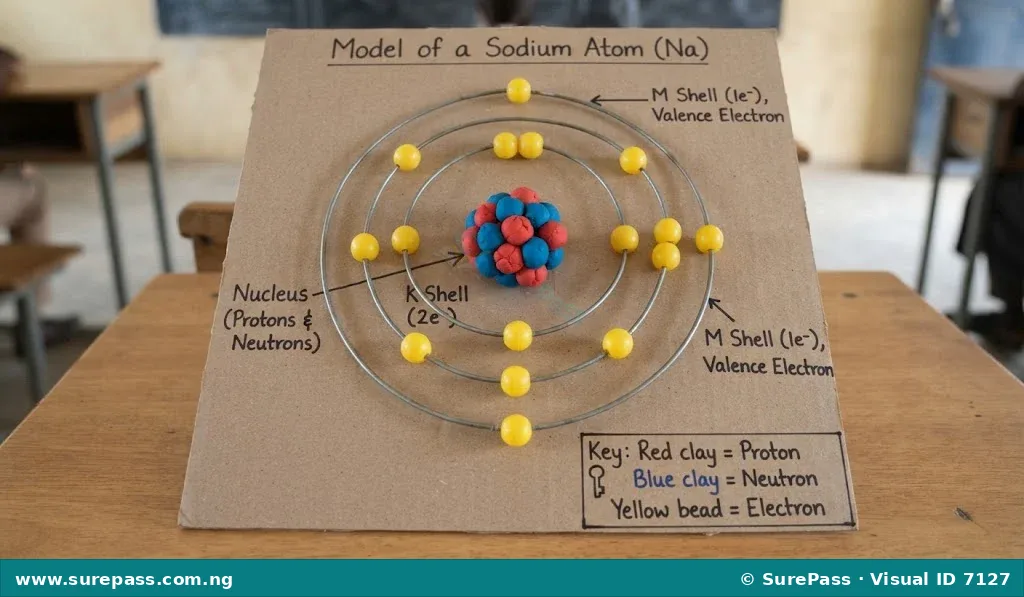
Making physical models helps to visualize the arrangement of electrons in shells around the nucleus of an atom. This practical activity describes how to construct a model of a sodium atom (\(^{23}_{11}\text{Na}\)) using simple, locally available materials.
The required materials are:
- A flat piece of thick cardboard or plywood (about 30 cm by 30 cm) to serve as the base.
- Different colored plastic beads, buttons, or small clay balls (11 of one color for protons, 12 of another color for neutrons, and 11 of a third color for electrons).
- Flexible copper wire or thick thread.
- Adhesive glue or office pins.
- A marker pen.
The procedure involves the following steps:
- Prepare the Nucleus: Roll 11 small balls of red clay (protons) and 12 small balls of blue clay (neutrons). Glue them together in a tight cluster at the center of the cardboard base to represent the nucleus.
- Draw or Construct the Shells: Cut three different lengths of flexible wire to form three concentric circles around the nucleus. The first circle represents the K shell, the second represents the L shell, and the third represents the M shell. Secure these wire circles to the cardboard base using glue or small pins.
- Place the Electrons: Use 11 small balls of yellow clay (or yellow beads) to represent the electrons. Attach them to the wire shells according to the electronic configuration of sodium (2, 8, 1):
- Attach 2 yellow beads to the innermost wire circle (K shell).
- Attach 8 yellow beads to the middle wire circle (L shell), spacing them out in pairs.
- Attach 1 yellow bead to the outermost wire circle (M shell).
- Label the Model: Use the marker pen to write the name of the element (“Sodium Atom”), its symbol (\(^{23}_{11}\text{Na}\)), and a key indicating which color represents protons, neutrons, and electrons.



0 comments
Open the discussion when you need it. Comments stay collapsed until requested so the initial article remains light.