


ARTICLE CONTENTSOn this page 9 sections
Chemical Combination
Performance Objectives
By the end of the lesson, students should be able to:
- explain the laws of conservation of matter, constant composition, reciprocal proportion and multiple proportions;
- determine valency of elements from their atomic configuration;
- explain the relationship between the valency and reactivity of elements to form new substances;
- perform simple experiments and solve simple problems involving the laws of conservation of matter, constant composition, reciprocal proportion and multiple proportions.
Introduction to Chemical Combination
Chemical combination is the process by which two or more chemical substances react to form new substances.
Matter is composed of extremely small particles called atoms. During chemical reactions, these atoms rearrange themselves, breaking existing chemical bonds and forming new ones. This rearrangement is governed by specific quantitative laws known as the laws of chemical combination. Understanding these laws allows chemists to predict the quantities of reactants needed and products formed during chemical processes.
The Laws of Chemical Combination
Four fundamental laws govern how elements combine to form compounds. These are the Law of Conservation of Matter, the Law of Constant Composition, the Law of Multiple Proportions, and the Law of Reciprocal Proportion.
1. The Law of Conservation of Matter
The Law of Conservation of Matter states that matter can neither be created nor destroyed during a chemical reaction, but can only be transformed from one form to another.
This law, formulated by Antoine Lavoisier in 1789, implies that the total mass of the reactants before a chemical reaction must equal the total mass of the products after the reaction. In a closed system, no mass is lost to the surroundings, and no mass is gained from the outside.
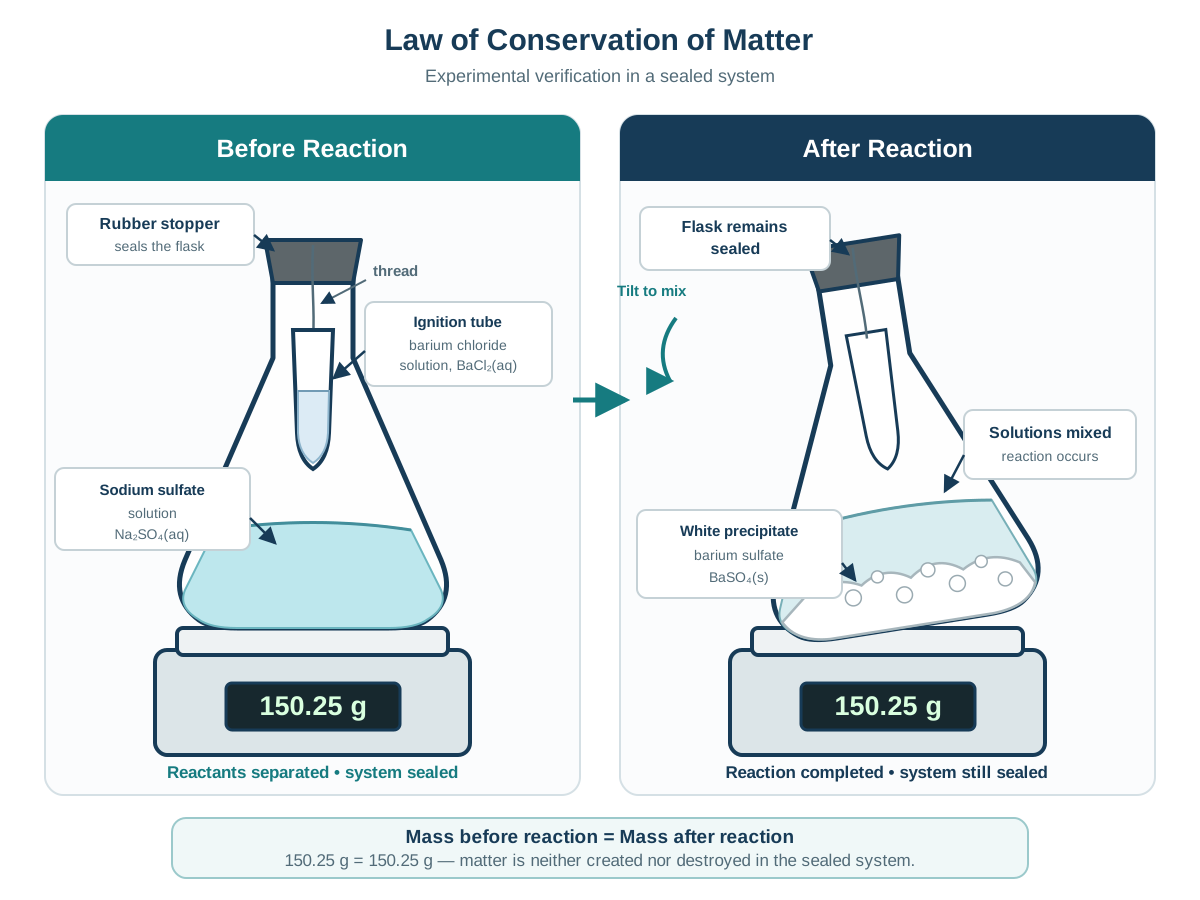
To demonstrate this law, a precipitation reaction can be carried out in a sealed vessel. For example, when an aqueous solution of sodium chloride ($NaCl$) is mixed with an aqueous solution of silver nitrate ($AgNO_3$), a white precipitate of silver chloride ($AgCl$) and a solution of sodium nitrate ($NaNO_3$) are formed. The chemical equation for the reaction is:
$$NaCl_{(aq)} + AgNO_{3(aq)} \rightarrow AgCl_{(s)} + NaNO_{3(aq)}$$
If the mass of the reactants and the reaction vessel is measured before mixing, and then measured again after the reaction has occurred, the two mass values are found to be identical.
Worked Example 1
A student heated $10.00\text{ g}$ of calcium carbonate ($CaCO_3$) in a strong, sealed container. After the reaction was complete, $5.60\text{ g}$ of calcium oxide ($CaO$) remained in the container, along with a quantity of carbon dioxide gas ($CO_2$). Calculate the mass of carbon dioxide gas produced during this thermal decomposition.
Solution:
According to the Law of Conservation of Matter:
$$\text{Total Mass of Reactants} = \text{Total Mass of Products}$$
The reactant is calcium carbonate, and the products are calcium oxide and carbon dioxide. Therefore:
$$\text{Mass of } CaCO_3 = \text{Mass of } CaO + \text{Mass of } CO_2$$
Substitute the known values into the equation:
$$10.00\text{ g} = 5.60\text{ g} + \text{Mass of } CO_2$$
Rearrange the equation to solve for the mass of carbon dioxide:
$$\text{Mass of } CO_2 = 10.00\text{ g} – 5.60\text{ g}$$
$$\text{Mass of } CO_2 = 4.40\text{ g}$$
The mass of carbon dioxide gas produced is $4.40\text{ g}$.
2. The Law of Constant Composition (or Definite Proportions)
The Law of Constant Composition states that all pure samples of a particular chemical compound always contain the same elements combined together in the same proportion by mass.
This law, proposed by Joseph Proust in 1799, means that no matter the source of a compound or the method used to prepare it, the ratio of the masses of the constituent elements remains constant. For example, pure water ($H_2O$) obtained from rain, a river, or synthesized in a laboratory always contains hydrogen and oxygen combined in a mass ratio of approximately $1:8$ (or $11.1\%$ hydrogen and $88.9\%$ oxygen by mass).
Worked Example 2
Two different samples of copper(II) oxide ($CuO$) were analyzed. The first sample, prepared by heating copper in oxygen, contained $1.20\text{ g}$ of copper and $0.30\text{ g}$ of oxygen. The second sample, obtained by the thermal decomposition of copper(II) carbonate, contained $2.40\text{ g}$ of copper and $0.60\text{ g}$ of oxygen. Show whether these results agree with the Law of Constant Composition.
Solution:
To verify the law, calculate the mass ratio of copper to oxygen in both samples.
For the first sample:
$$\text{Ratio of Copper to Oxygen} = \frac{\text{Mass of Copper}}{\text{Mass of Oxygen}}$$
$$\text{Ratio} = \frac{1.20\text{ g}}{0.30\text{ g}} = 4.00$$
The ratio of copper to oxygen in the first sample is $4:1$.
For the second sample:
$$\text{Ratio of Copper to Oxygen} = \frac{2.40\text{ g}}{0.60\text{ g}} = 4.00$$
The ratio of copper to oxygen in the second sample is also $4:1$.
Since the ratio of the masses of copper and oxygen is identical in both samples, the results illustrate and agree with the Law of Constant Composition.
3. The Law of Multiple Proportions
The Law of Multiple Proportions states that if two elements combine to form more than one compound, the masses of one element that combine with a fixed mass of the other element are in a simple ratio of whole numbers.
This law was formulated by John Dalton in 1803. It applies to elements that can combine in different ratios to form different substances. For example, carbon and oxygen combine to form two distinct gases: carbon monoxide ($CO$) and carbon dioxide ($CO_2$).
In carbon monoxide ($CO$), $12\text{ g}$ of carbon combines with $16\text{ g}$ of oxygen. In carbon dioxide ($CO_2$), $12\text{ g}$ of carbon combines with $32\text{ g}$ of oxygen. Comparing the masses of oxygen that combine with a fixed mass of carbon ($12\text{ g}$):
$$\text{Ratio of Oxygen Masses} = 16 : 32 = 1 : 2$$
The ratio $1:2$ is a simple whole-number ratio, which confirms the law.
Worked Example 3
Iron forms two different chlorides. Analysis shows that in the first chloride, $2.00\text{ g}$ of iron combines with $2.54\text{ g}$ of chlorine. In the second chloride, $2.00\text{ g}$ of iron combines with $3.81\text{ g}$ of chlorine. Show that these data illustrate the Law of Multiple Proportions.
Solution:
The mass of one of the elements (iron) is already fixed at $2.00\text{ g}$ in both compounds. Therefore, compare the masses of chlorine that combine with this fixed mass of iron.
$$\text{Mass of Chlorine in Compound 1} = 2.54\text{ g}$$
$$\text{Mass of Chlorine in Compound 2} = 3.81\text{ g}$$
Find the ratio of these masses by dividing both values by the smaller value ($2.54$):
$$\text{Ratio} = \frac{2.54}{2.54} : \frac{3.81}{2.54}$$
$$\text{Ratio} = 1 : 1.5$$
To convert this into a whole-number ratio, multiply both terms by 2:
$$\text{Ratio} = 2 : 3$$
Since $2:3$ is a simple whole-number ratio, the data illustrate the Law of Multiple Proportions.
4. The Law of Reciprocal Proportion
The Law of Reciprocal Proportion states that the weights of two elements A and B which combine separately with a fixed weight of a third element C are either the same or in a simple ratio of the weights in which A and B combine with each other.
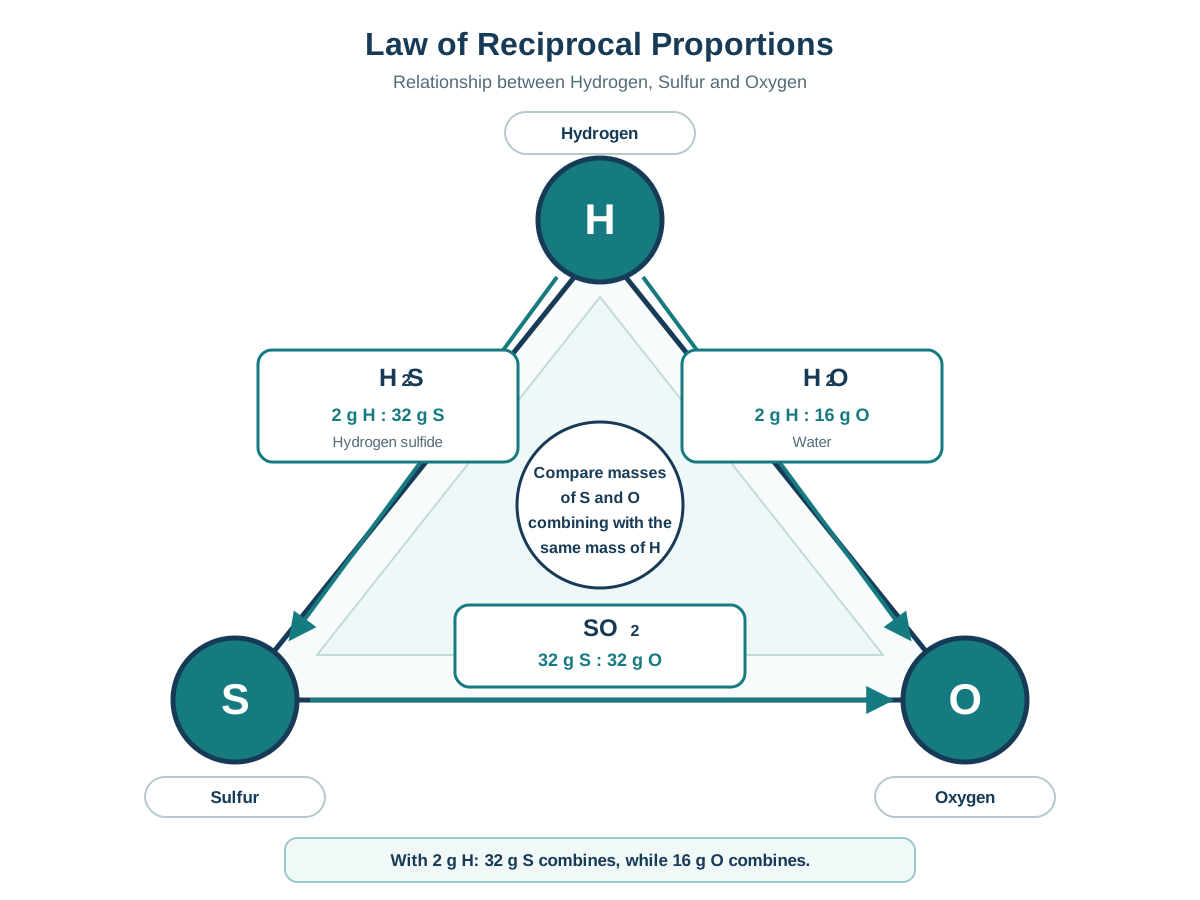
This law, proposed by Jeremias Richter in 1792, can be understood by examining three elements: sulfur ($S$), oxygen ($O$), and hydrogen ($H$).
Hydrogen combines with sulfur to form hydrogen sulfide ($H_2S$). Hydrogen also combines with oxygen to form water ($H_2O$). Sulfur and oxygen combine directly with each other to form sulfur dioxide ($SO_2$).
In $H_2S$, $2\text{ g}$ of hydrogen combines with $32\text{ g}$ of sulfur. The mass ratio of sulfur to hydrogen is $32:2$.
In $H_2O$, $2\text{ g}$ of hydrogen combines with $16\text{ g}$ of oxygen. The mass ratio of oxygen to hydrogen is $16:2$.
The masses of sulfur and oxygen that combine with a fixed mass of hydrogen ($2\text{ g}$) are $32\text{ g}$ and $16\text{ g}$ respectively. The ratio of these masses is:
$$\text{Ratio 1} = 32 : 16 = 2 : 1$$
Now, examine the direct combination of sulfur and oxygen in sulfur dioxide ($SO_2$). In $SO_2$, $32\text{ g}$ of sulfur combines with $32\text{ g}$ of oxygen. The ratio of their masses is:
$$\text{Ratio 2} = 32 : 32 = 1 : 1$$
Finally, compare Ratio 1 and Ratio 2:
$$\frac{\text{Ratio 1}}{\text{Ratio 2}} = \frac{2/1}{1/1} = \frac{2}{1}$$
This comparison yields a simple whole-number ratio of $2:1$, which validates the Law of Reciprocal Proportion.
Worked Example 4
Sodium ($Na$) combines with chlorine ($Cl$) to form sodium chloride ($NaCl$). Sodium also combines with hydrogen ($H$) to form sodium hydride ($NaH$). Chlorine and hydrogen combine to form hydrogen chloride ($HCl$).
In $NaCl$, $39.34\%$ is sodium and $60.66\%$ is chlorine.
In $NaH$, $95.83\%$ is sodium and $4.17\%$ is hydrogen.
In $HCl$, $2.74\%$ is hydrogen and $97.26\%$ is chlorine.
Show that these analytical figures illustrate the Law of Reciprocal Proportion.
Solution:
Let sodium ($Na$) be the third element (C) whose mass is fixed. Calculate the masses of chlorine (A) and hydrogen (B) that combine with a fixed mass of $1.00\text{ g}$ of sodium.
In $NaCl$:
$$39.34\text{ g} \text{ of sodium combines with } 60.66\text{ g} \text{ of chlorine.}$$
$$1.00\text{ g} \text{ of sodium combines with } \frac{60.66}{39.34} = 1.542\text{ g} \text{ of chlorine.}$$
In $NaH$:
$$95.83\text{ g} \text{ of sodium combines with } 4.17\text{ g} \text{ of hydrogen.}$$
$$1.00\text{ g} \text{ of sodium combines with } \frac{4.17}{95.83} = 0.0435\text{ g} \text{ of hydrogen.}$$
The ratio of the mass of chlorine to the mass of hydrogen combining with the fixed mass of sodium is:
$$\text{Ratio 1} = \frac{\text{Mass of Chlorine}}{\text{Mass of Hydrogen}} = \frac{1.542}{0.0435} = 35.45$$
Now, determine the mass ratio of chlorine to hydrogen when they combine directly in $HCl$:
$$2.74\text{ g} \text{ of hydrogen combines with } 97.26\text{ g} \text{ of chlorine.}$$
$$\text{Ratio 2} = \frac{\text{Mass of Chlorine}}{\text{Mass of Hydrogen}} = \frac{97.26}{2.74} = 35.50$$
Compare Ratio 1 and Ratio 2:
$$\frac{\text{Ratio 1}}{\text{Ratio 2}} = \frac{35.45}{35.50} \approx 1 : 1$$
Since the comparison yields a ratio of approximately $1:1$, which is a simple whole-number ratio, the data illustrate the Law of Reciprocal Proportion.
Valency of Elements
Valency is the combining power of an element, representing the number of hydrogen atoms (or their equivalent) that one atom of the element can combine with or displace.
Valency is a fundamental property that determines how atoms of different elements interact to form chemical compounds. It is directly related to the electronic configuration of the atoms.
Atomic Configuration and Valency
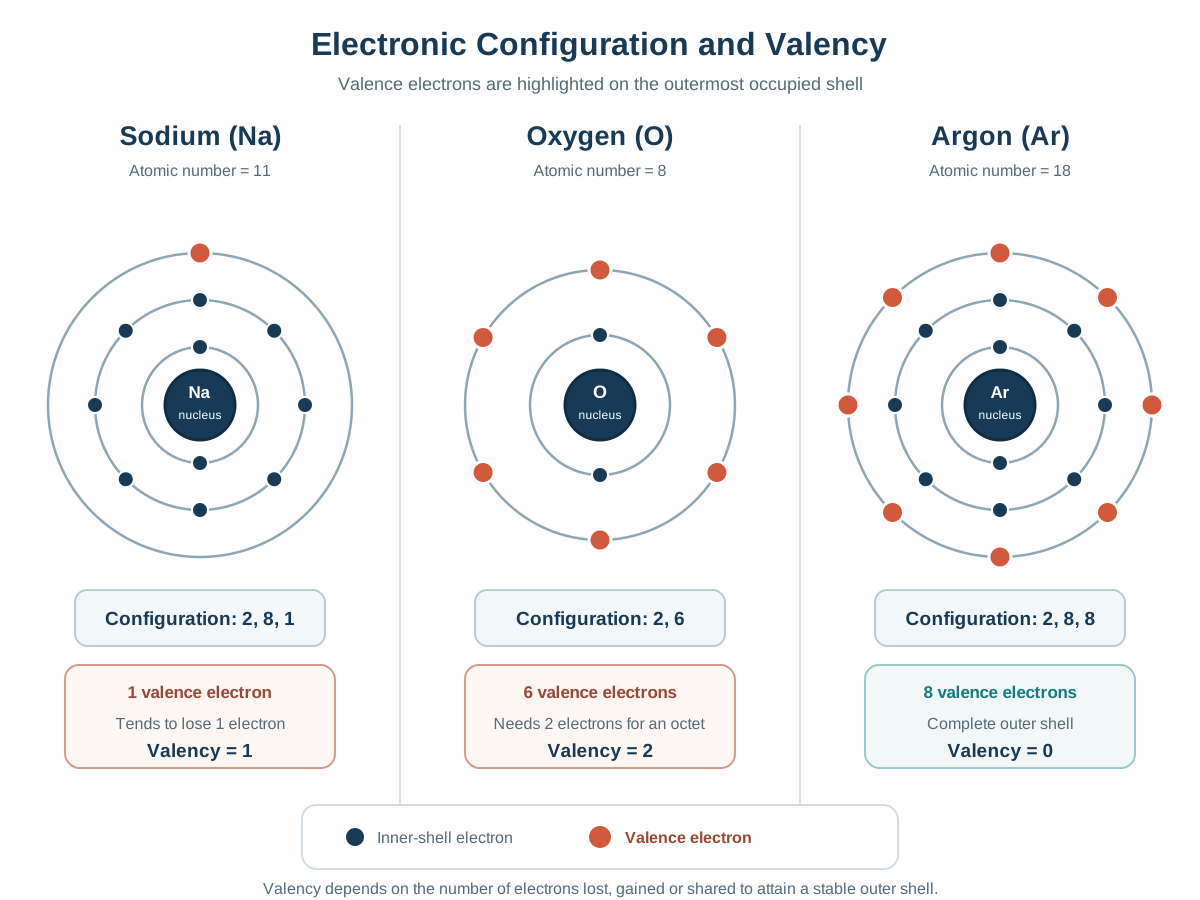
According to the Bohr model of the atom, electrons are arranged in concentric shells around the nucleus. These shells are designated as K, L, M, and N, starting from the shell closest to the nucleus. Each shell can hold a maximum number of electrons:
The K shell can hold up to 2 electrons.
The L shell can hold up to 8 electrons.
The M shell can hold up to 18 electrons (though it is stable with 8 for the first 20 elements).
The N shell can hold up to 32 electrons.
The outermost shell of an atom is called the valence shell, and the electrons in this shell are called valence electrons. Atoms are chemically stable when their valence shell is completely filled. For most elements, this stable state requires eight electrons in the outer shell, a principle known as the octet rule. For light elements like hydrogen and helium, stability is achieved with two electrons in the K shell, known as the duet rule.
To achieve this stable configuration, atoms gain, lose, or share valence electrons during chemical reactions. The number of electrons an atom must lose, gain, or share to achieve a stable outer shell determines its valency:
If an atom has 1, 2, or 3 valence electrons (typically metals), it tends to lose these electrons to achieve a stable inner octet. Its valency is equal to the number of valence electrons lost.
If an atom has 4 valence electrons, it tends to share these electrons with other atoms. Its valency is 4.
If an atom has 5, 6, or 7 valence electrons (typically non-metals), it tends to gain 3, 2, or 1 electron(s) respectively to complete its octet. Its valency is calculated as $8 – \text{number of valence electrons}$.
If an atom has 8 valence electrons (noble gases), its outer shell is already complete. It does not need to lose, gain, or share electrons. Its valency is 0.
Valencies of the First Twenty Elements
The table below lists the atomic number, name, symbol, electronic configuration, number of valence electrons, and valency of the first twenty elements of the periodic table.
| Atomic Number | Element Name | Symbol | Electronic Configuration (K, L, M, N) | Valence Electrons | Valency |
|---|---|---|---|---|---|
| 1 | Hydrogen | H | 1 | 1 | 1 |
| 2 | Helium | He | 2 | 2 | 0 |
| 3 | Lithium | Li | 2, 1 | 1 | 1 |
| 4 | Beryllium | Be | 2, 2 | 2 | 2 |
| 5 | Boron | B | 2, 3 | 3 | 3 |
| 6 | Carbon | C | 2, 4 | 4 | 4 |
| 7 | Nitrogen | N | 2, 5 | 5 | 3 |
| 8 | Oxygen | O | 2, 6 | 6 | 2 |
| 9 | Fluorine | F | 2, 7 | 7 | 1 |
| 10 | Neon | Ne | 2, 8 | 8 | 0 |
| 11 | Sodium | Na | 2, 8, 1 | 1 | 1 |
| 12 | Magnesium | Mg | 2, 8, 2 | 2 | 2 |
| 13 | Aluminium | Al | 2, 8, 3 | 3 | 3 |
| 14 | Silicon | Si | 2, 8, 4 | 4 | 4 |
| 15 | Phosphorus | P | 2, 8, 5 | 5 | 3 (or 5) |
| 16 | Sulfur | S | 2, 8, 6 | 6 | 2 (or 4, 6) |
| 17 | Chlorine | Cl | 2, 8, 7 | 7 | 1 |
| 18 | Argon | Ar | 2, 8, 8 | 8 | 0 |
| 19 | Potassium | K | 2, 8, 8, 1 | 1 | 1 |
| 20 | Calcium | Ca | 2, 8, 8, 2 | 2 | 2 |
Valency and Chemical Reactivity
The chemical reactivity of an element is its tendency to react with other substances to form new compounds. This reactivity is determined by how easily an atom can achieve a stable electronic configuration, which depends directly on its valency.
Elements with a valency of 0, such as helium, neon, and argon, have completely filled valence shells. Because they do not need to gain, lose, or share electrons to achieve stability, they are chemically unreactive and are classified as inert or noble gases.
Metals with 1, 2, or 3 valence electrons (such as sodium, magnesium, and aluminium) have low ionization energies. They readily lose these outer electrons to form positively charged ions (cations). The fewer electrons a metal has to lose, the more reactive it generally is. For example, sodium (valency 1) is highly reactive and reacts violently with water, whereas magnesium (valency 2) reacts much more slowly.
Non-metals with 5, 6, or 7 valence electrons (such as nitrogen, oxygen, and fluorine) have high electron affinities. They readily gain electrons to form negatively charged ions (anions) or share electrons to form covalent bonds. The fewer electrons a non-metal needs to gain to complete its octet, the more reactive it is. For example, fluorine (valency 1) is extremely reactive because it only needs to gain one electron to achieve stability.
Using Valency to Write Chemical Formulas
Valency is used to determine the ratio in which atoms combine to form compounds. This is done using the valency cross-over method. The steps involved in this method are:
- Write down the symbols of the combining elements or radicals side by side, placing the metal or positive element first.
- Write the valency of each element directly above its symbol.
- Cross over the valency numbers so that the valency of the first element becomes the subscript of the second element, and the valency of the second element becomes the subscript of the first element.
- Simplify the subscripts to the lowest whole-number ratio if necessary. Subscripts of 1 are not written in the final formula.
For example, to write the formula for aluminium oxide:
The symbols are $Al$ and $O$. The valency of aluminium is 3, and the valency of oxygen is 2. Crossing over these valencies gives $Al_2O_3$.
To write the formula for calcium oxide:
The symbols are $Ca$ and $O$. The valency of calcium is 2, and the valency of oxygen is 2. Crossing over these valencies gives $Ca_2O_2$. Simplifying the ratio $2:2$ to $1:1$ yields the final formula, $CaO$.
Practical Activities and Skills
How to Verify the Law of Conservation of Matter
This practical activity demonstrates that the total mass of substances remains constant during a chemical reaction.
The required materials and reagents are:
- A $150\text{ cm}^3$ conical flask
- A small ignition tube or small test tube
- A rubber stopper that fits the conical flask tightly
- A piece of sewing thread
- A digital weighing balance (accurate to $0.01\text{ g}$)
- $10\text{ cm}^3$ of $0.1\text{ M}$ sodium sulfate ($Na_2SO_4$) solution
- $5\text{ cm}^3$ of $0.1\text{ M}$ barium chloride ($BaCl_2$) solution
The procedure involves the following steps:
- Pour the $10\text{ cm}^3$ of sodium sulfate solution into the conical flask.
- Pour the $5\text{ cm}^3$ of barium chloride solution into the small ignition tube.
- Tie a piece of thread around the neck of the ignition tube.
- Carefully lower the ignition tube into the conical flask, ensuring that the tube remains upright and that the two solutions do not mix.
- Secure the thread by pressing the rubber stopper firmly into the mouth of the conical flask. The ignition tube should hang suspended inside the flask.
- Place the entire assembled flask on the digital balance and record the initial mass ($M_1$) in grams.
- Tilt and swirl the conical flask gently so that the barium chloride solution spills out of the ignition tube and mixes thoroughly with the sodium sulfate solution.
- Observe the chemical reaction. A white precipitate of barium sulfate will form immediately, indicating that a chemical reaction has occurred.
- Place the flask back onto the digital balance and record the final mass ($M_2$) in grams.
- Compare the two mass values ($M_1$ and $M_2$).
Important safety tips include:
- Ensure the rubber stopper is tightly fitted to prevent any liquid or gas from escaping during the reaction.
- Handle the glass apparatus with care to avoid breakage.
- Wear safety goggles and laboratory coats throughout the experiment.
The expected result is that the mass before mixing ($M_1$) is equal to the mass after mixing ($M_2$). This observation confirms that mass is conserved during the chemical reaction, verifying the Law of Conservation of Matter.
Drawing and Recording Experimental Setups
Recording scientific observations accurately is an essential skill in chemistry. When drawing experimental setups, the following guidelines should be followed:
- Use a sharp pencil to draw clean, single-line diagrams. Do not shade or sketch the lines.
- Draw the apparatus in proportion and show them in two dimensions rather than attempting three-dimensional drawings.
- Use a ruler to draw straight horizontal lines for labels. Label lines should point directly to the center of the apparatus being identified and should not cross each other.
- Write the labels in block letters.
- Include a clear, descriptive title below the diagram.
When recording findings in a laboratory notebook, a structured format should be used. The record should contain:
- Title: The name of the experiment.
- Aim: A brief statement of what the experiment is designed to show or measure.
- Apparatus and Reagents: A complete list of all equipment and chemicals used.
- Procedure: A concise, step-by-step description of the actions performed, written in the passive voice (for example, “The flask was weighed” instead of “I weighed the flask”).
- Observations: A detailed record of what was seen, heard, felt, or measured during the experiment (such as color changes, precipitate formation, gas evolution, or temperature changes).
- Discussion: An explanation of the observations based on chemical principles, including relevant chemical equations.
- Conclusion: A final statement summarizing what was learned or verified by the experiment.
Comprehensive Practice Problems
Problem 1
A series of experiments was conducted to study the composition of water. In the first experiment, $0.50\text{ g}$ of hydrogen gas was burned in excess oxygen to produce $4.50\text{ g}$ of water. In the second experiment, $2.00\text{ g}$ of hydrogen gas was reacted with copper(II) oxide to yield $18.00\text{ g}$ of water. Determine if these results confirm the Law of Constant Composition.
Solution:
Calculate the percentage of hydrogen by mass in the water produced in both experiments.
For the first experiment:
$$\text{Mass of Hydrogen} = 0.50\text{ g}$$
$$\text{Mass of Water} = 4.50\text{ g}$$
$$\text{Percentage of Hydrogen} = \frac{\text{Mass of Hydrogen}}{\text{Mass of Water}} \times 100\%$$
$$\text{Percentage of Hydrogen} = \frac{0.50\text{ g}}{4.50\text{ g}} \times 100\% = 11.11\%$$
For the second experiment:
$$\text{Mass of Hydrogen} = 2.00\text{ g}$$
$$\text{Mass of Water} = 18.00\text{ g}$$
$$\text{Percentage of Hydrogen} = \frac{2.00\text{ g}}{18.00\text{ g}} \times 100\% = 11.11\%$$
Since the percentage of hydrogen by mass is identical ($11.11\%$) in both samples of water, the composition of water is constant. This confirms the Law of Constant Composition.
Problem 2
Two oxides of lead were analyzed. The first oxide contained $92.83\%$ lead by mass, and the second oxide contained $89.62\%$ lead by mass. Show that these values illustrate the Law of Multiple Proportions.
Solution:
First, calculate the masses of lead and oxygen in $100\text{ g}$ of each oxide.
For the first oxide:
$$\text{Mass of Lead} = 92.83\text{ g}$$
$$\text{Mass of Oxygen} = 100.00\text{ g} – 92.83\text{ g} = 7.17\text{ g}$$
For the second oxide:
$$\text{Mass of Lead} = 89.62\text{ g}$$
$$\text{Mass of Oxygen} = 100.00\text{ g} – 89.62\text{ g} = 10.38\text{ g}$$
Next, fix the mass of lead at $1.00\text{ g}$ and calculate the mass of oxygen that combines with it in each compound.
In the first oxide, the mass of oxygen that combines with $1.00\text{ g}$ of lead is:
$$\text{Mass of Oxygen} = \frac{7.17\text{ g}}{92.83\text{ g}} = 0.0772\text{ g}$$
In the second oxide, the mass of oxygen that combines with $1.00\text{ g}$ of lead is:
$$\text{Mass of Oxygen} = \frac{10.38\text{ g}}{89.62\text{ g}} = 0.1158\text{ g}$$
Now, find the ratio of the masses of oxygen that combine with the fixed mass of lead:
$$\text{Ratio} = \frac{0.0772}{0.0772} : \frac{0.1158}{0.0772}$$
$$\text{Ratio} = 1 : 1.5$$
Multiply by 2 to obtain a whole-number ratio:
$$\text{Ratio} = 2 : 3$$
Because $2:3$ is a simple whole-number ratio, the data illustrate the Law of Multiple Proportions.
Summary
The laws of chemical combination provide the quantitative foundation for chemistry. The Law of Conservation of Matter states that mass is neither created nor destroyed during chemical reactions. The Law of Constant Composition states that a pure compound always contains the same elements in the same mass ratio. The Law of Multiple Proportions states that when two elements form multiple compounds, the masses of one element combining with a fixed mass of the other are in a simple whole-number ratio. The Law of Reciprocal Proportion describes how the mass ratios of two elements combining with a third element relate to the ratio in which they combine with each other. Valency, determined by the electronic configuration of an atom’s valence shell, dictates how elements react and combine to form stable chemical substances.

0 comments
Open the discussion when you need it. Comments stay collapsed until requested so the initial article remains light.