



ARTICLE CONTENTSOn this page 8 sections
Carbon and its Compounds
Performance Objectives
By the end of the lesson, students should be able to:
- identify the position of carbon on the Periodic Table;
- describe the structure of carbon;
- state the atomic number, mass number, valency and relative atomic mass of carbon;
- identify various substances in and around us that contain carbon;
- describe the unique characteristics of carbon as an element;
- define the term allotrope;
- identify the isotopes of carbon;
- explain the relationship between the structure of carbon and the existence of many natural and synthetic carbon containing compounds;
- explain the uses and importance of carbon to life and the society.
Introduction to Carbon
Carbon is one of the most important elements on Earth, forming the backbone of all known life. It is found in many forms, from the air we breathe to the food we eat and the fuels we use.
Position and Symbol of Carbon
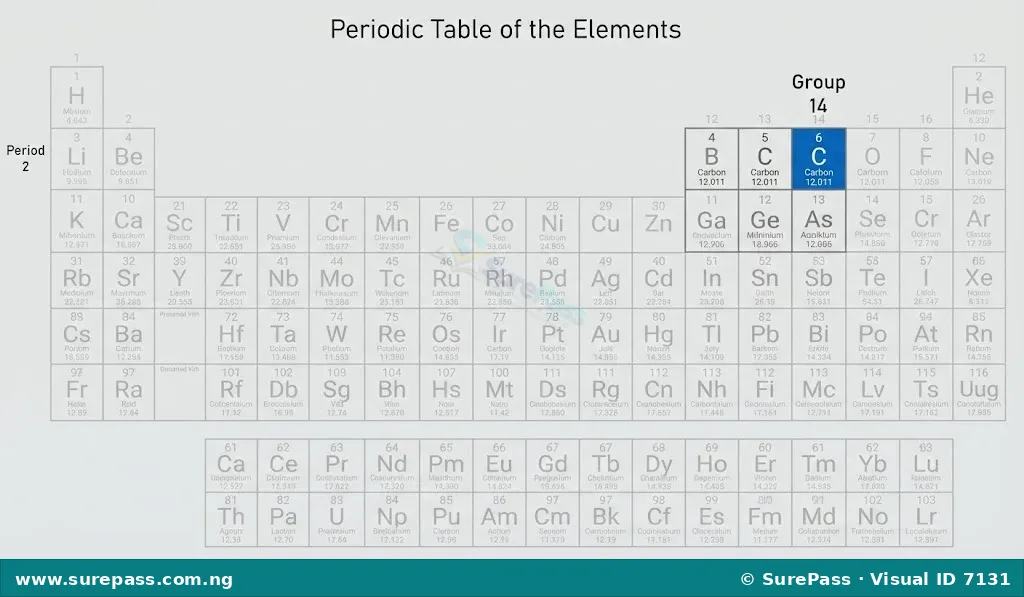
Carbon is a non-metallic element. Its chemical symbol is C. On the Periodic Table of elements, carbon is located in Group 14 (or Group IVA) and Period 2. This position indicates that carbon has four valence electrons and two electron shells.
Atomic Structure of Carbon
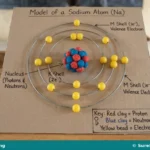
The structure of a carbon atom determines its chemical behaviour. An atom of carbon consists of a nucleus containing protons and neutrons, surrounded by electrons in electron shells.
The key features of carbon’s atomic structure are:
- Atomic Number (Z): The atomic number of carbon is 6. This means that every carbon atom has 6 protons in its nucleus. In a neutral carbon atom, there are also 6 electrons.
- Mass Number (A): The most common isotope of carbon has a mass number of 12. This means it has 6 protons and 6 neutrons (12 – 6 = 6) in its nucleus.
- Electron Configuration: With 6 electrons, the electron configuration of carbon is 2, 4. This means there are 2 electrons in the first shell and 4 electrons in the outermost shell (valence shell).
- Valency: Carbon has a valency of 4. This is because it has 4 valence electrons and can either gain 4 electrons or lose 4 electrons to achieve a stable octet configuration. However, it typically achieves stability by sharing its 4 valence electrons, forming four covalent bonds.
- Relative Atomic Mass (RAM): The relative atomic mass of carbon is approximately 12.01. This value is an average of the mass numbers of its naturally occurring isotopes, taking into account their abundance.
Isotopes of Carbon
Isotopes are atoms of the same element that have the same number of protons but different numbers of neutrons. This results in the same atomic number but different mass numbers.
Carbon has several isotopes, but the most common and stable ones are:
- Carbon-12 (12C): This is the most abundant isotope, making up about 98.9% of all natural carbon. It has 6 protons and 6 neutrons.
- Carbon-13 (13C): This stable isotope makes up about 1.1% of natural carbon. It has 6 protons and 7 neutrons.
- Carbon-14 (14C): This is a radioactive isotope with 6 protons and 8 neutrons. It is present in very small amounts and is used in radiocarbon dating to determine the age of ancient organic materials.
Unique Characteristics of Carbon
Carbon possesses unique characteristics that enable it to form a vast number of compounds, more than any other element. These characteristics are directly related to its atomic structure and valency.
- Tetravalency: Carbon has a valency of 4, meaning it can form four covalent bonds with other atoms. This allows it to bond with a wide variety of elements, including other carbon atoms, hydrogen, oxygen, nitrogen, and halogens.
- Catenation: This is the ability of carbon atoms to link together to form long chains, branched chains, and rings. Carbon-carbon bonds are strong and stable, allowing for the formation of molecules with diverse sizes and shapes. This property is almost unique to carbon among elements.
- Ability to Form Multiple Bonds: Carbon atoms can form single bonds (C-C), double bonds (C=C), and triple bonds (C≡C) with other carbon atoms or with atoms of other elements like oxygen and nitrogen. This adds to the variety and complexity of carbon compounds.
- Small Atomic Size: Carbon is a relatively small atom. This allows its atoms to come close together, forming strong and stable covalent bonds.
The combination of tetravalency, catenation, and the ability to form multiple bonds explains why carbon is the central element in organic chemistry and why there are so many natural and synthetic carbon-containing compounds. These properties allow carbon to create complex molecular structures essential for life and various industrial applications.
Allotropes of Carbon
An allotrope is one of two or more different physical forms in which an element can exist. These different forms arise from different arrangements of atoms within the element, leading to distinct physical and chemical properties.
Carbon exhibits allotropy, meaning it exists in several different forms. The main allotropes of carbon are crystalline forms like diamond and graphite, and amorphous forms like charcoal, coal, and soot.
Diamond
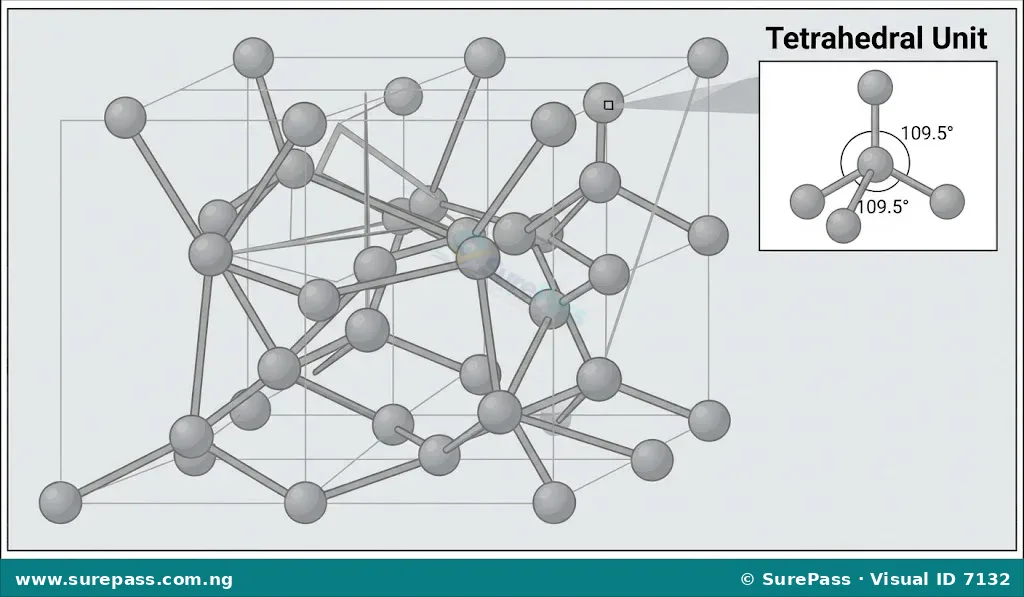
Diamond is a crystalline allotrope of carbon known for its extreme hardness and brilliance. In diamond, each carbon atom is covalently bonded to four other carbon atoms in a tetrahedral arrangement. This forms a giant covalent network structure.
Properties of diamond include:
- It is the hardest known natural substance.
- It has a very high melting point.
- It is a poor conductor of electricity because all its valence electrons are used in bonding.
- It is transparent and refracts light strongly.
Uses of diamond include:
- Cutting tools for glass, metals, and rocks due to its hardness.
- Drilling bits for oil exploration.
- Jewellery due to its brilliance and rarity.
Graphite
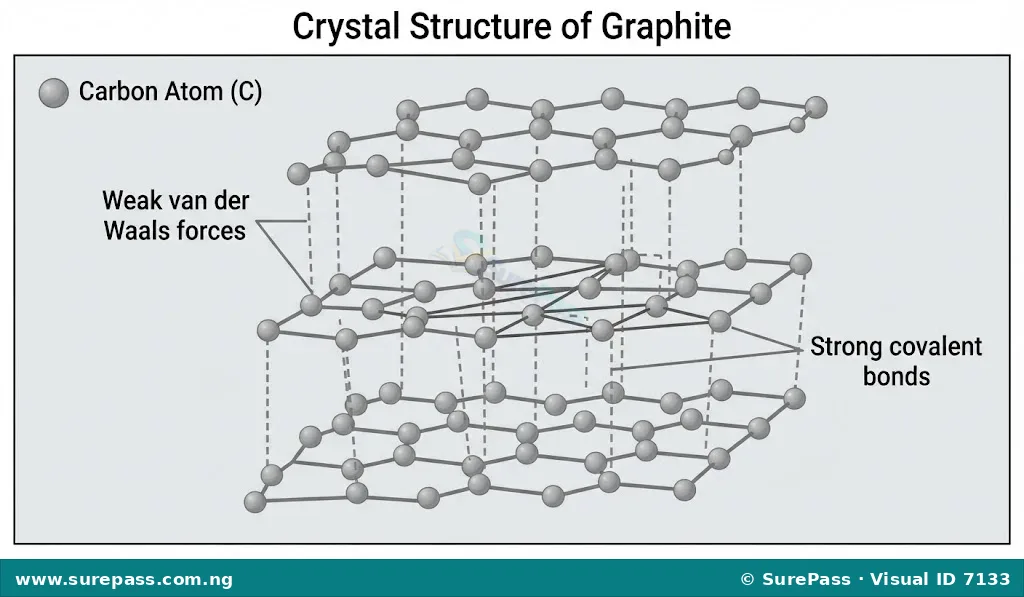
Graphite is another crystalline allotrope of carbon, which is soft and slippery. In graphite, each carbon atom is covalently bonded to three other carbon atoms in a hexagonal planar arrangement. These hexagonal layers are stacked on top of each other and held together by weak intermolecular forces.
Properties of graphite include:
- It is soft and slippery.
- It is a good conductor of electricity because each carbon atom has one free electron not involved in bonding, which can move between layers.
- It has a high melting point.
- It is opaque and greyish-black.
Uses of graphite include:
- As a lubricant in machinery due to its slippery nature.
- In pencils as the “lead” (mixed with clay).
- As electrodes in electrolytic cells due to its electrical conductivity.
- In nuclear reactors as a moderator.
Amorphous Carbon
Amorphous carbon refers to forms of carbon that do not have a definite crystalline structure. These forms often consist of tiny, randomly arranged graphite-like crystallites.
Examples of amorphous carbon include:
- Charcoal: Produced by heating wood or other organic matter in the absence of air (destructive distillation). It is porous and used as a fuel, adsorbent, and in water purification.
- Soot (Carbon Black): Formed by the incomplete combustion of hydrocarbons. It is used as a pigment in inks, paints, and as a filler in rubber products like tyres.
- Coal: A fossil fuel formed from ancient plant matter under heat and pressure over millions of years. It is a complex mixture of carbon compounds and is discussed in more detail below.
Substances Containing Carbon
Carbon is a fundamental component of many substances found in our daily lives and the environment. Examples of substances that contain carbon include:
- Living Organisms: All plants, animals, and microorganisms are made up of carbon compounds (e.g., proteins, carbohydrates, fats, DNA).
- Foods: Fruits, vegetables, grains, and meat all contain carbon compounds.
- Fossil Fuels: Coal, petroleum (crude oil), and natural gas are rich in carbon.
- Atmospheric Gases: Carbon (IV) oxide (carbon dioxide) is present in the air.
- Rocks and Minerals: Limestone, marble, and shells are primarily composed of calcium carbonate (CaCO3).
- Everyday Materials: Wood, paper, plastics, fabrics (like cotton and wool), candles, and charcoal are all carbon-based.
Coal: Types and Uses
Coal is a combustible black or brownish-black sedimentary rock formed from the remains of ancient plants that accumulated in swamps and were subjected to intense heat and pressure over millions of years. It is a major fossil fuel and a significant source of energy.
Types of Coal
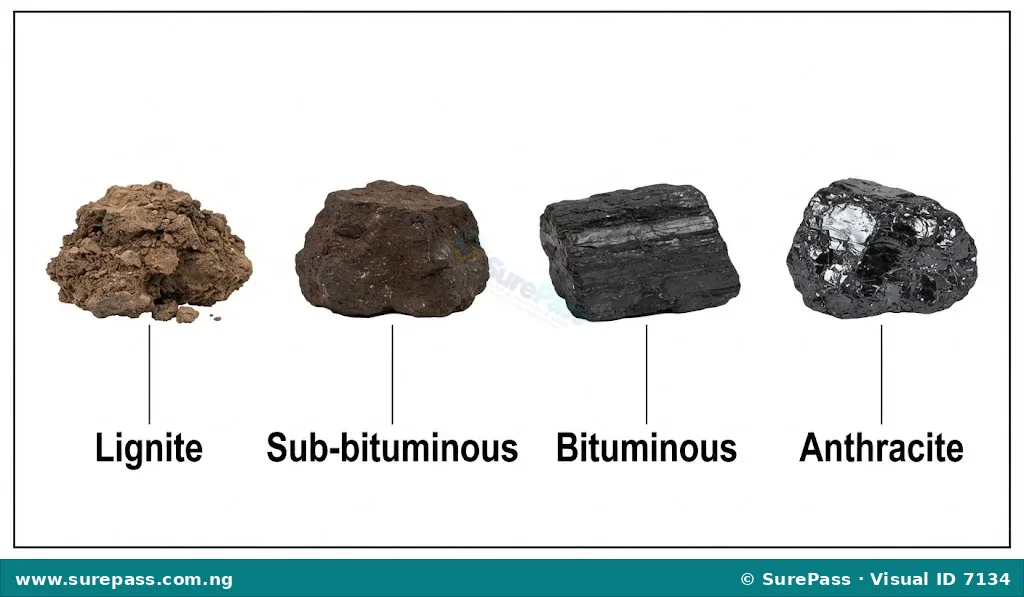
Coal is classified into different types based on its carbon content, moisture content, and heating value. The main types, from lowest to highest carbon content, are:
- Lignite (Brown Coal): This is the lowest rank of coal, with a carbon content of about 25-35%. It has high moisture content and a relatively low heating value. Lignite is often used in power generation.
- Sub-bituminous Coal: This coal has a carbon content of about 35-45%. It has a lower moisture content and higher heating value than lignite. It is also primarily used for electricity generation.
- Bituminous Coal (Black Coal): This is a dense, black coal with a carbon content of about 45-86%. It has a high heating value and is widely used for electricity generation, as well as in the production of coke for the steel industry.
- Anthracite: This is the highest rank of coal, with a carbon content of 86-97%. It is hard, brittle, and has a shiny black appearance. Anthracite has the highest heating value and burns cleanly with very little smoke. It is used for domestic heating and some industrial applications.
Uses of Coal
Coal has various uses, primarily as an energy source and a raw material for other products:
- Electricity Generation: The most significant use of coal is in thermal power plants, where it is burned to heat water, produce steam, and drive turbines to generate electricity.
- Industrial Fuel: Coal is used as a fuel in various industries, including cement production, paper manufacturing, and chemical industries.
- Coke Production: Bituminous coal is heated in the absence of air to produce coke, a porous carbon material. Coke is essential in blast furnaces for iron and steel production.
- Chemical Feedstock: Coal can be processed to produce various chemicals, including coal tar, ammonia, and synthetic fuels.
- Domestic Heating: In some regions, coal (especially anthracite) is used for heating homes.
Carbon Compounds and Their Uses
Carbon forms a vast array of compounds, many of which are vital for life and industrial processes. Here, we focus on some simple but important inorganic carbon compounds.
Carbon (IV) Oxide (Carbon Dioxide, CO2)
Carbon dioxide is a colourless, odourless gas that is naturally present in the Earth’s atmosphere. It is a product of respiration, combustion, and decomposition.
Uses of carbon dioxide include:
- Photosynthesis: Plants use carbon dioxide from the atmosphere, along with water and sunlight, to produce glucose (food) and oxygen. This process is fundamental to life on Earth.
- Carbonated Drinks: Carbon dioxide is dissolved in water under pressure to produce fizzy drinks like soft drinks and beer.
- Fire Extinguishers: Carbon dioxide is heavier than air and does not support combustion, making it effective in smothering fires, especially electrical fires.
- Refrigerant (Dry Ice): Solid carbon dioxide, known as dry ice, sublimes (changes directly from solid to gas) at -78.5 °C. It is used for refrigeration, especially for preserving perishable goods during transport.
- Chemical Industry: Used in the production of urea, a common fertiliser.
Carbon (II) Oxide (Carbon Monoxide, CO)
Carbon monoxide is a colourless, odourless, and highly poisonous gas. It is formed during the incomplete combustion of carbon-containing materials when there is insufficient oxygen.
Uses of carbon monoxide include:
- Reducing Agent: Carbon monoxide is a strong reducing agent and is used in the extraction of metals from their ores, particularly iron in blast furnaces.
- Fuel: It is a component of some fuel gases, such as producer gas and water gas, and can be burned to produce energy.
- Chemical Feedstock: Used in the synthesis of various organic chemicals, such as methanol.
Safety Note: Carbon monoxide is extremely dangerous. It binds irreversibly to haemoglobin in the blood, preventing oxygen transport and leading to suffocation. Adequate ventilation is crucial when burning fuels.
Synthetic Gas (Syngas) and Gasification
Synthetic gas, commonly known as syngas, is a mixture primarily composed of carbon monoxide (CO) and hydrogen (H2). It can also contain small amounts of carbon dioxide and methane.
Syngas is produced through a process called gasification.
Gasification is a process that converts carbon-containing materials (such as coal, biomass, or waste) into syngas by reacting them at high temperatures (typically above 700 °C) with a controlled amount of oxygen and/or steam, but not enough to cause complete combustion.
The main reactions involved in coal gasification are:
- C(s) + O2(g) → CO2(g) (partial combustion to provide heat)
- C(s) + H2O(g) → CO(g) + H2(g) (water-gas shift reaction)
- C(s) + CO2(g) → 2CO(g) (Boudouard reaction)
Uses of synthetic gas include:
- Fuel: Syngas can be burned directly as a fuel for electricity generation or industrial heating.
- Chemical Feedstock: It is a crucial raw material for the synthesis of various chemicals, including methanol, ammonia, and synthetic liquid fuels (e.g., through the Fischer-Tropsch process).
- Hydrogen Production: Syngas can be further processed to produce pure hydrogen, which is used in fuel cells and other industrial applications.
Importance of Carbon to Life and Society
Carbon’s unique properties make it indispensable for life and modern society:
- Basis of Life: Carbon is the fundamental element of all organic molecules, including carbohydrates, proteins, lipids, and nucleic acids (DNA and RNA), which are essential for the structure and function of living organisms.
- Energy Source: Fossil fuels (coal, petroleum, natural gas) are carbon-based and provide the majority of the world’s energy for electricity, transportation, and industry.
- Building Materials: Wood, a carbon-based material, is used extensively in construction. Plastics, derived from petroleum, are also carbon compounds used in countless products.
- Food and Agriculture: Carbon dioxide is vital for photosynthesis, the process by which plants produce food. Carbon compounds are also key components of fertilisers.
- Industrial Applications: Carbon in its various forms (diamond, graphite, charcoal, soot) has diverse industrial uses, from cutting tools and lubricants to pigments and adsorbents.
- Environmental Role: Carbon cycles through the Earth’s atmosphere, oceans, land, and living organisms, playing a critical role in regulating the planet’s climate.



0 comments
Open the discussion when you need it. Comments stay collapsed until requested so the initial article remains light.