



ARTICLE CONTENTSOn this page 6 sections
Standard Separation Techniques
Performance Objectives
By the end of the lesson, students should be able to:
- explain the terms separation techniques;
- identify substances that require separation;
- discuss ways of separating the substances into components;
- name the apparatus for separating the substances;
- use different techniques to separate mixtures.
Introduction to Separation Techniques
In chemistry, many substances exist as mixtures. A mixture contains two or more substances that are physically combined but not chemically bonded. Often, it is necessary to separate these components to obtain pure substances or to remove unwanted materials.
A separation technique is a method used to separate a mixture into its individual components or pure substances. These techniques rely on the differences in physical properties of the components in the mixture, such as boiling point, particle size, density, or solubility.
Separating mixtures is important in various aspects of life, from purifying water for drinking to extracting valuable chemicals in industries. For example, crude oil, a mixture of many hydrocarbons, is separated into petrol, diesel, and kerosene through specific techniques.
Identifying Substances that Require Separation
Many substances encountered daily are mixtures that often require separation. These can be categorised based on the states of matter of their components.
- Solid-solid mixtures: These mixtures consist of two or more solid substances. An example is a mixture of sand and iron filings, or a mixture of salt and sand.
- Solid-liquid mixtures: These mixtures involve a solid dispersed in a liquid. Examples include muddy water (soil particles in water), a mixture of sand and water, or a solution of salt in water.
- Liquid-liquid mixtures: These mixtures consist of two or more liquids. They can be immiscible (do not mix, like oil and water) or miscible (mix completely, like alcohol and water). An example is a mixture of water and kerosene.
- Gas-liquid mixtures: These involve a gas dissolved or dispersed in a liquid, such as carbon dioxide in a soft drink.
- Gas-gas mixtures: These mixtures consist of two or more gases, such as air (a mixture of nitrogen, oxygen, and other gases).
The need for separation arises when one or more components are desired in a pure form, or when impurities need to be removed from a substance.
Common Separation Techniques
Several standard techniques are used to separate mixtures, each chosen based on the specific properties of the components. The principles behind these techniques exploit differences in properties such as particle size, density, solubility, and boiling points.
Filtration
Filtration is a separation technique used to separate insoluble solid particles from a liquid or gas. The principle of filtration relies on the difference in particle size between the solid and the liquid. The mixture is passed through a filter medium (like filter paper) that has pores large enough for the liquid particles to pass through but small enough to retain the solid particles.
The liquid that passes through the filter is called the filtrate, and the solid retained on the filter is called the residue.
Apparatus for Filtration
The common apparatus used for filtration in a laboratory include:
- Filter funnel: Holds the filter paper.
- Filter paper: The porous medium that separates the solid from the liquid.
- Beaker or conical flask: Used to collect the filtrate.
- Retort stand and clamp: Used to hold the filter funnel in place.
- Stirring rod: Used to guide the mixture into the filter funnel.
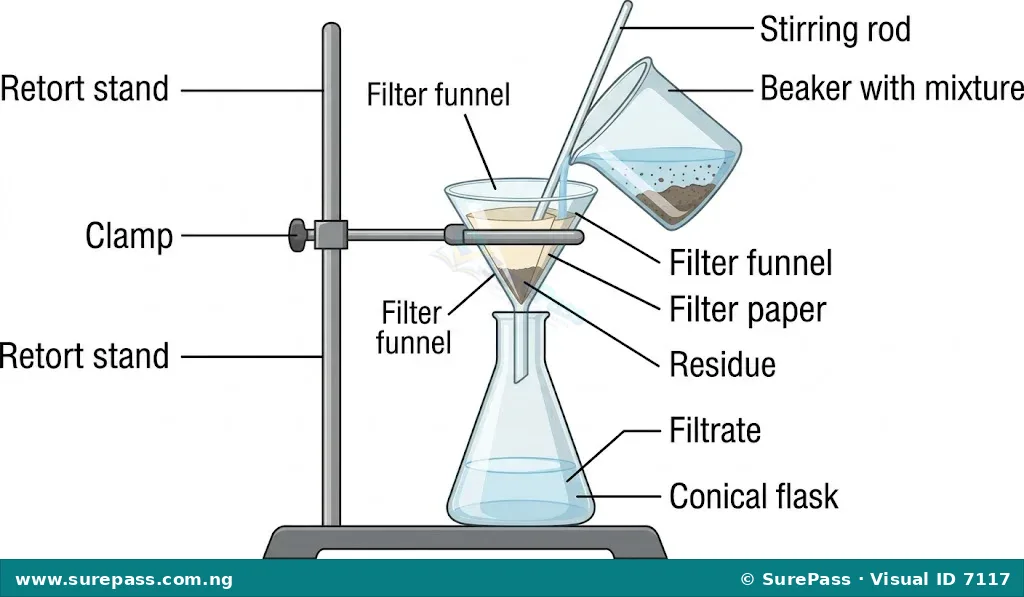
Procedure for Filtration
The procedure for separating an insoluble solid from a liquid by filtration involves the following steps:
- Fold a piece of filter paper into a cone shape and place it inside the filter funnel.
- Place the filter funnel in the neck of a conical flask or beaker, supported by a retort stand and clamp.
- Pour the mixture of insoluble solid and liquid slowly into the filter funnel, guiding the flow with a stirring rod to prevent splashing and ensure the liquid does not go above the filter paper.
- Observe the liquid (filtrate) collecting in the conical flask and the solid (residue) remaining on the filter paper.
- Once all the liquid has passed through, carefully remove the filter paper with the residue and allow it to dry.
Example: Separating sand from water. When a mixture of sand and water is filtered, the sand (residue) remains on the filter paper, and the water (filtrate) passes through.
Evaporation
Evaporation is a separation technique used to separate a soluble solid from a liquid, typically when the solid is non-volatile (does not easily turn into gas) and the liquid is volatile (easily turns into gas). The principle relies on the difference in boiling points between the liquid and the solid. The liquid is heated until it evaporates, leaving the solid behind.
Apparatus for Evaporation
The common apparatus used for evaporation in a laboratory include:
- Evaporating dish: A shallow, heat-resistant dish used to hold the solution.
- Bunsen burner: Provides heat for evaporation.
- Tripod stand: Supports the evaporating dish over the Bunsen burner.
- Gauze mat: Placed on the tripod stand to support the evaporating dish and distribute heat evenly.
- Retort stand and clamp: Can be used to hold the evaporating dish or to support other apparatus if a water bath is used.
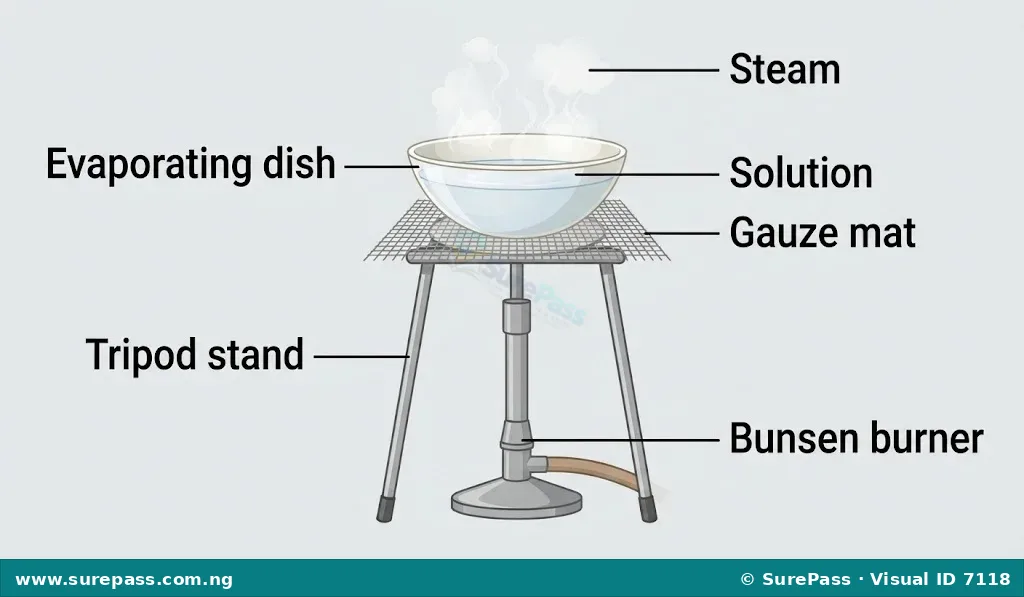
Procedure for Evaporation
The procedure for separating a soluble solid from a liquid by evaporation involves the following steps:
- Pour the solution (mixture of soluble solid and liquid) into an evaporating dish.
- Place the evaporating dish on a gauze mat supported by a tripod stand.
- Heat the evaporating dish gently with a Bunsen burner.
- Continue heating until all the liquid has evaporated, leaving the solid residue in the dish.
- Allow the evaporating dish to cool before handling.
Example: Separating salt from saltwater. When saltwater is heated, the water evaporates as steam, leaving the solid salt behind in the evaporating dish.
Safety Note: When evaporating, avoid heating to complete dryness, especially if the solid might decompose or spit. For some substances, it is better to stop heating when crystals start to form and allow the remaining liquid to evaporate at room temperature.
Crystallization
Crystallization is a separation technique used to obtain a pure solid in crystalline form from a solution. It is an improvement over simple evaporation when a pure, well-formed solid is desired. The principle involves dissolving the solid in a suitable solvent, forming a saturated solution, and then allowing the solvent to evaporate slowly or cooling the solution to reduce the solubility of the solid, causing it to crystallise out.
Apparatus for Crystallization
The apparatus for crystallization is similar to that for evaporation, but often includes additional items for controlled cooling:
- Beaker: For dissolving the solid and preparing the solution.
- Evaporating dish or crystallising dish: For allowing crystals to form.
- Bunsen burner, tripod stand, gauze mat: For heating to form a saturated solution.
- Filter funnel and filter paper: For filtering impurities from the hot saturated solution (hot filtration).
- Watch glass: Can be used to cover the crystallising dish during slow cooling.
Procedure for Crystallization
The procedure for obtaining pure crystals from a solution involves the following steps:
- Dissolve the impure solid in the minimum amount of hot solvent to form a saturated solution.
- Filter the hot saturated solution to remove any insoluble impurities. This step is called hot filtration.
- Transfer the clear filtrate to an evaporating dish or crystallising dish.
- Heat the solution gently to evaporate some of the solvent until the solution becomes concentrated enough for crystals to form upon cooling. This point is reached when a drop of the solution placed on a cold watch glass forms crystals immediately.
- Remove the heat and allow the concentrated solution to cool slowly, preferably at room temperature. As it cools, the solubility of the solid decreases, and pure crystals will form.
- Once crystals have formed, separate them from the remaining liquid (mother liquor) by filtration.
- Wash the crystals with a small amount of cold, pure solvent to remove any adhering impurities.
- Dry the crystals by pressing them between filter papers or by placing them in a desiccator.
Example: Obtaining pure copper(II) sulphate crystals from an impure solution. The impure copper(II) sulphate is dissolved in hot water, filtered, and then the solution is allowed to cool slowly to form blue copper(II) sulphate crystals.
Fractional Crystallization
Fractional crystallization is a separation technique used to separate two or more soluble solids that are dissolved in the same solvent, based on their different solubilities at varying temperatures. The principle is that substances have different solubilities in a given solvent, and these solubilities change differently with temperature. One substance will crystallise out before the other as the solution cools.
Apparatus for Fractional Crystallization
The apparatus used for fractional crystallization is similar to that for simple crystallization, but often involves more precise control over temperature and repeated steps:
- Beakers: For preparing solutions and collecting fractions.
- Heating apparatus (Bunsen burner, tripod stand, gauze mat): For dissolving solids and concentrating solutions.
- Cooling baths (e.g., ice bath): For controlled cooling.
- Filter funnels and filter paper: For separating crystals from the mother liquor.
- Thermometer: To monitor temperature during cooling.
Procedure for Fractional Crystallization
The procedure for separating two soluble solids by fractional crystallization involves the following steps:
- Dissolve the mixture of two soluble solids in the minimum amount of hot solvent to form a saturated solution.
- Allow the hot solution to cool slowly. As the solution cools, the less soluble component will start to crystallise out first.
- When a significant amount of the first component has crystallised, separate these crystals by filtration. This is the first fraction.
- Reheat the remaining solution (mother liquor) and concentrate it further, or cool it to a lower temperature. The second, more soluble component will then start to crystallise out.
- Separate the second set of crystals by filtration. This is the second fraction.
- Repeat the process of dissolving, cooling, and filtering to obtain purer fractions of each component.
Example: Separating a mixture of potassium nitrate and sodium chloride. Potassium nitrate is much more soluble in hot water than sodium chloride, but its solubility drops sharply on cooling. Sodium chloride’s solubility changes less with temperature. When a hot saturated solution of both is cooled, potassium nitrate will crystallise out first, leaving most of the sodium chloride in solution.
Laboratory Apparatus and Safety
Proper handling and setting up of laboratory apparatus are crucial for successful and safe separation experiments. Each piece of apparatus has a specific function and should be used correctly.
General Laboratory Safety Rules
- Always wear safety goggles to protect the eyes from chemical splashes or broken glass.
- Know the location of safety equipment such as fire extinguishers, fire blankets, and emergency showers.
- Never eat, drink, or chew gum in the laboratory.
- Do not run or play in the laboratory.
- Always read instructions carefully before starting any experiment.
- Report any spills, breakages, or accidents to the teacher immediately.
- Handle glassware carefully to avoid breakage.
- When heating substances, always point the mouth of the test tube or beaker away from yourself and others.
- Dispose of chemical waste properly as instructed by the teacher.
- Wash hands thoroughly with soap and water after every experiment.
Handling and Setting Up Apparatus
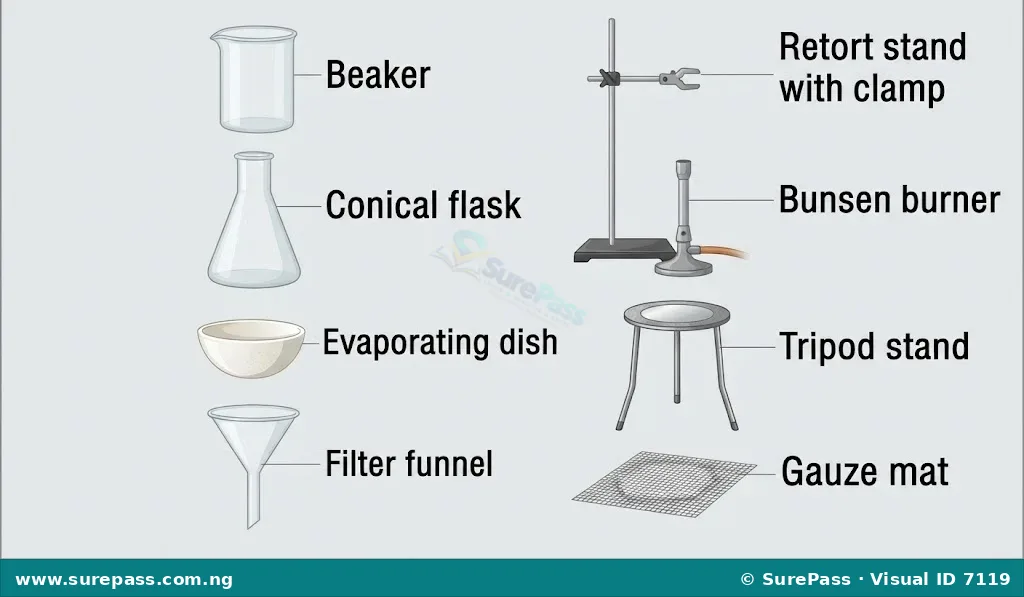
When setting up apparatus for separation techniques, precision and stability are key. For example, when setting up a filtration apparatus, ensure the retort stand is stable and the clamp securely holds the funnel. For evaporation, ensure the tripod stand is firm and the gauze mat is correctly placed to support the evaporating dish.
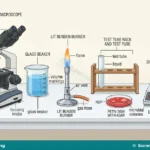
Drawing and labelling apparatus set-ups are important skills for recording experimental procedures and understanding the function of each component. Diagrams should be clear, proportionate, and all parts should be correctly labelled.


0 comments
Open the discussion when you need it. Comments stay collapsed until requested so the initial article remains light.