



ARTICLE CONTENTSOn this page 14 sections
Gas Laws
Performance Objectives
By the end of the lesson, students should be able to:
- state gas laws (Boyle’s, Charles, Graham’s, Gay- Lussac’s laws, etc.);
- express the gas laws as equations relating temperature, pressure and volume of gases;
- explain the Kelvin Scales of temperature and its relationship to Celsius Scale;
- solve simple mathematical problems involving the gas laws;
- relate the behavior of gases to the Kinetic theory;
- state the relationship between the rate of diffusion and density;
- describe mole-volume relationship in the combined gas equation;
- prove that PV=nRT as the general gas equation;
- Describe some applications of gas laws in the industrial processes.
The Kinetic Molecular Theory of Gases
The behavior of gases under various conditions of temperature, pressure, and volume can be explained using the kinetic molecular theory. This theory provides a microscopic model of how individual gas particles behave and interact with one another.
The kinetic molecular theory of gases is based on the following postulates:
- Gases consist of tiny particles called molecules, which are in constant, random, straight-line motion, colliding with one another and with the walls of the container.
- The actual volume occupied by the gas molecules themselves is negligible compared to the total volume of the container.
- There are no attractive or repulsive forces between the molecules of an ideal gas.
- Collisions between gas molecules, and between the molecules and the container walls, are perfectly elastic, meaning that no kinetic energy is lost during collisions.
- The average kinetic energy of the gas molecules is directly proportional to the absolute temperature of the gas.
The pressure exerted by a gas is the result of the continuous collision of these rapidly moving gas molecules against the walls of the container. When the temperature of a gas increases, the average kinetic energy of the molecules increases, causing them to move faster and collide more frequently and forcefully with the container walls.
Measurable Properties of Gases
To understand gas laws, four fundamental physical quantities must be measured:
- Volume ($V$): The space occupied by the gas, measured in cubic decimetres ($\text{dm}^3$), cubic centimetres ($\text{cm}^3$), or litres ($\text{L}$). Note that $1\text{ dm}^3 = 1\text{ L} = 1000\text{ cm}^3$.
- Pressure ($P$): The force exerted per unit area by gas molecules on the container walls, measured in atmospheres ($\text{atm}$), millimetres of mercury ($\text{mmHg}$), or Pascals ($\text{Pa}$). Note that $1\text{ atm} = 760\text{ mmHg} = 1.013 \times 10^5\text{ N/m}^2\text{ (or Pa)}$.
- Temperature ($T$): The measure of the average kinetic energy of the gas molecules, measured in Celsius ($^\circ\text{C}$) or Kelvin ($\text{K}$).
- Amount of Substance ($n$): The quantity of gas particles present, measured in moles ($\text{mol}$).
The Kelvin and Celsius Temperature Scales
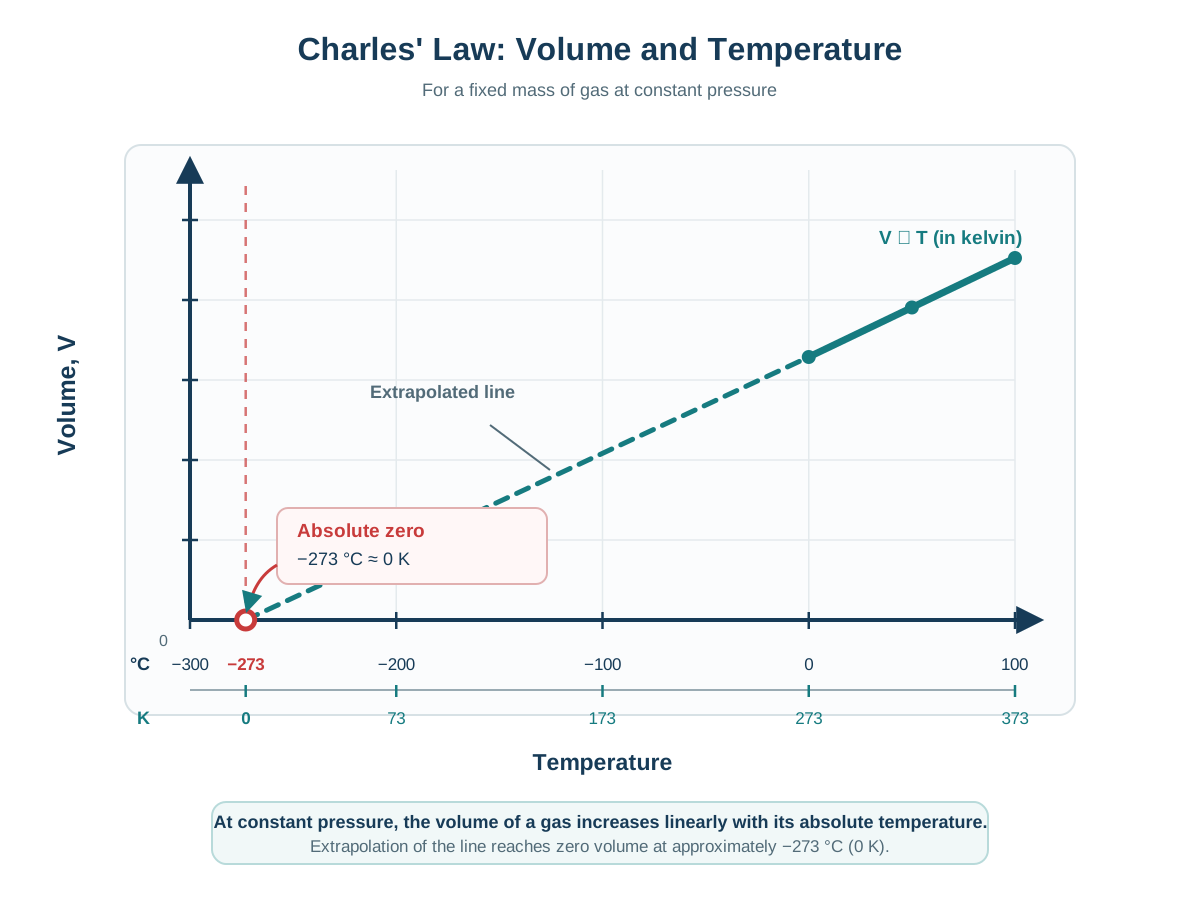
The Kelvin scale, also known as the absolute temperature scale, is the standard unit of temperature in gas law calculations. It starts at absolute zero, which is the theoretical temperature at which all molecular motion stops.
Absolute zero is the temperature at which the volume of a gas would theoretically become zero, corresponding to $-273.15^\circ\text{C}$ (usually simplified to $-273^\circ\text{C}$).
To convert temperature from the Celsius scale to the Kelvin scale, the following relationship is used:
$$T(\text{K}) = \theta(^\circ\text{C}) + 273$$
To convert temperature from the Kelvin scale to the Celsius scale, the relationship is:
$$\theta(^\circ\text{C}) = T(\text{K}) – 273$$
Worked Examples on Temperature Conversion
Example 1: Convert $27^\circ\text{C}$ to Kelvin.
Using the conversion formula:
$$T = 27 + 273 = 300\text{ K}$$
Example 2: Convert $373\text{ K}$ to Celsius.
Using the conversion formula:
$$\theta = 373 – 273 = 100^\circ\text{C}$$
Boyle’s Law
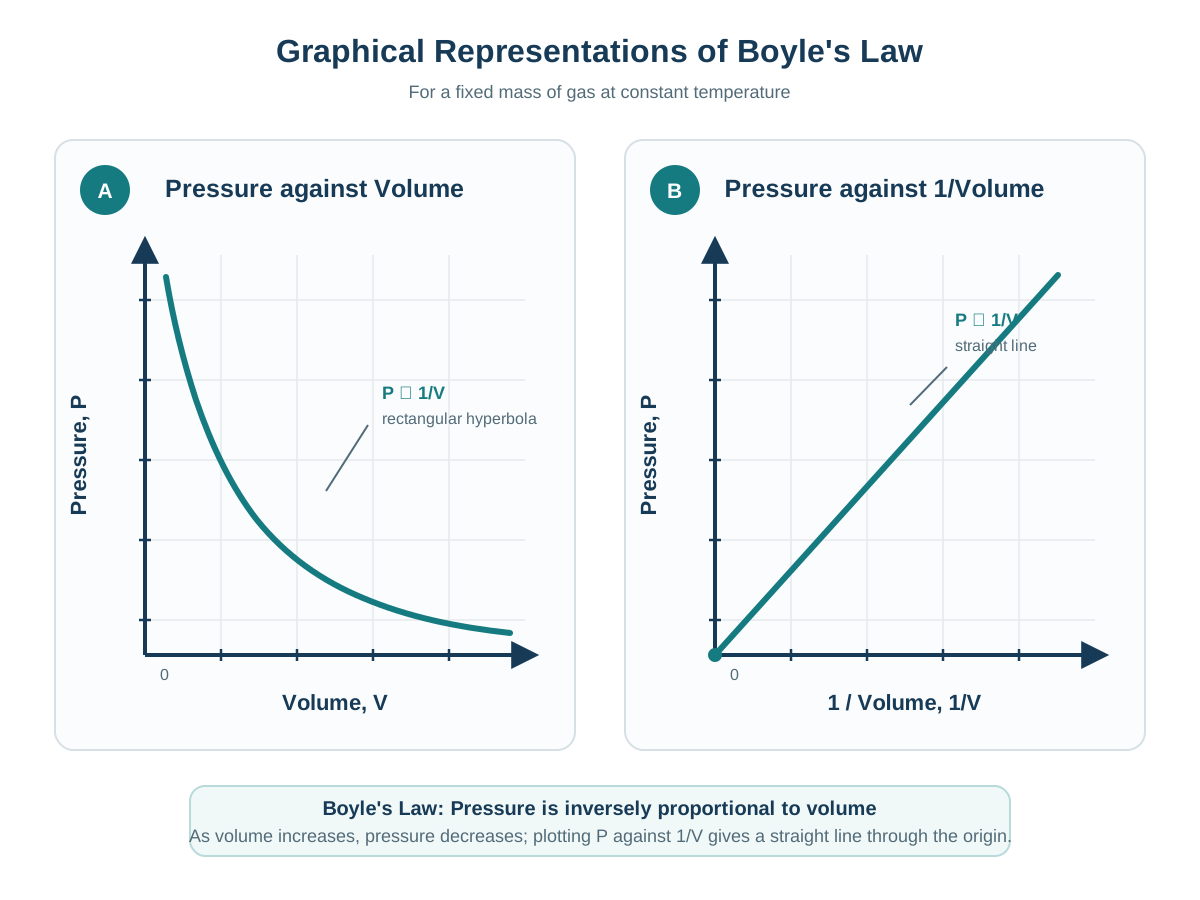
Boyle’s law states that the volume of a given mass of gas is inversely proportional to its pressure, provided the temperature remains constant.
Mathematically, this relationship is expressed as:
$$V \propto \frac{1}{P}$$
$$V = \frac{k}{P}$$
$$PV = k$$
Where $k$ is a constant. For a gas changing from an initial state (state 1) to a final state (state 2) at constant temperature, the equation becomes:
$$P_1V_1 = P_2V_2$$
Where:
- $P_1$ is the initial pressure.
- $V_1$ is the initial volume.
- $P_2$ is the final pressure.
- $V_2$ is the final volume.
According to the kinetic theory, when the volume of a gas is decreased at constant temperature, the gas molecules are confined to a smaller space. This increases the frequency of collisions per unit area on the container walls, resulting in an increase in pressure.
Observe the graphical representations of Boyle’s law below.
Worked Example on Boyle’s Law
Question: A gas occupies a volume of $400\text{ cm}^3$ at a pressure of $760\text{ mmHg}$. Calculate its volume if the pressure is increased to $1000\text{ mmHg}$ at constant temperature.
Solution:
Identify the given parameters:
$$P_1 = 760\text{ mmHg}$$
$$V_1 = 400\text{ cm}^3$$
$$P_2 = 1000\text{ mmHg}$$
$$V_2 = ?$$
Apply Boyle’s law equation:
$$P_1V_1 = P_2V_2$$
Substitute the values and solve for $V_2$:
$$760 \times 400 = 1000 \times V_2$$
$$V_2 = \frac{760 \times 400}{1000}$$
$$V_2 = 304\text{ cm}^3$$
The final volume of the gas is $304\text{ cm}^3$.
Charles’ Law
Charles’ law states that the volume of a given mass of gas is directly proportional to its absolute temperature, provided the pressure remains constant.
Mathematically, this relationship is expressed as:
$$V \propto T$$
$$\frac{V}{T} = k$$
Where $k$ is a constant and $T$ is the temperature in Kelvin. For a gas changing from an initial state to a final state at constant pressure, the equation is:
$$\frac{V_1}{T_1} = \frac{V_2}{T_2}$$
Where:
- $V_1$ is the initial volume.
- $T_1$ is the initial absolute temperature (in Kelvin).
- $V_2$ is the final volume.
- $T_2$ is the final absolute temperature (in Kelvin).
According to the kinetic theory, when a gas is heated, the average kinetic energy of its molecules increases. The molecules move faster and collide with the container walls more frequently and with greater force. To keep the pressure constant, the volume of the container must expand to increase the distance between molecules and maintain a constant collision rate per unit area.
Observe the graphical representation of Charles’ law below, showing how volume varies with temperature in Celsius and Kelvin.
Worked Example on Charles’ Law
Question: A sample of gas has a volume of $2.5\text{ dm}^3$ at $27^\circ\text{C}$. What will be its volume at $127^\circ\text{C}$ if the pressure remains constant?
Solution:
First, convert the temperatures from Celsius to Kelvin:
$$T_1 = 27 + 273 = 300\text{ K}$$
$$T_2 = 127 + 273 = 400\text{ K}$$
Identify the other parameters:
$$V_1 = 2.5\text{ dm}^3$$
$$V_2 = ?$$
Apply Charles’ law equation:
$$\frac{V_1}{T_1} = \frac{V_2}{T_2}$$
Substitute the values and solve for $V_2$:
$$\frac{2.5}{300} = \frac{V_2}{400}$$
$$V_2 = \frac{2.5 \times 400}{300}$$
$$V_2 = 3.33\text{ dm}^3$$
The final volume of the gas is $3.33\text{ dm}^3$.
Gay-Lussac’s Law (Pressure Law)
Gay-Lussac’s law (Pressure Law) states that the pressure of a given mass of gas is directly proportional to its absolute temperature, provided the volume remains constant.
Mathematically, this relationship is expressed as:
$$P \propto T$$
$$\frac{P}{T} = k$$
Where $k$ is a constant and $T$ is the temperature in Kelvin. For a gas changing from an initial state to a final state at constant volume, the equation is:
$$\frac{P_1}{T_1} = \frac{P_2}{T_2}$$
Where:
- $P_1$ is the initial pressure.
- $T_1$ is the initial absolute temperature (in Kelvin).
- $P_2$ is the final pressure.
- $T_2$ is the final absolute temperature (in Kelvin).
According to the kinetic theory, heating a gas in a rigid container (constant volume) increases the speed and kinetic energy of the molecules. Since the volume cannot change, the faster-moving molecules collide more frequently and with greater force against the container walls, leading to an increase in pressure.
Worked Example on Gay-Lussac’s Law
Question: The pressure of a gas in a steel cylinder is $4.0\text{ atm}$ at $30^\circ\text{C}$. Determine the pressure of the gas if the cylinder is heated to $150^\circ\text{C}$.
Solution:
Convert the temperatures to Kelvin:
$$T_1 = 30 + 273 = 303\text{ K}$$
$$T_2 = 150 + 273 = 423\text{ K}$$
Identify the other parameters:
$$P_1 = 4.0\text{ atm}$$
$$P_2 = ?$$
Apply Gay-Lussac’s law equation:
$$\frac{P_1}{T_1} = \frac{P_2}{T_2}$$
Substitute the values and solve for $P_2$:
$$\frac{4.0}{303} = \frac{P_2}{423}$$
$$P_2 = \frac{4.0 \times 423}{303}$$
$$P_2 = 5.58\text{ atm}$$
The final pressure of the gas is $5.58\text{ atm}$.
The Combined Gas Law
The combined gas law is obtained by combining Boyle’s law and Charles’ law into a single mathematical relationship. It relates the pressure, volume, and absolute temperature of a constant mass of gas.
From Boyle’s law: $V \propto \frac{1}{P}$ (at constant $T$)
From Charles’ law: $V \propto T$ (at constant $P$)
Combining these two relationships gives:
$$V \propto \frac{T}{P}$$
$$V = \frac{kT}{P}$$
$$\frac{PV}{T} = k$$
For a gas undergoing a change in conditions, the combined gas equation is written as:
$$\frac{P_1V_1}{T_1} = \frac{P_2V_2}{T_2}$$
Standard Temperature and Pressure (s.t.p.)
To compare different gases, standard reference conditions of temperature and pressure are used. These standard conditions are:
- Standard Temperature: $0^\circ\text{C}$ or $273\text{ K}$.
- Standard Pressure: $1\text{ atm}$, $760\text{ mmHg}$, or $1.013 \times 10^5\text{ N/m}^2$.
Worked Example on the Combined Gas Law
Question: A gas occupies a volume of $600\text{ cm}^3$ at $27^\circ\text{C}$ and $750\text{ mmHg}$ pressure. Calculate its volume at standard temperature and pressure (s.t.p.).
Solution:
Identify the initial conditions:
$$V_1 = 600\text{ cm}^3$$
$$T_1 = 27 + 273 = 300\text{ K}$$
$$P_1 = 750\text{ mmHg}$$
Identify the final conditions at s.t.p.:
$$T_2 = 273\text{ K}$$
$$P_2 = 760\text{ mmHg}$$
$$V_2 = ?$$
Apply the combined gas equation:
$$\frac{P_1V_1}{T_1} = \frac{P_2V_2}{T_2}$$
Substitute the values and solve for $V_2$:
$$\frac{750 \times 600}{300} = \frac{760 \times V_2}{273}$$
$$1500 = \frac{760 \times V_2}{273}$$
$$V_2 = \frac{1500 \times 273}{760}$$
$$V_2 = 538.82\text{ cm}^3$$
The volume of the gas at s.t.p. is $538.82\text{ cm}^3$.
Avogadro’s Law and the Mole Concept
Avogadro’s law states that equal volumes of all gases at the same temperature and pressure contain the same number of molecules.
Mathematically, this is expressed as:
$$V \propto n$$
$$\frac{V}{n} = k$$
Where $n$ is the number of moles of the gas. This law implies that the volume of a gas is directly related to the number of particles (moles) present, regardless of the chemical identity of the gas.
A mole is the amount of substance containing as many elementary entities as there are atoms in exactly $12\text{ g}$ of carbon-12.
This number of entities is known as Avogadro’s number ($N_A$), which has a constant value of $6.02 \times 10^{23}$ particles per mole.
Molar volume is the volume occupied by one mole of any gas at standard temperature and pressure (s.t.p.), which is equal to $22.4\text{ dm}^3$ (or $22400\text{ cm}^3$).
Thus, at s.t.p., $1\text{ mole}$ of any gas (such as $\text{O}_2$, $\text{H}_2$, $\text{CO}_2$, or $\text{NH}_3$):
- Contains $6.02 \times 10^{23}$ molecules.
- Occupies a volume of $22.4\text{ dm}^3$.
The Ideal Gas Equation
The ideal gas equation is a single equation of state that relates the pressure, volume, temperature, and number of moles of an ideal gas. It is derived by combining Boyle’s law, Charles’ law, and Avogadro’s law.
The derivation involves the following steps:
From Boyle’s law: $V \propto \frac{1}{P}$ (at constant $T, n$)
From Charles’ law: $V \propto T$ (at constant $P, n$)
From Avogadro’s law: $V \propto n$ (at constant $P, T$)
Combining these three relationships gives:
$$V \propto \frac{nT}{P}$$
Introducing a proportionality constant, $R$ (known as the molar gas constant):
$$V = \frac{nRT}{P}$$
Rearranging the equation yields the ideal gas equation:
$$PV = nRT$$
Where:
- $P$ is the pressure of the gas.
- $V$ is the volume of the gas (in $\text{dm}^3$).
- $n$ is the number of moles of the gas ($\text{mol}$).
- $R$ is the universal gas constant.
- $T$ is the absolute temperature (in Kelvin).
The value of the gas constant $R$ depends on the units used for pressure and volume. Common values include:
- $R = 0.0821\text{ dm}^3\text{ atm K}^{-1}\text{ mol}^{-1}$ (when pressure is in $\text{atm}$ and volume is in $\text{dm}^3$).
- $R = 8.314\text{ J mol}^{-1}\text{ K}^{-1}$ (when pressure is in $\text{N/m}^2$ or $\text{Pa}$ and volume is in $\text{m}^3$).
Worked Example on the Ideal Gas Equation
Question: Calculate the volume occupied by $2.5\text{ moles}$ of an ideal gas at a pressure of $1.5\text{ atm}$ and a temperature of $27^\circ\text{C}$. (Take $R = 0.0821\text{ dm}^3\text{ atm K}^{-1}\text{ mol}^{-1}$)
Solution:
Identify the given parameters:
$$n = 2.5\text{ moles}$$
$$P = 1.5\text{ atm}$$
$$T = 27 + 273 = 300\text{ K}$$
$$R = 0.0821\text{ dm}^3\text{ atm K}^{-1}\text{ mol}^{-1}$$
$$V = ?$$
Apply the ideal gas equation:
$$PV = nRT$$
Rearrange the equation to solve for $V$:
$$V = \frac{nRT}{P}$$
Substitute the values:
$$V = \frac{2.5 \times 0.0821 \times 300}{1.5}$$
$$V = \frac{61.575}{1.5}$$
$$V = 41.05\text{ dm}^3$$
The volume occupied by the gas is $41.05\text{ dm}^3$.
Graham’s Law of Diffusion
Graham’s law of diffusion states that the rate of diffusion of a gas is inversely proportional to the square root of its density or molar mass, under constant conditions of temperature and pressure.
Diffusion is the process by which gas molecules spread out and mix with other gas molecules due to their random kinetic motion.
Mathematically, Graham’s law is expressed as:
$$R \propto \frac{1}{\sqrt{d}}$$
Where $R$ is the rate of diffusion and $d$ is the density of the gas. Since the density of a gas is directly proportional to its molar mass ($M$) at constant temperature and pressure, the law can also be written as:
$$R \propto \frac{1}{\sqrt{M}}$$
For two different gases, Gas 1 and Gas 2, comparing their rates of diffusion gives:
$$\frac{R_1}{R_2} = \sqrt{\frac{d_2}{d_1}} = \sqrt{\frac{M_2}{M_1}}$$
Since the rate of diffusion ($R$) is inversely proportional to the time ($t$) taken for a given volume of gas to diffuse ($R = \frac{V}{t}$), the relationship between diffusion time and molar mass is:
$$\frac{t_2}{t_1} = \sqrt{\frac{d_2}{d_1}} = \sqrt{\frac{M_2}{M_1}}$$
Experimental Demonstration of Graham’s Law
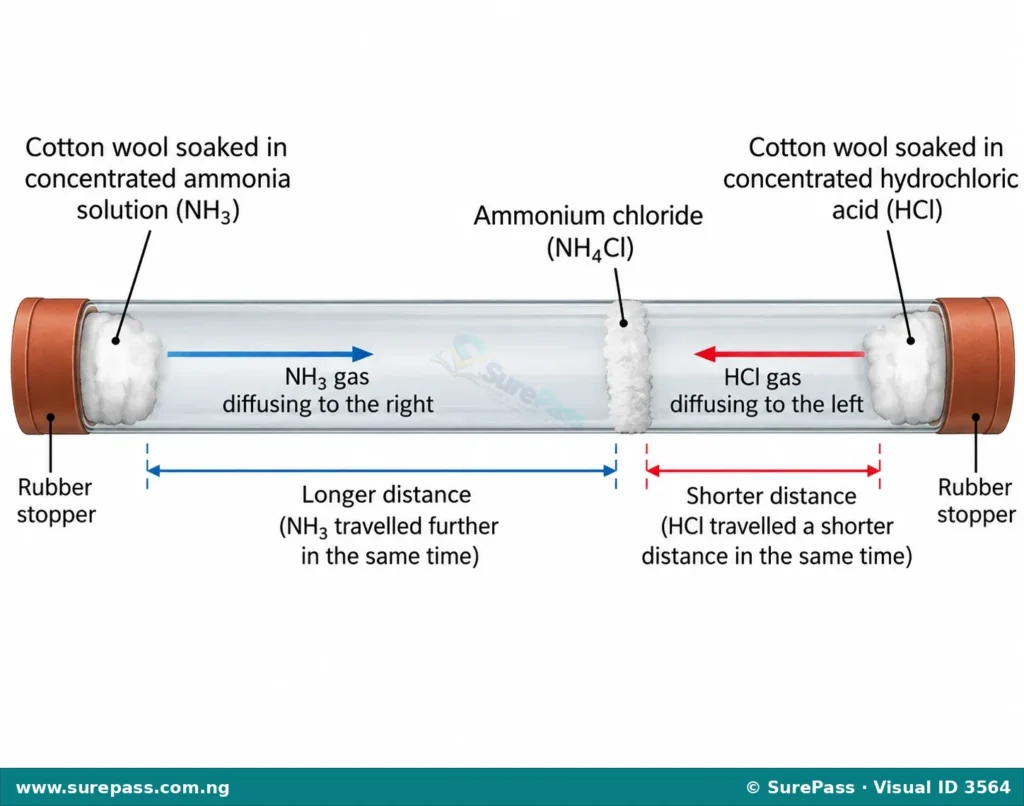
The relative rates of diffusion of gases can be demonstrated experimentally using a long, horizontal glass tube. Cotton wool soaked in concentrated ammonia ($\text{NH}_3$) solution is placed at one end of the tube, and cotton wool soaked in concentrated hydrochloric acid ($\text{HCl}$) is placed at the opposite end. Both ends are sealed with rubber bungs.
Ammonia gas ($\text{NH}_3$, molar mass $= 17\text{ g/mol}$) and hydrogen chloride gas ($\text{HCl}$, molar mass $= 36.5\text{ g/mol}$) evaporate from the cotton wool and diffuse toward each other inside the tube. When they meet, they react to form a dense white ring of solid ammonium chloride ($\text{NH}_4\text{Cl}$):
$$\text{NH}_{3(g)} + \text{HCl}_{(g)} \rightarrow \text{NH}_4\text{Cl}_{(s)}$$
Because ammonia gas has a lower molar mass than hydrogen chloride gas, it diffuses faster. Consequently, the white ring of ammonium chloride forms closer to the hydrochloric acid end of the tube, demonstrating that lighter gases diffuse faster than heavier gases.
Observe the experimental setup for demonstrating Graham’s law of diffusion below.
Worked Example on Graham’s Law
Question: Oxygen gas ($\text{O}_2$) has a molar mass of $32\text{ g/mol}$ and diffuses at a rate of $12\text{ cm}^3/\text{s}$. Calculate the rate of diffusion of hydrogen gas ($\text{H}_2$), which has a molar mass of $2\text{ g/mol}$, under the same conditions.
Solution:
Identify the given parameters:
$$R_{\text{O}_2} = 12\text{ cm}^3/\text{s}$$
$$M_{\text{O}_2} = 32\text{ g/mol}$$
$$M_{\text{H}_2} = 2\text{ g/mol}$$
$$R_{\text{H}_2} = ?$$
Apply Graham’s law equation:
$$\frac{R_{\text{H}_2}}{R_{\text{O}_2}} = \sqrt{\frac{M_{\text{O}_2}}{M_{\text{H}_2}}}$$
Substitute the values:
$$\frac{R_{\text{H}_2}}{12} = \sqrt{\frac{32}{2}}$$
$$\frac{R_{\text{H}_2}}{12} = \sqrt{16}$$
$$\frac{R_{\text{H}_2}}{12} = 4$$
$$R_{\text{H}_2} = 4 \times 12 = 48\text{ cm}^3/\text{s}$$
The rate of diffusion of hydrogen gas is $48\text{ cm}^3/\text{s}$.
Applications of Gas Laws in Industrial Processes
The principles of gas laws are widely applied in various industrial, scientific, and domestic processes. Some key applications include:
- Industrial Liquefaction of Gases: Gases such as nitrogen, oxygen, and carbon dioxide are liquefied on an industrial scale by applying high pressure and cooling them to very low temperatures. This process relies on the relationship between pressure, volume, and temperature.
- Storage of Compressed Gases: Industrial and medical gases (such as oxygen in hospital cylinders, nitrogen, and liquefied petroleum gas (LPG) for domestic cooking) are stored under high pressure in strong steel cylinders. This allows a large mass of gas to be compressed into a small, portable volume, as described by Boyle’s law.
- The Haber Process: In the industrial manufacture of ammonia, nitrogen and hydrogen gases are reacted at high pressure (about $200\text{ atm}$) and controlled temperature. Understanding gas behavior and volume relationships is critical for optimizing the yield of ammonia.
- Hot Air Balloons: Hot air balloons operate on the principle of Charles’ law. Heating the air inside the balloon causes it to expand and become less dense than the surrounding cool air, creating the buoyant force needed to lift the balloon.
- Safety Valves and Pressure Cookers: Pressure cookers use Gay-Lussac’s law. By sealing the vessel, the volume remains constant. As the temperature increases, the pressure of the steam inside rises significantly, raising the boiling point of water and cooking food faster. Safety valves are calibrated to release gas if the pressure exceeds safe limits.
Summary
The study of gas laws describes how gases behave under varying physical conditions. Boyle’s law relates pressure and volume at constant temperature, Charles’ law relates volume and temperature at constant pressure, and Gay-Lussac’s law relates pressure and temperature at constant volume. These laws are unified in the combined gas equation and the ideal gas equation ($PV = nRT$). Graham’s law explains how gases diffuse based on their molar masses, while the kinetic molecular theory provides the theoretical foundation for all these observations. These principles are vital for numerous industrial applications, from gas storage to chemical manufacturing.



0 comments
Open the discussion when you need it. Comments stay collapsed until requested so the initial article remains light.