


ARTICLE CONTENTSOn this page 11 sections
Chemical Equilibrium
Performance Objectives
By the end of the lesson, students should be able to:
- explain chemical equilibrium;
- write balanced equations for simple equilibrium reactions;
- state the characteristics of equilibrium systems;
- apply Le Chatelier’s principle to predict equilibrium shifts;
- describe the factors affecting equilibrium of chemical reaction;
- mention applications of chemical equilibrium in the industry.
Concept of Reversible Reactions and Chemical Equilibrium
Chemical reactions can be classified into two main categories based on the direction in which they proceed: irreversible reactions and reversible reactions.
An irreversible reaction is a chemical reaction that proceeds in only one direction, where the reactants are completely converted into products and the products cannot react to reform the reactants.
An example of an irreversible reaction is the combustion of wood or the reaction between sodium metal and water. Once these reactions occur, the products cannot easily be converted back into the original reactants under normal laboratory conditions.
A reversible reaction is a chemical reaction that can proceed in both the forward and reverse directions under the same experimental conditions.
In a reversible reaction, reactants react to form products (the forward reaction), and simultaneously, the products react to reform the original reactants (the reverse reaction). An example of a reversible reaction is the thermal decomposition of ammonium chloride. When solid ammonium chloride is heated, it decomposes into ammonia gas and hydrogen chloride gas. When these gases cool, they recombine to form solid ammonium chloride again.
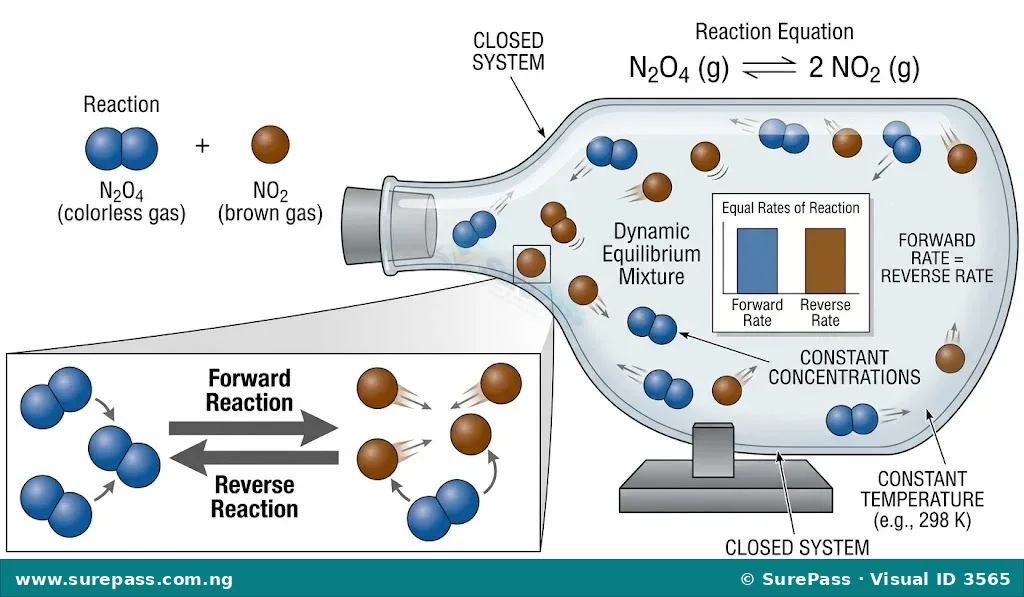
When a reversible reaction is carried out in a closed system, a state is eventually reached where the rate of the forward reaction equals the rate of the reverse reaction. This state is known as chemical equilibrium.
Chemical equilibrium is a state in a reversible reaction where the rate of the forward reaction equals the rate of the reverse reaction, resulting in no net change in the concentrations of reactants and products over time.
At this point, the reaction has not stopped. Instead, reactants are being converted into products at the exact same speed that products are being converted back into reactants. Because these two opposing processes occur at equal rates, the system appears static from the outside, but at the molecular level, it is highly active. For this reason, chemical equilibrium is described as a dynamic equilibrium.
Observe the diagram below to understand the molecular nature of dynamic equilibrium in a closed system.
Writing and Balancing Reversible Chemical Equations
To represent a reversible reaction in a chemical equation, a double arrow (⇌) is used instead of the single arrow (→) found in irreversible reactions. The double arrow indicates that the reaction occurs in both directions simultaneously.
When writing and balancing reversible chemical equations, the same laws of conservation of mass apply. The number of atoms of each element must be equal on both sides of the equation, and state symbols must be included to show the physical state of each substance.
Common state symbols used in chemical equations include:
- (s) for solid;
- (l) for liquid;
- (g) for gas;
- (aq) for aqueous solution (substances dissolved in water).
Examples of balanced reversible chemical equations include:
- The synthesis of ammonia (Haber Process):
N2(g) + 3H2(g) ⇌ 2NH3(g) - The dissociation of dinitrogen tetroxide:
N2O4(g) ⇌ 2NO2(g) - The thermal decomposition of calcium carbonate in a closed container:
CaCO3(s) ⇌ CaO(s) + CO2(g) - The reaction between steam and red-hot iron:
3Fe(s) + 4H2O(g) ⇌ Fe3O4(s) + 4H2(g)
Characteristics of Equilibrium Systems
A chemical system must satisfy specific conditions to establish and maintain a state of equilibrium. These conditions define the fundamental behavior of equilibrium mixtures.
The main characteristics of a system at chemical equilibrium are:
- Closed System: Equilibrium can only be established in a closed system, where no matter can enter or leave the reaction vessel. If gases are allowed to escape into the atmosphere, the reverse reaction cannot occur, and equilibrium will not be reached.
- Dynamic Nature: The reaction does not stop at equilibrium. The forward and reverse reactions continue to take place at the same rate.
- Equal Rates: The rate of the forward reaction is exactly equal to the rate of the reverse reaction.
- Constant Macroscopic Properties: All observable physical properties of the system, such as color intensity, temperature, pressure, density, and the concentrations of reactants and products, remain constant over time.
- Approachability from Either Direction: The same equilibrium state can be reached whether the reaction is started with pure reactants or pure products, provided the temperature and pressure remain constant.
- No Effect of Catalyst on Position: A catalyst speeds up both the forward and reverse reactions to the same extent. Consequently, a catalyst helps the system reach equilibrium faster but does not change the relative amounts of reactants and products present at equilibrium.
Le Chatelier’s Principle
When a chemical system at equilibrium is subjected to an external change, the system responds to counteract that change and establish a new equilibrium state.
Le Chatelier’s principle states that if an external constraint or stress is applied to a system in dynamic equilibrium, the system will adjust itself in a way that tends to counteract or minimize the effect of that constraint.
The term “stress” refers to any change in the experimental conditions of the system, such as a change in concentration, temperature, or pressure. By applying this principle, chemists can predict how an equilibrium system will shift when these conditions are altered.
Factors Affecting Chemical Equilibrium
The position of chemical equilibrium can be shifted by changing the concentration of substances, the temperature of the system, or the pressure of gaseous systems.
Concentration
According to Le Chatelier’s principle, if the concentration of a substance in an equilibrium mixture is increased, the system will shift to consume that substance. If the concentration is decreased, the system will shift to produce more of that substance.
The effects of concentration changes on a general equilibrium system (A + B ⇌ C + D) are:
- Adding a reactant (increasing the concentration of A or B): The system shifts to the right (forward direction) to consume the added reactants, producing more products (C and D).
- Removing a product (decreasing the concentration of C or D): The system shifts to the right (forward direction) to replace the lost products.
- Adding a product (increasing the concentration of C or D): The system shifts to the left (reverse direction) to consume the added products, forming more reactants (A and B).
- Removing a reactant (decreasing the concentration of A or B): The system shifts to the left (reverse direction) to replace the lost reactants.
Temperature
The effect of temperature on an equilibrium system depends on whether the forward reaction is exothermic (releases heat) or endothermic (absorbs heat).
For an exothermic reaction, heat can be treated as a product of the reaction:
Reactants ⇌ Products + Heat (ΔH is negative)
The effects of temperature changes on an exothermic reaction are:
- Increasing the temperature: The system shifts to the left (reverse direction) to absorb the added heat, decreasing the yield of products.
- Decreasing the temperature: The system shifts to the right (forward direction) to produce more heat, increasing the yield of products.
For an endothermic reaction, heat can be treated as a reactant:
Reactants + Heat ⇌ Products (ΔH is positive)
The effects of temperature changes on an endothermic reaction are:
- Increasing the temperature: The system shifts to the right (forward direction) to absorb the added heat, increasing the yield of products.
- Decreasing the temperature: The system shifts to the left (reverse direction) to minimize the loss of heat, decreasing the yield of products.
Pressure
Pressure changes only affect equilibrium systems that involve gaseous reactants or products, and where there is a difference in the total number of moles of gas between the reactant side and the product side of the balanced equation.
The effects of pressure changes on gaseous equilibrium systems are:
- Increasing the pressure (or decreasing the volume): The system shifts in the direction that produces fewer moles of gas to reduce the pressure.
- Decreasing the pressure (or increasing the volume): The system shifts in the direction that produces more moles of gas to increase the pressure.
- No change in moles of gas: If the total number of moles of gas is the same on both sides of the equation, a change in pressure has no effect on the position of equilibrium.
Consider the synthesis of ammonia:
N2(g) + 3H2(g) ⇌ 2NH3(g)
The reactant side has 4 moles of gas (1 mole of N2 and 3 moles of H2), while the product side has 2 moles of gas (2 moles of NH3). Increasing the pressure on this system will shift the equilibrium to the right (forward direction) because 2 moles of gas exert less pressure than 4 moles of gas.
Now consider the reaction between hydrogen and iodine gases:
H2(g) + I2(g) ⇌ 2HI(g)
Both sides of the equation have exactly 2 moles of gas. Therefore, changing the pressure of this system has no effect on the position of the equilibrium.
The Effect of a Catalyst
A catalyst is a substance that increases the rate of a chemical reaction without being consumed in the process. In a reversible reaction, a catalyst increases the rates of both the forward and reverse reactions by the same factor. Consequently, a catalyst does not shift the position of equilibrium and has no effect on the yield of the products. It only reduces the time required for the system to reach the state of equilibrium.
Industrial Applications of Chemical Equilibrium
In chemical industries, maximizing the yield of products while minimizing production costs is essential. Industrial chemists apply Le Chatelier’s principle to determine the optimum conditions of temperature, pressure, and concentration required to obtain the highest possible yield of products at a reasonable rate.
Two major industrial processes that rely on the principles of chemical equilibrium are the Haber Process and the Contact Process.
The Haber Process for the Manufacture of Ammonia
Ammonia is produced industrially by the direct combination of nitrogen gas and hydrogen gas. The reaction is reversible and exothermic:
N2(g) + 3H2(g) ⇌ 2NH3(g) ΔH = -92.4 kJ/mol
To obtain a high yield of ammonia, the following conditions are applied based on equilibrium principles:
- High Pressure: Since the forward reaction results in a decrease in the number of moles of gas (from 4 moles to 2 moles), a high pressure shifts the equilibrium to the right. Industrially, a pressure of about 200 atmospheres is used.
- Low Temperature: Since the forward reaction is exothermic, a low temperature shifts the equilibrium to the right to increase the yield of ammonia. However, at very low temperatures, the rate of the reaction becomes too slow to be commercially viable. Therefore, a compromise temperature of about 450 °C is used.
- Use of a Catalyst: To ensure the reaction proceeds at a fast rate at the compromise temperature of 450 °C, a catalyst of finely divided iron is used.
- Continuous Removal of Ammonia: Ammonia gas is continuously liquefied and removed from the reaction chamber. This decreases the concentration of the product, shifting the equilibrium to the right to produce more ammonia. Unreacted nitrogen and hydrogen gases are recycled back into the reactor.
The Contact Process for the Manufacture of Tetraoxosulfate(VI) Acid
The key step in the Contact Process is the catalytic oxidation of sulfur(IV) oxide to sulfur(VI) oxide. This reaction is reversible and exothermic:
2SO2(g) + O2(g) ⇌ 2SO3(g) ΔH = -197 kJ/mol
The optimum conditions used to maximize the yield of sulfur(VI) oxide are:
- Pressure: The forward reaction involves a decrease in the number of moles of gas (from 3 moles to 2 moles). Although high pressure would shift the equilibrium to the right, the conversion of sulfur(IV) oxide to sulfur(VI) oxide is already very high (about 98%) at normal atmospheric pressure. Therefore, a low pressure of 1 to 2 atmospheres is maintained to save equipment costs.
- Temperature: Since the reaction is exothermic, a low temperature favors the forward reaction. A compromise temperature of about 450 °C is used to maintain an acceptable reaction rate.
- Use of a Catalyst: Vanadium(V) oxide (V2O5) is used as a catalyst to speed up the rate of reaction at the compromise temperature.
- Excess Oxygen: An excess of air (oxygen) is supplied to increase the concentration of reactants, which shifts the equilibrium to the right.
Practical Demonstration: Effect of Temperature on Equilibrium
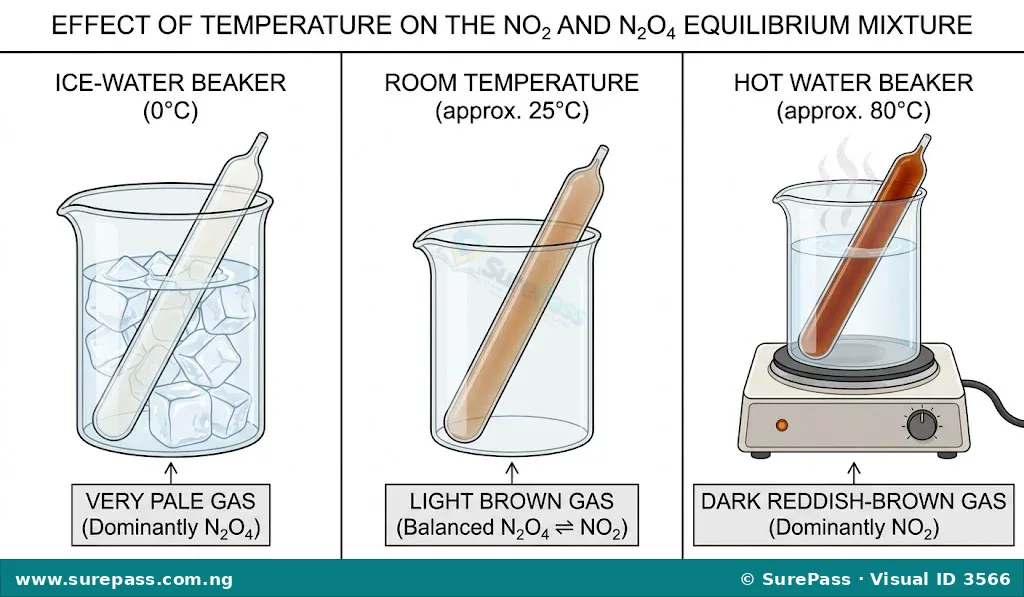
The effect of temperature on chemical equilibrium can be demonstrated using the reversible thermal dissociation of nitrogen dioxide gas. Nitrogen dioxide (NO2) is a dark brown gas, while dinitrogen tetroxide (N2O4) is a colorless gas. The two gases exist in dynamic equilibrium in a sealed tube according to the following endothermic equation:
N2O4(g) ⇌ 2NO2(g) ΔH = +57.2 kJ/mol
The required materials for this demonstration are:
- Three sealed glass tubes containing an equilibrium mixture of nitrogen dioxide and dinitrogen tetroxide;
- One beaker containing ice cubes and cold water (ice bath);
- One beaker containing hot water (hot water bath);
- A source of heat (such as a Bunsen burner or electric hot plate) to prepare the hot water.
The procedure involves the following steps:
- Prepare the hot water bath using the heat source and the ice bath using the ice cubes.
- Keep one sealed tube at room temperature to serve as a control for color comparison.
- Place the second sealed tube into the beaker of hot water. Observe the color change of the gas inside the tube over a few minutes.
- Place the third sealed tube into the beaker of ice water. Observe the color change of the gas inside the tube over a few minutes.
- Remove the tubes from the hot and cold baths and allow them to return to room temperature. Observe the color changes as they return to the initial state.
During the demonstration, the following observations and inferences are made:
- In the hot water bath: The gas inside the tube becomes much darker brown. This indicates that increasing the temperature shifts the equilibrium to the right (the endothermic direction) to absorb the added heat, producing more brown nitrogen dioxide gas.
- In the ice bath: The gas inside the tube becomes pale brown or nearly colorless. This indicates that decreasing the temperature shifts the equilibrium to the left (the exothermic direction) to release heat, producing more colorless dinitrogen tetroxide gas.
- Returning to room temperature: Both tubes return to the original light brown color of the control tube, demonstrating that the equilibrium shift is completely reversible.
Observe the visual representation of this experiment below.
Summary of Industrial Conditions
The table below summarizes the optimum conditions used in the Haber and Contact processes to balance product yield and reaction rate.
| Industrial Process | Reversible Reaction Equation | Compromise Temperature | Optimum Pressure | Catalyst Used |
|---|---|---|---|---|
| Haber Process (Ammonia Synthesis) | N2(g) + 3H2(g) ⇌ 2NH3(g) | 450 °C | 200 atm | Finely divided iron |
| Contact Process (Sulfur Trioxide Synthesis) | 2SO2(g) + O2(g) ⇌ 2SO3(g) | 450 °C | 1 to 2 atm | Vanadium(V) oxide (V2O5) |
Review Questions
The following questions are provided to test comprehension of the concepts covered in this unit:
- Explain the term chemical equilibrium and state why it is described as dynamic.
- State four characteristics of a chemical system at equilibrium.
- State Le Chatelier’s principle.
- Predict the direction in which the equilibrium will shift for the reaction: N2(g) + O2(g) ⇌ 2NO(g) (ΔH = +180 kJ/mol) when:
- the temperature is increased;
- the pressure is increased;
- oxygen gas is added to the system.
- Describe how Le Chatelier’s principle is applied to maximize the yield of ammonia in the Haber process.
- Explain why a catalyst does not affect the position of equilibrium in a reversible reaction.



0 comments
Open the discussion when you need it. Comments stay collapsed until requested so the initial article remains light.