


ARTICLE CONTENTSOn this page 8 sections
Particulate Nature of Matter
Performance Objectives
By the end of the lesson, students should be able to:
- explain the concept of matter;
- recognize the various states of matter;
- name the fundamental particles of matter;
- state the postulates of Dalton’s Atomic theory;
- explain the significance of Dalton’s theory in chemistry.
The Concept of Matter
Matter is anything that has mass and occupies space.
The physical universe is composed entirely of matter. Common examples of matter found in the environment include soil, water, air, stones, wood, school desks, and living organisms. Even invisible gases, such as oxygen and carbon dioxide, are classified as matter because they possess mass and fill the space of their containers.
To confirm that an object is matter, two criteria must be met:
- The object must have mass, which is the quantity of physical material it contains. Mass is measured in kilograms or grams using a balance.
- The object must occupy space, meaning it has a measurable volume.
The Fundamental Particles of Matter
Matter is not continuous, but is instead composed of extremely tiny, discrete particles. These particles are in constant motion and are held together by varying degrees of attractive forces.
The three fundamental particles of matter are:
- Atoms
- Molecules
- Ions
An atom is the smallest particle of an element that can take part in a chemical reaction.
Atoms are the basic building blocks of all substances. Examples include atoms of hydrogen, oxygen, iron, and gold.
A molecule is the smallest particle of a substance that can exist independently and retain the chemical properties of that substance.
Molecules are formed when two or more atoms bond together chemically. Examples include a molecule of water (H2O), which consists of two hydrogen atoms and one oxygen atom, and a molecule of oxygen gas (O2), which consists of two oxygen atoms.
An ion is an atom or a group of atoms that carries an electrical charge.
Ions are formed when atoms gain or lose electrons. Examples include the sodium ion (Na+), which carries a positive charge, and the chloride ion (Cl−), which carries a negative charge.
States of Matter
Matter exists in four distinct physical states depending on temperature and pressure. These states are solid, liquid, gas, and plasma.
The Solid State
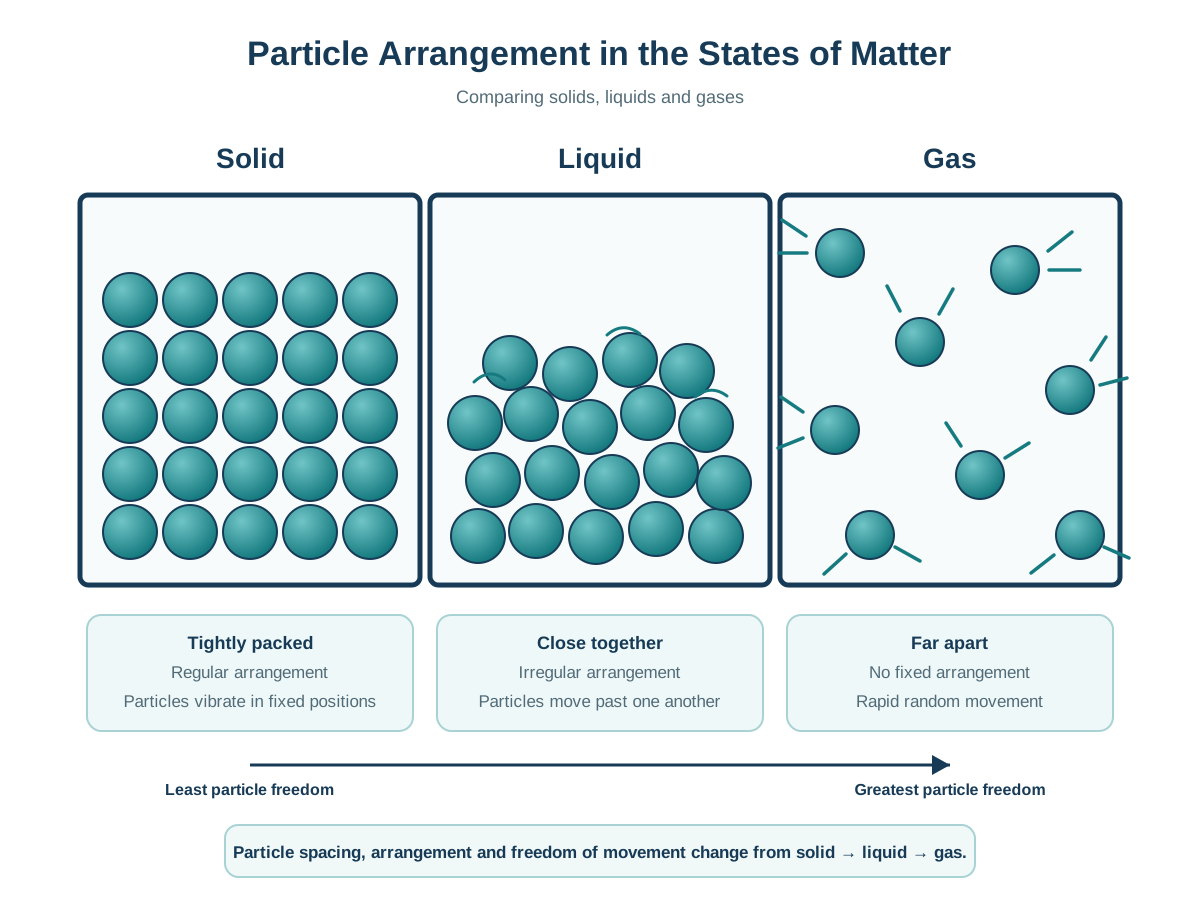
Solids have a definite shape and a definite volume. The particles in a solid are tightly packed in a highly ordered, regular pattern. Strong forces of attraction hold these particles closely together, preventing them from moving freely. Consequently, the particles only vibrate and rotate about fixed positions. This rigid arrangement explains why solids cannot be easily compressed and do not flow.
The Liquid State
Liquids have a definite volume but no definite shape. A liquid takes the shape of the container it occupies. The particles in a liquid are close together, but they are not arranged in a rigid, orderly pattern. The forces of attraction between the particles are weaker than those in solids, allowing the particles to slide past one another and move about randomly. This mobility enables liquids to flow and be poured.
The Gas State
Gases have no definite shape and no definite volume. A gas expands to completely fill any container in which it is placed. The particles in a gas are separated by very large distances, and the forces of attraction between them are negligible. Gas particles move rapidly, randomly, and continuously in all directions, colliding with one another and with the walls of the container. Because of the vast empty spaces between the particles, gases are highly compressible.
The Plasma State
Plasma is a state of matter consisting of highly ionized gas containing super-energetic and super-excited particles at very high temperatures.
In the plasma state, electrons are stripped away from the nuclei of atoms, creating a mixture of free electrons and positive ions. Plasma conducts electricity and is highly influenced by magnetic fields. While rare in daily life on Earth, plasma is the most abundant state of matter in the universe. It is found in stars, including the sun, as well as in lightning bolts and neon signs.
Comparison of Solids, Liquids, and Gases
The physical differences between the three primary states of matter can be explained by the arrangement and behavior of their constituent particles.
The table below summarizes these differences:
| Property | Solid | Liquid | Gas |
|---|---|---|---|
| Shape | Definite shape | Indefinite shape (takes the shape of the container) | Indefinite shape (fills the container) |
| Volume | Definite volume | Definite volume | Indefinite volume |
| Particle Arrangement | Tightly packed in a regular, orderly pattern | Closely packed but disordered | Very far apart with no orderly arrangement |
| Particle Movement | Vibrate and rotate about fixed positions | Slide past one another and move randomly | Move rapidly and randomly in all directions |
| Forces of Attraction | Very strong | Moderate (weaker than in solids) | Negligible (almost non-existent) |
| Compressibility | Incompressible | Almost incompressible | Highly compressible |
Observe the diagram below to see how the arrangement of particles differs across the three primary states of matter.
Changes of State
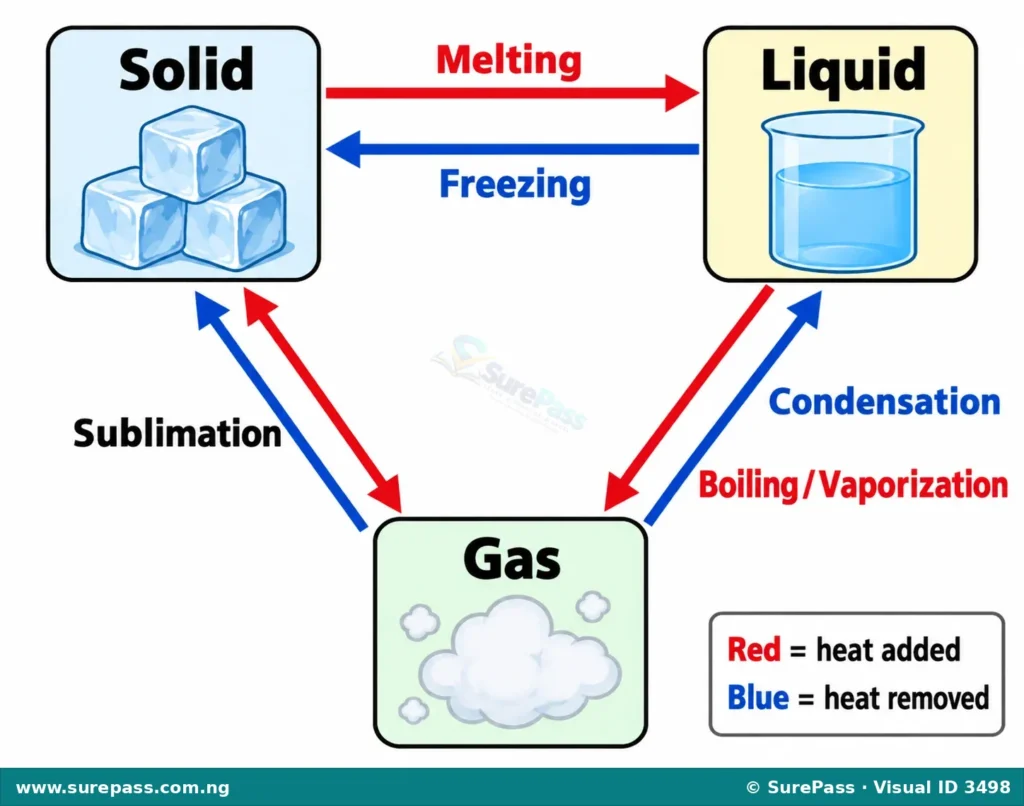
Matter can transition from one physical state to another when thermal energy is added or removed. These transitions are physical changes because the chemical identity of the substance remains unaltered.
The primary processes involved in the changes of state are:
- Melting
- Boiling
- Condensation
- Freezing
- Sublimation
Melting is the process by which a solid changes into a liquid upon the application of heat.
When a solid is heated, its particles gain kinetic energy and vibrate more violently. At a specific temperature called the melting point, the particles acquire enough energy to overcome the strong attractive forces holding them in fixed positions, and the solid turns into a liquid. An example is ice melting into liquid water.
Boiling is the process by which a liquid changes into a gas at a specific temperature called the boiling point, where the vapour pressure of the liquid equals the atmospheric pressure.
During heating, liquid particles gain kinetic energy and move faster. At the boiling point, particles throughout the liquid have sufficient energy to escape the attractive forces of the liquid state and transform into vapor. An example is liquid water boiling to form steam.
Condensation is the process by which a gas or vapour changes into a liquid when heat is removed.
As a gas cools, its particles lose kinetic energy and move more slowly. The attractive forces between the particles begin to pull them closer together, transitioning the substance back into the liquid state. An example is water vapour condensing into liquid water droplets on a cold surface.
Freezing is the process by which a liquid changes into a solid when heat is removed.
When a liquid is cooled, the particles lose kinetic energy and move slower. At a specific temperature called the freezing point, the particles lose enough energy for the attractive forces to lock them into fixed, orderly positions, forming a solid. An example is liquid water freezing into ice.
Sublimation is the process by which a solid changes directly into a gas without passing through the liquid state, or vice versa.
Certain substances have weak intermolecular forces that allow them to transition directly from solid to gas upon heating, or from gas to solid upon cooling (sometimes referred to as deposition). Common examples of substances that sublime include ammonium chloride, iodine crystals, camphor, and dry ice (solid carbon dioxide).
The diagram below illustrates the relationship between these different changes of state.
Dalton’s Atomic Theory
In 1808, an English chemist named John Dalton proposed a scientific theory to explain the particulate nature of matter and the laws of chemical combination. This theory is known as Dalton’s Atomic Theory.
Postulates of Dalton’s Atomic Theory
The main postulates of Dalton’s atomic theory are:
- All matter is made up of tiny, indivisible particles called atoms.
- Atoms can neither be created nor destroyed during any chemical change.
- Atoms of the same element are alike in all respects, especially in mass and chemical properties, but differ from the atoms of other elements.
- When atoms combine to form compounds, they do so in simple, whole-number ratios.
- All chemical reactions involve the combination, separation, or rearrangement of atoms.
Significance of Dalton’s Atomic Theory in Chemistry
Dalton’s atomic theory was a major milestone in the development of modern chemistry. Its significance includes:
- Foundation of Modern Chemistry: It provided the first systematic, scientific framework for understanding the particulate nature of matter, shifting chemistry from qualitative observations to quantitative measurements.
- Explanation of Chemical Laws: The theory successfully explained the fundamental laws of chemical combination, such as the Law of Conservation of Mass (which aligns with the postulate that atoms cannot be created or destroyed) and the Law of Definite Proportions (which aligns with the postulate that atoms combine in simple, whole-number ratios).
- Concept of the Atom: It established the atom as the basic unit of chemical reactions, enabling scientists to develop chemical formulas and balance chemical equations.
Practical Demonstrations of Changes of State
To understand the particulate nature of matter, practical experiments can be performed to observe how substances change from one state to another.
Activity 1: Demonstrating Melting and Boiling of Water
This activity demonstrates the transition of water from a solid (ice) to a liquid (water), and finally to a gas (steam).
The required materials and apparatus are:
- Ice blocks
- A 250 mL glass beaker
- A laboratory thermometer (range −10 °C to 110 °C)
- A Bunsen burner (or spirit lamp)
- A tripod stand and wire gauze
- A retort stand and clamp
The procedure involves the following steps:
- Place several ice blocks into the clean glass beaker.
- Set up the tripod stand and place the wire gauze on top of it.
- Place the beaker containing the ice on the wire gauze.
- Clamp the thermometer to the retort stand and lower it into the beaker so that the bulb is completely surrounded by ice, ensuring the bulb does not touch the bottom or sides of the beaker.
- Record the initial temperature of the ice.
- Light the Bunsen burner and apply a gentle flame to the bottom of the beaker.
- Observe the ice as it melts, noting the temperature at which the solid ice completely turns into liquid water.
- Continue heating the liquid water and record the temperature at regular intervals until the water boils vigorously and turns into steam.
- Record the temperature at which boiling occurs.
The diagram below shows the correct laboratory setup for this activity.

The observations and notes for this activity are:
- The initial temperature of the ice is at or below 0 °C.
- During melting, the temperature remains constant at 0 °C until all the ice has turned into liquid water. This constant temperature is the melting point of ice.
- As heating continues, the temperature of the water rises steadily.
- At 100 °C, the water begins to boil vigorously, and steam is observed rising from the beaker. The temperature remains constant at 100 °C during boiling. This constant temperature is the boiling point of water.
Activity 2: Demonstrating Sublimation of Ammonium Chloride
This activity demonstrates how a solid substance can transition directly into the gaseous state without melting into a liquid first.
The required materials and apparatus are:
- Ammonium chloride crystals (NH4Cl)
- An evaporating dish
- A glass funnel
- A Bunsen burner
- A tripod stand and wire gauze
- Cotton wool
The procedure involves the following steps:
- Place a small quantity of ammonium chloride crystals into the evaporating dish.
- Place the evaporating dish on the wire gauze on top of the tripod stand.
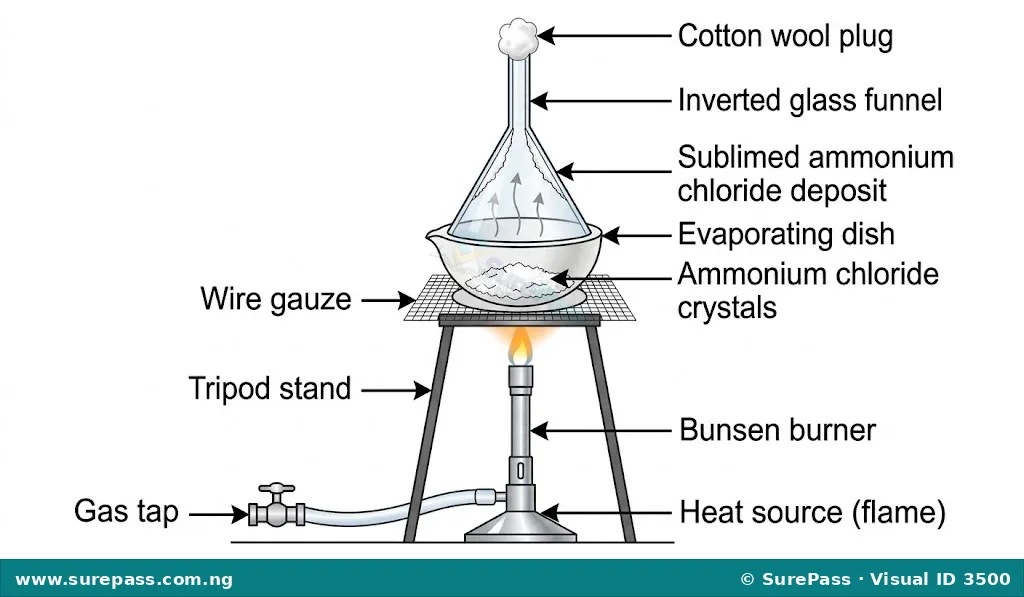
- Invert the glass funnel and place it over the evaporating dish to cover the crystals.
- Plug the narrow stem of the inverted funnel with a small piece of cotton wool to prevent the escape of vapor.
- Light the Bunsen burner and heat the evaporating dish gently.
- Observe the changes taking place inside the evaporating dish and on the cooler upper walls of the funnel.
- Remove the burner and allow the apparatus to cool down completely.
The diagram below shows the correct laboratory setup for demonstrating sublimation.
The observations and notes for this activity are:
- Upon heating, the solid ammonium chloride does not melt into a liquid. Instead, it directly changes into dense white fumes (vapor).
- As the white vapor rises and touches the cooler upper walls of the inverted funnel, it cools and deposits directly back as a white solid. This deposited solid is called the sublimate.
- This process demonstrates sublimation, where the substance bypasses the liquid state entirely during both heating and cooling.

0 comments
Open the discussion when you need it. Comments stay collapsed until requested so the initial article remains light.